
Did you know that cybercrime reports from Australian small businesses jumped by 23% in the last financial year? It's a sobering figure that proves why your it infrastructure for small business australia can't just be an afterthought anymore. You're likely tired of NBN dropouts and the constant anxiety of AI-driven scams hitting your staff's inboxes. It often feels like you're fighting technical fires instead of actually running your company.
We know how frustrating it is to deal with slow internet or disconnected systems that refuse to talk to each other. You deserve a reliable, "set and forget" tech environment that works as hard as you do. This guide will show you how to master a modern Australian tech stack to ensure your business is resilient, secure, and ready to scale. We'll walk through the retirement of the Essential Eight framework in favour of the new "Essentials" series, the rise of AI voice agents, and how to audit your telco contracts to avoid those notorious 60-month traps. By the end, you'll have a clear roadmap to faster communication and total peace of mind.
Key Takeaways
- Modern it infrastructure for small business australia has moved beyond on-site servers to cloud-first environments that allow you to scale without the physical clutter.
- High-speed business fibre and integrated VoIP systems are the foundation of professional communication, ensuring you never lose a connection with a client.
- Protecting your assets requires more than just a password; following the ACSC "Essentials" series helps shield your business from increasingly sophisticated AI-driven threats.
- A practical tech audit—checking your actual internet speeds and retiring hardware over four years old—is vital for maintaining a resilient and efficient workplace.
- Embracing AI voice agents can transform how you handle enquiries, allowing you to capture every lead while your team focuses on high-value tasks.
What is IT Infrastructure for Small Business?
In its simplest form, What is IT Infrastructure? refers to the combined set of hardware, software, network resources, and services that keep your company running. It is the foundation of your digital environment. For years, this meant a physical server humming in a back room, but it infrastructure for small business australia has evolved significantly. By 2026, the focus has shifted toward "invisible" infrastructure. This means your tools exist in the cloud, managed by experts, so you can focus on your customers rather than your cables.
Think of your infrastructure as a silent partner. When it's designed correctly, you barely notice it's there. Your emails arrive, your calls are crystal clear, and your data is secure. However, when it fails, your entire operation grinds to a halt. A modern approach requires a unified strategy where your internet, phones, and security protocols work together seamlessly instead of acting as isolated silos.
The Shift from Hardware to Service
Most Australian firms have ditched the noisy, heat-generating server cupboards of the past. Instead, they're embracing scalable cloud environments that grow as the business grows. This transition is largely driven by Managed IT Services and the rise of Infrastructure as a Service (IaaS). This model allows smaller teams to access enterprise-grade technology without the enterprise-grade price tag.
- Reduced Capital Expenditure: You no longer need to drop ten thousand dollars on a server every five years.
- Predictable Costs: Tech expenses move from lumpy capital outlays to a steady, manageable monthly operating expense.
- Instant Scalability: Adding a new staff member or a new department takes minutes, not weeks of hardware procurement.
Why Your Tech Stack is Your Frontline Advantage
Your infrastructure is no longer just a back-office support function; it's your frontline advantage. In a competitive market, customer experience is everything. Fast, reliable internet and integrated communication tools allow a five-person team to provide the same level of responsiveness as a fifty-person enterprise. This professional polish builds trust and wins contracts.
When your systems talk to each other, you remove the friction that slows down service delivery. Whether it's an AI voice agent answering after-hours calls or a secure connection allowing your team to work from anywhere, your tech stack defines your professional image. Modern infrastructure is the digital nervous system of an Australian small business.
The 4 Pillars of a Resilient Tech Stack in 2026
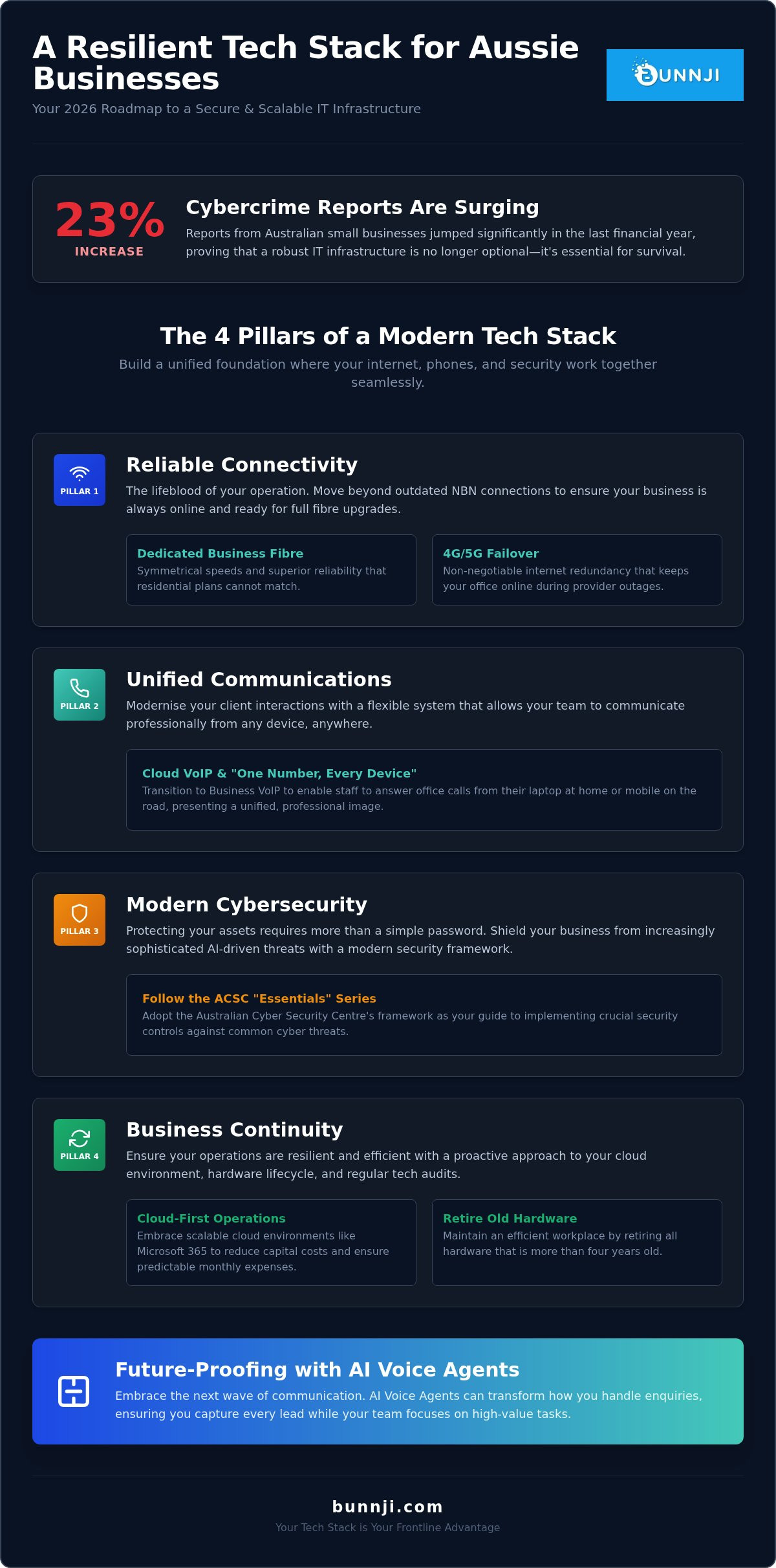
Building a resilient it infrastructure for small business australia requires looking at your tech stack as a single, cohesive unit. You can't treat your internet, your phones, and your security as separate problems to solve. In 2026, these elements are deeply intertwined. If one pillar crumbles, the others will likely follow. To keep your doors open and your team productive, you must focus on four critical areas: connectivity, communication, security, and continuity.
Reliable Connectivity and Internet Redundancy
Reliable connectivity is the lifeblood of your operation. Many owners fall into the "copper trap" by relying on outdated NBN connections that still use old wiring. Dedicated Business Fibre offers symmetrical speeds and superior reliability that residential plans simply can't match. However, even the best fibre connection isn't invincible. This is why internet redundancy is non-negotiable for a modern office. Having a 4G or 5G failover ensures that when a provider has an outage, your office stays online without a second of downtime. It's about ensuring your building is ready for full fibre upgrades before your competitors are.
Unified Communications and Cloud VoIP
Communication has moved far beyond the plastic desk phone. Modern teams need flexibility. Transitioning to Business VoIP Australia allows for a "One Number, Every Device" setup. This means your staff can answer office calls from their laptop at home or their mobile on the road. If you aren't ready to scrap your existing hardware, SIP trunking can modernise your current equipment by connecting it to the cloud. It's a cost-effective way to get the benefits of VoIP without a total overhaul. This unified approach makes a small team look like a national enterprise.
Cloud Computing and Microsoft 365 Integration
Cloud computing, specifically through Microsoft 365 integration, is the standard for organising files and emails. It's about more than just storage; it's about collaboration. Microsoft Teams has become the central hub for internal chat and video, while single sign-on (SSO) keeps your infrastructure tidy and secure. This setup ensures that your team can access what they need securely from any location. It removes the friction of disconnected systems that refuse to talk to each other.
Security is the final, vital pillar. You need to protect both your digital perimeter and the people working within it. Following government guidelines on Cybersecurity for Small Business is an excellent starting point for any local firm. Protecting your data isn't just about software; it's about creating a culture of awareness. If you are unsure where your current setup stands, performing a quick telecommunications audit can reveal hidden vulnerabilities before they become expensive problems.
Cybersecurity and the Essential Eight Framework
Small businesses are often the "soft target" for automated cyberattacks. Hackers don't always look for the biggest prize; they look for the easiest door. In Australia, the ACSC reported a 23% increase in cybercrime reports from small businesses in the 2024-25 financial year. This makes your security posture a core component of your it infrastructure for small business australia. You can't afford to treat protection as an optional extra when the threats are becoming more frequent and sophisticated.
The Essential Eight Framework has long been the gold standard for local protection. While the ASD is currently transitioning this to the new "Essentials" series, the core strategies remain your best defence. Managed security services take the guesswork out of this transition. They ensure you stay compliant with Australian standards without needing a full-time IT department to monitor every update.
Implementing the Essential Eight for Small Business
The goal for most small teams is to reach "Maturity Level 1". This isn't about spending a fortune; it's about closing the most obvious gaps that criminals exploit. Multi-Factor Authentication (MFA) is the single most important hurdle you can place in front of a hacker. If you aren't using phishing-resistant MFA across all your systems, you're leaving the front door unlocked. Modern standards now suggest a 48-hour patching timeline for critical vulnerabilities in internet-facing services, which is much easier to manage when you have a partner handling the technical heavy lifting.
Other critical steps include:
- Application Control: Ensuring only approved software can run on your network.
- Restricting Admin Privileges: Limiting who can change system settings to prevent accidental breaches.
- Daily Backups: Keeping your data stored in a separate, secure cloud environment so you can recover quickly from an incident.
Protecting Your Comms from Scams
In 2026, the threat landscape has expanded to your phone lines. AI-cloned voices are now used in sophisticated corporate phishing attacks to trick staff into transferring funds or revealing sensitive data. Your next cyberattack might literally start with a phone call that sounds exactly like your business partner. This is why your communication strategy must be part of your broader security infrastructure.
Secure VoIP providers play a massive role here. They help filter out malicious calls and known scam numbers before they ever reach your team. Beyond the tech, training your staff to spot "social engineering" over the phone is vital. If a request sounds unusual, even if the voice is familiar, your team should have a protocol to verify the identity through a second, trusted channel. It's about providing peace of mind through both smart technology and clear processes.
How to Audit Your IT Infrastructure: A Practical Roadmap
You don't need a computer science degree to know if your technology is holding you back. A regular audit ensures your it infrastructure for small business australia remains a silent partner in your success rather than a source of daily frustration. Follow these five steps to identify where your money is being wasted and where your risks are hiding.
- Step 1: Conduct a connectivity check. Use a speed test tool to measure your actual performance against what's on your bill. If you're paying for high-speed fibre but experiencing lag, you might have a bottleneck in your internal wiring or router.
- Step 2: Review your hardware lifecycle. Any workstation or server older than four years is a liability. The cost of a new machine is almost always lower than the cost of lost productivity and increased security risks from outdated it infrastructure for small business australia.
- Step 3: Audit your telecommunications contracts. Look for 60-month "trap" contracts. These long-term commitments often hide equipment costs and prevent you from moving to better, cheaper technology as it becomes available.
- Step 4: Assess your "Time to Recover". Ask yourself a hard question: if your internet or main system died right now, how many hours would it take to get back to work? If the answer is "days," your redundancy plan needs help.
- Step 5: Identify communication gaps. Are you missing customer enquiries because your phone system is too rigid to follow you out of the office?
The 10-Minute Telecommunications Audit
Grab your latest bill and look for "zombie" lines. These are unused phone numbers or data plans that you've been paying for long after the staff member left or the project ended. You should also verify that you actually own your phone numbers. Some providers make it incredibly difficult to port your numbers away if you decide to switch. While you're at it, review your mobile fleet. Moving to Business Mobile SIM Only Plans can often cut your monthly spend significantly without sacrificing coverage or reliability.
Evaluating Disaster Recovery and Redundancy
A backup is only as good as its last successful restore. Don't just assume the green light on your backup drive means you're safe. Schedule a time to actually restore a random file to prove the system works. For your connectivity, ensure you have an automatic failover to a 4G or 5G network. Disaster recovery is a business strategy, not just a technical backup. It's about how quickly you can return to serving your customers after a failure. If you want a professional eye on your setup, you can book a comprehensive telecommunications audit to find every hidden efficiency in your current contracts.
Future-Proofing with Bunnji: Smart Comms and Managed Support
Building a future-proof it infrastructure for small business australia isn't just about surviving the next cyberattack or internet outage. It's about creating a platform that proactively helps you grow. At Bunnji, we believe that technology should be an asset, not a burden. We provide the resources of a global player with the personal touch of an Australian-owned boutique provider. This means no-nonsense contracts, no 60-month traps, and a commitment to being present when you need us most.
AI Voice Agents: The Next Frontier of Infrastructure
One of the most significant shifts in 2026 is the move from traditional receptionists to AI voice agents for business. These aren't simple "press one for sales" menus. They are intelligent platforms that handle high call volumes and complex out-of-hours enquiries with ease. By integrating your phone system directly with your CRM and calendar, these AI agents can automate bookings and update lead information in real time. It's a cost-effective way to scale your front-of-house operations without adding to your headcount, ensuring you never miss a lead again.
Managed IT and Networking That Scales
A truly intelligent infrastructure requires a solid foundation of managed IT and networking. We design bespoke Wi-Fi and networking solutions that eliminate dead zones in your office, ensuring your team stays connected whether they are at their desk or in a meeting room. Our managed services involve ongoing monitoring to catch security vulnerabilities before they are exploited. This keeps your business compliant with the latest Australian security standards without the headache of manual updates.
We move away from the outdated "break-fix" mentality. Waiting for something to fail before fixing it is a recipe for downtime and lost revenue. Instead, we take a partnership approach. This involves transparent, fixed-cost pricing that provides better peace of mind and allows you to budget with confidence. By choosing a partner that understands the specific needs of the local market, you gain access to elite service without the bureaucratic layers of a giant corporation. Your it infrastructure for small business australia becomes a seamless extension of your business, ready to scale whenever you are.
Building Your Resilient Digital Future
Your business deserves a tech stack that works as hard as you do. Mastering your it infrastructure for small business australia is no longer about managing cables in a cupboard; it's about creating a seamless, "set and forget" environment that scales with your ambition. By moving to cloud-first services and integrating AI voice agents, you ensure that every customer enquiry is captured while your data remains shielded by Australian security standards.
Success in 2026 relies on proactive redundancy and transparent partnerships. Don't let hidden telco fees or outdated hardware slow your momentum. Our team brings no-nonsense Australian expertise to help you navigate complex contracts and implement disaster recovery plans that actually work. We specialise in AI receptionists and high-speed fibre to give you a genuine frontline advantage. It's about removing technical friction so you can focus on growth.
Take the first step toward total peace of mind. Book a 10-minute Telecommunications Audit with Bunnji today and discover how a truly modern infrastructure can transform your operations. You've got big plans for your business, and we're here to make sure your technology is ready to back them up.
Frequently Asked Questions
What is the most important part of IT infrastructure for a small business?
Reliable connectivity is the most critical component of it infrastructure for small business australia. Without a stable internet connection, your cloud software, VoIP phones, and remote collaboration tools all stop working. It acts as the digital nervous system of your company. While hardware and software are vital, they become useless if your team cannot access the data they need. Prioritising business fibre and internet redundancy ensures your operations remain resilient even during provider outages.
How much should an Australian small business spend on IT infrastructure?
There is no single dollar figure, but many firms allocate between 4% and 7% of their revenue toward technology. Research indicates that total IT spending in Australia is forecast to reach A$172.3 billion in 2026, driven largely by investments in software and AI-optimised servers. Instead of looking at it as an expense, view it as a productivity investment. Focus on predictable monthly costs through managed services to avoid large, unexpected capital outlays.
Do I really need a business NBN plan, or is a home plan okay?
You definitely need a dedicated business plan. Residential plans don't offer the Service Level Agreements (SLAs) required to protect your income. If a home connection fails, you might wait days for a technician. Business NBN provides priority support, static IP addresses for secure remote access, and symmetrical speeds for clearer video calls. It's a small monthly difference that prevents massive losses in productivity during a technical fault.
What is the "Essential Eight" and does it apply to my small business?
Yes, the Essential Eight framework applies to every Australian business regardless of size. It provides a baseline of eight strategies, like multi-factor authentication and daily backups, to shield you from common cyber threats. While the Australian Signals Directorate is currently replacing it with the new "Essentials" series, these core principles remain vital. Implementing even Maturity Level 1 can stop the vast majority of automated attacks targeting small firms today.
How can I protect my business from AI voice scams?
Protection starts with a mix of smart technology and clear internal processes. Use secure VoIP systems that help filter out malicious calls and known spoofed numbers. You should also establish a "second channel" verification protocol. If a staff member receives an unusual request, even from a voice that sounds like a director, they must verify it via a separate text or internal chat. Training your team to spot social engineering is your best defence.
What is the difference between managed IT and a regular repair shop?
The primary difference is proactive versus reactive support. A repair shop follows a "break-fix" model; you only call them when something is already broken. Managed IT services provide ongoing monitoring and maintenance to prevent those failures from happening in the first place. This partnership approach includes regular security updates, hardware lifecycle management, and strategic planning. It ensures your it infrastructure for small business australia scales smoothly without constant emergency repairs.
How often should I audit my telecommunications contracts?
You should audit your contracts at least once a year or whenever you consider adding new services. These reviews help you identify "zombie" lines you no longer use and ensure you aren't trapped in 60-month contracts with hidden equipment fees. A regular audit also lets you take advantage of better pricing as technology evolves. It's the best way to keep your overheads low while ensuring your tech stack remains modern and efficient.


