

Your business is likely paying a "loyalty tax" hidden inside a 60-month equipment contract that you no longer need. While traditional telcos want to lock your team into rigid, multi-year cycles, the most agile Australian companies are pivoting to business mobile sim only plans to regain control. It is a shift from being a passive subscriber to a strategic operator. You already know that managing dozens of individual services is a logistical headache, and seeing data go to waste on one line while another hits its limit is genuinely frustrating.
We agree that your telecommunications should support your growth, not stifle your cash flow with hidden fees and outdated hardware. This 2026 buyer’s guide promises to show you exactly how to cut overheads and improve team flexibility by choosing the right SIM only strategy for your unique needs. We will examine the latest 5G offerings from major providers, explore the benefits of unified billing, and explain how to integrate your mobile fleet with modern AI voice agents and cloud communication tools for a truly connected, modern workforce.
Key Takeaways
- Learn how data pooling eliminates individual data wastage and protects your business from unexpected "bill shock" across your entire team.
- Uncover the true cost of handset bundles compared to flexible business mobile sim only plans to stop paying for hardware long after it has been depreciated.
- Understand how a "Bring Your Own Device" (BYOD) policy combined with month-to-month flexibility empowers a more agile, remote-ready Australian workforce.
- Discover the essential steps for a seamless mobile fleet transition, including how to audit your current services to avoid contract exit penalties.
- Explore how to integrate your mobile services with cloud VoIP systems and AI receptionists to maintain a professional presence on any device.
Why Aussie Firms are Switching to Business Mobile SIM Only Plans
Australian businesses are moving away from the restrictive "free phone" model that dominated the last decade. A business SIM only plan provides the essential cellular service, including data, voice, and text, without forcing a hardware purchase into the same contract. This separation is the foundation of a modern mobile strategy. By leveraging SIM card technology independently of the device, companies can deploy services to any compatible handset in minutes rather than waiting for a courier to deliver a new box.
The shift toward "Bring Your Own Device" (BYOD) has accelerated this trend. Many employees prefer using their personal smartphones for work, provided the business covers the service cost. For the employer, this eliminates the logistical burden of tracking, repairing, and replacing physical assets. It also allows for rapid scaling. If you hire five new consultants tomorrow, you can organise business mobile sim only plans for them instantly. They simply insert the SIM or activate an eSIM on their existing device and start working.
Accessing these plans requires a valid ABN or ACN. This distinction is vital because corporate-grade plans offer features consumer services lack. You gain access to centrally managed portals, dedicated account support, and the ability to pool data across your entire fleet. It transforms mobile connectivity from a collection of individual bills into a strategic business asset.
The Financial Logic: Capex vs. Opex
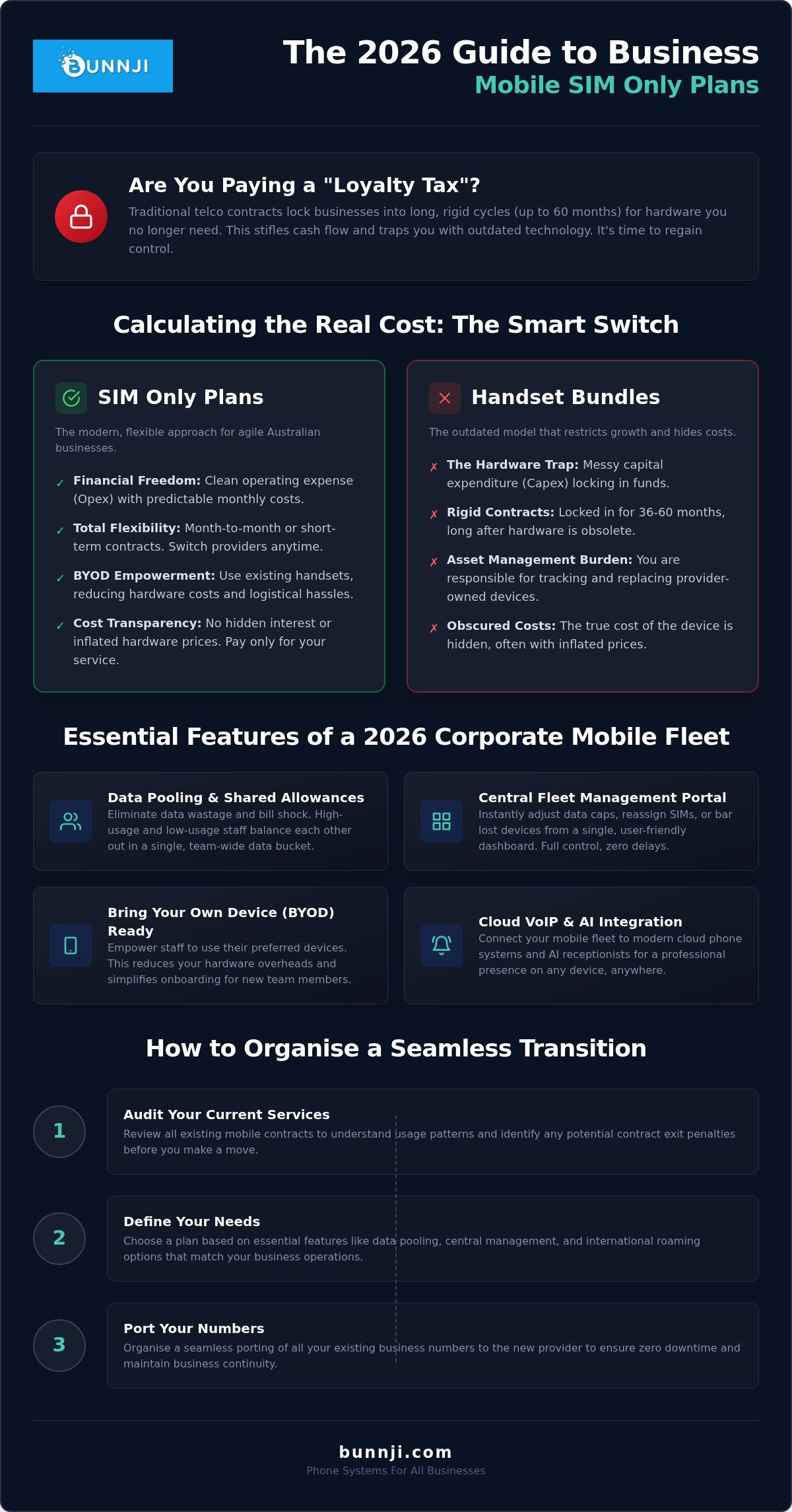
Bundling a handset into a service plan often obscures the true cost of the hardware. When you opt for business mobile sim only plans, you move your telecommunications spend from a messy capital expenditure (Capex) model to a clean operating expense (Opex). This provides much-needed balance sheet transparency. You see exactly what you are paying for the data and the connection.
Buying handsets outright or through separate financing is frequently more cost-effective. Telco bundles often include "hidden interest" or inflated retail prices for the device. By separating the two, you can often claim the full cost of the SIM service as a tax deduction for business use while managing your hardware depreciation on your own terms. It keeps your cash flow predictable and your accounting simple.
Escaping the Hardware Trap
Traditional telcos often use 36 or 60-month contracts to subsidise expensive handsets. These long-term commitments are a trap. If your business needs change after two years, you are still stuck paying off hardware that might already be obsolete. SIM only plans offer the freedom of month-to-month or short-term agreements.
This flexibility allows you to remain "network agnostic." If a provider's service quality drops in your area or a competitor offers a better data deal, you can port your numbers and leave without facing massive hardware payout figures. You upgrade your team's phones when it makes sense for your budget, not when a telco contract expires.
Essential Features of a 2026 Corporate Mobile Fleet
Managing a mobile fleet in 2026 requires more than just a handful of active connections. It demands a unified approach to data usage and device security. Modern business mobile sim only plans now act as integrated components of your broader IT stack. This ensures your team can access cloud-based CRM tools and high-definition video conferencing with the same stability they experience at their desks. Before committing to a provider, it is wise to check network coverage for your specific operational areas to ensure 5G availability is consistent where your staff actually work.
A central fleet management portal is non-negotiable for scaling teams. It allows your office manager to reassign SIMs, adjust data caps, or bar lost devices instantly through a dashboard. For executives travelling abroad, international roaming should be a simple daily add-on or a shared global bucket rather than a pay-per-megabyte trap. Managing these global voice services through a single provider ensures your communication costs remain transparent, regardless of geographical boundaries.
Data Pooling and Shared Allowances
Individual data limits are a relic of the past. In a corporate environment, usage is rarely uniform across the team. Your field technicians might consume 50GB of data on site while your office-based staff barely use 2GB. A shared data pool allows these patterns to balance out, ensuring you don't pay for unused data on one line while facing excess charges on another. This "team bucket" approach effectively eliminates bill shock. We recommend setting automated alerts at 50% and 85% of the total pool capacity to maintain tight cost control without the need for constant manual monitoring.
Security and Redundancy at the SIM Level
Modern SIMs are a vital layer of your cybersecurity strategy. High-tier providers now offer SIM-based filtering to block known malicious URLs and SMS phishing scams before they even reach the handset. Beyond security, 5G-enabled SIMs provide essential internet redundancy for your physical office. Mobile data redundancy prevents business downtime by automatically switching your office traffic to the cellular network during fixed-line NBN outages.
If your current setup feels fragmented or lacks these modern safeguards, performing a quick telecommunications audit can reveal where data is being wasted and where your security might be thin.
SIM Only vs. Handset Bundles: Calculating the Real Cost
The "free" handset is one of the most successful marketing illusions in the Australian telco industry. When you bundle a device with your service, you aren't getting a gift; you're essentially taking out a high-interest loan. By choosing business mobile sim only plans, you unmask the true cost of the connection. Most bundled contracts bake the handset price into the monthly fee, often resulting in you paying more than the retail price over two or three years. It is a lack of transparency that costs Australian firms thousands annually.
Purchasing hardware outright allows your business to claim immediate depreciation under current tax rules, rather than drip-feeding the expense over a long contract. A professional telecommunications audit for business often reveals that companies are still paying "hardware subsidies" on lines where the initial contract ended months ago. Telcos rarely volunteer to lower your bill once the phone is paid off. Switching to a month-to-month SIM only arrangement stops this overpayment instantly.
The 60-Month Contract Warning
We regularly see predatory 60-month equipment contracts that tie businesses to specific handsets for five years. This is a dangerous trap. Mobile technology evolves rapidly; a flagship phone from half a decade ago is virtually useless for modern cloud applications today. These long-term agreements often hide the true service cost and make exiting the provider nearly impossible without facing crippling payout fees. If you are stuck in one of these, the first step is identifying the exact "fair market value" payout clause. Transitioning to business mobile sim only plans as these contracts expire is the only way to regain your operational agility.
Hardware Lifecycle Management
Decoupling your SIM from your handset allows for more intelligent lifecycle management across your team. Not every staff member needs the latest flagship device to be productive. Your sales team might require high-end cameras and 5G speeds, while warehouse staff might be perfectly served by rugged, refurbished models. SIM only flexibility lets you mix and match device ages and manufacturers within a single fleet. You can replace a cracked screen or upgrade a specific user's phone on your own timeline, without resetting a 24-month clock for the entire office. This approach is both financially prudent and more sustainable for the environment.
How to Organise a Seamless Mobile Fleet Transition
Transitioning a corporate fleet shouldn't be a logistical nightmare. While the prospect of moving dozens of services feels daunting, a methodical approach ensures your team stays connected throughout the switch. The primary goal when moving to business mobile sim only plans is to maintain operational continuity while shedding the financial dead weight of your previous contract. This process begins long before the new SIM cards arrive at your office. If you don't have a clear map of your current services, you're likely to port over inefficiencies that cost you money.
The 10-Minute Telecommunications Audit
Before you sign a new agreement, you must perform a forensic review of your current billing. Most Australian businesses are paying for at least two or three "zombie" SIMs; active lines assigned to former employees or forgotten tablet devices that haven't been used in months. You should ask your current provider for a comprehensive service list and specifically query any premium service subscriptions or recurring international roaming fees. These small, hidden charges often account for a 15% bloat in monthly telecommunications overheads. Identifying these leaks allows you to right-size your new fleet from day one.
Number Porting and Ownership
Your business phone numbers are valuable company assets. You must verify that your business, rather than a third-party provider or an individual employee, holds legal ownership of every number in the fleet. In Australia, the porting process for mobile numbers is highly regulated and generally efficient. While an individual number can often port in minutes, a larger fleet transition should be scheduled during a low-traffic period to ensure zero client calls are missed. Most networks complete the switch-over within 24 to 48 hours, but your services will remain active on the old SIM until the moment the new one is ready to take over.
Once the technical switch is underway, clear communication with your staff is essential. Provide a simple set of instructions for inserting the new SIM or activating an eSIM on their device. This is also the ideal time to update your internal IT policy. Ensure every device in the fleet is integrated into your cybersecurity framework, requiring multi-factor authentication for all company apps. If you aren't sure where to start, a 10-minute telecommunications audit can pinpoint exactly where your current fleet is leaking money and where your security needs strengthening.
Beyond the SIM: Integrating Mobile with Unified Communications
A mobile fleet should never operate in a vacuum. In 2026, the most successful Australian firms treat their business mobile sim only plans as strategic endpoints for their entire communication stack. This means your mobile service is no longer just a way to make calls on the road; it is a high-speed data pipe that connects your team to your core office systems. By integrating these plans with a robust business voip australia strategy, you turn every smartphone into a fully functional office extension. This is the era of the "Softphone," where a simple app uses your mobile data to provide access to office directories, transfer calls to colleagues, and maintain a professional presence from any location.
One Number, Every Device
Professionalism suffers when staff give out personal mobile numbers to clients. It creates a fragmented customer experience and makes it impossible to track communication history if an employee leaves the business. Unified communications solve this by assigning a single business number to every user, regardless of the device they are holding. When a client calls your office number, it can ring on the desk phone, the laptop, and the mobile simultaneously. This setup ensures your staff maintain their privacy while the business retains control over its data. Centralised call recording and logging also become seamless, providing a vital layer of compliance and quality control that individual mobile plans simply cannot offer.
AI and Mobile: The Future of the Aussie Workforce
The integration of mobile fleets with ai voice agents for business is changing how teams manage their time. Your mobile staff are often busy on site or in meetings, leading to missed opportunities. Modern AI receptionists can now screen mobile calls, answer common queries, and even book appointments directly into your team's calendars while they are occupied. These agents act as a 24/7 front desk that never sleeps.
Because these tools sync mobile call data directly with your CRM, every interaction is captured in real time. No lead is ever missed because a staff member forgot to write down a number while driving between jobs. The low latency of 5G-enabled business mobile sim only plans provides the necessary speed to power these AI-driven tools, ensuring the conversation between the AI agent and the caller is natural and responsive. It is a level of sophistication that transforms a standard mobile fleet into a proactive sales and service engine.
Future-Proof Your Mobile Strategy
The transition to business mobile sim only plans is more than a cost-cutting exercise; it's a shift toward a more agile, integrated workforce. By decoupling your cellular service from restrictive hardware cycles, you regain control over your cash flow and technology lifecycle. Data pooling effectively prevents bill shock while unified communications turn a simple handset into a powerful office extension. The future of the Aussie workplace relies on this level of flexibility and the seamless integration of AI-driven tools to manage your client interactions.
Don't let your growth be stifled by the hidden costs of outdated 60-month equipment contracts. Our Australian-based expert support team is ready to help you streamline your fleet and integrate your mobile services with the latest AI Voice Agents. To see exactly where your current setup is leaking money, Book a 10-Minute Telecommunications Audit with Bunnji today. It's time to simplify your infrastructure and focus on what you do best. Your team deserves a connection that moves at the speed of your business.
Frequently Asked Questions
Can I keep my existing business mobile numbers when switching to a SIM only plan?
You can certainly keep your existing numbers through a process called Mobile Number Portability. This is a regulated service in Australia that allows you to move your service between providers without any downtime. You simply provide your current account details and ABN to the new provider; they handle the technical switch in the background. It's important to ensure your current contract has ended to avoid any early exit fees from your previous carrier.
Are business mobile SIM only plans tax-deductible for Australian companies?
Most business mobile sim only plans are generally considered a fully tax-deductible operating expense for Australian companies when used for business purposes. Because these plans separate the service cost from the hardware, your accounting team can easily track and claim the monthly fees. We recommend keeping detailed records of your ABN-linked invoices. This transparency is a significant advantage over consumer plans, where personal and business usage often become difficult to separate for tax purposes.
How does data pooling work across a large team mobile fleet?
Data pooling aggregates the individual data allowances of every SIM in your fleet into a single shared bucket. If you have ten staff members on 50GB plans, your business has a total pool of 500GB to use each month. This system is highly efficient because it allows heavy data users to be offset by those who primarily use office Wi-Fi. It effectively eliminates the risk of expensive overage charges on individual lines by balancing out usage patterns.
What is the difference between a consumer SIM and a business SIM plan?
The primary difference lies in management and scalability. While consumer plans are designed for individuals, business-grade services offer a central management portal to control dozens of services at once. You also gain access to corporate-only features like data pooling, unified billing, and dedicated Australian-based support. Additionally, business plans require an ABN or ACN, which unlocks access to specific fleet discounts and more robust security features that consumer-grade services typically lack.
Do I need a new SIM card to access 5G on my business plan?
You will likely need a 5G-compatible SIM card or an eSIM if your current hardware is more than a few years old. Most business mobile sim only plans issued in 2026 come with 5G access as a standard inclusion. If you're using an older 4G SIM, it won't be able to connect to the higher frequency bands required for 5G speeds. Upgrading to an eSIM is often the fastest way to gain access without waiting for a physical card.
Can I add an AI receptionist to my business mobile service?
You can definitely integrate AI receptionists with your mobile fleet. These AI voice agents work by intercepting calls to your business number and handling them based on your specific rules. They can answer common questions, screen callers, and even book appointments directly into your calendar. This integration ensures your mobile team isn't constantly interrupted by basic enquiries, allowing them to focus on high-value tasks while the AI handles the frontline communication professionally.
What happens if a staff member leaves the company? How do I manage the SIM?
Managing a departing staff member is straightforward because the business retains legal ownership of the service. You can instantly reassign the SIM to a new hire or suspend the service through your online management portal. This prevents the former employee from taking the business number or continuing to use company data. It's a significant security benefit compared to letting staff use their own personal plans, where the business has zero control over the number or data access.
Is there a limit to how many SIMs I can have on one business account?
There is generally no hard limit to the number of services you can hold on a single business account. Most providers are designed to scale with you, whether you need five SIMs or five hundred. As your fleet grows, you can continue to add new lines to your existing data pool and management dashboard. This scalability is a core feature of corporate-grade telecommunications, ensuring your infrastructure grows alongside your team without requiring a complete system overhaul.


