
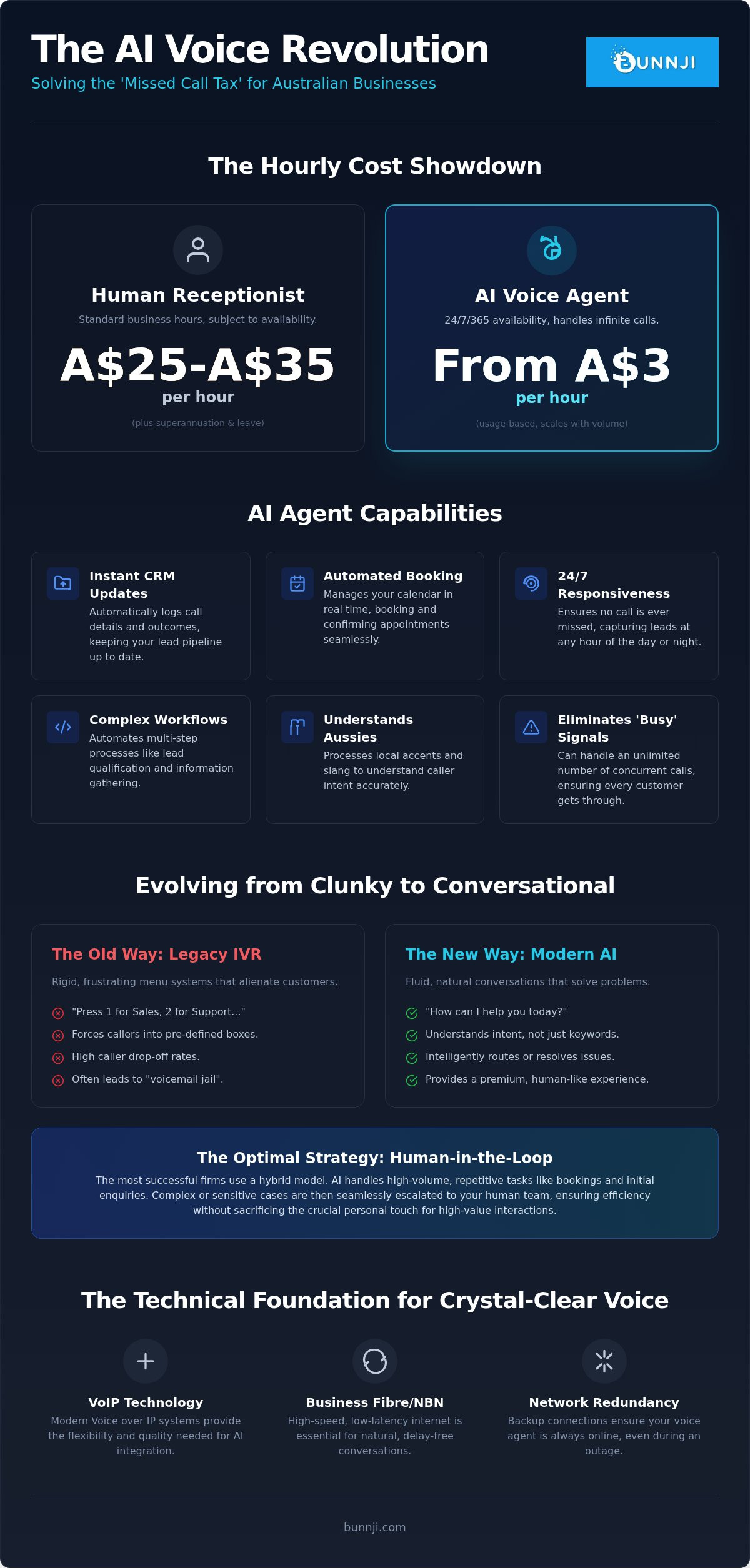
Did you know that while a human receptionist costs between A$25 and A$35 per hour, ai voice agents for business can now operate for as little as A$3 per hour? It's a massive price gap that is currently reshaping the local economy. You've likely felt the frustration of seeing a missed call notification during a peak period, knowing that the lead has already dialled your competitor. For most Australian firms, the choice has always been between expensive 24/7 staffing or simply accepting lost revenue as a cost of doing business.
This 2026 trend report confirms that the trade-off is finally over. We'll explore how these digital agents are eliminating missed calls by providing elite, human-like interaction that never sleeps. These aren't the clunky bots of the past. They are integrated telecommunications assets designed to manage your calendar and update your CRM in real time. We'll preview the latest ACMA-compliant technologies that allow you to automate complex workflows and provide seamless appointment booking without the complexity of traditional call centres. Discover how to reclaim your time and ensure your business stays responsive every hour of the day.
Key Takeaways
- Understand why the "Missed Call Tax" is draining Australian SME profits and how sophisticated digital staff reclaim that lost revenue.
- Learn how ai voice agents for business provide a high-performance alternative to traditional receptionists at a fraction of the hourly cost.
- Discover the efficiency of automated calendar management and instant CRM data entry that keeps your lead pipeline moving without human intervention.
- Identify the critical technical requirements, including high-speed business fibre and NBN redundancy, needed to maintain crystal-clear voice quality.
- Explore the practical steps to implementation, starting with a comprehensive telecommunications audit to pinpoint exactly where your current system is failing.
The Rise of AI Voice Agents: Solving the Australian Missed Call Crisis
Every missed call is a missed opportunity. For Australian SMEs in 2026, this has evolved into a literal "Missed Call Tax." It isn't a government levy, but rather the compounding revenue lost when a potential customer hits a voicemail and immediately rings the next business in the search results. Consumers no longer have the patience to wait for a call back. They expect an immediate, professional response at any hour. This shift in behaviour has turned 24/7 availability from a competitive advantage into a baseline requirement for survival.
We've all experienced the frustration of legacy "Press 1 for Sales" IVR systems. These rigid, menu-driven trees were designed to filter callers rather than help them. Modern ai voice agents for business represent a complete departure from that era. They are sophisticated, LLM-powered digital staff members capable of holding fluid, natural conversations. They don't just route calls; they solve problems, qualify leads, and provide a level of service that was previously only possible with a large, expensive team of human receptionists.
What is an AI Voice Agent for Business?
To understand these agents, you have to look at Natural Language Understanding (NLU). In simple terms, this technology allows the agent to interpret the "intent" behind a caller's words. It doesn't just listen for keywords. It "reasons" through the conversation to provide a helpful response. This evolution of virtual assistant technology has reached a level of sophistication where the agent can handle the unique nuances of the Australian market. This includes accurately processing local accents and understanding Aussie slang. Whether a caller says they want to "book a time" or they're "looking to get a quote sorted," the agent understands the context and acts accordingly.
Why 2026 is the Tipping Point for Voice Automation
Several factors have made 2026 the year of mass adoption for voice automation. Low-latency processing has finally eliminated the awkward "bot delay," making conversations feel instantaneous and natural. We've also seen a shift from generic, off-the-shelf bots to bespoke business agents. These are trained on your specific service lists, pricing, and business logic. When you combine this technical maturity with the rising cost of traditional labour in Australian metropolitan centres, the business case becomes undeniable. AI voice agents for business provide a scalable, reliable way to manage high call volumes without the overhead of a massive physical office or 24/7 shift rotations.
How AI Voice Agents Compare to Traditional Reception Services
The financial disparity between traditional staffing and automated solutions is stark. A human receptionist in Australia typically commands a salary reflecting the current market rate of A$25 to A$35 per hour. When you factor in superannuation, leave entitlements, and the overhead of 24/7 shift rotations, the "cost per call" during quiet periods becomes unsustainable. In contrast, ai voice agents for business operate on a usage-based model that scales with your volume. You pay for the minutes you use, not the idle time spent waiting for the phone to ring.
AI vs. Human Receptionists: The Pros and Cons
Reliability is where the digital agent excels. While a human staff member might be occupied with a walk-in customer or another call, an AI agent can handle an infinite number of concurrent inquiries. It never gets "busy" and doesn't require overtime pay for handling a midnight emergency call. However, we must acknowledge the emotional component. For high-stakes situations or sensitive customer complaints, the empathy of a human voice remains invaluable. This is why the most successful Australian firms are adopting a "human-in-the-loop" model. The AI handles the high-volume, repetitive tasks like appointment setting, while complex or sensitive cases are seamlessly escalated to your local team. This approach ensures you never miss a lead while maintaining a personal touch for critical interactions.
Moving Beyond Legacy IVR Systems
Most customers have developed a reflexive hatred for traditional "Press 1 for Sales" menus. These legacy systems are rigid and often lead to "voicemail jail." Modern AI replaces this with natural routing. Instead of navigating a maze, the caller simply states their need. A sophisticated agent understands the difference between a new sales enquiry and a billing dispute, routing the call or resolving the issue immediately. This is the core distinction: a "bot" follows a fixed script, but an "agent" possesses the reasoning capability to achieve an outcome. If you are unsure where your current system is leaking leads, it might be time for a telecommunications audit to identify the gaps in your call flow.
By removing the friction of traditional reception, you provide a faster, more professional experience. You aren't just saving on labour costs; you are increasing the "velocity" of your business. New leads are qualified instantly, and existing clients get their questions answered without being placed on hold. This level of responsiveness is what separates market leaders from the rest in 2026.
Strategic Benefits: What Can an AI Agent Actually Do?
Most business owners wonder if ai voice agents for business can handle real-world complexity or if they're just fancy answering machines. They aren't. These agents act as proactive team members that execute specific business logic. They don't just record messages; they qualify leads, solve problems, and trigger actions. By handling the high-volume, repetitive tasks that usually clog up your phone lines, they free your human staff to focus on high-value work that requires deep expertise and personal connection.
The CRM and Calendar Connection
A voice agent is only as powerful as the data it can access and update. We specialise in connecting phone calls to your CRM and calendar to ensure a closed-loop system. When a call comes in, the agent identifies the caller, checks your live availability, and books a slot that suits both parties. The flow is instantaneous: the call happens, the logic is applied, the appointment is booked, and your CRM is updated. There is no manual transcription and no delay. It's a seamless transition from a verbal request to a digital record that keeps your pipeline moving without human intervention.
Beyond booking, these agents excel at managing the "middle" of the customer journey. They can handle complex FAQs by drawing on your business's specific knowledge base. They also manage outbound follow-ups, such as calling a list of leads to confirm interest or sending payment reminders for overdue invoices. This proactive approach keeps your cash flow healthy and ensures no prospect falls through the cracks due to a busy office schedule.
Industry-Specific Use Cases in Australia
The versatility of ai voice agents for business allows them to adapt to the unique requirements of different sectors. In the legal industry, law firms use these agents for initial client intake and preliminary conflict checks. This ensures that when a solicitor finally speaks to a prospect, all the necessary background data is already organised in the file. It saves hours of billable time every week.
Medical clinics use the technology to automate the constant reshuffling of appointments. If a doctor is running late, the agent can call the afternoon's patients to offer a later time or a reschedule. Meanwhile, in the trades and services sector, agents handle emergency call-outs after hours. They can distinguish between a minor leak and a burst pipe, only escalating the true emergencies to the on-call plumber. This level of discernment protects your team's rest while ensuring your customers are always supported.
The Technical Foundation: VoIP, NBN, and Redundancy
Your AI agent is only as capable as the pipe it lives in. While the software provides the intelligence, your local telecommunications infrastructure provides the voice. If your business NBN connection is unstable, even the most sophisticated ai voice agents for business will struggle to maintain a professional standard. High-quality voice interactions require more than just raw speed; they require a stable, low-latency environment where data packets arrive in the correct order without delay.
Why Your Internet Connection Matters for AI
Latency and jitter are the primary culprits behind poor voice quality. Latency is the delay between a caller speaking and the AI responding. If this delay exceeds a few hundred milliseconds, the conversation feels disjointed and robotic. Jitter refers to the variation in that delay. When jitter is high, the AI's speech may sound garbled or "glitchy." For firms relying on voice automation, a standard residential-grade connection isn't enough. You need high-speed business fibre to ensure the throughput required for multiple concurrent AI calls.
Reliability is equally critical. An internet outage doesn't just take your computers offline; it silences your digital receptionist. We recommend implementing business internet backup solutions to ensure your AI remains active during local NBN maintenance or unexpected faults. A 5G backup link acts as an essential failover, automatically taking over the voice traffic if your primary line drops. This redundancy provides the peace of mind that your "Missed Call Tax" remains at zero, regardless of external network issues.
Modernising legacy hardware is the final piece of the puzzle. SIP trunking acts as the bridge between your existing phone system and the cloud-based AI. It allows you to retain your local Australian numbers while gaining the flexibility to route calls through an AI platform. This setup ensures that your telephony stack is resilient, scalable, and ready for 2026 standards.
Cybersecurity and AI Voice Scams
As voice technology evolves, so do the threats. Australian businesses must be vigilant regarding the rise of AI voice clones used in social engineering scams. Protecting your staff involves more than just software; it requires strict verification protocols for any internal request involving sensitive data or financial transfers. You must also consider data sovereignty. Under the Privacy Act 1988, you have a responsibility to know where your customer’s voice data is being stored. Choosing providers with regional Australian infrastructure is the best way to ensure compliance and reduce data residency risks.
The best way to identify hidden vulnerabilities in your current setup is through a comprehensive telecommunications audit. This process uncovers outdated hardware or insecure routing that could compromise your voice quality or security. To ensure your infrastructure is ready for the next generation of voice technology, visit bunnji.com to speak with an expert who understands the nuances of the Australian NBN landscape.
Implementing AI Voice: How to Get Started with Bunnji
Transitioning to ai voice agents for business doesn't require a total overhaul of your existing operations. The most effective approach is methodical and data-driven. It begins with a comprehensive telecommunications audit to identify exactly where your current system is failing. By pinpointing the specific times and days when calls are being missed, we can build a deployment strategy that targets your most significant revenue leaks first. This ensures you see an immediate return on investment without disrupting your daily workflow.
Once the audit is complete, we recommend choosing a specific pilot use case. Many Australian firms start with an after-hours receptionist or a dedicated appointment setter. This allows you to test the technology in a controlled environment before expanding its role. As the agent handles these initial interactions, the system engages in continuous monitoring. It "learns" from every conversation, allowing us to refine the logic and knowledge base to ensure the agent's performance only improves over time.
Crafting Your AI Agent’s Persona
The tone of your digital staff member is just as important as its technical capability. For Australian firms, a "helpful local expert" persona consistently performs best. This tone strikes the right balance between professional authority and approachable, no-nonsense service. We avoid the "uncanny valley" by being transparent about the AI's nature; customers appreciate honesty and efficiency over a bot trying too hard to pass as human. We customise the knowledge base to ensure the agent understands local terminology and nuances, providing a familiar experience for every caller.
The Bunnji Advantage: Local Support, Global Tech
Bunnji bridges the gap between sophisticated global technology and the practical needs of local businesses. We understand that while the underlying AI models are expansive, your business needs a focused, reliable solution that actually works on the Australian NBN. Our approach is straightforward: no bloated contracts and no unnecessary equipment. We provide the elite service of a global provider with the attitude of a boutique partner. You get a direct line to experts who can help you scale your voice operations as your business grows. If you're ready to eliminate missed calls and modernise your communications, book a strategy session to see an AI agent in action.
Future-Proof Your Business Communications Today
The shift toward ai voice agents for business isn't just about adopting new tech; it's about reclaiming lost revenue and ensuring your firm never sleeps. By combining sophisticated digital staff with robust Australian NBN infrastructure, you eliminate the "Missed Call Tax" that drains local SME profits. We've explored how these agents move beyond simple bots to become integrated partners that manage your schedule and keep your CRM data pristine.
At Bunnji, we provide the local expertise and Australian-based support needed to navigate this transition without the usual technical friction. Our agents offer seamless CRM and calendar integration, providing a proven reduction in missed call costs while maintaining a personal touch. You don't have to choose between high-level global technology and a boutique, responsive relationship. It's time to simplify your infrastructure and focus on growth.
See how Bunnji’s AI Voice Agents can transform your business. The future of Australian service is responsive, automated, and human-centric. Take the first step toward a more efficient operation today.
Frequently Asked Questions
Can an AI voice agent really sound like a human?
Yes, modern agents use advanced neural text-to-speech technology to mimic human inflection, tone, and cadence with remarkable accuracy. These systems are specifically designed to handle the nuances of Australian accents and local expressions naturally. While the technology is sophisticated, we recommend being transparent with callers to maintain trust. This ensures a professional interaction that feels fluid rather than robotic or disjointed.
Will an AI voice agent work with my existing Australian phone number?
Yes, you can easily integrate your existing local Australian phone number with our system. We use SIP trunking or simple call forwarding to route your calls through the AI platform without any disruption. This means you don't need to change your marketing materials or business cards. You retain full ownership of your numbers while gaining the benefits of automated call handling and 24/7 coverage.
Is AI voice technology secure for handling sensitive client data?
Security is a primary focus, and our systems are built to comply with the Privacy Act 1988. We prioritise data sovereignty by using regional Australian infrastructure to ensure your customer’s voice data stays within the country. All interactions are encrypted, and access controls are strictly managed. This provides a secure environment for handling sensitive client information and preliminary intake data without risking exposure.
How much does an AI voice agent cost compared to a human?
Ai voice agents for business are significantly more cost-effective than traditional staffing. While a human receptionist in Australia typically costs between A$25 and A$35 per hour, an AI alternative can operate for approximately A$3 per hour. You also avoid the overhead of superannuation, leave entitlements, and shift penalties. This usage-based model ensures you only pay for the minutes you actually use.
What happens if the AI agent gets stuck or cannot answer a question?
If the agent encounters a complex query it cannot resolve, it follows a pre-defined escalation path immediately. It can seamlessly transfer the caller to a human team member or offer to take a detailed message for a follow-up. This "human-in-the-loop" model ensures that high-stakes or sensitive issues are always handled by your expert staff. The caller never feels ignored or trapped in a loop.
Do I need a special NBN plan to run AI voice agents?
You don't need a specific "AI plan," but a stable, high-speed business NBN or fibre connection is essential for voice quality. Reliable interactions depend on low latency and minimal jitter, which residential-grade plans often struggle to guarantee during peak times. We recommend a business-grade connection with a 5G backup to ensure your AI agent remains responsive and sounds crystal clear during every interaction.
How long does it take to set up an AI receptionist?
A basic AI receptionist can be configured and live within a few business days. However, a fully integrated system that syncs with your CRM and custom knowledge base typically takes two to four weeks to perfect. This timeline includes the initial telecommunications audit, persona customisation, and rigorous testing. We ensure the agent is fully trained on your specific business logic before it handles live customer calls.
Can the AI agent book appointments directly into my Google or Outlook calendar?
Yes, our ai voice agents for business offer native integration with both Google Calendar and Microsoft Outlook. The agent checks your real-time availability and only offers slots that are actually free. Once a booking is confirmed, the appointment appears instantly in your calendar with all the caller’s details attached. This eliminates double-bookings and removes the need for manual data entry by your admin team.


