
Not long ago, choosing a phone system meant deciding how many desk phones were required, how many telephone lines the business needed and which PBX would sit in the communications cupboard.
In 2026, the conversation is very different.
Business communications increasingly bring together cloud phone systems, business internet, fibre, mobile connectivity, Microsoft Teams, CRM platforms, remote-working applications, network redundancy and artificial intelligence.
For Australian businesses, this creates both an opportunity and a challenge.
The opportunity is to build a communications environment that allows employees to work from almost anywhere, gives customers more ways to reach the business and uses automation to reduce repetitive administrative work.
The challenge is that moving everything to the cloud makes the underlying network more important than ever.
A sophisticated cloud phone system is of little value if the office internet connection is unreliable. Likewise, installing a faster NBN connection doesn't solve a poorly designed network, inadequate Wi-Fi or an outdated telephone environment.
The smartest approach is therefore to stop looking at telecommunications as a collection of separate products.
Voice, internet, mobile, networking and AI are becoming parts of the same business communications ecosystem.
This guide explains what Australian businesses should consider when reviewing that ecosystem in 2026.
Key Takeaways
- Cloud phone systems provide significantly more flexibility than traditional on-premise PBX environments.
- Reliable VoIP requires appropriate internet connectivity and network design.
- FTTP and business-grade fibre can provide important benefits for cloud-dependent businesses.
- Internet redundancy should be considered wherever an outage would materially affect operations.
- Microsoft Teams Phone and dedicated cloud PBX platforms suit different business requirements.
- Existing telecommunications and equipment finance contracts should be understood before changing providers.
- Number porting should be carefully planned before existing services are cancelled.
- AI voice agents are creating new ways to answer calls, capture enquiries, schedule appointments and integrate communications with CRM systems.
- The future of business telecommunications is increasingly integrated, automated and device-independent.
1. From Traditional PBX to Cloud Communications
Australian telecommunications have undergone a fundamental transition.
Traditional telephone services historically depended on dedicated copper lines and physical PBX equipment installed at the customer's premises.
Those systems performed an important job, but they were designed for a very different workplace.
Employees generally worked from one location. A telephone extension belonged to a desk. Moving an employee could mean moving cables or reprogramming hardware. Adding a new office often meant installing another system.
Modern businesses don't necessarily operate that way.
Employees work from offices, homes, customer premises, vehicles and interstate locations. Customers expect businesses to be reachable quickly. Organisations increasingly rely on cloud applications rather than local servers.
The phone system has had to evolve with them.
What Is a Cloud Phone System?
A cloud phone system moves much of the intelligence traditionally located inside the office PBX into a hosted environment.
Calls are carried using IP technology, while users can access their business extension through multiple devices.
Depending on the platform, this can include:
- IP desk phones
- Cordless handsets
- Desktop applications
- Laptop applications
- Mobile apps
- Web browsers
The user's business identity is no longer necessarily tied to one physical telephone.
An employee can potentially answer their business extension at their desk in the morning and through a mobile application later that afternoon while away from the office.
To the customer, they are still dealing with the same business.
Modern Cloud Phone Features
Cloud communications can provide features including:
- Auto attendants
- Call queues
- Hunt groups
- Call forwarding
- Voicemail-to-email
- Call recording
- Call reporting
- Mobile applications
- Desktop softphones
- Video collaboration
- Presence information
- Multi-site extensions
- Centralised administration
- CRM integrations
- Business continuity routing
- AI integrations
The real advantage isn't any single feature.
It is the ability to create a communications environment that can adapt as the organisation changes.
2. Why Businesses Are Moving Away From Traditional PBX Systems
A traditional PBX isn't automatically bad technology.
Many have operated reliably for years.
The problem is that older systems can become increasingly difficult and expensive to maintain.
Replacement components may become harder to obtain. Specialist technicians may be required to make changes. Remote working can require additional infrastructure. Integration with modern software may be limited.
Cloud platforms address many of these limitations.
Easier Scalability
Adding an employee to a traditional system might require additional hardware capacity.
With cloud communications, adding a user can often be largely a software configuration process.
The same applies when opening another office.
Rather than operating completely separate telephone systems, multiple locations can potentially operate within one communications environment.
Supporting Hybrid Work
Remote work changed what businesses expect from telecommunications.
Employees increasingly expect to answer business calls without physically sitting beside their desk phone.
Cloud applications allow a business extension to travel with the employee.
This can be particularly useful for:
- Sales teams
- Field staff
- Managers
- Professional services
- Multi-location organisations
- Employees working from home
Importantly, employees can communicate using the business identity without necessarily giving customers their personal mobile number.
3. Your Cloud Phone System Is Only as Good as Your Network
One of the biggest mistakes businesses can make is evaluating a cloud phone system without evaluating the internet and network carrying the calls.
VoIP converts speech into digital packets.
Those packets travel across the network just like other data.
Voice, however, is particularly sensitive to network performance.
If an email arrives one second later, nobody notices.
If part of a conversation arrives one second late, everybody notices.
Latency, Jitter and Packet Loss
Three important concepts affect VoIP performance.
Latency measures the delay between data being transmitted and received.
Jitter refers to variations in packet arrival time.
Packet loss occurs when some packets don't reach their destination.
When these become excessive, users can experience:
- Robotic voices
- Audio cutting in and out
- Delayed conversations
- One-way audio
- Poor call quality
- Disconnections
This is why buying the fastest advertised internet plan doesn't automatically guarantee excellent VoIP.
The entire network matters.
4. Don't Forget the Internal Network
Businesses often blame the internet provider when call quality deteriorates.
Sometimes the internet service is responsible.
Sometimes the problem is inside the building.
Potential issues include:
- Poor-quality routers
- Incorrect firewall configuration
- Congested switches
- Inadequate cabling
- Poor Wi-Fi coverage
- Network loops
- Incorrect VLAN configuration
- Bandwidth saturation
- Inappropriate QoS configuration
A well-designed business communications environment should therefore consider the LAN and WAN together.
Quality of Service
Quality of Service, commonly known as QoS, allows network equipment to recognise and appropriately prioritise certain categories of traffic.
Voice is latency-sensitive, so appropriate QoS policies can help protect call performance when the network becomes busy.
However, QoS isn't magic.
It cannot compensate indefinitely for an undersized or unstable internet connection.
Good VoIP performance comes from combining suitable connectivity with appropriate network architecture.
5. NBN, FTTP, Business Fibre or 5G?
Australian businesses now have more connectivity options than ever.
There isn't one universal answer.
The appropriate connection depends on how the organisation operates.
NBN
NBN can be entirely suitable for many small and medium businesses.
The experience, however, can vary depending on the access technology available at the premises, the selected speed tier, provider network and other technical factors.
Businesses should consider both download and upload requirements.
As organisations adopt cloud storage, video conferencing, off-site backups and cloud telephony, upload performance becomes increasingly important.
FTTP
Fibre to the Premises extends fibre connectivity directly to the premises.
Where available, FTTP can provide an excellent foundation for cloud-based business operations and can support higher-speed services than many older copper-dependent access technologies.
For businesses moving increasing amounts of their operations into the cloud, an FTTP upgrade may therefore be worth investigating.
Business-Grade Fibre
Some organisations need more than a standard broadband service.
Dedicated business fibre services may offer characteristics such as:
- Symmetrical bandwidth
- Higher upload speeds
- Service-level commitments
- Higher capacity
- Improved performance consistency
- Business support arrangements
Whether this level of connectivity is necessary depends on the operational impact of poor performance or downtime.
A 10-person organisation running critical cloud applications may have greater connectivity requirements than a 50-person organisation using relatively lightweight applications.
Business internet should therefore be designed around workload and risk, not simply employee count.
5G
5G can also play an important role.
In areas with strong coverage and suitable network conditions, 5G can provide impressive performance.
It can be used as a primary connection in some scenarios, but one of its most useful business applications is as a secondary connection for redundancy.
6. Internet Redundancy: What Happens When the NBN Goes Down?
Every business considering cloud communications should answer one question:
What happens if our primary internet connection fails?
If the answer is “everything stops,” there is a significant single point of failure.
An internet outage can potentially affect:
- Cloud phones
- EFTPOS
- Microsoft 365
- CRM platforms
- Cloud accounting
- File access
- Security systems
- Video conferencing
- Remote access
- Online bookings
For businesses that depend heavily on connectivity, redundancy can be extremely valuable.
Automatic Failover
A secondary 4G, 5G or fixed connection can be configured as a backup path.
When appropriately designed network equipment detects that the primary service has failed, traffic can be redirected to the secondary connection.
When the primary service returns, traffic can transition back.
The exact impact on existing calls depends on the network and VoIP architecture, which is why redundancy should be tested rather than assumed.
Test Your Business
A useful telecommunications exercise is to simulate an outage.
Disconnect the primary internet connection and observe what happens.
Can staff still receive calls?
Can they make calls?
Does the secondary internet service activate?
Can EFTPOS operate?
Can staff access critical applications?
A backup service that has never been tested isn't a business continuity strategy.
7. Microsoft Teams Phone vs Dedicated Cloud PBX
Microsoft Teams is already embedded in many Australian organisations.
It is therefore logical to ask whether Teams should also become the telephone system.
The answer depends on the business.
Teams Phone
For organisations deeply integrated with Microsoft 365, Teams Phone can provide an attractive unified experience.
Employees can use the same environment for:
- Chat
- Meetings
- Collaboration
- Internal calls
- External telephone calls
Appropriate Microsoft licensing and public telephone network connectivity are required, with deployment options varying according to the organisation's requirements and provider arrangements.
Dedicated Cloud PBX
A dedicated cloud PBX may be preferable where telephony itself is operationally complex.
Examples include businesses requiring:
- Busy reception environments
- Sophisticated call queues
- Multiple departments
- Complex call flows
- Advanced reporting
- Call recording
- Contact-centre features
- 1300/1800 number management
- Specialised CRM integrations
- Multi-site routing
Neither architecture is inherently superior.
The correct platform is the one that fits the organisation's workflow.
8. Audit Your Telecommunications Before Signing Anything New
Many businesses don't know exactly what they are paying for telecommunications.
Over time, services accumulate.
There may be separate invoices for:
- Internet
- Phones
- Mobile services
- Equipment
- Maintenance
- Number services
- SIP
- 1300 numbers
- Additional sites
Before changing providers, gather everything.
Then identify the real total monthly cost.
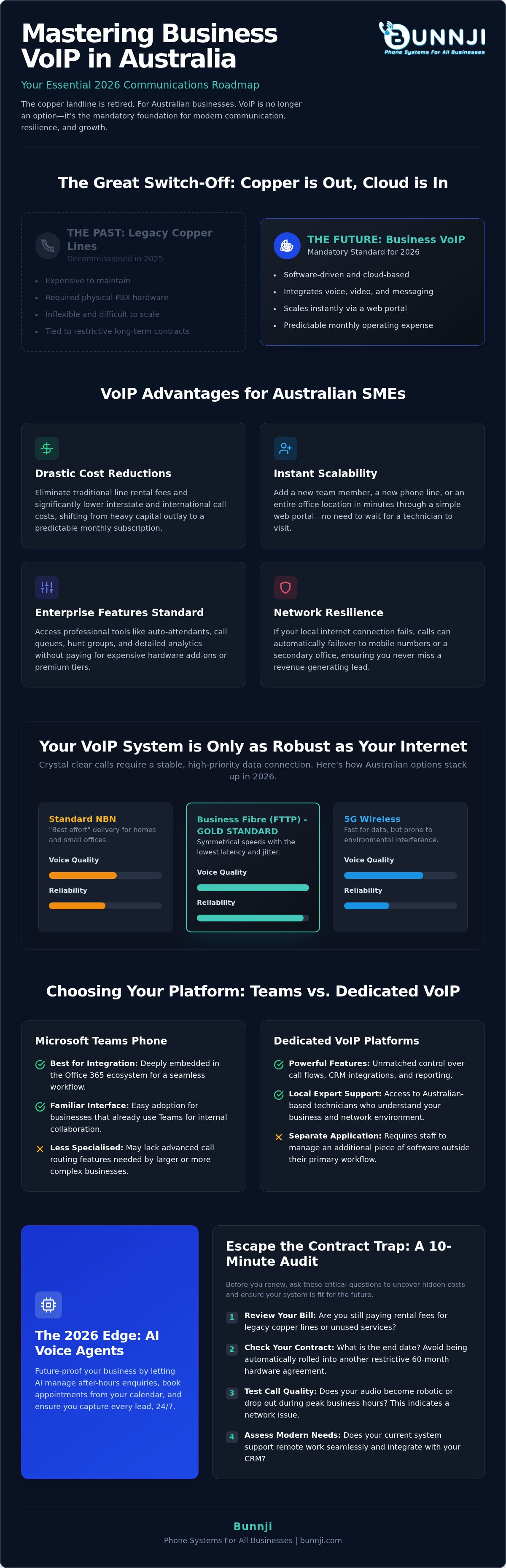
A 10-Minute Telecommunications Audit
Review:
- Current phone system
- Internet service at each location
- Mobile services
- Business numbers
- 1300/1800 services
- Equipment rental
- Finance agreements
- Contract expiry dates
- Support charges
- Redundancy services
Also identify anything on the invoice that nobody can explain.
You may discover services that are no longer required or costs that were assumed to be part of one agreement but are actually separate.
9. The 60-Month Telecommunications Contract Problem
One of the most important areas to investigate is equipment finance.
A telecommunications provider may supply the service while a completely separate finance company owns the equipment agreement.
This can create confusion when the customer wants to move.
Cancelling the telecommunications service doesn't necessarily cancel the equipment contract.
Before changing provider, obtain:
- Original agreement
- Contract commencement date
- Contract expiry date
- Monthly equipment payment
- Remaining term
- Current payout figure
- Equipment ownership details
Then calculate the complete financial impact of changing.
A good provider shouldn't simply say:
“We can save you $100 per month.”
They should determine whether an existing financial commitment means the customer would actually be worse off.
10. Number Porting: Protect Your Business Identity
For an established business, its telephone number can be part of its identity.
Customers know it.
It may appear on Google, websites, vehicles, signage, directories and years of marketing material.
Fortunately, changing providers doesn't necessarily mean changing numbers.
Business numbers can generally be ported, subject to eligibility and carrier requirements.
But porting needs to be managed carefully.
A single number may be relatively straightforward.
A large range or legacy configuration can be considerably more complicated.
The safest principle is:
Don't cancel the existing service before the port has successfully completed.
Your provider should first establish exactly which numbers exist, who controls them and how they are configured.
11. AI Is Changing the Business Phone System
The next major telecommunications shift is already underway.
Artificial intelligence is beginning to change what happens when somebody calls a business.
Traditional automation asks callers to navigate menus:
“Press 1 for sales.”
“Press 2 for accounts.”
AI allows something far more natural:
“How can I help you today?”
The caller can then explain what they need in ordinary language.
The AI system interprets the request and determines what should happen next.
12. What Can an AI Voice Agent Actually Do?
Depending on the technology and integrations, an AI voice agent can potentially:
- Answer calls 24/7
- Understand natural language
- Answer common questions
- Capture names and contact information
- Determine why someone is calling
- Qualify sales enquiries
- Transfer calls
- Take structured messages
- Check calendar availability
- Schedule appointments
- Update CRM records
- Produce call summaries
- Trigger workflows
- Send follow-up notifications
This means the telephone system can become connected to the organisation's broader digital workflow.
13. AI Receptionist + CRM + Calendar
Consider a professional services business.
A prospective customer calls after hours.
Instead of voicemail, an AI receptionist answers.
The caller explains what they need.
The system can potentially collect the caller's information, establish the type of service required, check available appointments, make a booking and create a structured record for the team to review the following morning.
For a trade business, the workflow might include capturing the suburb, job type and urgency.
For a medical or allied-health practice, it might involve answering approved general questions and assisting with appointment workflows while appropriately protecting sensitive information.
For an automotive workshop, it could capture vehicle details and booking requirements.
The value isn't simply replacing somebody who answers the telephone.
It is connecting the conversation to the workflow that follows it.
14. Should AI Replace the Human Receptionist?
For many businesses, probably not.
The more useful question is:
Which calls genuinely require a human?
Humans remain particularly important when conversations involve:
- Judgement
- Empathy
- Negotiation
- Complex complaints
- Sensitive matters
- Technical expertise
- Relationship management
AI is potentially valuable for repetitive and structured interactions.
That could include:
- Opening hours
- Basic service information
- Appointment requests
- Routine enquiries
- After-hours calls
- Initial qualification
- Message taking
The strongest model for many organisations may therefore be AI plus humans, rather than AI versus humans.
15. Missed Calls Are a Business Problem, Not Just a Phone Problem
Think about what happens when someone calls your business and nobody answers.
Do they leave a voicemail?
Sometimes.
Do they call a competitor?
Sometimes.
That makes missed-call management a customer acquisition issue.
Modern communications systems can create an escalation path.
For example:
Reception → Call queue → Another team → Mobile app → AI receptionist → Voicemail
The objective is to give a genuine customer enquiry the best possible chance of being answered.
Businesses investing thousands of dollars in websites, Google advertising and lead generation should pay equal attention to what happens when those leads actually pick up the telephone.
16. One Number, Every Device
The future of business telephony isn't necessarily the disappearance of the desk phone.
Physical handsets remain practical in many environments.
Reception desks, medical practices, warehouses, retail stores and offices may continue using them for years.
What is changing is that the desk phone is becoming one endpoint among many.
The employee's business identity can potentially follow them across:
Desk phone → Computer → Mobile → Remote office
Customers continue calling the same number.
Employees remain reachable without publishing their private mobile numbers.
This is one of the most practical benefits of unified communications.
17. What Will Business Communications Look Like Towards 2030?
The distinction between the phone system and other business applications is likely to become increasingly blurred.
Communications platforms are becoming more integrated with:
- CRM
- Artificial intelligence
- Calendars
- Customer databases
- Workflow automation
- Messaging
- Video
- Analytics
- Business applications
A future telephone conversation may automatically create a transcript, produce a summary, identify follow-up tasks and update the CRM.
AI may assist with routing calls based on intent rather than simply asking callers to select a department.
Managers may gain better insight into unanswered calls, customer demand and service levels.
And employees may increasingly think less about which device they are using.
They will simply use their business communications identity wherever they happen to be working.
18. How to Choose a Business Telecommunications Provider
When comparing providers, don't look only at the advertised monthly price.
Ask what happens after installation.
Consider:
- Where is support located?
- Who answers when there is a problem?
- Who manages the internet service?
- Who supports the phone system?
- Who manages number porting?
- Who supports the network?
- What happens during an outage?
- Is automatic failover available?
- Can multiple sites be connected?
- Can employees work remotely?
- Can the platform integrate with CRM systems?
- Are AI capabilities available?
- Is equipment purchased, rented or financed?
- What are the contract terms?
- What happens if the business relocates?
- What happens if the business grows?
Telecommunications is operational infrastructure.
The quality of the relationship after the sale can be just as important as the technology sold on day one.
19. Build a Communications Strategy, Not Another Phone Contract
The biggest opportunity for Australian businesses isn't simply replacing one PBX with another.
It is stepping back and examining the entire communications environment.
How do customers contact us?
How do our employees communicate?
What happens when the internet fails?
Can staff work from anywhere?
Are we paying for services we no longer require?
Can our systems communicate with each other?
Where could automation save time?
What happens to a customer who calls after hours?
Those questions lead to better telecommunications decisions than simply asking how much a handset costs.
Bunnji: Smarter Business Communications
At Bunnji, we believe business telecommunications should be designed around the organisation using it.
That means understanding the existing environment before recommending the next one.
We help Australian businesses bring together areas including:
- Cloud business phone systems
- Business NBN
- Fibre connectivity
- Internet redundancy
- 4G and 5G backup
- Business mobile
- SIP and number services
- Managed networking and Wi-Fi
- Remote-working communications
- AI voice solutions
- Communications integrations
Our objective is to reduce complexity and create an environment that works as one connected solution.
When reviewing an existing telecommunications environment, we also believe it is important to understand existing contractual obligations.
If equipment is subject to an existing rental or finance agreement, that should form part of the conversation before a customer changes provider.
A telecommunications upgrade should make the business better off — operationally and commercially.
Take Control of Your Business Communications
Business telecommunications have moved far beyond the traditional office telephone.
Voice is becoming software.
Internet is becoming critical infrastructure.
Mobile and office communications are converging.
AI is beginning to participate directly in customer conversations.
And the businesses that benefit most won't necessarily be those that adopt every new technology first.
They will be the businesses that choose the right combination of technologies and make them work together properly.
If your organisation is reviewing an ageing phone system, experiencing unreliable internet, paying multiple telecommunications suppliers or exploring AI-powered customer communications, it may be time to review the entire environment rather than replacing individual services one at a time.
Talk to Bunnji about a telecommunications review.
We'll help you understand your current environment, identify risks and unnecessary complexity, assess connectivity and redundancy, review existing contractual commitments and explore how modern cloud and AI communications could support your business.
Because the objective isn't simply to give your business a newer telephone.
It's to make sure your customers can reach you, your people can communicate and your technology is ready for what comes next.


