

What if your business could stay online even when the physical NBN cables in your street are accidentally cut or fail? You've likely felt the sting of a sudden outage that brings your entire team to a standstill or ruins the quality of an important client VoIP call. It's frustrating when your productivity is at the mercy of ageing infrastructure or expensive civil works that just aren't feasible for your site.
We understand that for an Australian business in 2026, internet isn't just a utility; it's the lifeblood of your cloud services and AI tools. This guide explores how business fixed wireless internet australia has transformed from a rural alternative into a premium, low-latency solution for urban and regional centres alike. You'll discover how to achieve 99.9% uptime and ensure your voice calls remain crystal clear through high-speed wireless technology.
We'll break down the latest 2026 speed tiers, compare the best redundancy setups, and show you how to implement a secondary link that kicks in automatically the moment your main line fails. It's time to stop worrying about the "what-ifs" and start building a connection that actually works for you.
Key Takeaways
- Learn why business fixed wireless internet australia is the leading choice for bypassing ageing copper infrastructure and securing reliable, high-speed connectivity in 2026.
- Understand how symmetric upload speeds and low latency ensure your cloud phone systems and AI voice agents run without jitter or dropouts.
- Discover the power of true path diversity to eliminate single points of failure, protecting your uptime even if ground cables are physically damaged.
- Compare the stability of dedicated wireless spectrum against the potential congestion of 5G mobile broadband to choose the right primary link for your site.
- Get a roadmap for a seamless transition, from auditing your current telecommunications to porting numbers without any operational downtime.
Business Fixed Wireless: Why is it Trending in 2026?
Fixed wireless technology uses high-frequency microwave radio signals to transmit data between two fixed points, typically a carrier tower and a dedicated antenna on your building's roof. While many once viewed this as a backup option for regional areas, business fixed wireless internet australia has emerged as a premium metro requirement. It's the most effective way to bypass the "Aussie copper" bottleneck that still plagues many commercial precincts. As the ACCC implements new service standards in July 2026, the focus has shifted toward technologies that offer genuine path diversity and stability.
Modern businesses can't afford to wait for complex civil works. If your building's underground conduits are blocked or the lead-in pipes are collapsed, traditional fibre installation can take months and cost thousands in trenching fees. Fixed wireless leaps over these physical barriers. It provides a high-speed link that doesn't rely on the same ageing pits and pipes as your primary NBN connection. This makes it the ultimate redundancy tool for 2026. It's no longer just a "save-me" tech; it's a strategic choice for any office that refuses to be taken offline by a single backhoe incident down the street.
Breaking the 'Rain Fade' Myth
Old-fashioned satellite connections often struggle during a heavy downpour, but modern carrier-grade fixed wireless is a different beast entirely. We use sophisticated equipment designed specifically for Australian conditions to maintain signal integrity through wind and rain. Unlike consumer satellite, these microwave links operate over much shorter distances with highly focused beams. The result is a connection where signal stability often rivals physical fibre. It provides the rock-solid foundation needed for business VoIP Australia, ensuring your voice traffic remains clear even when the weather turns. The reliability is now so high that many firms use it as their primary data link.
The Infrastructure: Towers vs. Pits
The beauty of wireless lies in what you don't see. There's no digging, no council permits for ripping up footpaths, and no waiting for a technician to find a spare pair in a damp underground pit. Deployment is rapid because the infrastructure is already in the air. The only metric that truly matters for your site is "Line of Sight" to a local tower. Once that's confirmed, your business can be up and running with a high-performance link in a fraction of the time it takes to organise a traditional fibre build. This speed of deployment is why wireless has become the go-to for office fit-outs and urgent capacity upgrades this year.
Technical Performance: Speed, Latency, and SLAs
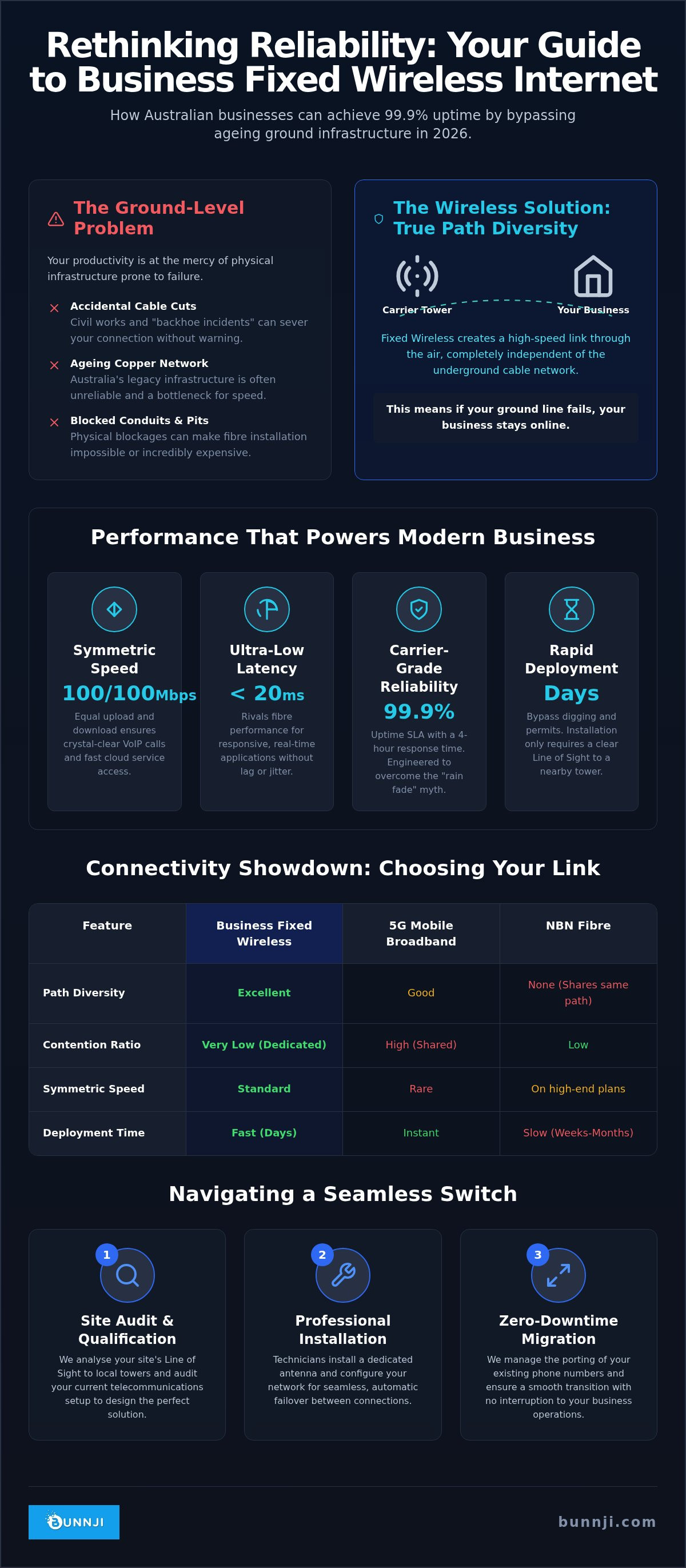
Performance in 2026 is defined by more than just raw download numbers. For a mid-sized firm, the baseline expectation has shifted to 100/100Mbps. Unlike residential plans that prioritise downloading Netflix, business fixed wireless internet australia provides symmetric speeds. This means your upload is just as fast as your download. It is the secret sauce for business VoIP Australia, where a weak upload link often causes "choppy" audio or dropped calls during peak times. When you're running a professional operation, your data needs to move both ways with equal efficiency.
Latency, or "ping," is another area where fixed wireless shines. It frequently rivals NBN fibre and easily beats satellite connections. While satellite signals must travel to space and back, fixed wireless travels in a direct line across the horizon. This results in sub-20ms latency, which is essential for real-time applications. Aligning with the Australian Government's internet strategy to improve national digital resilience, carrier-grade wireless now offers the stability required for the most demanding cloud environments. Low contention ratios also ensure that your neighbours' afternoon video streaming doesn't slow down your 3 PM board meeting.
Decoding Business-Grade SLAs
A Service Level Agreement (SLA) is your safety net. In the business world, "best efforts" isn't good enough. A professional SLA often guarantees a 4-hour response time. This means if your link goes on the blink, a technician is working on it immediately, not "sometime next week." We focus on uptime percentages like 99.9% or 99.95%. While that 0.05% difference seems small, it represents hours of potential lost productivity over a year. Our managed IT approach ensures these agreements are enforced, giving you the peace of mind that your connection is backed by a concrete promise of performance.
Capacity for Modern Cloud Workloads
Modern offices are heavy-lifting environments. Between CRM syncing, 4K video conferencing, and the rise of AI voice agents for business, your bandwidth needs are constantly evolving. AI agents specifically require extremely low jitter to sound human and responsive. Fixed wireless provides this rock-solid consistency. If your team grows, scaling your speed is usually a simple phone call away. There's no need for a technician visit or new cabling. If you aren't sure if your current link can handle the load, it might be time to book a telecommunications audit to see where your bottlenecks are hiding.
Fixed Wireless vs. 5G vs. Fibre: Choosing Your Primary Link
Selecting the right primary link involves more than just looking at a speed tier. While fibre is often hailed as the gold standard for raw throughput, the National Broadband Network (NBN) frequently presents hidden challenges, such as collapsed lead-in conduits or expensive trenching requirements. This is where business fixed wireless internet australia provides a strategic alternative. It offers high-speed performance that rivals traditional fibre without the need to dig up the pavement or wait months for civil works to be completed.
5G mobile broadband is another contender, but it operates on a fundamentally different principle. While it's fast to deploy, it's a shared medium. This means your speeds are at the mercy of every other mobile user connected to the same tower. For a professional office, this lack of predictability can be a dealbreaker. Your decision framework should focus on your building's physical location and your team's specific data habits. If your operations rely on consistent, low-latency cloud access, business fixed wireless internet australia offers a level of reliability that mobile networks simply can't match.
The 'Shared vs. Dedicated' Spectrum Debate
Think of 5G like a public motorway; it works well until a footy match or a major event happens nearby. When thousands of people hit the local tower at once, your office speeds will fluctuate. Fixed wireless avoids this "tower congestion" by using a dedicated antenna on your roof that pinpoints a signal directly to the carrier's base station. You aren't competing with the public for bandwidth. This point-to-point architecture also provides enhanced security. It's much harder for an external party to intercept a focused microwave beam than it is to tap into a broad mobile broadcast that is being sent in every direction.
Cost Analysis: Install Fees and Monthly Spend
Businesses are often tempted by the "zero-dollar" install fees associated with standard NBN plans. However, these plans often come with a "copper tax" in the form of frequent outages and maintenance delays. A specialised wireless setup does require an initial investment for the dish and professional mounting. But when you look at the long-term ROI, the picture changes. Avoiding just one day of total downtime can pay for the entire install. A slightly higher monthly spend on a dedicated wireless link ensures your staff stay productive, which is far more cost-effective than paying a team to sit idle while you wait for a ground cable to be repaired.
- Choose Fibre if you have existing high-quality lead-ins and require multi-gigabit capacity.
- Choose Fixed Wireless for rapid deployment, symmetric speeds, and a link that bypasses ground-level infrastructure.
- Choose 5G for temporary pop-up sites or very small teams with minimal data requirements.
Strategic Redundancy: Using Wireless to Bulletproof Your Uptime
Many businesses fall into the "Single Point of Failure" trap by relying on two separate NBN lines for redundancy. While this looks like a solid backup plan on paper, those cables usually share the same physical trench or pit in the street. If a contractor digs up the footpath or a storm floods the local exchange, both connections will fail simultaneously. This is where business fixed wireless internet australia provides a genuine safety net. By using an aerial signal, you achieve true path diversity. Your connection stays live even when the ground cables are severed or damaged.
Modern networking hardware allows for automatic failover. This means your system detects a drop in the primary link and switches to wireless in milliseconds. It's a vital part of a resilient connectivity strategy that often includes business mobile SIM only plans for your mobile workforce. When these elements work together, your organisation becomes virtually immune to local infrastructure outages, ensuring your team remains productive while competitors are left waiting for repairs.
Disaster Recovery Planning for 2026
Every business has a "critical path" of applications that must remain online. Whether it's your cloud VoIP system, point-of-sale software, or your CRM, these tools are the lifeblood of your revenue. Fixed wireless serves as the ultimate insurance policy for digital-first firms. It guarantees that your most essential services remain accessible regardless of what happens in the street. To find your vulnerabilities before they become expensive problems, book a 10-minute telecommunications audit to secure your uptime and identify hidden risks.
Redundancy for Remote and Hybrid Teams
In a hybrid world, the head office acts as a vital data hub. Remote staff rely on this hub to stay connected via VPN tunnels and shared cloud environments. If the office goes dark, the whole team stops. Implementing business fixed wireless internet australia provides the stability needed to support high-density encrypted traffic without the congestion often found on mobile broadband. Professional Australian offices no longer accept "best efforts" as a standard. They demand a secondary link that offers the same performance and reliability as their primary one.
Navigating the Switch: How Bunnji Organises Your Business Internet
Switching providers shouldn't feel like a gamble. We don't just sell you a generic plan and walk away. Our process begins with a comprehensive audit of your entire tech stack. By understanding how your team actually uses data, we can tailor business fixed wireless internet australia to fit your specific workflow. This ensures your cloud applications, backups, and communication tools have the exact capacity they need to thrive. We look at your current usage patterns and identify where a wireless link can provide the most value, whether as a primary connection or a strategic redundancy solution.
Migration is often the biggest hurdle for growing firms. We handle the heavy lifting, including porting your existing numbers and switching data links without the usual headaches. We also provide expert guidance to help you avoid the "hidden costs" often buried in the industry's notorious 60-month telecommunications equipment contracts. You deserve a partner who values transparency over bureaucratic layers. Our local support means you'll always talk to an Aussie expert who knows your specific network configuration inside out, rather than a script in a distant call centre.
Step 1: The Site Qualification
Before a single dish is mounted, we perform a rigorous site qualification. This involves checking for a clear "Line of Sight" to the nearest high-speed carrier tower to guarantee signal integrity. We don't stop at the roof, though. Our team evaluates your internal cabling to ensure that high-speed wireless data actually reaches every desk in your office without being throttled by outdated local hardware. We provide a transparent quote that covers everything from the mounting hardware to the final configuration, so there are no "nasty surprises" on the day of installation.
Step 2: Integration and Optimisation
Once the link is live, we move into the integration phase. We specialise in configuring your network to prioritise traffic for VoIP and AI voice agents. This ensures your most critical communication channels remain crystal clear, even during heavy data transfers or cloud backups. We also layer in managed firewalls and robust cybersecurity to protect your new wireless connection from external threats. The final handover includes training for your team, ensuring everyone knows how to monitor their new, stable connection and understand the failover protocols we've put in place for total peace of mind.
- Tech Stack Audit: We align your internet speed with your actual software requirements.
- Contract Review: We help you escape restrictive, long-term equipment traps.
- Traffic Prioritisation: We ensure your voice calls always have the "right of way" on your network.
Future-Proof Your Connectivity Strategy
By 2026, the digital landscape moves too fast for businesses to be held back by underground cable failures or mobile tower congestion. Adopting business fixed wireless internet australia is a strategic move that provides your office with the symmetric speeds and low latency needed for today's AI-driven workloads. Whether you use it as a primary link to bypass ageing copper or as a fail-safe redundancy solution, the peace of mind that comes with a dedicated aerial signal is invaluable.
We pride ourselves on being more than just a provider. As managed IT and cybersecurity experts, we specialise in Australian business redundancy to ensure your team never misses a beat. Our no-nonsense, expert-led technical support is always a phone call away, helping you navigate the complexities of modern infrastructure without the corporate jargon. Don't wait for the next NBN outage to find the weak links in your network. Book your 10-minute telecommunications audit with Bunnji today and take the first step toward a more resilient, high-performance future. Your business deserves a connection that is as ambitious as your goals.
Frequently Asked Questions
Is fixed wireless internet better than NBN for an Australian business?
Fixed wireless is often a superior choice for businesses that require rapid deployment or a secondary link that doesn't share the same underground path as the NBN. While NBN fibre offers excellent raw speed, fixed wireless avoids the "blocked conduit" issues common in older commercial buildings. It provides a reliable alternative that bypasses ground-level infrastructure risks. For many, the best strategy is using both to ensure 100% uptime for critical operations.
How much does a business fixed wireless installation cost in 2026?
Installation costs for business fixed wireless internet australia vary depending on the height of your building and the specific hardware required to achieve a clear line of sight. Some providers offer subsidised setups on longer contracts, while others charge an upfront fee for the professional mounting of the receiver dish. Because every site has unique physical requirements, we recommend a site qualification to get an accurate quote that avoids any nasty surprises on install day.
Does rain or bad weather really affect fixed wireless signals?
Modern microwave technology used in business-grade links is highly resilient to Australian weather conditions. While heavy "rain fade" can affect consumer satellite, the shorter distances and focused beams of fixed wireless maintain stability during storms. We use high-quality equipment with sufficient "fade margin" to ensure your connection remains rock-solid. You won't notice a drop in performance during a typical downpour, making it a reliable choice for year-round connectivity in most metro corridors.
Can I run my VoIP phone system over a fixed wireless connection?
You can definitely run your VoIP and cloud phone systems over fixed wireless. The technology is actually better suited for voice traffic than many standard NBN plans because it offers symmetric upload speeds and low latency. These factors prevent the jitter and lag that usually ruin call quality. Your AI voice agents and receptionists will sound clear and professional, provided your network is configured to prioritise voice traffic over other background data downloads.
What happens to my fixed wireless internet during a power outage?
Your internet connection will stop if your building loses power, as the on-site antenna and router require electricity to function. However, the carrier towers themselves usually have significant battery backups or generators to stay online during local grid failures. To maintain connectivity during a blackout, we recommend installing a UPS to power your networking gear. This allows your team to stay online using laptops and mobile devices until the local power is restored.
Do I need a special router for business fixed wireless?
You don't necessarily need a "wireless-only" router, but you do need a business-grade device with an Ethernet WAN port. For the best results, we recommend a router that supports dual-WAN failover. This allows the hardware to automatically switch between your primary fibre and your business fixed wireless internet australia link the moment a fault is detected. Using a managed router ensures that your traffic is correctly prioritised and that your cybersecurity layers remain active across both connections.
How long does it take to get fixed wireless installed at my office?
Installation is usually much faster than traditional fibre because it doesn't require digging up roads or footpaths. Once we confirm a clear line of sight to a local tower, the physical setup can often be completed in one or two weeks. This timeline is far shorter than the months of waiting often associated with NBN civil works or complex lead-in repairs. It's the perfect solution for offices that need to get online quickly without bureaucratic delays.
Is fixed wireless more secure than standard fibre or NBN?
Fixed wireless is exceptionally secure because the data is transmitted via a narrow, directed microwave beam between two specific points. Unlike mobile signals that broadcast in all directions, these beams are difficult to intercept without specialised equipment placed directly in the line of sight. When combined with modern encryption and a managed firewall, it provides a level of security that meets the strictest corporate standards. It's a robust choice for firms handling sensitive client data or financial transactions.


