
What if the copper wire connecting your office to the world is actually a bottleneck for your growth? With NBN Co accelerating the retirement of legacy infrastructure throughout 2026, sticking to a traditional desk phone isn't just a choice; it's a risk to your continuity. We understand the anxiety that comes with a business landline to voip migration. You shouldn't have to worry about missing critical client calls or getting tangled in complex number porting rules that seem designed to frustrate you.
You've built your reputation over years, and the thought of a "disconnected" tone is enough to keep any business owner awake. It's frustrating to pay premium rates for outdated tech that doesn't support a modern, mobile workforce. This guide shows you how to master the transition to cloud voice without losing your numbers or suffering a second of downtime. We'll explore how to audit your fibre internet redundancy, navigate the 2026 ACMA protections, and organise a system that slashes overheads while giving your team total flexibility. From the death of the traditional office phone to the rise of AI receptionists, this is your roadmap to a more resilient communication platform.
Key Takeaways
- Prepare for the 2026 copper shutdown to avoid forced disconnections and the inflated costs of maintaining legacy infrastructure.
- Audit your premises for hidden copper gremlins like lift phones and alarms to ensure a seamless business landline to voip migration.
- Adopt a "one number, every device" philosophy to empower your remote and hybrid workforce with consistent professional identity.
- Implement a parallel setup strategy to guarantee zero downtime and zero missed client calls during the transition phase.
- Leverage cloud voice as a foundation for AI receptionists that automate call handling and sync directly with your CRM.
The Sunset of the Australian Landline: Why Migration is Non-Negotiable in 2026
The Australian telecommunications landscape has reached a critical tipping point. In 2026, the final nails are being driven into the coffin of the Public Switched Telephone Network (PSTN) and Integrated Services Digital Network (ISDN). These legacy copper networks are no longer viable for modern commerce. VoIP migration is the transition of voice signals from physical copper circuits to digital data packets over the internet. By moving to Voice over Internet Protocol (VoIP), your firm shifts from a rigid, physical line to a flexible, software-driven environment.
Many businesses are currently victims of a "silent migration." This happens when your existing big-name telco switches your backend to digital but keeps you on an expensive, legacy billing structure. You pay for "line rental" that no longer exists in a physical sense. A proactive business landline to voip migration allows you to ditch these phantom fees in favour of transparent subscription models that scale with your actual headcount. It's a strategic move that turns a basic utility into a competitive advantage.
The Copper Switch-Off and ACMA Compliance
NBN Co has intensified its Targeted Upgrade Program, with 130,000 specific premises now required to move from copper to full-fibre. If your business is still on a legacy line, you're likely running on an emulated service that mimics old tech while using the new network. This creates a reliability gap. Under the 2026 ACMA Telecommunications Consumer Protections Code, businesses must ensure they have robust solutions for 000 emergency calling. Sticking with legacy tech is a liability. Without the battery backups or redundancy found in modern cloud systems, a simple power cut could silence your entire operation.
Escaping the 60-Month Contract Trap
One of the biggest hurdles in any business landline to voip migration is the "evergreen" clause. These are hidden terms in old telecommunications agreements that automatically renew your contract for years without your explicit consent. We often see firms stuck in 60-month equipment contracts for handsets that belong in a museum. Before signing any new terms, a comprehensive telco audit is essential. You must identify exactly what you own and what you're still paying off. Avoid the common mistake of bundling outdated, proprietary hardware into your new cloud plan. Modern VoIP thrives on open standards, giving you the freedom to choose your equipment rather than being locked into a single provider's ecosystem for the next half-decade.
The Pre-Migration Audit: Identifying Hidden Costs and Copper Gremlins
A successful business landline to voip migration isn't just a technical swap; it's a strategic audit. At Bunnji, we believe you can't build a modern system on a shaky foundation. Many firms jump straight into picking handsets without realising their legacy infrastructure is riddled with "copper gremlins." These are the non-voice services that still rely on your old lines. If you don't account for them, your transition will hit a wall.
Mapping these gremlins is the first step. You need to identify every service tied to your copper network, including:
- Lift phones: These are critical for safety and often require specific hardware to work over the NBN.
- Back-to-base alarms: Security systems frequently fail during a migration if they aren't updated to digital or mobile signals.
- Legacy fax lines: While rare, some industries still require faxing. You'll need a "Fax to Email" solution or an ATA adapter.
Beyond hardware, you must verify your internet capacity. High-concurrency voice traffic demands more than just "fast" internet; it requires stability. Understanding the benefits of VoIP for business helps you see why your NBN plan is the bedrock of your system. If your primary fibre link fails, your business shouldn't go dark. Redundancy planning is about ensuring a 4G or 5G failover kicks in instantly, keeping your team connected and your clients happy.
Auditing Your Current Call Flow
Before you move to the cloud, document exactly how calls move through your office. This is the best time to identify "dead ends" where customers get stuck on hold or sent to a generic voicemail that nobody checks. Decide which staff members actually need a physical desk phone and who would be better served by a softphone on their laptop or mobile. This clarity prevents over-ordering hardware and keeps your monthly overheads lean. You can start this process today by conducting a 10-minute telecommunications audit to see where your current gaps lie.
The Internet Redundancy Checklist
Business-grade NBN or Fibre is essential for crystal-clear calls. However, even the best fibre can be cut by a wayward excavator. A robust checklist must include:
- Automated Failover: A router that switches to 4G/5G data the moment the main line drops.
- Voice Prioritisation (QoS): Configuring your network to give phone calls "the right of way" over heavy file downloads.
- Wi-Fi Mesh Stability: Ensuring your office Wi-Fi is strong enough to handle roaming calls without jitter or drops.
Hardware, Softphones, and AI: Choosing Your New Communication Stack
Your communication stack is the engine room of your firm. During a business landline to voip migration, you have a rare opportunity to strip away legacy clutter and build a system that actually fits how your team works. This isn't just about replacing a corded phone with a cordless one. It's about creating a unified environment where your office number follows you from the boardroom to the home office. The 2026 X-Factor involves integrating AI voice agents for business into your migration plan to ensure you never miss a lead again.
Modern systems must "talk" to your customer database from Day 1. When a client calls, your staff should see their history, recent tickets, and preferences before they even say hello. This level of CRM integration turns your phone system from a simple utility into a powerful data tool that improves every customer interaction.
Desk Phones vs Softphones vs Mobile Apps
The modern Australian office is changing. While high-quality Yealink and Cisco hardware remain the gold standard for reception desks and executive suites, many firms are moving away from physical handsets entirely. The "Bunnji App" approach is winning for hybrid and remote teams because it turns any laptop or smartphone into a full-featured business extension. Retiring old desk units reduces your environmental footprint and slashes the upfront capital expenditure of your migration. You get the power of a professional PBX without the cable spaghetti or the maintenance costs of physical hardware.
AI Receptionists: Eliminating Missed Calls
Missed calls are a silent revenue killer. AI voice agents act as a digital safety net, handling overflow calls during peak periods and managing after-hours enquiries with human-like precision. These agents can link directly to your team's calendars to organise automated bookings, meaning you can secure new business while your staff are focused on deep work. When you compare the ROI of a digital receptionist to traditional, expensive answering services, the choice becomes clear. You get 24/7 coverage and instant CRM updates for a fraction of the cost of a human-staffed call centre. This "One Business Number, Every Device" philosophy ensures your brand remains present and responsive, no matter where your team is located.
The 5-Step Roadmap to a Zero-Downtime VoIP Migration
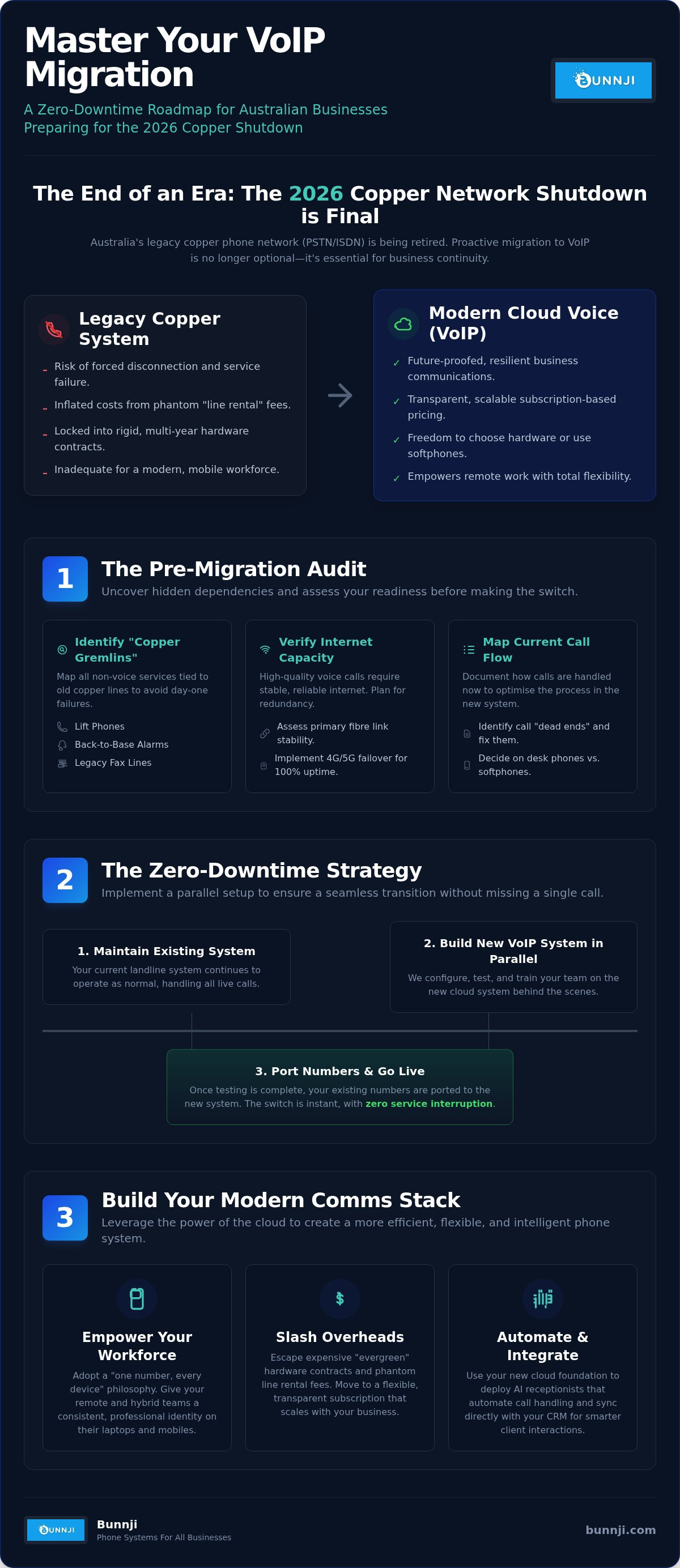
Moving your communication to the cloud shouldn't feel like a leap of faith. It's a calculated sequence of events. A zero-downtime business landline to voip migration relies on doing the heavy lifting before you touch a single physical line. By following a structured roadmap, you ensure your clients never hear a disconnected tone while your team gets up to speed with the new tech.
- Step 1: Audit & Strategy. You've already mapped your "gremlins" and call flow. Now, we lock in the redundancy plan and finalise your virtual architecture.
- Step 2: The Parallel Setup. We build your entire cloud environment while your copper lines remain active. This is where we configure your AI agents and CRM integrations.
- Step 3: Number Porting. We notify the carriers to move your numbers. This is a background process that doesn't affect your current dial tone.
- Step 4: Staff Training & Testing. Run a "dry hire" day. Let your team make internal calls and test the mobile apps before the final cutover.
- Step 5: The Cutover. Once the port is confirmed, we flick the switch. Calls stop hitting the old copper and start ringing on your new system instantly.
Demystifying Number Porting in Australia
Number porting is the most technical phase of the migration. Under ACMA rules, there's a significant difference between a Simple Port, usually for a single number, and a Complex Port, which involves multiple numbers or ISDN blocks. To avoid the dreaded "rejection loop," your porting data must match your last telco bill exactly. Even a small typo in your business name or address can delay the process by weeks. Maintaining ownership of your numbers is vital; it's your digital identity. We handle the paperwork to ensure your 1300 and local numbers move safely without you losing access for a single minute.
Parallel Running: The Secret to Zero Downtime
The biggest mistake in a business landline to voip migration is cutting the old cord too early. We recommend parallel running. This involves setting up your new system and using call forwarding from your old lines to test the new handsets and apps. It's the perfect time to verify call quality over your business NBN connection. Check for latency or jitter while your staff are actually using the system in a live environment. During the final week, we confirm your AI agent and CRM sync are live and pulling data correctly. If you're ready to secure your firm's future, book your managed migration today.
Future-Proofing Your Firm with Bunnji’s Managed Migration
Attempting a DIY business landline to voip migration often seems like a cost-saving measure, but it frequently results in fragmented call flows and unexpected downtime. A managed approach provides a safety net. It ensures that every technical nuance, from SIP trunking configuration to handset firmware updates, is handled by experts. This allows your team to focus on their core work while we manage the complex backend transition. Once you're in the cloud, scalability becomes a non-issue. You can add new lines, extensions, or AI agents in seconds through a central dashboard, eliminating the need for on-site technician visits as your firm expands.
Cybersecurity is the new frontier for business communications. Moving your voice services to the internet means your phone system is now a network asset that requires protection. We actively defend your infrastructure against "vishing" (voice phishing) and toll fraud, where malicious actors attempt to hijack your lines for expensive international calls. A managed migration incorporates these security layers from the start, ensuring your digital voice is as secure as your email or banking data.
Security and Compliance in the Cloud
Protecting your firm requires more than just a strong password. We implement Multi-Factor Authentication (MFA) for your phone system logins to prevent unauthorised access to your call history and settings. Compliance with the Australian Privacy Principles (APP) is also a major focus, especially regarding call recording. We help you manage data storage and notification requirements to ensure you meet local privacy rules. As AI voice scams become more sophisticated, we provide the tools and training to help your staff identify synthetic voices and social engineering tactics, keeping your business identity safe.
The Bunnji Difference: More Than Just a Provider
Most big telcos offer off-the-shelf plans that treat every business like a generic account number. We take the opposite approach. We provide tailored solutions designed for the specific needs of Australian firms, from boutique agencies to national enterprises. You get access to local support from experts who understand the Australian NBN footprint and ACMA regulations. We don't hide behind bureaucratic layers; we're a capable partner committed to your long-term success. The first step toward a more resilient, flexible, and cost-effective communication stack is simple. Start your journey by booking a professional telecommunications audit to see how we can streamline your switch to the cloud.
Secure Your Firm's Digital Future Today
The copper lines that once defined Australian business are fast becoming relics. A successful business landline to voip migration is about more than just switching hardware; it's about auditing your infrastructure for hidden "gremlins" and ensuring your internet redundancy is ironclad. By following a structured roadmap and embracing modern tools like AI receptionists, you turn a mandatory technical change into a strategic leap forward. You'll gain a flexible system that slashes overheads and supports your team wherever they work.
You don't have to navigate these complexities alone. Whether you're struggling to escape a restrictive 60-month contract or need national Australian support for a multi-site rollout, we provide the expert guidance you need. Our expertise in fibre redundancy and integrated AI voice solutions ensures your firm stays connected, secure, and competitive in 2026 and beyond.
Ready to eliminate the guesswork and protect your bottom line? Book your free 10-minute telecommunications audit with Bunnji today. It's the simplest way to ensure your transition is seamless, secure, and perfectly tailored to your team's unique requirements. Your future-proof communication system is just one conversation away.
Frequently Asked Questions
Will I lose my existing business phone number during the migration?
No, you can keep your number through the porting process. Your 1300, 1800, or local numbers are part of your digital identity. During a business landline to voip migration, we manage the transfer between carriers to ensure you maintain ownership. It's vital to match your account details exactly with your current provider's records to avoid delays. This process is regulated by the ACMA to protect your right to number portability.
How long does it actually take to migrate from a landline to VoIP?
The timeframe varies based on the complexity of your current setup. A simple port for a single number typically takes a few business days, while complex ports involving multiple lines or ISDN blocks can take four weeks or more. We recommend beginning the process at least a month before your desired cutover date. This allows enough time for the parallel setup and staff training phases mentioned in our roadmap.
What happens to my VoIP phone system if the internet goes down?
Your system stays active through automated redundancy and mobile failover. If your primary fibre link fails, a business-grade router switches to 4G or 5G data instantly. Because VoIP is cloud-based, calls can also be routed to mobile apps or external numbers automatically. This ensures your clients never receive a busy signal or a disconnected tone, even if your office suffers a local power cut or internet outage.
Do I need to buy all new hardware to switch to a VoIP system?
You don't necessarily need new physical handsets to make the switch. Many modern firms opt for softphones on laptops or mobile apps, which eliminates the need for desk hardware entirely. If you prefer a traditional desk phone, you'll need IP-enabled handsets from brands like Yealink or Cisco. While Analog Telephone Adapters (ATAs) can connect old copper phones to a digital network, we generally advise against this for long-term reliability.
Can I use my VoIP business number on my mobile phone while out of the office?
Yes, your business number follows you wherever you go. Through unified communications apps, your smartphone acts as a full office extension. You can make and receive calls, check business voicemails, and transfer callers just as if you were sitting at your desk. This "one number, every device" approach maintains your professional identity and ensures you don't have to give out your personal mobile number to clients while working remotely.
Is VoIP call quality as good as a traditional copper landline in 2026?
VoIP quality in 2026 actually exceeds traditional landlines when supported by a stable connection. High-definition (HD) voice codecs provide much clearer audio than the limited frequency range of old copper wires. To ensure this quality remains consistent during your business landline to voip migration, we implement Quality of Service (QoS) on your router. This prioritises voice packets over other data traffic, preventing any jitter or dropped calls during busy periods.
How does an AI receptionist work with a migrated VoIP system?
An AI receptionist acts as a cloud-native layer that handles your call traffic with human-like precision. It integrates directly into your VoIP call flow to manage overflow calls, answer frequently asked questions, or book appointments. Because the system is digital, the AI can instantly sync call data with your CRM. This ensures that every interaction is logged and your staff have full context before they follow up with a lead.
Are there any hidden costs I should watch out for when switching providers?
Watch out for contract exit fees and proprietary hardware lock-ins from legacy providers. Some big telcos charge significant "per number" porting fees that aren't always clear in the initial quote. You should also check for "evergreen" clauses in your current 60-month equipment contracts that might trigger payouts. Conducting a thorough telecommunications audit before you sign any new agreement is the best way to uncover and avoid these financial traps.


