

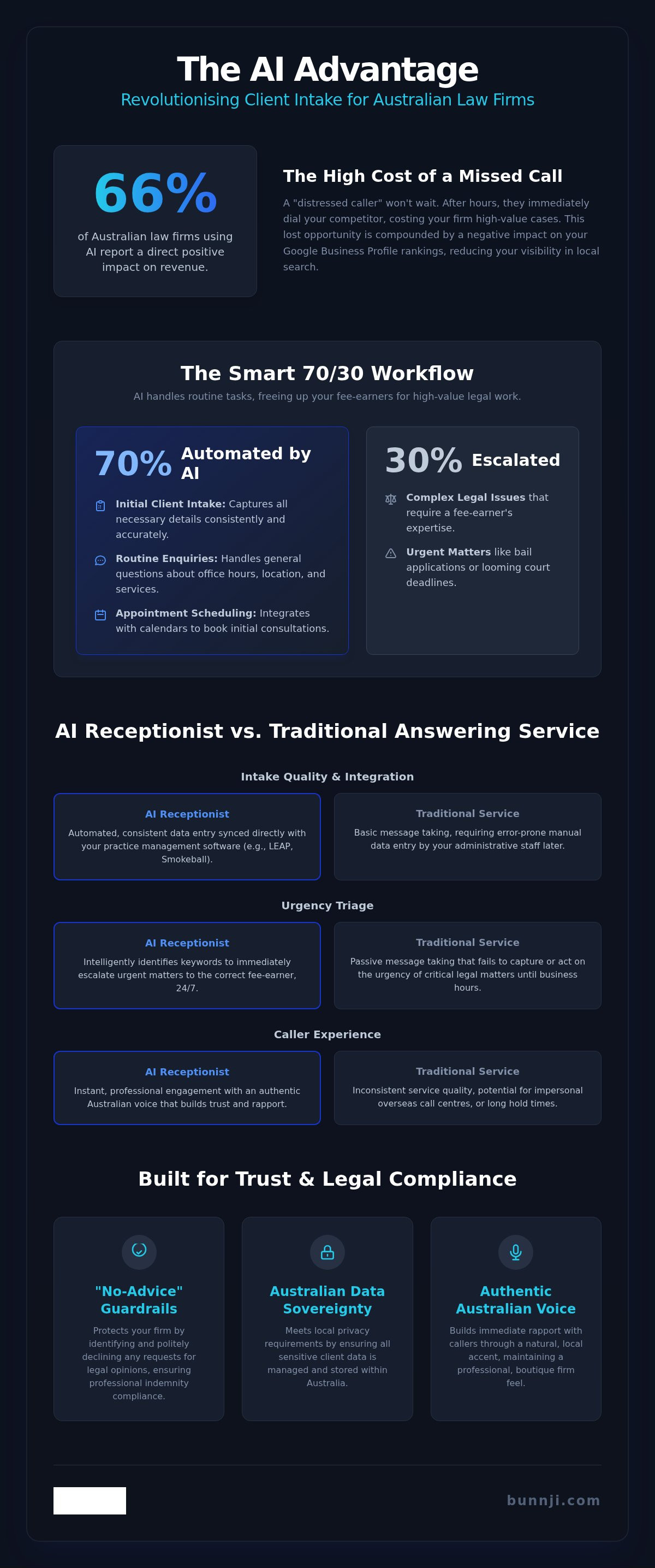
Recent industry reports reveal that 66% of Australian law firms using AI have already seen a direct positive impact on their revenue. You've likely felt the sting of a missed call from a high-value lead at 6 PM, knowing they'll probably dial your closest competitor before you've even finished dinner. It's a difficult balance to maintain professional standards while facing the high overheads of traditional after-hours answering services. Many practitioners worry that an ai receptionist for law firms might feel cold or impersonal, yet the cost of silence is often a lost client.
This article will show you how to capture every enquiry and protect your billable hours without adding to your administrative burden. We'll explore how modern AI voice agents provide 24/7 professional call handling and sync perfectly with practice management software like LEAP or Smokeball. You'll learn how local firms are automating the intake process, ensuring consistent data entry and meeting Australian privacy requirements. We are moving beyond simple call forwarding into a new era of seamless, automated client service that keeps your practice responsive and your data organised.
Key Takeaways
- Understand the "distressed caller" phenomenon and why immediate triage is vital to prevent high-value leads from contacting your competitors.
- Discover how an ai receptionist for law firms uses a 70/30 split to automate routine intake while escalating complex matters to fee-earners.
- Learn the essential steps for configuring conflict-of-interest protocols and maintaining data sovereignty within an automated legal workflow.
- Identify the infrastructure requirements, including business NBN redundancy, that ensure your AI voice agent remains responsive 24/7 without interruption.
The Evolution of Legal Intake: Why Australian Law Firms are Automating the Front Desk
Australian law firms are facing a critical shift in how they manage the front desk. Unlike a standard retail enquiry, a legal lead often arrives in a state of high stress. This "distressed caller" phenomenon means your prospective client is looking for immediate reassurance. If the phone rings out, they won't wait. They'll simply move to the next firm on their search results. In the broader context of Legal technology, the focus is moving from back-office efficiency to front-end responsiveness. You aren't just competing on legal expertise anymore; you're competing on how quickly you can acknowledge a person's problem.
Traditional 24/7 human answering services are becoming increasingly difficult to justify for boutique and mid-tier firms. High Australian labour costs and inconsistent service quality mean practices often pay a premium for operators who do little more than take a name and number. This passive approach fails to capture the urgency of legal matters. Worse, missed calls directly impact your firm's reputation and Google Business Profile rankings. When Google detects a pattern of unanswered calls or long response times, it can lower your visibility in local search results. The industry is moving away from just "answering the phone" toward a data-driven client intake model that captures every detail from the first second of contact.
The Real Cost of a Missed Legal Enquiry
The lifetime value of a single family law or personal injury matter can be tens of thousands of dollars. Losing that to a competitor because of an unanswered phone is an expensive oversight that most firms can't afford. Modern practices realise that asking a caller to "leave a message" is no longer a viable strategy for growth. An ai receptionist for law firms secures the "first-call" advantage by engaging the caller immediately. It provides the professional acknowledgement they need to stop searching and start the intake process. By the time you see the notification, the lead is already qualified and synced to your system, protecting your billable hours while growing your pipeline.
Triage and Urgency: Beyond Simple Message Taking
Not every call requires the same response. A general billing enquiry can wait until morning, but an urgent bail application or a looming court deadline cannot. An ai receptionist for law firms acts as a high-performance filter for your practice. By identifying specific keywords and intent, the system can trigger immediate escalations to a partner or a specialised team. This ensures the firm maintains a professional, calm presence for callers in high-stress situations. It also protects fee-earners from being interrupted by non-urgent administrative calls. This allows your team to focus on complex legal work while the AI handles the initial triage with precision and empathy.
How AI Receptionists Handle Complex Legal Workflows Safely
An ai receptionist for law firms is a conversational voice agent designed to act as a sophisticated front-end for your practice. It isn't a simple "press one for reception" system. Instead, it uses Natural Language Processing to understand the intent behind a caller's words. Most successful firms adopt a 70/30 split in their workflow. The AI manages roughly 70% of routine traffic, including initial intake and basic enquiries. The remaining 30% of calls involve complex legal issues that require human expertise. This model ensures your lawyers only spend time on high-value work while the AI handles the repetitive administrative tasks.
Authenticity is vital in the Australian legal market. Callers in distress need to feel they've reached a local, capable partner. Using authentic Australian accents in your AI voice agent builds immediate rapport and trust. It removes the frustration often associated with overseas call centres or robotic, American-voiced systems. This local resonance makes the transition from an AI interaction to a human consultation feel natural and professional. It's about maintaining a boutique feel while using global-standard technology.
The "No-Advice" Guardrail: Protecting Your Firm
Safety is the primary concern when introducing automation to a legal practice. We program these agents with strict guardrails to prevent them from providing legal opinions or commenting on case merits. If a caller asks for "just a quick bit of advice," the AI identifies the request and politely declines. It provides a standardised disclosure, clarifying its role as an automated assistant. This protects your firm's professional indemnity while ensuring every caller receives a consistent, compliant response. It manages expectations from the very first second of the call.
Seamless CRM and Calendar Synchronisation
Modern AI agents don't just record conversations; they execute workflows. They integrate directly with practice management software like LEAP, Smokeball, and Actionstep. When a new lead calls, the AI can automatically create a "Matter" or "Lead" file in your CRM. It populates the file with the caller's details and a summary of their situation. If the lead meets your criteria, the AI can even book an initial consultation directly into your calendar. For more technical details, see our guide on integrating virtual receptionists for CRM. A quick telecommunications audit with a specialist can confirm if your current internet infrastructure is ready for this level of automation.
Comparing AI vs. Traditional Answering Services for Legal Practices
Choosing between a human receptionist and an automated system isn't a binary decision; it's about ensuring total coverage. A human receptionist provides undeniable warmth and empathy, but they are limited by standard business hours and physical capacity. When your front-of-house staff is on lunch or handling a complex filing, the phone often goes to a legacy answering service. These services frequently rely on generic, scripted operators who lack legal context. This often results in frustrated callers and incomplete messages that require significant follow-up from your team.
An ai receptionist for law firms bridges this gap by providing 24/7 availability with instant data entry. Unlike a human operator, the AI never has a "sick day" and can handle multiple simultaneous calls during peak court times. The commercial impact of this technology shifts based on your firm's billing structure. For practices using the billable hour, the primary goal is removing "admin drag." Every minute a senior lawyer spends triaging a low-value enquiry is a minute of lost revenue. In fixed-fee models, profit is found in the margins of efficiency. Having clean, structured data synced directly to your practice management software means you aren't paying staff to re-type notes from a scribbled message pad.
Cost-Benefit Analysis: The Bottom Line
The salary for a full-time legal secretary in Australia represents a significant fixed overhead. An AI subscription typically costs a fraction of this amount while providing round-the-clock service. You don't just save on wages; you reduce the hidden costs of recruitment and training. The true ROI becomes clear when you quantify the value of capturing just one additional high-value matter per month. If a prospective client calls at 7 PM and reaches a professional AI agent instead of a voicemail, they stop looking for other firms. That single "save" can cover the cost of the technology for the entire year.
Scalability for Growing Firms
Growing practices often hit a bottleneck where a single phone line is no longer sufficient. Whether you've launched a new marketing campaign or a major news event has triggered a surge in enquiries, AI manages the overflow without a drop in quality. It ensures your brand voice remains consistent across 100% of calls. You won't have to worry about a stressed staff member sounding rushed or a legacy operator mispronouncing your firm's name. This allows you to scale your intake capacity instantly without the risk of hiring additional permanent staff before the revenue is fully realised.
Implementing AI in Your Firm: Conflict Checks, Compliance, and Data Sovereignty
Successfully integrating an ai receptionist for law firms requires a methodical approach that respects your professional and ethical obligations. It isn't a "plug-and-play" tool that you can set and forget. Instead, it acts as a digital gatekeeper that must be carefully calibrated to your firm's specific practice areas. A staged rollout is the most effective way to build confidence. Start by using the AI for after-hours calls or as a secondary overflow during peak periods. This allows you to review transcripts and refine the system's logic before it becomes your primary point of contact during business hours.
The implementation process follows five critical steps to ensure your firm remains protected:
- Step 1: Mapping Call Flows. Define exactly how different enquiries should be routed. A criminal law lead requires a different escalation trigger than a general enquiry about a closed file.
- Step 2: Conflict Protocols. Configure the AI to capture full names and opposing party details immediately. This ensures you can identify potential conflicts before the caller shares sensitive facts.
- Step 3: Privacy Compliance. Align the system with the Privacy Act 1988. This includes setting up automated data redaction for highly sensitive information like credit card numbers or health data.
- Step 4: Data Sovereignty. Ensure your provider hosts all data within Australian borders. This is a non-negotiable requirement for meeting the standards set by most state-based Law Societies.
- Step 5: Refinement. Monitor the AI's performance and adjust its "no-advice" guardrails to ensure it never crosses the line into providing legal opinions.
Data Sovereignty: Why "Onshore" Matters
Australian law firms handle some of the most sensitive data in the country. Using AI platforms that store call recordings or transcripts in overseas jurisdictions, such as the United States or Europe, introduces significant regulatory risks. State Law Societies are increasingly focused on where cloud data resides. If your voice data is stored offshore, you may be in breach of your professional indemnity requirements. Bunnji ensures your voice data remains strictly within Australian borders, providing the peace of mind that your client information is protected by local laws and standards.
Conflict of Interest Safeguards
One of the biggest fears for practitioners is the accidental creation of a retainer or a conflict of interest during the intake phase. We design the AI to stop the conversation the moment a potential opposing party is mentioned. This "Intake vs. Advice" boundary is essential for keeping the firm safe. By capturing basic names before deep facts, the AI allows you to perform a conflict check before any privileged information is disclosed. Read our latest trend report on AI voice agents for business to see how these safeguards are becoming a standard feature in modern legal practice. To start your transition to a more secure and automated intake process, book a telecommunications audit with our team today.
The Bunnji Advantage: Seamless AI Integration for Modern Australian Law
Deploying an ai receptionist for law firms is a significant step toward modernisation, but the software is only one half of the equation. A conversational voice agent requires a rock-solid VoIP and internet foundation to function effectively. If your office connection is unstable, your AI will sound choppy or, worse, fail to answer entirely. We focus on the infrastructure that makes high-performance AI possible. This means moving beyond simple software implementation and looking at your total business VoIP strategy to ensure every call is crystal clear and professionally handled.
A primary differentiator for our approach is the focus on internet redundancy. When the NBN goes down, many firms lose their ability to communicate with clients. Our systems include automated failover protocols that keep your virtual receptionist online even during a local outage. By integrating your AI agent into a unified communications platform, you ensure that client intake remains uninterrupted. This reliability is what transforms a simple tool into a dependable member of your legal team. It's about providing the peace of mind that your front door is always open.
Fibre Upgrades and 5G Redundancy
Legacy copper connections are the "weak link" in any modern AI strategy. They often suffer from high latency, which creates awkward pauses in AI conversations and frustrates callers. Upgrading to business-grade fibre provides the high-speed, low-latency environment required for natural, fluid speech. To protect against the unexpected, we implement 5G failover as a standard safety net. If your primary fibre line is interrupted, your system switches to the 5G network in seconds. This ensures your virtual receptionist never "goes to sleep" when a high-value lead is on the line.
Expert Guidance and Local Support
Many Australian firms are still tethered to outdated 60-month "lock-in" contracts for legacy PBX hardware. These rigid agreements often prevent you from adopting the latest AI-ready solutions and leave you overpaying for obsolete tech. We specialise in identifying these hidden costs through a comprehensive telecommunications audit. We help you transition from old-school desk phones to a flexible, Cloud AI platform that scales with your practice. You don't have to navigate this technical shift alone. Our local team provides the grounded, expert support needed to audit your current IT setup and build a bespoke roadmap for the future. Taking the first step is simple: book a comms audit to see how much you could save while upgrading your firm's capabilities.
Securing Your Firm's Digital Front Door
The shift toward automated intake is about more than just efficiency; it's about making sure your firm is accessible when a client needs you most. By deploying an ai receptionist for law firms, you secure a 24/7 front desk that triages enquiries and syncs data directly to your CRM. This transition protects your billable hours and ensures you never miss a high-value matter due to an unanswered call. You gain a competitive edge by being the first to respond, even when you're in court or the office is closed.
Success in this space requires a partner who understands the unique pressures of the Australian legal sector. We offer onshore Australian data sovereignty and specialise in legal practice integration to keep your firm compliant and secure. As internet redundancy experts, we ensure your AI agents stay online even when the local network fails. It's time to move away from rigid, legacy contracts and embrace a more agile, tech-forward approach to client service.
Take the first step toward a more responsive practice today. Book a 10-Minute Telecommunications Audit with Bunnji to identify hidden costs and modernise your firm's infrastructure. You've built a reputation for excellence; let's make sure your intake process reflects it.
Frequently Asked Questions
Can an AI receptionist accidentally give legal advice?
No, an ai receptionist for law firms cannot provide legal advice because it operates within strict pre-programmed guardrails. If a caller asks for a legal opinion, the AI identifies the intent and politely explains that it is an automated assistant. It redirects the caller to book a formal consultation with a qualified solicitor. This protects your firm from professional indemnity risks while ensuring every interaction remains purely administrative and consistent.
Is an AI receptionist compliant with the Australian Privacy Act 1988?
Yes, provided the system is configured correctly and your data stays onshore. Our solutions are designed to align with the Privacy Act 1988 by utilising Australian data centres for all voice recordings and transcripts. This ensures sensitive client information is never stored in overseas jurisdictions. We also implement automated redaction features to strip out sensitive personal identifiers, helping your firm meet its regulatory obligations without any manual intervention.
Does the AI receptionist sound like a real person with an Australian accent?
Yes, we utilise high-quality Natural Language Processing that features authentic Australian voices. It doesn't sound like a robotic American recording or an overseas call centre operator. This local resonance is vital for building trust with callers who might be in high-stress legal situations. The AI maintains a professional, calm, and friendly tone that reflects your firm's brand identity, ensuring the transition to a human lawyer feels entirely seamless.
How does the AI handle conflict-of-interest checks for new clients?
The AI handles this by prioritising the collection of names and opposing party details at the very start of the call. It is programmed to stop the intake process immediately if a potential conflict is flagged based on the names provided. This allows your team to review the lead before any privileged information is shared. By capturing structured data early, you can perform thorough conflict checks within your practice management software.
Will the AI receptionist integrate with LEAP or Smokeball?
Yes, our ai receptionist for law firms integrates directly with major legal platforms like LEAP and Smokeball. When a call concludes, the system automatically creates a new lead or matter file and populates it with the caller's details and a summary of the enquiry. It can also sync with your calendar to book initial consultations, removing the need for manual data entry and ensuring your firm's records are always up to date.
What happens to the AI receptionist if our office internet goes down?
Your AI receptionist stays online even if your office internet fails because it is hosted in the cloud. However, to ensure you can still access the data and notifications, we implement 5G failover and internet redundancy protocols. If your primary NBN connection goes down, your system switches to a secondary mobile network in seconds. This ensures you never lose visibility of incoming leads or the ability to return urgent calls.
Is it cheaper to use an AI receptionist than a traditional answering service?
It is generally much more cost-effective than a traditional 24/7 human answering service. Traditional services often charge per minute or per message, which can lead to unpredictable monthly bills. In contrast, AI agents operate on predictable subscription models and don't require the high overheads of human staff, such as superannuation or holiday pay. You also save on the billable time your lawyers would otherwise spend on manual administrative intake tasks.
Can I keep my existing firm phone number when switching to an AI agent?
You can absolutely keep your existing firm phone number. We handle the technical process of porting your number to our Cloud VoIP platform or setting up a simple call-forwarding rule to the AI agent. This means there is zero disruption for your existing clients or your marketing materials. Your firm maintains its established local presence while gaining the powerful automation and 24/7 responsiveness of a modern AI voice platform.


