

The fixed-line connection your office has relied on for years is likely the single biggest bottleneck holding back your digital transformation. In 2026, relying solely on a traditional wire into the wall is a gamble that most modern firms can't afford to take. We've all been there: a critical client call drops because of an NBN outage, or a massive cloud backup crawls along while your team waits. It's frustrating, and it's why more leaders are looking toward 5g business internet australia to solve their connectivity gaps. Those rigid 60-month contracts with hidden fees only make the situation feel more restrictive.
You deserve a connection that's as agile as your business. This guide explores the current landscape, proving that wireless is no longer just a backup option. We'll show you how to achieve total internet redundancy and the high-speed performance required to power sophisticated AI voice agents. By comparing 5G against NBN and fibre, you'll discover how to secure a fast, flexible setup that keeps you online without the technical debt of outdated infrastructure. We're breaking down the speeds, the setup costs, and the simple path to a more reliable office network.
Key Takeaways
- Modern 5G has evolved from a simple failover into a robust primary connection capable of supporting the high-speed demands of an AI-driven office.
- Evaluating the cost-to-performance ratio across Fibre, NBN, and 5g business internet australia helps you avoid the trap of restrictive, long-term contracts.
- True internet redundancy is vital for maintaining always-on cloud services and ensuring your AI voice agents never miss a client interaction.
- A professional signal audit is the most effective way to choose between internal modems and external antennas for a reliable office setup.
- Simplifying your infrastructure through a telecommunications audit can remove the friction of complex billing and improve your overall network stability.
Why 5G Business Internet is No Longer Just a Backup in 2026
For years, Australian firms viewed wireless internet as a secondary failover. It was the "break glass in case of emergency" option used only when a fixed line failed. In 2026, that narrative has shifted completely. The massive expansion of 5G infrastructure across the country has turned wireless into a robust, high-performance primary connection. Modern offices now operate in a cloud-first environment where every second of latency impacts the bottom line. Relying on a single physical cable is no longer a safe bet; it's a single point of failure.
The demand for connectivity has moved from "best effort" to "always on." This shift is driven by the rise of resource-heavy tools like AI voice agents and real-time data synchronisation. Business-grade 5g business internet australia is specifically engineered to handle these loads. Unlike residential wireless broadband, which often suffers from heavy congestion during peak hours, business-grade services offer the stability and priority needed to keep a professional team productive. It provides a level of transparency and reliability that consumer-grade plans simply cannot match.
The 2026 Speed and Capacity Reality
Speed is about more than just a number on a marketing brochure; it's about the capacity to handle simultaneous high-bandwidth tasks. In 2026, business 5G download speeds often rival or exceed entry-level fibre, while upload speeds have finally reached the levels required for seamless 4K video conferencing and large cloud backups. A critical factor here is the contention ratio. While residential users share bandwidth with hundreds of neighbours, business-grade solutions utilise prioritised data lanes. This ensures your connection remains stable even when the local network is under heavy load.
Agility: The Competitive Advantage of 5G
The ability to move fast is a significant competitive edge. Waiting weeks for an NBN technician to visit a new site or organise complex cabling is a drag on growth that most businesses can't afford. 5G offers a level of agility that fixed lines can't touch:
- Rapid Deployment: Set up a new office or a temporary project site in minutes, not months.
- Scalability: Increase your capacity as your team grows without the need for expensive infrastructure upgrades.
- Contract Flexibility: Move away from the trap of 60-month contracts and enjoy the freedom of month-to-month arrangements.
This flexibility allows you to adapt your connectivity as your business evolves, ensuring you only pay for the performance you actually need. By removing the friction of traditional installations, 5G empowers you to focus on your operations rather than your infrastructure.
5G vs NBN vs Fibre: The 2026 Business Connectivity Comparison
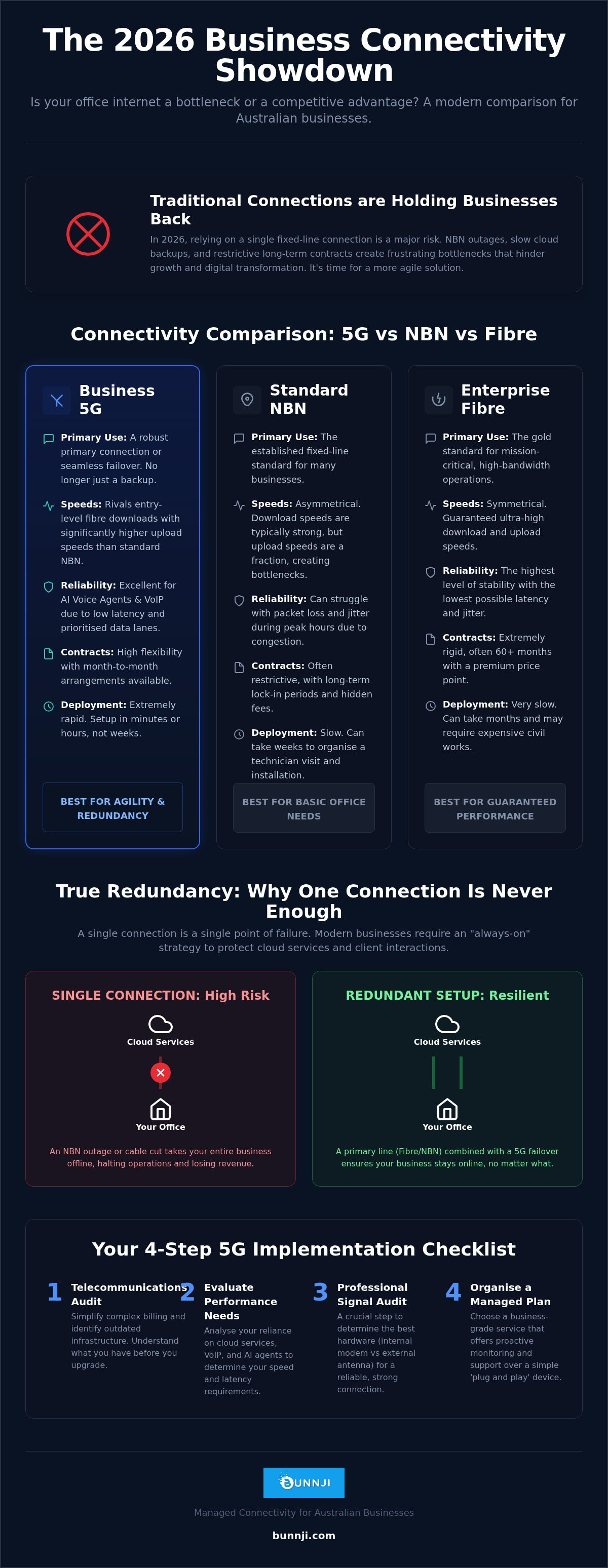
Choosing between connectivity options in 2026 requires looking beyond simple download speeds. While NBN (FTTP) and Enterprise Ethernet remain the stalwarts of fixed-line connectivity, 5g business internet australia has carved out a significant niche for firms that value rapid deployment and high upload capacity. For small to medium Australian firms, the cost-to-performance ratio of 5G is often superior to entry-level fibre, especially when you factor in the lack of expensive civil works or trenching required for new physical lines.
A critical distinction lies in symmetrical versus asymmetrical speeds. Most standard NBN plans are asymmetrical, meaning your upload speed is a fraction of your download. This creates a bottleneck for cloud backups and video calls. Enterprise Ethernet offers symmetrical speeds but at a premium price point. Business-grade 5G sits in the middle, offering significantly higher upload potential than traditional copper-based connections, which is vital for modern data-heavy operations.
Performance for VoIP and AI Voice Agents
If your office relies on unified communications, "hidden" stats like latency and jitter are more important than raw speed. Latency is the delay before data transfer begins, while jitter measures the variation in that delay. High levels of either will cause "robotic" voices or dropped calls. This is especially true for AI voice agents for business, which require ultra-low latency to process speech and respond in real-time without awkward pauses.
While traditional copper NBN often struggles with packet loss during peak hours, 5G infrastructure in 2026 is designed to prioritise voice traffic. Before committing to a plan, it's wise to perform a network test to ensure your packet loss remains below 1%. This small step prevents future headaches with your cloud phone system. You can check your local network compatibility to see which technology suits your current hardware.
Installation and Lead Times
The biggest hurdle for fibre is often the "lead time." A dedicated fibre build can take anywhere from 30 to 90 days depending on your location and the complexity of the site. In contrast, 5G offers "instant-on" capabilities, allowing you to be online the same day your hardware arrives. This makes it an ideal solution for businesses that need to move quickly or those currently navigating the NBN fibre upgrade for business process.
Many firms now opt for a hybrid approach. They deploy 5G immediately to keep the team productive while waiting for a long-term fibre installation. Once the fibre is live, the 5G connection doesn't go to waste; it becomes a seamless failover. This strategy ensures you have the immediate agility of wireless with the long-term bandwidth of glass, providing a balanced, always-on infrastructure.
Reliability and Redundancy: Why One Connection is Never Enough
For a modern Australian business, an internet outage is more than a minor inconvenience. It's a total halt to operations. When your primary link goes dark, your team can't access cloud files, your CRM becomes a static screen, and your phones stop ringing. The true cost of a single hour of downtime often extends far beyond lost wages; it includes missed sales opportunities and a tarnished reputation with clients who expect instant responsiveness. Relying on one physical cable means you're always one stray excavator or network glitch away from total silence.
This is where 5g business internet australia proves its worth as the ultimate redundancy tool. Unlike a second NBN line that likely shares the same street-level infrastructure, a 5G connection provides a completely diverse path. If the physical cables in your street are damaged, the wireless network remains unaffected. Automated failover systems ensure that when your primary fibre or NBN link drops, your network switches to 5G in seconds. Your staff might not even notice the change, and your digital doors stay open.
Implementing True Internet Redundancy
There's a significant difference between a simple "backup" and professional internet redundancy solutions. A backup often requires manual intervention, like plugging in a dongle when things go wrong. Redundancy is a managed, hands-off architecture. By configuring your router for seamless 5G failover, you ensure that your IP addresses and security protocols remain consistent during a switchover. This diverse pathing is the cornerstone of any modern disaster recovery plan, providing peace of mind that a single point of failure won't cripple your office.
Protecting Your VoIP and Cloud Systems
Voice services are particularly sensitive to network stability. Maintaining business VoIP Australia standards during a network event requires a connection that can handle real-time traffic without dropping packets. If your primary link fails, your 5G failover must be fast enough to keep active calls alive. This is vital for firms using AI receptionists or voice agents; these tools need a constant, low-latency stream to function. If the link breaks, the AI loses its "brain," leading to frustrated callers and lost leads.
Managed IT services play a vital role here by monitoring connection health 24/7. Rather than waiting for a staff member to complain about slow speeds, a managed system detects the primary outage and triggers the 5G failover instantly. We've seen this save firms during major national network events, where businesses with redundant wireless paths stayed online while their competitors were forced to send staff home. It's the difference between a resilient organisation and one that's vulnerable to external infrastructure failures.
How to Organise Your 5G Implementation: A 4-Step Checklist
Transitioning to 5g business internet australia is a strategic move that requires more than just unboxing a router. While the "plug and play" marketing of major telcos sounds appealing, it often overlooks the complexities of a commercial office environment. To ensure your connection is stable enough for AI voice agents and cloud-heavy workflows, you need a methodical deployment plan that accounts for local interference and network security. It's about building a foundation that supports growth rather than just finding a quick fix.
Step 1: The Site Audit and Signal Test
Your first priority is identifying how your specific building interacts with the 5G network. High-rise office blocks often use reinforced concrete and low-emissivity glass, both of which can significantly degrade wireless signals. A professional audit involves testing for dead zones and measuring signal strength at different times of the day to account for network load variations. This data determines whether you can rely on internal modems or if you require external high-gain antennas to pull a stable signal from the nearest tower, ensuring your connection doesn't drop during peak business hours.
Step 2: Security and Network Integration
A wireless connection shouldn't be a weak link in your cybersecurity perimeter. Integrating 5G into your existing Local Area Network (LAN) requires a managed firewall that treats the wireless link with the same scrutiny as a fixed-line fibre connection. You'll need to configure your hardware to separate guest Wi-Fi traffic from critical business data, ensuring that your internal systems remain isolated and secure. This setup must comply with Australian cybersecurity standards to protect against the rising threat of sophisticated data breaches and unauthorised access.
Implementing 5g business internet australia correctly means looking at your infrastructure as a whole. To round out your implementation, follow these four critical steps:
- Conduct a Signal Audit: Identify dead zones and building material interference before installing hardware.
- Choose the Right Hardware: Decide between internal gateways for strong signal areas or external antennas for challenging locations.
- Integrate with LAN: Connect your 5G gateway to your existing switches and access points for a unified network experience.
- Apply Cybersecurity Protocols: Implement managed firewalls and VLANs to protect sensitive company information.
Getting these steps right from day one prevents the frustration of dropped calls and slow speeds later. If you're unsure about your building's compatibility or signal strength, you can organise a signal audit for your office to ensure your hardware is positioned for peak performance and long-term reliability.
The Bunnji Difference: Managed Connectivity Over 'Plug and Play'
The biggest mistake many firms make is choosing a provider based on brand name alone. While the largest Australian telcos have the infrastructure, they often lack the responsiveness a growing business needs. When you choose 5g business internet australia through a generic retail plan, you're often left with a "plug and play" solution that offers zero support when your VoIP calls start dropping or your signal fluctuates. You aren't just buying a connection; you're buying the stability of your entire office operation.
We take a different path. Bunnji provides managed connectivity that treats your internet as a critical business tool, not just another utility bill. We combine 5G, NBN, and fibre into a cohesive strategy that supports your AI voice agents and cloud infrastructure. Our no-nonsense approach is about removing the friction that usually comes with technical setups. We focus on transparency, ensuring you understand exactly what you're paying for and why it matters for your bottom line.
Escaping the 60-Month Contract Trap
Many businesses are unknowingly tethered to 60-month telecommunications equipment contracts. These agreements often hide the true cost of hardware and make it impossible to pivot when better technology arrives. We specialise in identifying these "hidden" costs during our comprehensive audits. By moving to SIM-only and flexible business plans, you regain control of your budget and your technology roadmap. We help you audit your current telecommunications spend to find where you're overpaying for legacy services that no longer serve your team.
Your Partner in Australian Business Technology
We aren't just a provider; we're a local partner that understands the specific challenges of the Australian market. From managing your internet redundancy to integrating your cloud phone systems, we offer a unified communications experience. This means you have one point of contact for your 5g business internet australia, your phone systems, and your IT support. You'll never be bounced between international call centres or left waiting for a technician who doesn't show up. Our goal is to provide the peace of mind that comes with a reliable, high-performance network.
Ready to see where your current setup is costing you? You can book a 10-minute telecommunications audit with Bunnji to uncover hidden fees and build a more resilient, AI-ready network today. We'll help you navigate the complexities of modern connectivity so you can focus on running your business.
Secure Your Always-On Digital Future
Connectivity in 2026 is defined by resilience and speed. We've explored how wireless has matured into a robust primary connection and why a dual-path strategy is essential for any office relying on AI voice agents or cloud-based VoIP. By moving away from restrictive 60-month contracts and embracing a managed approach, you gain the flexibility to scale your technology as your business evolves. It's about ensuring your digital doors never close, even when the fixed-line infrastructure faces a glitch.
Bunnji is an Australian-owned and operated partner specialising in internet redundancy and disaster recovery. We provide no-nonsense contracts with full transparency, ensuring you never pay for capacity you don't use. Integrating 5g business internet australia into your broader IT strategy provides the peace of mind that your team will remain productive through any network event. Future-proof your office with Bunnji 5G Business Internet and take the first step toward a more agile, reliable network. Your office deserves a connection that works as hard as you do.
Frequently Asked Questions
Is 5G business internet better than NBN for my office?
5G is often better for offices requiring rapid deployment or a diverse redundant path, whereas NBN suits fixed locations with established internal wiring. While NBN offers consistent speeds, 5G provides the flexibility to move premises or set up temporary sites without waiting for technicians. For many firms, the best solution isn't "one or the other" but a hybrid approach that uses both technologies to ensure the office stays online during a network event.
How fast is 5G business internet in Australia in 2026?
In 2026, 5g business internet australia typically delivers download speeds ranging between 300Mbps and 600Mbps, with peak bursts reaching much higher in well-serviced areas. Upload speeds have also improved significantly, often sitting between 50Mbps and 100Mbps. These speeds are more than sufficient for handling simultaneous 4K video streams, large cloud file transfers, and the real-time data requirements of modern AI-driven business tools that have become standard in Australian offices.
Can I run my entire office phone system on a 5G connection?
You can certainly run a full cloud-based phone system on 5G, provided the connection has low latency and minimal jitter. Business-grade wireless hardware is designed to prioritise voice traffic, ensuring that your VoIP calls remain clear and stable. This is particularly important if you use AI voice agents, as they require a consistent data stream to process speech without delays. A professional signal audit helps confirm your connection is stable enough for high-volume calling.
What is the difference between home 5G and business 5G plans?
Business 5G plans differ from residential versions primarily through data prioritisation and lower contention ratios. While home users share bandwidth with their neighbours, business-grade services use "lanes" that prioritise your traffic during peak work hours. You also receive professional-grade hardware and local expert support, which are rarely included with consumer plans. These features ensure that your critical operations don't slow down just because the local residential network is congested.
Do I need an external antenna for 5G business internet?
Whether you need an external antenna depends entirely on your building's location and construction materials. Modern office blocks often use reinforced concrete or specialised glass that blocks wireless signals. While many gateways work well near a window, an external antenna can significantly boost stability and speed in challenging environments. We recommend a professional signal test to determine if your specific site requires additional hardware to maintain a reliable signal from the nearest tower.
Does 5G business internet come with unlimited data?
Most business-grade 5G plans in 2026 offer unlimited data to support the heavy requirements of modern cloud environments. This allows your team to perform large backups and run data-intensive applications without worrying about overage charges. However, it's always wise to check for "fair use" policies that might apply to extremely high-volume users. Most Australian providers now offer these plans on a month-to-month basis, providing the flexibility required for growing firms.
What happens to my 5G connection during a power outage?
If your office loses power, your 5G gateway will shut down unless it's connected to an Uninterruptible Power Supply (UPS). While mobile towers often have their own backup batteries to stay online during local outages, your internal hardware needs its own power source. Using a UPS ensures your 5g business internet australia stays active, allowing your team to remain connected via laptops and mobile devices until the main power is restored.
How long does it take to set up 5G business internet with Bunnji?
Setting up a managed 5G connection with Bunnji is significantly faster than waiting for a traditional fibre build. Once your hardware arrives, you can typically be online within minutes by following our straightforward activation steps. While a full NBN upgrade might take several weeks to organise, 5G provides an "instant-on" capability. This makes it the ideal choice for firms moving into new premises or those needing an immediate internet redundancy solution.


