

Most Australian business owners don't realise they're one bad storm or a single accidental cable cut away from a total digital blackout. You've likely felt that knot in your stomach when the NBN drops out during a busy trade period, leaving your staff idle and your customers frustrated. Conducting a regular telecommunications audit for business isn't just about finding a few extra dollars in your budget. It's about ensuring your operations are resilient enough to handle the unexpected without missing a beat.
It's understandable if you find your current telco bills impossible to decipher or if you feel trapped by a 60-month equipment contract that no longer serves your needs. You deserve the peace of mind that comes with a solid backup connection and a clear path toward modern, AI-driven cloud systems. This guide provides a straightforward 10-minute audit to help you identify hidden costs, eliminate nasty contract traps, and secure your connectivity. We'll show you exactly how to move away from legacy hardware and organise a communication setup that actually supports your growth and keeps you online no matter what happens.
Key Takeaways
- Identify and cut financial fat by cross-referencing your active mobile SIM plans and VoIP extensions against your actual headcount.
- Learn why a modern telecommunications audit for business prioritises AI-readiness and CRM integration over simple billing corrections.
- Protect your operations by auditing your single point of failure and ensuring your internet redundancy kicks in within seconds, not minutes.
- Uncover the hidden costs and payout figures buried in 60-month equipment contracts that keep your office tied to legacy hardware.
- Modernise your call handling with a roadmap to transition from traditional voicemails to intelligent AI receptionists.
What is a Telecommunications Audit and Why Does Your Business Need One Now?
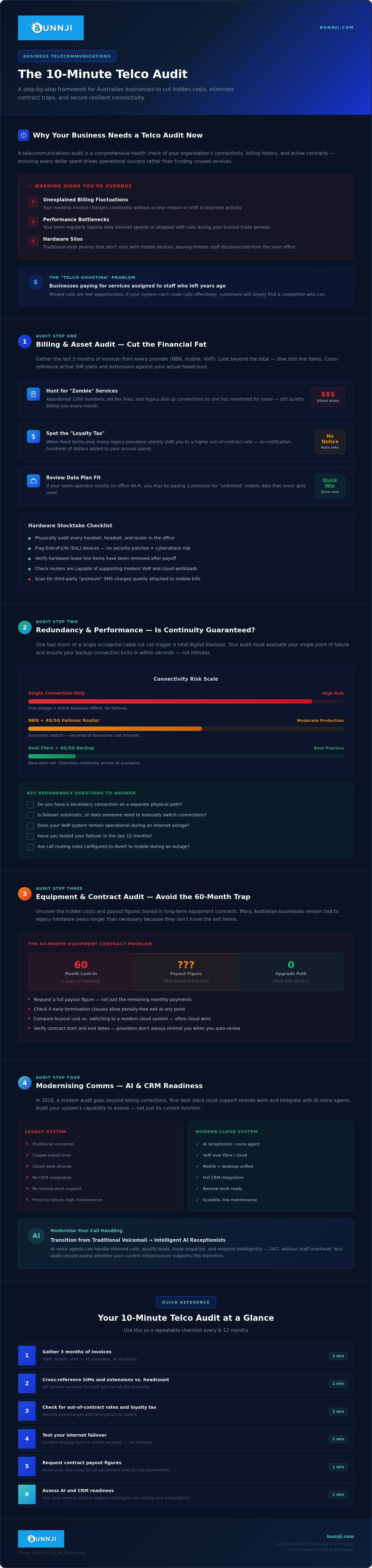
A telecommunications audit for business is a comprehensive health check for your organisation's connectivity and cost-efficiency. It's a systematic review of your firm's entire comms infrastructure, billing history, and active contracts. The goal is simple. You want to ensure that every cent you spend is actually contributing to your operational success rather than vanishing into the pockets of a provider for services you don't even use.
In 2026, the focus of these audits has shifted significantly. It's no longer just about finding a stray decimal point on a bill. Modern business requires a tech stack that seamlessly supports remote work and integrates with AI voice agents. Many Australian companies are currently suffering from a hidden drain on their resources. They're often paying for disconnected services, abandoned mobile lines, or unused SIP trunks that were set up for projects long since completed.
The Real Cost of Doing Nothing
Choosing to ignore your telco setup often leads to what we call telco ghosting. This occurs when businesses continue paying for services assigned to staff members who left the company years ago. It's a silent profit killer. Beyond the direct financial loss, there's a heavy toll on your reputation. Missed calls are lost opportunities. If your current system can't route calls effectively, your customers will simply find a competitor who can. Additionally, maintaining outdated copper-based legacy systems is becoming increasingly expensive. These ageing networks are prone to failure and lack the flexibility required in a modern, fast-paced environment.
Signs Your Business is Overdue for a Review
You don't need to be a technical expert to spot the warning signs. If you notice any of the following, a telecommunications audit for business should be your next priority:
- Unexplained billing fluctuations: Your monthly invoice changes constantly without a clear reason or a shift in your business activity.
- Performance bottlenecks: Your team regularly complains about slow internet speeds or dropped VoIP calls during your busiest trade periods.
- Hardware silos: You're still using traditional desk phones that don't sync with mobile devices; leaving your remote staff disconnected from the main office.
Staying with the status quo isn't just inconvenient. It's a risk to your business continuity. Taking ten minutes to assess where you stand today can prevent a major outage tomorrow.
The Billing and Asset Audit: Cutting the Financial Fat
Start your audit by gathering the last three months of invoices from every provider you use. This includes your NBN, mobile, and VoIP services. Having a multi-month view helps you spot patterns and identify charges that might be irregular. A telecommunications audit for business is most effective when you look beyond the total amount and dive into the line items. You'll often find that your monthly spend is inflated by services that no longer serve a purpose.
Cross-reference your current staff headcount with your active mobile SIM plans and phone extensions. It's common for businesses to continue paying for a mobile plan months after an employee has resigned. Similarly, look for 'zombie' services. These are the 1300 numbers, old fax lines, or legacy dial-up connections that nobody has monitored for years. You should also analyse your data usage. Many providers push 'unlimited' plans as the default, but if your team spends most of their time on office Wi-Fi, you might be paying a premium for data you never touch.
Identifying Billing Errors and Overcharges
Check your invoices for 'out of contract' rates. Once a fixed term ends, many legacy providers shift you to a higher monthly rate without a formal notification. This 'loyalty tax' can add hundreds of dollars to your annual spend. You should also scan for third-party 'premium' charges. These are small, recurring fees for SMS-based content services that can sneak onto business mobile bills. Finally, verify that you aren't being billed for hardware leases that should have concluded. If you've already paid off your handsets, those line items should have vanished from your bill months ago.
The Hardware Stocktake
Perform a physical audit of every handset, headset, and router in your office. Determine which pieces of equipment have reached 'End of Life' (EoL). These devices are a significant risk because they no longer receive security patches or firmware updates, making them an easy target for cyberattacks. You also need to confirm that your current routers are capable of supporting high-speed business NBN or fibre speeds. If your hardware is outdated, you're effectively paying for a high-speed connection that your office network can't actually deliver. If you're struggling to make sense of your current asset list, our experts can help you organise your infrastructure for better performance and lower costs.
Redundancy and Performance: Is Your Business Continuity Guaranteed?
Imagine a local construction crew accidentally severs the fibre line leading to your building. If your response involves staff sitting around waiting for a technician, your business lacks basic resilience. Identifying your single point of failure is a non-negotiable part of a telecommunications audit for business. You need to know exactly what stays online and what goes dark the moment your primary link fails. Testing your failover speed is the only way to be sure; if your backup takes ten minutes of manual fiddling to kick in, you aren't truly protected.
Performance isn't just about total uptime. It's about the quality of that time. We often see businesses with high-speed connections that are bottlenecked by poor Wi-Fi coverage. Dead zones in a warehouse or a boardroom don't just frustrate staff; they lead to dropped data packets and lag. For your cloud phone system, this manifests as high latency or jitter, making your professional voice calls sound robotic or disjointed. A quick audit of your internal network can reveal if your hardware is actually capable of distributing the speed you're paying for.
The Internet Redundancy Checklist
A true backup isn't just a second account with the same provider. It requires physical and logical diversity to be effective. Check your setup against these three pillars:
- Secondary Link: Do you have an active 5G or fixed-wireless backup ready to take the load immediately?
- Path Diversity: Is your backup link delivered via a different physical network? If your primary fibre and your backup line both enter the building through the same conduit, one accident can take out both.
- Automatic Failover: Does your router switch traffic to the backup link automatically? If it requires manual intervention, your business faces significant downtime while someone hunts for a password or a cable.
VoIP and Mobile Synchronisation
Your team shouldn't be tethered to a physical desk to remain productive. A modern business VoIP Australia setup ensures your staff can take and make calls on their mobile devices using the same business number. This unified communications approach is vital for disaster recovery. If your office becomes inaccessible due to a local emergency, your audit should confirm that calls can be instantly rerouted to mobile apps or external numbers. Test your routing logic today to ensure your reputation stays intact during a crisis, ensuring your customers always reach a human regardless of the situation at your physical premises.
The Equipment and Contract Audit: Avoiding the 60-Month Trap
Many Australian businesses find themselves handcuffed to contracts that outlast the technology they're paying for. When you perform a telecommunications audit for business, you must scrutinise the fine print of your hardware lease agreements. The 60-month contract trap is a common industry tactic. It locks you into a five-year commitment for handsets that will be obsolete in three. You need to identify the hidden payout figures that trigger if you try to upgrade or leave early. Often, you'll discover you don't even own the hardware. You're simply renting it indefinitely, paying multiple times the retail value over the life of the agreement.
Watch out for automatic renewal clauses. These are often buried deep in the terms and conditions. They can lock your business into another full year of service if you don't provide notice in a very specific window. It's a predatory practice that rewards inertia. A thorough telecommunications audit for business will flag these dates well before they become a problem, giving you the leverage to negotiate better terms or move to a more flexible provider.
Evaluating Your Current Service Level Agreements (SLAs)
A contract isn't just about what you pay; it's about what the provider guarantees when things go wrong. Audit your current SLAs to see if you have a 99.9% uptime guarantee or just a "best effort" promise. There's a massive difference when your phones go down during a peak sales period. Check the guaranteed response times for critical faults. A 4-hour fix is standard for professional providers, but legacy contracts often allow for two business days. You might also be paying for "Premium Support" that you've never actually called. If you aren't getting value from these add-ons, it's time to cut them and reinvest that budget into better hardware.
The Case for SIM-Only and Month-to-Month
The tech landscape has shifted toward flexibility. Locked-in hardware plans are rarely the most cost-effective choice for modern Australian teams. Switching to SIM-only business mobile plans allows you to upgrade handsets on your own schedule without being tied to a carrier's restrictive timeline. The same logic applies to your office phones. Month-to-month cloud VoIP contracts offer the agility to scale your user count up or down as your business changes. Transitioning away from legacy contracts requires a strategic approach to avoid crippling exit fees. We can help you navigate these complex agreements and find a clearer, more affordable path forward that prioritises your freedom over a vendor's bottom line.
Modernising Your Comms: Auditing for AI and CRM Integration
The final stage of a telecommunications audit for business moves beyond physical infrastructure and into the world of digital intelligence. You need to assess whether your current phone system actually talks to your other essential business tools. If your team is still manually logging call notes into Salesforce or HubSpot, you're wasting valuable hours every week. A modern system should automatically sync call data, providing a single source of truth for every customer interaction. This integration ensures that when a client calls, your staff has their full history right in front of them, allowing for a more personalised and efficient service.
Audit your call handling data to see exactly how many opportunities you're losing. If a significant percentage of calls go to voicemail or are missed entirely during peak trade, your bottom line is taking a hit. This is where AI voice agents for business become a game-changer. These agents can handle routine bookings and basic enquiries 24/7, ensuring you never miss a lead because your front desk was too busy. You also need to review your cybersecurity protocols. With the rise of 'vishing' and sophisticated AI voice scams, your phone system needs robust protection to verify identities and prevent social engineering attacks.
The AI Readiness Audit
Not all VoIP systems are created equal when it comes to future-proofing. Check if your provider offers open API access; without it, you'll struggle to implement modern AI integrations. An AI receptionist can dramatically reduce the workload on your front-desk staff by filtering out spam and handling low-level tasks. These intelligent systems sync phone calls directly to your digital calendar, allowing clients to book appointments without human intervention. If your current provider can't support these basic connections, you're already falling behind the curve.
Next Steps: Turning Your Audit into Action
Once you've completed these checks, prioritise the quick wins. Cancel those unused lines and ghost services immediately to see an instant reduction in your monthly spend. From there, develop a 12-month roadmap to transition any remaining legacy hardware to cloud-native solutions. Technology moves fast, so don't let this be a one-off event. Schedule your next telecommunications audit for business to occur at least once every 12 months. This consistent review ensures your organisation remains lean, secure, and ready to leverage the latest communication innovations as they emerge.
Secure Your Business Future and Stop the Spend
Running a lean, resilient operation starts with knowing exactly where your money goes. A regular telecommunications audit for business ensures you aren't paying a "loyalty tax" for fragile, outdated technology. You now have the roadmap to identify hidden billing errors, escape restrictive 60-month contracts, and build a redundant network that stays online when others fail. Modernising with AI-driven cloud systems isn't just a tech upgrade; it's a commitment to your customers and your team's productivity.
We are specialists in reducing hidden telco costs and provide expert guidance through our Australian-based support team. As advanced AI and Cloud VoIP integration experts, we simplify the transition from legacy hardware to a high-performance, future-proof setup. Don't wait for the next major outage to find the gaps in your system. Book your expert telecommunications audit with Bunnji today and gain the confidence that your business is truly ready for anything. You have the plan; let's get started.
Frequently Asked Questions
How long does a typical telecommunications audit take for a small business?
A preliminary telecommunications audit for business can be completed in as little as 10 minutes if you have your digital invoices handy. This initial health check focuses on spotting obvious billing errors and unused services. For a deeper dive into infrastructure redundancy and contract fine print, a professional review typically takes two to three business days. This ensures every mobile SIM, NBN link, and VoIP extension is accounted for and optimised for your current headcount.
What documents do I need to prepare for a telco audit?
You should gather your last three months of invoices from all providers, including your NBN, business mobile, and VoIP services. It's also vital to have copies of any active hardware lease agreements or service contracts. Having an up to date staff list is helpful so you can cross-reference active extensions with your actual team members. This preparation allows you to spot zombie services and unused lines that are silently draining your monthly budget.
Can I perform a telecommunications audit myself or do I need a consultant?
You can certainly perform the initial steps of a telecommunications audit for business yourself by following a structured checklist. This helps you identify low hanging fruit like unused mobile plans or legacy fax lines. However, engaging a specialist is often beneficial for navigating complex 60-month equipment contracts and identifying technical vulnerabilities in your redundancy setup. A professional can also provide a roadmap for integrating modern AI voice agents and CRM tools that you might otherwise overlook.
How much can a business realistically save after a telco audit?
Real-world savings depend on how long it's been since your last review, but many Australian firms find they are paying for services they no longer use. Beyond direct cost cutting, an audit provides value by preventing the massive financial hit of a total internet outage. By identifying out of contract rates and moving to SIM-only plans, you can often reinvest those savings into better hardware or more resilient fibre connections that support long-term growth.
What is the most common billing error found during an audit?
The most frequent error is paying for ghost services, which are lines or data plans for employees who have long since left the company. Another common issue is the loyalty tax, where a provider moves you to a significantly higher monthly rate once your initial contract term expires. Audits also frequently uncover third-party premium SMS charges and billing for hardware leases that should have concluded months or even years ago.
Is my old PBX system still worth auditing or should I just replace it?
Auditing an old PBX system is essential to understand exactly how much it's costing you in maintenance and missed opportunities. While you might keep it running, legacy hardware often lacks the security patches and CRM integration capabilities required in 2026. An audit usually reveals that the cost of maintaining ageing copper lines is higher than transitioning to a modern cloud VoIP system. This review helps you decide when to switch for better performance and security.
What happens if I find I am locked into a 60-month contract?
If you discover you're trapped in a 60-month contract, your first step is to calculate the specific payout figure. Don't assume you're stuck; sometimes the monthly savings from a modern provider are large enough to offset the exit fee over the remaining term. We specialise in helping businesses navigate these complex agreements. We can often find a path toward more flexible, month-to-month arrangements that give you back control over your office technology and mobile fleet.
How does an audit help with cybersecurity and preventing phone scams?
An audit identifies End of Life hardware that no longer receives security updates, which is a primary entry point for hackers. It also involves reviewing your call handling protocols to ensure your team is protected against vishing and sophisticated AI voice scams. By assessing your system's ability to verify caller identities and implement secure routing, an audit builds a stronger perimeter. This proactive approach ensures your communication channels aren't the weakest link in your business's cybersecurity strategy.


