

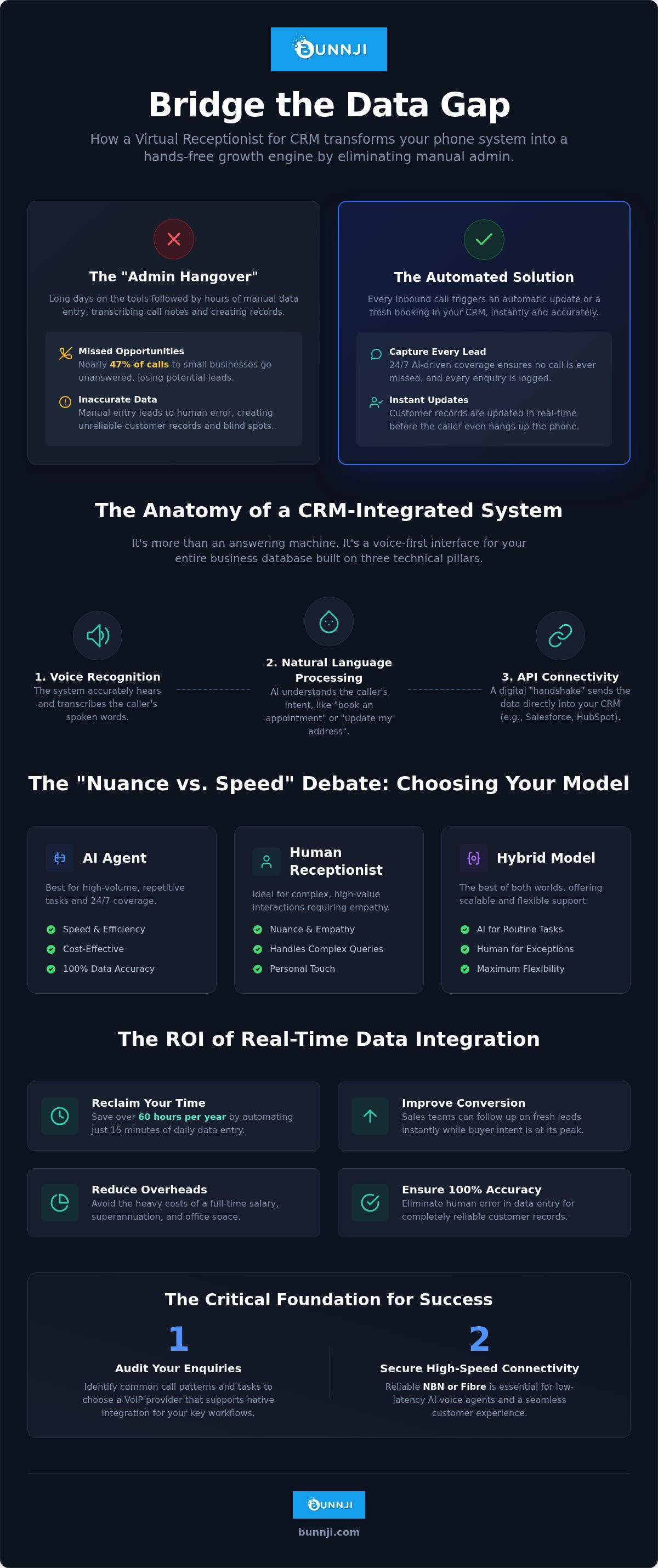
Imagine finishing a long day on the tools only to spend your evening squinting at a laptop, manually typing call notes into your database. It's a common headache for Australian business owners who feel they're constantly double-handling information just to keep their records straight. Research shows nearly 47% of calls to small businesses go unanswered, which means you're likely losing leads while you're busy working. When you integrate a virtual receptionist for CRM, that manual admin and those missed opportunities simply disappear. Instead of playing catch-up, every inbound call triggers an automatic update or a fresh booking in your system.
We know that hiring a full-time staff member is a massive overhead that many boutique firms can't justify. You need a way to stay responsive without the heavy price tag. This guide will show you how to bridge the gap between your phone lines and your customer data to eliminate manual admin for good. You'll learn how 24/7 AI-driven coverage and seamless calendar syncs can transform your workflow. We'll explore the latest 2026 integration trends and the specific steps to turn your phone system into a hands-free growth engine.
Key Takeaways
- Stop wasting hours on manual data entry by bridging the gap between your phone lines and your business database.
- Learn how a virtual receptionist for CRM uses advanced API connectivity to automate bookings and update customer records instantly.
- Evaluate the "Nuance vs. Speed" debate to decide if an AI agent, human receptionist, or hybrid model is the best fit for your 2026 operations.
- Discover the two-step audit process for identifying enquiry patterns and choosing a VoIP provider that supports native integration.
- Recognise why reliable high-speed connectivity like NBN or Fibre is the critical foundation for any high-performing AI voice agent.
The Data Gap: Why Your CRM Needs a Virtual Receptionist in 2026
For many Australian business owners, the workday doesn't actually end when the phone stops ringing. It's the "Admin Hangover" that gets you. This is that sluggish, unpaid hour spent at the kitchen table manually transcribing scribbled call notes into your database. In 2026, simply taking a message is no longer a viable strategy for a growing firm. Disconnected phone systems create massive blind spots in your customer journey, where leads are forgotten and follow-ups are missed. By implementing a virtual receptionist for CRM, you eliminate this friction entirely. The gap between a verbal conversation and a digital record is bridged instantly, ensuring your data is always live and accurate.
The local market has reached a tipping point where customer expectations for speed have never been higher. If a caller has to repeat their history every time they dial in, they'll likely look elsewhere. A siloed phone system means your team is flying blind, lacking the context needed to provide a personal touch. Moving to an integrated model ensures that every interaction is logged, every contact is updated, and no opportunity falls through the cracks of a busy afternoon.
Moving Beyond Simple Answering Services
Traditional services often rely on a virtual assistant or a basic call centre to relay messages via email. While this keeps the phone lines open, it doesn't solve the core data problem. During high-volume periods, even the best live agents struggle to log into a client's CRM and update records in real-time. This leads to a reactive workflow where you're always one step behind. An AI-driven agent, however, executes tasks with precision. It doesn't just "answer"; it triggers workflows, verifies existing customer details, and logs the interaction before the caller even hangs up. This shift from reactive answering to proactive execution is what separates elite Australian firms from the rest.
The ROI of Real-Time Data Integration
Calculating the ROI of a virtual receptionist for CRM starts with reclaimed time. If your team spends even 15 minutes a day on manual data entry, that adds up to over 60 hours a year lost to low-value tasks. Automating lead intake and appointment scheduling allows your staff to focus on high-value work that actually moves the needle. Consider the following benefits of real-time logging:
- Improved Conversion: Sales teams can follow up on fresh leads immediately while the intent is at its peak.
- Reduced Overheads: You avoid the heavy costs of a full-time salary, superannuation, and office space by using a scalable AI subscription.
- Accuracy: Human error in data entry is eliminated, ensuring your customer records are 100% reliable.
By choosing a solution that connects your voice lines directly to your database, you aren't just buying a phone service. You're investing in a scalable system that grows with your business without increasing your administrative burden.
The Anatomy of a CRM-Integrated Virtual Receptionist
A virtual receptionist for CRM isn't just a digital answering machine. It's a voice-first interface for your entire business database. To function effectively, the system relies on three technical pillars: Voice Recognition to hear the caller, Natural Language Processing (NLP) to understand their intent, and API Connectivity to talk to your software. Without these, you're just recording audio. With them, you're automating your office. The system acts as a bridge, ensuring that every word spoken on the phone has a direct impact on your digital records.
High-performance connectivity is the silent partner in this setup. For a conversation to feel natural, latency must be extremely low. This is why many Australian firms look beyond basic virtual assistant services and move toward AI agents that run on high-speed NBN or Fibre backbones. If the connection lags, the AI's response time suffers, and the illusion of a seamless, human-like interaction breaks. Reliability here isn't just about staying online; it's about the quality of the customer experience.
How the Voice-to-CRM Sync Works
The magic happens through Application Programming Interfaces, or APIs. These are the digital handshakes that allow your phone system to 'talk' to platforms like HubSpot, Salesforce, or Pipedrive. When a call comes in, the system identifies the number and instantly pulls up the contact's history. It knows who is calling before the first greeting is even finished.
Data mapping ensures that specific details, like a change of address or a new project enquiry, are filed in the correct fields automatically. Once the call ends, the system doesn't just stop. It can trigger immediate actions, such as sending a follow-up SMS or a 'thank you' email. This ensures the lead stays warm while your team is busy elsewhere. If you want to see how this fits your current setup, you can explore AI voice agent options that simplify these complex workflows.
Calendar Integration and Appointment Setting
The most powerful feature of a modern virtual receptionist for CRM is its ability to manage your diary. Through a two-way sync, the AI 'reads' your live availability. It won't suggest a 2:00 PM slot if you're already in a site meeting or a client consultation. It sees the gaps in your day as they happen.
You can customise the logic to suit your working style. This includes setting buffer times so you aren't rushing from one call to the next, or defining specific booking rules for different service types. The result is a seamless journey from the initial dial-tone to a confirmed calendar invite. Every booking just shows up in your diary, fully detailed and ready for you to take action without any manual intervention.
Choosing the Right Model: Human, AI, or Hybrid?
Selecting the right interface for your customers is a strategic choice. In 2026, the debate isn't just about cost; it's about the customer journey. If your firm handles a high volume of routine enquiries, a virtual receptionist for CRM becomes a no-brainer. It processes data at a speed no human can match. However, for complex disputes or high-value negotiations, the human touch still holds significant weight. The goal is to match the technology to the intent of the caller.
Data security is a non-negotiable factor in this decision. Any system you deploy must align with the Australian Privacy Act. This means ensuring that call recordings and customer data are stored and managed with high-level encryption, especially when syncing directly to your cloud-based CRM. Reliability and compliance go hand-in-hand when you're handling sensitive business information.
The Human Element: When Reassurance is Key
Some calls require a level of reassurance that only a person can provide. High-stakes industries often favour a live Australian voice for sensitive consultations where empathy is the priority. The challenge here is human error; manual entry into a database is prone to mistakes and delays. To get the best of both worlds, you can set up "warm transfers". This allows your AI agent to handle the initial vetting and data collection before passing the caller directly to your mobile. The agent provides you with a brief summary of the caller's intent, which is already logged in your system before you even say hello.
The AI Advantage: Scale and Consistency
The most significant benefit of an AI-driven virtual receptionist for CRM is its ability to handle simultaneous calls. Your customers will never hear a busy signal again, even during your busiest promotion or peak season. This consistency extends to your brand voice. Every caller receives the same professional greeting and accurate information, regardless of how many people are dialling in at once. Because the system operates 24/7, you're capturing leads and booking appointments while the rest of Australia is asleep. It's a scalable solution that ensures your business stays open, even when the office lights are off.
A hybrid model often provides the most robust solution for modern Australian firms. You use AI for the heavy lifting, such as intake, basic FAQs, and calendar scheduling, while keeping your human team available for deep, complex work. This ensures speed for the customer and peace of mind for you, knowing that every interaction is recorded accurately in your database without you lifting a finger.
How-To: Setting Up Your Virtual Receptionist for CRM
Setting up a virtual receptionist for CRM requires a methodical approach to ensure the technology serves your business goals. You can't just "plug and play" if you want a premium result. Start by auditing your current call flow. Review your last month of call logs to identify common enquiry patterns. Do most callers want to book a service, or are they checking on an existing order? Once you understand these patterns, you can select a VoIP provider that offers native CRM integration. This ensures the connection is stable and the data transfer is instantaneous.
Mapping your data fields is the next critical step. You must decide which pieces of information from the call, such as contact name, phone number, and intent, should land in specific fields in your CRM. This prevents data clutter and keeps your lead lists clean. After mapping, you'll need to script the AI. This is where you infuse your brand's unique personality into the greetings and responses. Finally, conduct "live-fire" drills. Call the system yourself using different scenarios to ensure the logic holds up before you go live to the public. To get started with a system built for the Australian market, book a telecommunications audit with our team today.
Mapping the Customer Journey
Your goal is to define the "Happy Path". This is the ideal, friction-free flow from the initial greeting to a confirmed booking or logged lead. However, the real world is messy. You must also prepare for edge cases. If a caller asks a question the AI doesn't have the answer to, the system needs a clear instruction. It shouldn't just hit a dead end. Instead, it should offer a polite alternative or trigger an escalation. Setting up this "Safety Net" ensures that complex enquiries are passed to a human staff member via a warm transfer or an urgent notification, maintaining a high standard of service.
Technical Configuration and API Keys
You don't need to be a developer to handle the technical side. Most modern CRMs allow you to generate API keys through their settings or integrations menu. Think of an API key as a secure digital password that lets your phone system talk to your database. Once connected, you can set up Webhooks. These are real-time triggers that send alerts to your team via Slack or email the moment a call concludes. Before you finish, verify the sync. Create a test lead named "John Citizen" and walk through a booking. If John appears in your CRM lead list with all the correct details, you're ready to scale.
Beyond the Dial Tone: Why Bunnji is Australia’s Choice for AI Voice
Bunnji isn't just another software vendor. We're an Australian-owned firm that understands the local telecommunications landscape from the ground up. Integrating a virtual receptionist for CRM is a significant step toward efficiency, but the software is only half the battle. You need a partner who can manage the entire technical stack, from the AI agent's voice to the fibre optic cable in the ground. By choosing a provider that specialises in both high-speed connectivity and intelligent automation, you ensure your business doesn't just answer calls; it converts them into measurable growth.
Local expertise matters when you're moving away from legacy infrastructure. We provide Australian-based support and expert telecommunications audits to ensure your transition is seamless. We don't hide behind bureaucratic layers or cold corporate scripts. Instead, we act as a capable partner, applying years of experience to simplify your technical environment. This grounded approach allows you to focus on your core operations while we handle the complexity of your voice and data systems.
The Importance of a Robust Network
Your AI agent is only as good as your internet connection. If your NBN drops out, your virtual front desk goes dark, leaving customers in the lurch. This is why we focus on internet redundancy as a core part of our service. We provide the high-performance NBN and Fibre backbones required for crystal-clear, low-latency voice interactions. When your connectivity is stable, your AI sounds natural and responsive. For a deeper look at how to structure your office tech for the future, see our Business VoIP Australia: The Complete 2026 Strategy Guide.
Ready to Modernise Your Intake?
Transitioning from a legacy phone system to an AI-powered powerhouse is the ultimate way to future-proof your firm. We offer bespoke, Aussie-voiced agents that reflect your brand's unique personality. This local touch ensures your callers feel heard and valued from the moment they dial in, rather than feeling like they've reached an offshore call centre. To see what's possible for your business this year, check out our AI Voice Agents: 2026 Trend Report for Australian Firms.
Moving toward a truly unified communication platform means having one business number across every device, integrated with a virtual receptionist for CRM that never sleeps. It's about removing friction for your customers and eliminating the "Admin Hangover" for your staff. We're here to help you bridge the gap between your phone lines and your data, giving you the peace of mind to grow your business with confidence.
Step Into the Future of Automated Client Intake
In 2026, staying competitive means removing every bit of friction from your workflow. We've explored how bridging the gap between your phone lines and your database eliminates the "Admin Hangover" and ensures no lead is ever left behind. By choosing a virtual receptionist for CRM, you aren't just answering calls; you're building a scalable engine for growth that operates 24/7. It's about moving from reactive message-taking to proactive workflow execution.
The key to success lies in the foundation. A sophisticated AI agent requires the stability of redundant NBN and Fibre connectivity to deliver a natural, low-latency experience. With expert Australian-based support and seamless integration with over 200 CRMs, Bunnji provides the local expertise needed to modernise your operations without the corporate complexity. It's time to stop double-handling data and start focusing on the high-value work that truly moves your business forward.
Automate your front desk with Bunnji AI Agents today and experience the peace of mind that comes with a truly unified communication platform. We're ready to help you build a more responsive, efficient, and profitable firm.
Frequently Asked Questions
Can an AI virtual receptionist really understand an Australian accent?
Yes, modern AI voice agents are specifically trained to handle the nuances of the Australian accent. Using Natural Language Processing (NLP), these systems accurately interpret local slang, varying pronunciations, and unique speech patterns. This ensures that whether a caller has a broad or cultivated accent, the system captures their intent correctly. It is a far cry from the robotic voices of the past; today's agents offer a natural, fluid conversation experience for every caller.
How much does it cost to integrate a virtual receptionist with my CRM?
Integration costs depend on the complexity of your specific workflow and the volume of calls you expect to process. While some software might charge per-user fees, a bespoke virtual receptionist for CRM setup is typically structured as a scalable subscription. This model allows you to avoid the heavy overheads associated with a full-time salary. You should also account for potential API access fees required by some specific CRM software providers.
Will I lose my existing business phone number if I switch to an AI agent?
You won't lose your existing business number when you transition to an AI-powered system. Most modern VoIP providers allow you to port your current 1300, 1800, or local landline number seamlessly. This means your branding remains consistent and your customers don't have to update their contact lists. The AI agent simply becomes the new front door for your existing lines, managing calls efficiently across all your connected devices.
Does the virtual receptionist work after hours and on public holidays?
Yes, the system provides full 24/7 coverage, including public holidays and weekends. Unlike human staff, an AI agent never needs a break or a holiday, ensuring your business is always responsive to new enquiries. This allows you to capture leads and book appointments while your competitors are closed. Every call received after hours is logged directly into your database, so your team can hit the ground running the next morning.
Is my customer data safe when using a cloud-based virtual receptionist?
Protecting your customer data is a top priority that aligns with the Australian Privacy Act. Reliable providers use high-level encryption for both data at rest and in transit between your phone system and your CRM. This ensures that sensitive information, such as contact details and call notes, remains secure at all times. Choosing a local partner with a focus on cybersecurity provides an extra layer of peace of mind for your firm.
Can the AI receptionist handle complex enquiries or just simple bookings?
While AI excels at routine tasks like bookings and FAQs, it is designed to recognise when a query needs a human touch. You can customise the logic to ensure complex disputes or high-value enquiries are escalated immediately. By using a virtual receptionist for CRM, you automate the majority of routine interactions. This frees up your human team to focus on the deep, complex work that requires empathy and professional judgment.
What happens if my internet goes down while the AI is answering a call?
Reliability depends on your network redundancy. If your primary NBN or Fibre connection fails, a professionally configured system should automatically switch to a secondary link, such as 4G or 5G backup. This ensures the AI agent stays online and continues to manage your calls without interruption. Investing in a robust network backbone is the best way to guarantee your virtual front desk never goes dark during critical business hours.
Do I need to be a tech expert to set up the CRM integration?
You don't need to be a technical expert to get started with these systems. Most integrations are managed through simple API keys and user-friendly dashboards provided by your VoIP partner. A capable provider will handle the heavy lifting, from mapping your data fields to training the AI on your brand voice. This allows you to reap the benefits of sophisticated technology without having to navigate the underlying technical infrastructure yourself.


