

That 60-month telecommunications contract sitting in your filing cabinet isn't just a commitment; it's likely a financial anchor holding your business back from the agility it needs in 2026. Most Australian business owners feel the same sense of dread when the monthly telco invoice arrives. It's often a mess of indecipherable line items, which is why modern telecom expense management australia strategies are now focused on identifying "ghost" services and former employees' mobile plans that should have been cancelled years ago.
You don't have to accept these predatory terms as the cost of doing business. You can strip away the complexity, escape restrictive bundles, and significantly reduce your monthly spend without losing service quality. This guide explores how to audit your current infrastructure, leverage the latest ACMA enforceable standards, and swap bloated contracts for lean, flexible cloud systems and SIM-only plans that put you back in the driver's seat.
Key Takeaways
- Understand why modern telecom expense management australia must encompass your entire communications stack, from mobile fleets to cloud-based VoIP systems.
- Uncover the mathematical reality of 60-month contracts and learn why "free" hardware bundles often end up costing three times the retail value.
- Follow a straightforward five-step audit to identify "ghost" services and ensure you aren't paying for mobile plans assigned to former employees.
- Gain insights into how AI voice agents and SIM-only business plans provide a flexible, high-performance alternative to traditional, high-cost telco models.
What is Telecom Expense Management (TEM) for Australian Businesses?
Managing a modern business means juggling a constant stream of digital connections. At its core, Telecom Expense Management (TEM) is the strategic discipline of overseeing a firm's entire communications spend to ensure every dollar provides actual value. For many organisations, telecom expense management australia has evolved from a simple monthly bill-check into a sophisticated process of cost recovery and vendor accountability. It covers everything from your mobile fleet and fixed-line internet to VoIP systems and cloud collaboration tools. The goal isn't just to pay the bills on time; it's to gain the visibility required to eliminate waste and hold providers to their promises.
Australian businesses face a unique landscape compared to global counterparts. With the complexities of NBN tier pricing and the rapid rollout of 5G business plans, costs can spiral if they aren't monitored with precision. Without a clear strategy, you're likely overpaying for capacity you don't use or bandwidth that doesn't meet your operational needs. Effective TEM creates a bridge between your finance department and your IT infrastructure, ensuring that technical needs never outpace your budget.
Why TEM is Critical in 2026
The shift to data-heavy cloud applications and permanent remote work setups has fundamentally changed how we consume bandwidth. We've moved away from traditional copper lines to complex business NBN and fibre tiers where pricing structures often feel like a moving target. TEM is the process of aligning telco utility with actual business usage. With the ACMA implementing new enforceable industry standards in early 2026, businesses now have more leverage to demand transparency. However, staying on top of these changes requires more than a casual glance at a PDF invoice; it requires methodical usage analytics to ensure you aren't being overcharged for services that no longer fit your workflow.
The Hidden Drain on Australian SME Profits
Profit margins are often eroded by "ghost" services that continue to bill long after they've lost their utility. Common areas of waste include unassigned mobile SIMs still linked to former employees and redundant internet lines left active after an office move. Many companies also pay a "loyalty tax" simply because they haven't audited their plans in over 24 months. Some industry professionals report that these overlooked costs can account for a significant portion of a typical monthly bill. Identifying these redundant services is the first step toward significant cost recovery. By stripping away these unnecessary line items, you can redirect those funds back into growth-focused areas of your business.
Escaping the Trap: The Hidden Costs of 60-Month Telco Contracts
Many Australian businesses find themselves tethered to legacy infrastructure because of a signature they made years ago. The industry tactic of bundling "free" hardware into a 60-month contract is a classic trap that prioritises vendor lock-in over your operational freedom. While it looks like an interest-free way to upgrade your office, the reality is far more expensive. As noted by the Enterprise Technology Management Association (ETMA), managing these complex vendor relationships is a core pillar of modern expense control. Without proactive telecom expense management australia, these agreements become a silent drain on your capital.
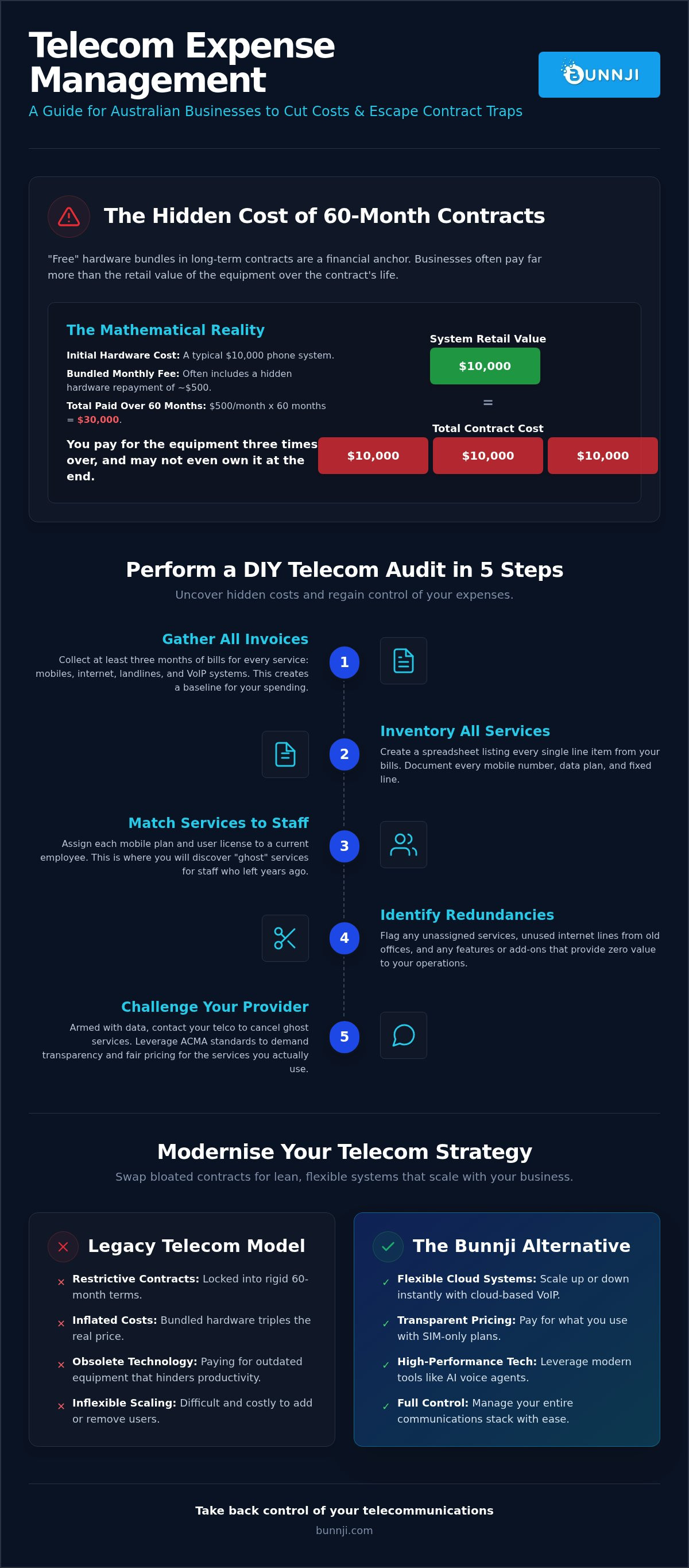
The maths behind these deals is often staggering. If you finance a $10,000 phone system over 60 months with a monthly service fee, you might find yourself paying $500 a month for the hardware component alone. By the time the contract ends, that $10,000 system has cost you $30,000. You have effectively paid for the equipment three times over, yet many contracts don't even grant you ownership at the end of the term. You're left with a choice: pay a large "balloon" fee to keep obsolete gear or sign another five-year deal for a new set of plastic handsets.
The Problem with Long-Term Equipment Financing
Technology moves faster than these contracts. A handset or router that was "cutting edge" in 2021 is often a paperweight by 2026. You're left paying for obsolete gear while your competitors use flexible, cloud-based tools. Scaling is another headache. If you downsize your team, those 60-month commitments don't budge. You're stuck paying for empty desks and unassigned lines. Watch out for "evergreen" clauses too. These terms can automatically renew your contract for another year if you miss a tiny 30-day cancellation window. It is a cycle designed to keep you paying for the past.
Strategies for Contract Payouts and Porting
Leaving a bad deal requires a calculated break-even analysis. Sometimes, paying a $5,000 exit fee is actually cheaper than staying in a contract that costs $1,000 a month for another two years. Moving to business voip australia allows you to break the hardware dependency entirely. Instead of leasing proprietary desk phones, you use software that runs on existing devices. The most critical asset in these negotiations is your phone numbers. Ensure you have the legal right to port your numbers away from the provider. If they hold your numbers hostage, they hold your business hostage. A quick 10-minute telecommunications audit can reveal exactly how much these legacy agreements are costing you and provide a clear path to ownership and agility.
The Three Pillars of a Modern TEM Strategy
Moving from reactive bill-paying to proactive control requires a structured framework. A robust telecom expense management australia strategy rests on three critical pillars that transform your communications stack from an unpredictable overhead into a manageable, transparent utility. By focusing on inventory, auditing, and procurement, you can stop the cycle of overpayment and reclaim your budget for more productive business initiatives.
Pillar 1: Centralised Inventory and Asset Tracking
You cannot manage what you cannot see. Every organisation needs a "Single Source of Truth" for its mobile and fixed assets. This means maintaining a live database that tracks every active SIM card, handset, and NBN circuit in your fleet. Distinguishing between SIM-only plans and hardware-inclusive plans is vital for clear financial reporting. When staff work remotely, this inventory becomes your frontline defence against "ghost" services. It ensures you aren't paying for data plans assigned to former employees or devices sitting forgotten in a desk drawer.
Pillar 2: Automated Billing Audits and Disputes
Billing errors with major Australian carriers are frequent and often subtle. These are rarely massive discrepancies that trigger obvious alarms. Instead, they appear as small, recurring line items for features you never requested or agreed to. A modern strategy uses automated audits to cross-reference invoices against your inventory and agreed contract rates. When you spot an error, you must lodge a formal dispute to recover those funds. Transitioning to business mobile sim only plans can significantly simplify this process. These plans remove the complex hardware subsidies that make traditional bills so hard to decipher, leading to cleaner billing cycles and faster reconciliation.
Pillar 3: Strategic Sourcing and Plan Optimisation
Many businesses fall into the "unlimited" data trap, paying a premium for capacity they never actually use. Strategic sourcing involves moving away from "off-the-shelf" retail plans and opting for bespoke connectivity that matches your specific operational needs. This requires a vendor-neutral approach when selecting NBN or Fibre providers. By right-sizing your data pools based on actual usage analytics, you can achieve significant savings without compromising performance. Leveraging multi-carrier strategies also provides essential internet redundancy. If one network fails, your business stays online, ensuring that cost control never comes at the expense of reliability.
How to Perform a DIY Telecom Audit in 5 Steps
You don't need expensive software to start reclaiming your budget. A manual audit can uncover the low-hanging fruit that carriers often hope you'll ignore. Effective telecom expense management australia starts with a clear-eyed look at your current commitments. Follow these five steps to strip back the waste.
- Step 1: Gather your data. Pull the last three months of consolidated invoices. A 90-day window is essential to distinguish between a one-off spike and a recurring pattern of overspending.
- Step 2: The payroll cross-check. Match every active SIM card against your current employee list. If a staff member left six months ago but their line is still active, you're essentially donating money to your carrier.
- Step 3: Scrutinise equipment fees. Look for line items labelled "equipment rental" or "maintenance." If you've already paid off your hardware, these charges should be zero, yet they often linger on bills.
- Step 4: Locate redundant connections. Check for NBN or fixed-line services in satellite offices or storerooms that are no longer in use. Hybrid work models have left many offices with "ghost" connections that serve no one.
- Step 5: Benchmark your rates. Compare what you're paying per gigabyte or per user against current market-leading SIM-only and VoIP plans. If you haven't switched in two years, you're likely paying a significant premium.
Red Flags to Watch For on Your Invoice
Carriers often hide margin in vague descriptors. Be wary of "Service Fees" or "Admin Charges" that aren't tied to a specific, measurable utility. We frequently see international roaming charges on accounts that haven't left the country, or massive data overage fees that could be eliminated by a simple plan upgrade. These small leaks can sink a business budget over time, especially if they are replicated across a large fleet of devices.
The "10-Minute Audit" Framework
Flag any service or mobile line that shows zero usage over a 90-day period.
To stay ahead of your providers, maintain a simple spreadsheet tracking the end dates of every contract. This prevents "evergreen" renewals from locking you into another cycle without your consent. While a DIY approach works for smaller fleets, you should call a professional auditor if your bill exceeds 50 pages or if you suspect deep-rooted contractual errors. If you're ready for a faster result, start your 10-minute telecommunications audit today to see exactly where you can save.
Modernising Your Telecom Strategy with Bunnji
A DIY audit is an excellent starting point, but professional telecom expense management australia requires a partner that understands the granular details of the local market. Bunnji simplifies this entire process by moving your business away from rigid, opaque agreements toward transparent, no-lock-in communication solutions. We act as the bridge between your operational needs and technical infrastructure. This ensures that your transition from legacy copper to high-speed business fibre is handled without the typical telco headache. By integrating managed IT services with our telco audits, we provide a holistic view of your technology spend. Your internet, mobile fleet, and security protocols should work in harmony rather than as siloed, expensive departments.
Bunnji’s Approach to Cost Recovery
We specialise in the heavy lifting of contract negotiations. Our process involves a deep dive into your existing equipment contracts to find viable exit strategies from those 60-month traps we discussed earlier. Beyond just cutting costs, we look for ways to innovate. Replacing expensive, legacy reception services with ai voice agents for business allows your firm to handle calls with precision while significantly reducing overheads. We pair this with customised SIM-only fleet management. This allows you to scale your mobile requirements up or down instantly, ensuring you never pay for a "ghost" service again.
Future-Proofing Your Business for 2030
The next few years will see a total shift toward unified communications. The era of being tethered to a physical desk phone is ending. We help you move toward a "one number, every device" model that allows your team to stay connected from anywhere in Australia. Redundancy is another critical focus. Many providers try to sell expensive backup lines that double your monthly spend. We design smarter failover strategies that keep you online during an NBN outage without blowing the budget. The goal is a lean, agile, and resilient communications stack that serves your business, not the other way around.
Ready to see how much you could be saving? Book your free 10-minute telecommunications audit with Bunnji today and take the first step toward reclaiming your telco budget.
Take Control of Your Business Communications Spend
Reclaiming your budget from bloated telco providers is about more than just checking an invoice. It's about shifting your entire approach to telecom expense management australia. By identifying "ghost" services and understanding the true cost of hardware-heavy contracts, you can finally align your utility spend with actual business usage. Moving toward flexible SIM-only plans and AI-driven receptionists isn't just a cost-cutting exercise; it's a strategic move to future-proof your organisation and reclaim your operational agility.
As an Australian-owned and operated provider, we specialise in helping firms navigate the complex world of contract payouts and ownership audits. We bring the resources of a global player with the personal touch of a boutique partner. Don't let another month of indecipherable bills drain your profits. Book Your Free 10-Minute Telecommunications Audit with our AI-driven cost reduction experts today. You'll gain the peace of mind that comes with transparent billing and a simplified, modern vendor strategy. We are here to help you organise your communications so you can focus on growing your business.
Frequently Asked Questions
What is the average saving from telecom expense management in Australia?
Savings vary based on the complexity of your stack. Many Australian firms find that identifying redundant lines and misaligned plans leads to immediate cost recovery. While some industry professionals report that businesses can recover a significant portion of their spend through a full audit, the real value lies in stopping the loyalty tax. It is about ensuring your monthly spend matches your actual data and voice usage.
Can I exit a 60-month telecommunications equipment contract early?
Yes, you can exit these contracts, though it usually involves a payout calculation. We specialise in auditing these 60-month agreements to find the break-even point where paying an exit fee is cheaper than staying in a bloated plan. Small businesses also have protections against unfair contract terms under Australian Consumer Law. It is often more cost-effective to pay a one-off fee to move to a flexible, SIM-only model.
How does TEM differ for remote or hybrid Australian workforces?
Remote work introduces ghost services where SIM cards and data plans are assigned to staff who no longer use them. Modern telecom expense management australia strategies for hybrid teams focus on centralised asset tracking and usage analytics. This ensures you aren't paying for high-speed home office connections or mobile data pools that go unused. It is about maintaining a single source of truth for every device across the country.
Is telecom expense management software necessary for small businesses?
Software isn't always necessary for smaller fleets, but a structured process is. For an SME with fewer than 50 connections, a manual spreadsheet audit often provides the same clarity as expensive platforms. The key is consistency in tracking contract end dates and cross-referencing bills against payroll. As you scale, automated tools become more valuable for spotting carrier billing errors that are impossible to find with the naked eye.
What are the most common hidden fees on Australian business telco bills?
The most frequent offenders are vague service fees, international roaming on domestic lines, and data overage charges. You might also find recurring maintenance fees for hardware that was paid off years ago. Many Australian carriers rely on these small, indecipherable line items to boost their margins. Identifying these requires a line-by-line audit to ensure every charge is tied to a specific utility in your current contract.
How can AI voice agents help reduce my telecommunications expenses?
AI voice agents reduce the human cost of handling routine calls and reception tasks. Instead of paying for a full-time receptionist or an expensive third-party answering service, these agents handle bookings and enquiries with precision. They integrate directly with your CRM and calendar. This technology allows you to scale your business response capacity without a corresponding increase in your monthly telecommunications or staffing overheads.
Does Bunnji handle the porting of numbers from my current provider?
We handle the entire porting process to ensure your numbers remain your most valuable asset. Owning your numbers provides the leverage you need in any negotiation. We manage the technical transfer from your current provider to our flexible VoIP or mobile systems. Our team ensures there is no downtime during the switch. This provides a seamless transition that protects your business identity while moving you away from restrictive legacy contracts.
What is the difference between an audit and ongoing expense management?
An audit is a one-time health check that identifies immediate waste and contract exit strategies. Ongoing telecom expense management australia is the continuous process of monitoring usage, auditing monthly bills for carrier errors, and optimising plans as your team grows. While an audit provides a quick win in cost recovery, ongoing management ensures those savings stick. Your business never falls back into the trap of predatory, long-term bundles.


