

If your Finance Manager calls you right now, sounding exactly like themselves and citing an urgent invoice, would you still ask for a secret passphrase? Most of us wouldn't, because we're hardwired to trust the familiar tone of a colleague or director. However, that natural instinct is now a major vulnerability because ai voice scams are getting better at an alarming rate. With vishing attacks using deepfake voices rising by 170% in a single quarter of 2025, the reality is that a voice is no longer a reliable proof of identity.
We understand the anxiety that comes with these sophisticated threats. It’s stressful to think your staff could be manipulated through emotional urgency and high-tech trickery. This guide will help you trade that worry for a solid plan. You'll discover the evolving landscape of AI-generated voice fraud and learn the practical protocols your Australian business needs to stay secure under the September 2026 Scams Prevention Framework rules. We'll preview the latest vishing trends and provide a clear security checklist to give you genuine peace of mind about your office phone system.
Key Takeaways
- Understand how only three seconds of audio from a public profile can be used to create a perfect vocal clone of your senior leadership.
- Learn to identify the specific tactics used in "Fake CEO" and "Supplier Redirect" scams that specifically target Australian finance teams.
- Discover why ai voice scams are getting better at bypassing human intuition and which subtle vocal red flags still remain in 2026.
- Establish a robust "call-back" culture and internal multi-factor authentication protocols to verify every sensitive request.
- See how modern cloud phone systems and AI receptionists act as a critical security buffer to authenticate callers before they reach your staff.
The New Reality: Why AI Voice Scams Are Getting Better in 2026
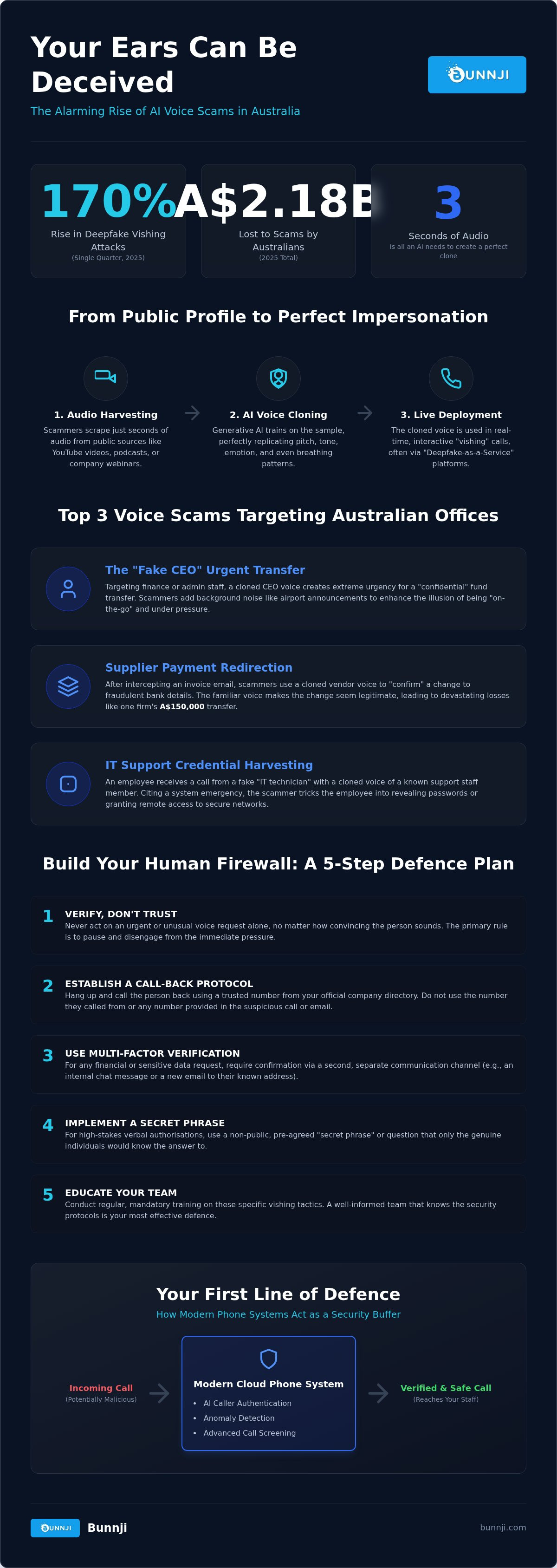
The 2026 threat landscape has shifted. We've moved past the era of grainy, robotic recordings that were once easy to spot. Today, voice cloning technology has reached a point of near-zero latency and perfect inflection. If a scammer has just three seconds of high-quality audio from a LinkedIn video, a podcast, or a company webinar, they can generate a perfect clone of a director's voice. This isn't just about mimicry; it's about emotional intelligence. Modern AI can now simulate stress, urgency, or even the specific breathing patterns of a person under pressure. For Australian firms, the stakes are higher than ever. While A$25 million losses used to be headline news, they are fast becoming the "old normal" in an environment where Australians lost A$2.18 billion to scams in 2025 alone. It is clear that ai voice scams are getting better, moving beyond simple recordings to real-time, interactive conversations.
The Technology Behind the Threat
The engine driving this change is audio deepfake technology, specifically Generative Adversarial Networks (GANs). To explain this in plain English, think of a GAN as two AI models locked in a competition. One model creates a voice, while the other tries to spot the fake. They go back and forth millions of times until the "fake" is indistinguishable from the original. Scammers no longer need to be tech geniuses to use this. They now use "Deepfake-as-a-Service" platforms, allowing them to launch high-volume attacks for a small subscription fee. This is why traditional "challenge questions," like asking for a mother's maiden name, are often useless. If a scammer has done their homework on social media, they already have the answers.
Scamwatch Trends for Australian Firms
The ACCC and Scamwatch have issued urgent warnings regarding this new wave of voice-based business fraud. Vishing is the voice-equivalent of phishing, and in 2026, it has become the primary tool for bypassing digital firewalls through synthesised vocal manipulation. Scammers often target small to medium businesses as "soft entries" into the market. They know these firms might have fewer resources than a major bank, yet they still provide a gateway into larger corporate supply chains. Because ai voice scams are getting better at mimicking trusted vendors, a single phone call can now compromise a multi-million dollar contract. It's no longer enough to trust your ears; you must trust your protocols.
The Three Most Dangerous Voice Scams Targeting Australian Offices
While technical firewalls are essential, the most effective tool in a scammer's kit is psychological. They don't just hack systems; they hack people. By leveraging social engineering, criminals exploit the trust we place in a familiar voice. This is why ai voice scams are getting better at infiltrating even the most secure Australian workplaces. These attacks bypass traditional logic because they target our natural inclination to be helpful to colleagues and partners.
The Fake CEO (Whaling) Scenario
This attack typically targets the finance department or senior administrative staff. Scammers scrape a CEO's voice from a YouTube interview or a company webinar to create a convincing clone. To add a layer of authenticity, they often overlay the audio with background noise like airport announcements or cafe chatter. This creates a sense of "on-the-go" urgency. When the "boss" calls demanding an out-of-cycle transfer for a "confidential deal," the emotional pressure often causes staff to bypass standard financial controls. Even with a warning from the Federal Trade Commission highlighting how AI enhances impersonation schemes, the sheer realism of the audio can be overwhelming for an unprepared employee.
Supplier Payment Redirection
This is perhaps the most damaging scam for Australian B2B firms. Scammers often intercept an email thread regarding an upcoming invoice. They then follow up with a cloned voice call from a "trusted vendor" to verify a change in bank details. The psychological power of hearing a familiar voice confirm the fraudulent details makes the change feel legitimate. In 2025, Australian businesses lost millions to these redirection tactics. One mid-sized firm recently lost over A$150,000 when they believed they were speaking to their long-term logistics partner. The voice was perfect, the tone was professional, and the loss was devastating. It's a reminder that ai voice scams are getting better at mimicking the subtle nuances of a long-term business relationship.
IT Support Credential Harvesting
In this scenario, a technician calls an employee using the cloned voice of an actual internal IT staff member. They claim there's a "network emergency" and need immediate remote access to the user's workstation. Because the employee recognises the voice, they are far more likely to grant access or hand over sensitive login credentials. Protecting your business requires more than just training; it requires a communication platform designed for the modern threat landscape. A robust cloud phone system can provide the authentication layers needed to flag these suspicious calls before they reach your team.
Spotting the Unspottable: Can You Actually Tell It Is AI?
By 2026, the technology has reached a tipping point where the human ear can no longer reliably distinguish between a real person and a synthetic clone. We've moved beyond the "uncanny valley" where something felt slightly off. Today, ai voice scams are getting better at capturing the unique verbal thumbprint of an individual, including their regional Australian accent and specific speech patterns. This development has birthed a new era of Business Voice Compromise (BVC), the vocal successor to the notorious email-based scams that have plagued firms for years.
While the audio quality might be flawless, the deception often reveals itself through three distinct categories of red flags:
- Vocal Red Flags: Listen for minute audio artifacts. These might manifest as a slight metallic "ping," unnatural pauses between sentences, or a lack of ambient room noise that doesn't match the caller's supposed location.
- Emotional Red Flags: This is the most common indicator. Scammers rely on extreme urgency or absolute secrecy to bypass your critical thinking. If a caller insists that "this cannot wait" or "don't tell anyone else yet," your guard should go up immediately.
- Protocol Red Flags: AI clones are frequently used to convince staff to deviate from established company policy. If a request involves skipping a standard approval process or using an unofficial payment channel, it is almost certainly a scam.
The Limitations of AI in Live Conversation
Despite the perfect sound, the underlying logic of a voice clone is often scripted and brittle. AI still struggles with complex, overlapping dialogue or highly specific industry jargon used in a casual context. You can use the "Interrupt Test" to expose a fake. By abruptly changing the subject or asking a non-sequitur like, "Did you see that storm that hit the coast this morning?", you force the AI to process new, unplanned data. This often causes a noticeable lag or a generic, nonsensical response that breaks the illusion. While the sound is perfect, the logic of the AI is often scripted and brittle.
Technical Detection Tools vs. Human Intuition
Many Australian businesses are now deploying software that scores every incoming call based on the likelihood of it being synthetic. These tools look for digital signatures that the human ear misses. Relying on technology alone is a losing battle. Scammers constantly update their systems to bypass these filters. The most effective defence remains a combination of high-tech screening and old-fashioned gut feel. If a director who is usually calm suddenly sounds frantic and asks for a six-figure transfer to a new account, trust your intuition over the voice. In 2026, ai voice scams are getting better, but they still cannot replicate the shared history and nuanced understanding of a real human partnership.
A 5-Step Defence Strategy for Your Business
Trust is no longer a safety net in the Australian workplace. In an era where ai voice scams are getting better, your primary defence is no longer your ears; it is your operational protocol. Relying on a familiar tone is a liability that scammers are eager to exploit. To protect your firm, you must move toward a zero-trust model for every high-stakes phone request. This involves shifting the burden of proof from the listener to the caller through a series of rigid, non-negotiable steps.
- Step 1: Establish a Call-Back Culture. If a director or vendor calls with an urgent request, hang up. Call them back on their known, internal extension or an official office line.
- Step 2: Implement Internal Multi-Factor Authentication (MFA). Approvals should never live on a single channel. If a "boss" calls to authorise a payment, require a secondary confirmation via a secure platform like Microsoft Teams.
- Step 3: Create Safe Phrases for Finance. For transfers over a specific threshold, use non-obvious code words that change monthly. These are essential for scaling security across a 20-person office.
- Step 4: Conduct Regular Awareness Training. Use simulated AI scam calls to test your team. Practical experience is the best teacher for spotting subtle vocal artifacts.
- Step 5: Audit Your Public Audio Footprint. Minimise the amount of public audio available for your key executives on LinkedIn or YouTube to reduce the risk of a perfect clone.
The "Known Number" Rule
Never trust the name or number on your screen. Scammers use spoofing technology to make their calls appear as if they are coming from a trusted local contact or even your own office. You must train your staff to recognise that Caller ID is easily manipulated. Using advanced cloud phone systems allows your team to see the true origin of a call, stripping away the mask and providing much-needed visibility. It's a simple change that prevents a six-figure mistake.
Staff Training and Culture
Your security is only as strong as your weakest link. It is vital to create a culture where staff feel safe questioning a senior manager without fear of reprisal. If an employee is too afraid to verify an "urgent" request from the CEO, your security is already broken. Integrating these protocols into your broader Managed IT Services strategy ensures your telecommunications and data security work in tandem. We recommend booking a comprehensive telecommunications audit to identify the specific vulnerabilities within your firm's current communication workflow.
How Modern Phone Systems Act as a Security Buffer
Your office phone system must be more than a simple communication tool. It needs to be an active participant in your security strategy. Because ai voice scams are getting better, relying on legacy hardware creates a dangerous gap in your perimeter. Modern cloud-based infrastructure provides the technical hurdles necessary to trip up even the most sophisticated deepfake attacks before they ever reach a human ear. By shifting your defence from the staff member to the system itself, you create a layered shield that is much harder to penetrate.
AI Voice Agents as the First Line of Defence
One of the most effective ways to neutralise the threat of vishing is to remove the human element from the initial contact. AI receptionists serve as a non-human gatekeeper. These agents don't get emotional. They aren't swayed by the artificial urgency that scammers use to bypass logic. By following strict verification protocols for every external caller, an AI agent can authenticate a person's identity against your database before transferring the call. For a deeper look at how this technology is evolving, see our AI Voice Agents: 2026 Trend Report for Australian Firms. This gatekeeper approach ensures malicious actors are vetted long before they can attempt to manipulate your staff.
Cloud VoIP security also leverages encrypted SIP trunking and advanced call analytics to monitor for suspicious patterns in real-time. When a call arrives, modern systems automatically cross-reference the incoming data with your CRM records. If the voice claims to be a known supplier but the metadata doesn't match the verified history, the system flags the call as high-risk. This automated verification provides a level of precision that manual checking simply cannot match. It ensures that your team only speaks with verified contacts, removing the guesswork from daily operations.
Managed IT and Cybersecurity Audits
In 2026, your phone system is a critical part of your IT security perimeter. It's no longer a separate utility. It is a data endpoint. This is why Bunnji integrates telecommunications into a broader cybersecurity framework. Our telecommunications audit identifies hidden security gaps in legacy hardware that scammers love to exploit. By moving to a specialised unified communications model, your firm maintains a single, secure identity for all staff. This makes it significantly harder for outsiders to impersonate your team. We help you build a resilient environment where technology simplifies your life rather than complicating your security. Partnering with a capable local expert ensures your defences evolve as quickly as the threats do.
Future-Proofing Your Business Against Vocal Fraud
In 2026, the sound of a trusted voice is no longer a guarantee of identity. We've explored how ai voice scams are getting better by leveraging near-zero latency and emotional intelligence to bypass traditional security. Protecting your firm requires a shift from passive trust to active verification; this means combining a robust "call-back" culture with modern technical buffers like AI receptionists and encrypted cloud VoIP.
By implementing multi-factor authentication for financial approvals and conducting regular staff awareness training, you can turn your team into a resilient line of defence. Your phone system shouldn't be a vulnerability. Instead, it should be a strategic asset that flags threats before they reach your staff's ears. As specialists in secure Australian cloud phone systems, we provide a no-nonsense approach to business cybersecurity and expert guidance on AI voice agent integration.
Protect your firm with a 10-minute Telecommunications Audit from Bunnji to ensure your communication infrastructure is ready for the challenges ahead. Staying secure doesn't have to be complex when you have the right protocols and partners in place.
Frequently Asked Questions
Is it really possible for AI to sound exactly like my boss?
Yes, it's absolutely possible. By 2026, cloning technology has advanced to the point where only three seconds of audio is required to create a near-perfect replica. These systems capture unique vocal thumbprints, including specific Australian accents and breathing patterns. This realism is why ai voice scams are getting better at tricking staff who rely on vocal familiarity to authorise sensitive business payments or data transfers.
What should I do if I suspect a call is an AI voice scam?
Hang up immediately and use a different channel to verify the request. Call the person back on their known internal extension or a trusted number from your company records. Never use the "redial" function or a number provided by the caller, as scammers often spoof caller IDs to look like local office lines. Taking ten seconds to verify can save your firm from a six-figure loss.
How much audio does a scammer need to clone a voice in 2026?
Modern technology requires as little as three seconds of clear audio to generate a convincing clone. Scammers often scrape this from public sources like LinkedIn videos, webinars, or podcasts. Once they have this tiny sample, they can use generative models to create infinite live speech. This allows them to hold real-time, interactive conversations that sound exactly like the person they are impersonating.
Can Australian banks help if I lose money to a voice scam?
Recovery options have improved with the Scams Prevention Framework rules commencing on 1 September 2026. There's a proposed A$3,000 automatic reimbursement for verified losses that doesn't require a full investigation. Banks and telecommunications providers must also be members of the Australian Financial Complaints Authority (AFCA). If your business loses more than this, your ability to recover funds often depends on demonstrating that you followed reasonable internal security protocols.
Are AI receptionists safer than human ones for screening calls?
They can be a powerful secondary defence because AI receptionists follow rigid verification protocols without emotional bias. Unlike humans, an AI agent won't feel pressured by a "CEO" sounding stressed or angry. It can authenticate callers against your database and require specific credentials before any staff member picks up the phone. This removes the primary emotional trigger that scammers rely on to bypass logic.
How do I report an AI voice scam in Australia?
You should report any attempt or loss to Scamwatch, which is managed by the ACCC. Additionally, business-related cybercrime should be logged with the Australian Signals Directorate via the ReportCyber website. Reporting is critical because non-compliance with the Scams Prevention Framework can result in civil penalties of up to A$50 million for providers who fail to protect their users from these sophisticated and targeted vishing attacks.
What is the "Call-Back" method and why is it so effective?
The "Call-Back" method involves hanging up on a suspicious caller and manually dialling their verified number. This is effective because it bypasses spoofed caller IDs and ends the scammer's connection. Since ai voice scams are getting better at mimicking sound, this physical step of initiating a new connection is the only way to ensure you are actually speaking to the real person and not a synthetic clone.
Can my business phone system block these AI-generated calls?
Modern cloud systems use encrypted SIP trunking and advanced analytics to flag high-risk calls in real-time. While no system is 100% foolproof, these tools can identify digital signatures and metadata inconsistencies that the human ear misses. They act as a critical first filter, significantly reducing the number of malicious calls that reach your team. Integrating your phone system with your CRM adds another layer of verification.


