

What if the biggest threat to your company isn't a shadowy hacker in a basement, but the very phone system sitting on your desk? Most Australian business owners focus on their firewall while leaving the digital back door wide open. It's a stressful reality. You're likely trying to figure out if your current cyber attack protection for business is actually up to the task or just a collection of expensive jargon that won't stop a staff member from clicking the wrong link. You want to protect your hard-earned revenue from scams without needing a degree in computer science to understand how it all works.
We agree that IT security often feels like a moving target that's far too complex. This article is designed to change that. You'll discover why your current setup might be leaving you vulnerable and how to build a bulletproof protection strategy for 2026. We've put together a clear, no-nonsense guide on the ten essential questions you must ask any provider before you switch services. By the end, you'll have a simple checklist to ensure your phone and data systems are secure, giving you the confidence to focus on growing your business instead of worrying about the next threat.
Key Takeaways
- Learn why "spray and pray" automated attacks mean no Australian business is too small to be a target for modern hackers.
- Understand the risks of "Vishing" and how unsecured VoIP systems can lead to costly toll fraud if left exposed.
- Discover why a multi-layered approach to cyber attack protection for business is essential to defend against sophisticated "Zero Day" threats.
- Identify the critical steps for implementing the Australian "Essential Eight" framework to move beyond basic antivirus and firewalls.
- Find out how a 10-minute telecommunications audit can uncover hidden vulnerabilities in your current phone and internet setup.
Myth 1: "My Business is Too Small to be a Cyber Target"
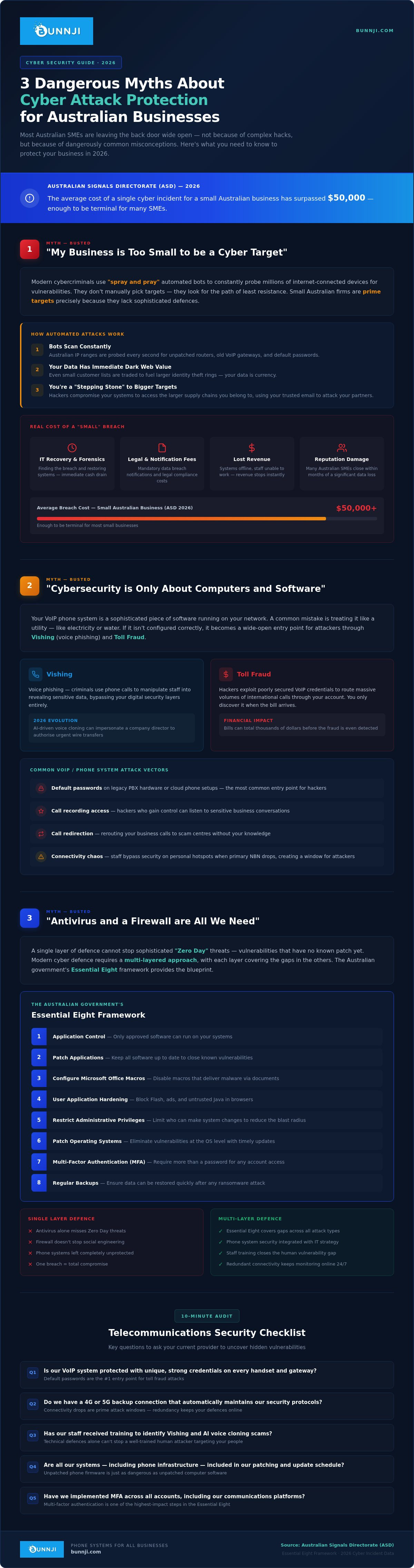
It's a common belief that anonymity is a form of security. Many local business owners assume that because they aren't a multinational corporation, they aren't worth a hacker's time. This thinking leaves the back door wide open. Modern cybercriminals don't sit at keyboards picking targets manually; they use "spray and pray" tactics to find the path of least resistance. They don't care about your brand name or your turnover. They care about your vulnerabilities.
Automated vulnerability scanning is the practice of using software bots to constantly probe millions of internet-connected devices for unpatched security holes. These bots are the modern entry point for almost every major breach. Small firms are often the primary choice for criminals precisely because they lack sophisticated cyber attack protection for business. You are seen as a low-risk, high-reward target for an automated bot that never sleeps.
The "Invisible" Target on Your Back
Bots scan Australian IP ranges every second of the day. They aren't looking for your company profile; they're looking for an unpatched router or an old VoIP gateway. Once inside, your data has immediate value on the dark web. Even small customer lists are traded to fuel larger identity theft rings. Your business is also a valuable "stepping stone". By compromising your systems, hackers can often gain access to the larger supply chains you belong to, using your trusted email address to launch attacks on your bigger partners.
The Real Cost of a "Small" Breach
The financial fallout from a breach is often terminal for a small firm. According to 2026 data from the Australian Signals Directorate (ASD), the average cost of a single cyber incident for a small business has surpassed $50,000. This isn't just a hypothetical number. It represents real-world expenses that can drain your cash flow instantly:
- Immediate IT recovery and digital forensic costs to find the leak.
- Legal fees and mandatory data breach notification requirements.
- Lost revenue while your systems are offline and staff can't work.
Money is only part of the problem. Reputational damage is far harder to fix. When customers realise their personal details were compromised because of a lack of cyber attack protection for business, trust evaporates. Statistics show that many Australian SMEs never fully recover from a significant data loss, often closing their doors within months of the initial attack.
Myth 2: "Cybersecurity is Only About Computers and Software"
You probably have a firewall for your computers, but what about your handsets? A common mistake is treating the phone system as a separate utility like electricity or water. In reality, your VoIP system is a sophisticated piece of software running on your network. If it isn't configured correctly, it becomes a wide-open entry point for attackers. This is where "Vishing" or voice phishing comes into play. Criminals use phone calls to manipulate staff into giving up sensitive data, often bypassing your digital security layers entirely. This is an essential part of modern cyber attack protection for business.
Beyond data theft, there is the immediate financial risk of toll fraud. Hackers can exploit poorly secured VoIP credentials to route massive volumes of international traffic through your account. You only find out when the bill arrives, often totalling thousands of dollars. Building a safe environment requires looking at every communication channel, not just your email inbox. You can find more detail on this in our Business VoIP Australia: The Complete 2026 Strategy Guide.
Why Your Phone System is the New Front Door
Hackers frequently target legacy PBX hardware or cloud phone setups that use default passwords. Once they gain control, they can listen to call recordings or redirect calls to scam centres. We are now seeing the rise of AI-driven voice scams in 2026. These involve cloning the voice of a director to authorise urgent wire transfers. It's a high-tech version of social engineering. Training your staff to recognise these patterns is just as important as your technical defences.
The Link Between Internet Redundancy and Security
Stable connectivity is a pillar of security. When your primary NBN connection drops, staff often resort to unsecure personal hotspots or bypass security protocols to stay productive. This chaos is exactly when attackers strike. Business-grade fibre provides the stability needed for real-time security monitoring. Combining this with a 4G or 5G backup ensures your encrypted tunnels never go offline. A robust strategy for cyber attack protection for business must include this level of reliable redundancy.
If you're unsure where your vulnerabilities lie, a 10-minute telecommunications audit can provide the clarity you need to secure your lines.
Myth 3: "Antivirus and a Firewall are All We Need"
Relying solely on a firewall and basic antivirus is like locking your front door but leaving every window in the house wide open. While these tools were sufficient a decade ago, they are no longer enough to stop modern threats. Traditional antivirus software works by recognising "signatures" of known viruses. If a hacker launches a "Zero Day" attack, which exploits a brand-new vulnerability that hasn't been documented yet, your antivirus will likely stay silent. This is why a modern strategy for cyber attack protection for business must move toward a layered approach.
We often refer to this as the "Swiss Cheese" model of security. Every individual layer of defence has holes, just like a slice of cheese. However, when you stack multiple slices on top of each other, the holes don't align, and the path for an attacker is blocked. In Australia, the gold standard for this layered defence is the "Essential Eight" framework. It provides a prioritised list of mitigation strategies that make it significantly harder for criminals to compromise your systems.
Beyond the Basics: The Essential Eight for 2026
The Australian Signals Directorate developed the Essential Eight to help organisations protect themselves. In 2026, three of these strategies are particularly critical for any small to medium enterprise:
- Multi-Factor Authentication (MFA): This is now non-negotiable. Even if a hacker steals a staff member's password, they cannot gain access without a second form of verification, such as a code sent to a secure app.
- Restricting Administrative Privileges: Most employees don't need the ability to install new software or change system settings. By limiting these rights, you stop malware from automatically spreading across your entire network if one computer is compromised.
- Daily Immutable Backups: Regular backups are your final safety net. These must be "immutable," meaning they cannot be changed or encrypted by ransomware. Keeping them off-site ensures that even a physical disaster won't wipe out your data.
The Human Element: Training Your Team
Your staff are your "human firewall," and they are often the first line of cyber attack protection for business. In 2026, phishing attempts have become incredibly sophisticated, often using AI to mimic the tone and style of your internal communications. Training your team to spot these red flags is vital. They should be wary of any message requesting urgent financial transfers or sensitive credentials, even if it appears to come from a known contact.
Building a "no-blame" culture is equally important. If a staff member accidentally clicks a suspicious link, they need to feel comfortable reporting it immediately rather than hiding the mistake. Rapid reporting can mean the difference between a minor incident and a total system shutdown. Regular security drills and awareness updates keep these risks top-of-mind, ensuring your team remains a proactive part of your defence strategy.
Building a Multi-Layered Protection Strategy
Creating a robust defence doesn't mean you have to rebuild your entire IT department from scratch. It's about closing the gaps that hackers find through automation. A solid strategy for cyber attack protection for business follows a logical progression from visibility to active defence. It starts with understanding your current footprint and ends with a plan for when things go wrong. It's about being prepared.
- Step 1: Conduct a full audit. You can't secure a network if you don't know every device and line connected to it.
- Step 2: Implement MFA. MFA is non-negotiable. Apply Multi-Factor Authentication to every login, from your email to your VoIP admin portal.
- Step 3: Secure your infrastructure. Use managed firewalls to protect your NBN and VoIP traffic from external probes.
- Step 4: Create a recovery plan. Document exactly how your business will operate and restore data if a breach occurs.
The 10-Minute Telecommunications Audit
Visibility is the enemy of the cybercriminal. Start by identifying "ghost" numbers, which are old lines or handsets that are still active but no longer used. These are often unmonitored and provide an easy way into your system. Review your current service contracts to ensure they include modern security compliance clauses. Finally, test your internet redundancy. Test your failover. If your primary fibre goes down, does your backup keep your security protocols active, or does it leave you exposed? You can book a professional 10-minute telecommunications audit to find these hidden gaps immediately.
Securing Your Remote and Hybrid Team
The modern office isn't contained within four walls. This makes cyber attack protection for business more challenging. Public Wi-Fi at a local cafe is a massive risk for staff handling sensitive data. Ensure your team uses secure VPNs or encrypted "softphone" apps on their mobile devices instead of standard cellular calls for business tasks. Centralising data access through managed platforms prevents "shadow IT" risks, where staff use unapproved apps that don't meet your security standards. By keeping everyone on the same secure platforms, you maintain control no matter where they work. It's a simple way to stay safe.
How Bunnji Secures Your Business Communications
Most Australian business owners are tired of being the middleman between their IT provider and their phone company. When a security gap appears, each side often points the finger at the other, leaving your data in limbo. We solve this by taking full responsibility for your entire digital environment. Our integrated approach combines Managed IT and Telecommunications into one seamless service. This ensures that your NBN, VoIP, and data systems are all working under a single, unified strategy for cyber attack protection for business.
Having one partner manage your NBN, VoIP, and security doesn't just reduce complexity; it removes the friction that hackers exploit. We build bespoke security architectures that are specifically tailored for Australian SMEs. We don't believe in generic, off-the-shelf solutions that leave your back door open. Instead, we provide a high-performance office environment where every communication channel is monitored and protected by experts who know your business by name.
Managed IT Services That Grow With You
Our team focuses on proactive monitoring rather than the outdated "break-fix" support model. We don't just wait for your system to crash or a breach to occur. We actively hunt for vulnerabilities and patch them in real-time to keep your operations running smoothly. As your firm adopts modern tools, we ensure they don't become liabilities. This includes safely integrating AI Voice Agents into your existing CRM. These agents can handle high call volumes and organise your calendar while keeping your customer data strictly encrypted. For a deeper look at how these technologies are evolving, check out our AI Voice Agents: 2026 Trend Report for Australian Firms.
Ready to Secure Your Firm?
The path to a bulletproof office starts with a "security-first" telecommunications audit. We look past the surface to find the hidden gaps in your NBN failover, your VoIP credentials, and your staff access levels. This bespoke audit is designed for businesses that need elite protection without the corporate jargon or bureaucratic layers. It's about giving you the peace of mind that your systems are secure so you can focus on growth. Our experts are ready to help you build a strategy that lasts well into 2026 and beyond. This integrated approach is the most effective way to manage cyber attack protection for business.
Book your Bunnji cybersecurity and comms audit today!
Secure Your Future with a Unified Strategy
Protecting your company in 2026 requires looking beyond the computer screen. We've explored how automated bots don't care about your business size and why your VoIP system is often the most overlooked entry point for hackers. A truly effective cyber attack protection for business isn't just about software; it's about a multi-layered approach that secures your voice lines, your internet connection, and your staff's habits. By integrating your IT and telecommunications, you eliminate the finger-pointing and close the gaps that criminals exploit.
Bunnji is an Australian-owned and operated partner specialising in secure NBN and VoIP integration. We provide proactive managed IT for growing national teams, ensuring your technology remains an asset rather than a liability. Peace of mind comes from knowing your systems are monitored by experts who understand the local landscape. Take the first step toward a bulletproof office today. Secure your business with a Bunnji Telecommunications Audit and gain the confidence to focus on your next big move. You've worked hard to build your business; let's make sure it's protected properly.
Frequently Asked Questions
What is the most common cyber attack for Australian businesses in 2026?
Business Email Compromise (BEC) and AI-enhanced phishing remain the most frequent threats facing Australian organisations in 2026. These attacks use generative AI to create perfectly written, highly personalised messages that bypass traditional spam filters. They often target accounts payable departments to divert large payments into criminal accounts. Implementing robust cyber attack protection for business is the only way to catch these sophisticated social engineering attempts before they cause significant financial loss.
Is business NBN more secure than residential NBN?
Business NBN is significantly more secure because it offers features residential plans lack, such as static IP addresses and enhanced service level agreements (SLAs). These allow for more stable VPN tunnels and secure remote access for your team. Unlike residential services, business-grade connections often include prioritised data traffic and faster fault restoration. These features are critical for maintaining continuous security monitoring and preventing unauthorised network access during unexpected outages.
How does Multi-Factor Authentication (MFA) actually protect my business?
Multi-Factor Authentication (MFA) adds a vital second layer of security by requiring a separate verification step beyond just a password. Even if a hacker steals your login credentials, they cannot access your system without the unique code from your mobile app or physical token. It's one of the most effective ways to improve cyber attack protection for business, stopping the majority of automated credential-stuffing attacks almost instantly.
Can my business phone system be hacked?
Yes, modern VoIP and cloud phone systems are essentially software applications and are frequently targeted by hackers. Attackers exploit weak passwords or unpatched firmware to commit toll fraud, where they route expensive international calls through your account. They can also use your phone system to listen to private conversations or steal customer data. Securing your handsets with the same rigour as your laptops is essential for modern firms.
What should I do immediately if I think my business has been breached?
You should immediately isolate the affected devices by disconnecting them from the network to stop the spread of malware. Change all critical passwords from a clean device and contact your managed IT partner to begin forensic recovery. Under Australian law, you may also need to notify the Office of the Australian Information Commissioner (OAIC) if the breach involves sensitive personal data that could lead to serious harm.
How often should we conduct a cybersecurity audit?
You should conduct a comprehensive cybersecurity audit at least once a year, though quarterly reviews are the gold standard for high-growth firms. Technology moves fast, and new vulnerabilities emerge daily. Regular audits ensure that your patches are current, your staff training is fresh, and your backup systems actually work. A 10-minute telecommunications audit is a great starting point to identify immediate gaps in your phone and internet security.
Are AI voice scams a real threat to small businesses?
AI voice scams are a rapidly growing threat to small businesses in 2026. Criminals use short audio clips from social media or public videos to clone a director's voice with startling accuracy. They then call staff to authorise urgent, fraudulent transfers. Because small businesses often have less formal verification processes than large corporations, they are frequently targeted for these high-pressure, sophisticated vishing attacks that bypass traditional digital security.
Is cloud storage safer than keeping data on a local server?
Cloud storage is generally safer than local servers because major providers invest heavily in physical security, redundancy, and advanced encryption that most small businesses cannot afford. While a local server is prone to hardware failure, fire, or physical theft, cloud systems offer automated backups and professional management. However, you must still manage your own access controls and MFA to ensure your cloud environment remains truly secure and private.


