

Did you know the average cost of IT downtime for Australian businesses has climbed to $9,000 per minute in 2026? For most Aussie firms, a sudden NBN outage or a sophisticated cyberattack isn't just a minor hurdle; it's a total operational shutdown that bleeds revenue and erodes client trust. Effective disaster recovery planning is no longer a back-office IT task. It's a critical strategy for survival. You've likely experienced the confusion of having backups that don't actually lead to recovery, or perhaps you're stuck with complex fibre contracts that offer no real redundancy when the connection drops.
We know how much is at stake when your phones go silent and your data is out of reach. This guide simplifies the complexity of modern infrastructure and new 2026 privacy regulations to help you regain control. You'll learn how to build a robust disaster recovery plan that protects your firm from data loss while lowering your cyber insurance premiums. We'll provide a clear, actionable template to ensure your internet and voice services stay online, giving you the confidence that your business is ready for anything.
Key Takeaways
- Conduct a localised risk assessment to identify threats unique to the Australian landscape, from environmental hazards to infrastructure failures.
- Understand why disaster recovery planning is your technical blueprint for instant operational resilience, distinct from broad business continuity.
- Secure your communication lines with internet redundancy and Cloud VoIP to keep your staff connected on any device during an outage.
- Move beyond simple backups by implementing a rigorous testing schedule that includes tabletop exercises and full cut-over simulations.
- Learn how a managed resilience strategy can help satisfy 2026 compliance standards and potentially lower your cyber insurance premiums.
What is Disaster Recovery Planning and Why Does it Matter in 2026?
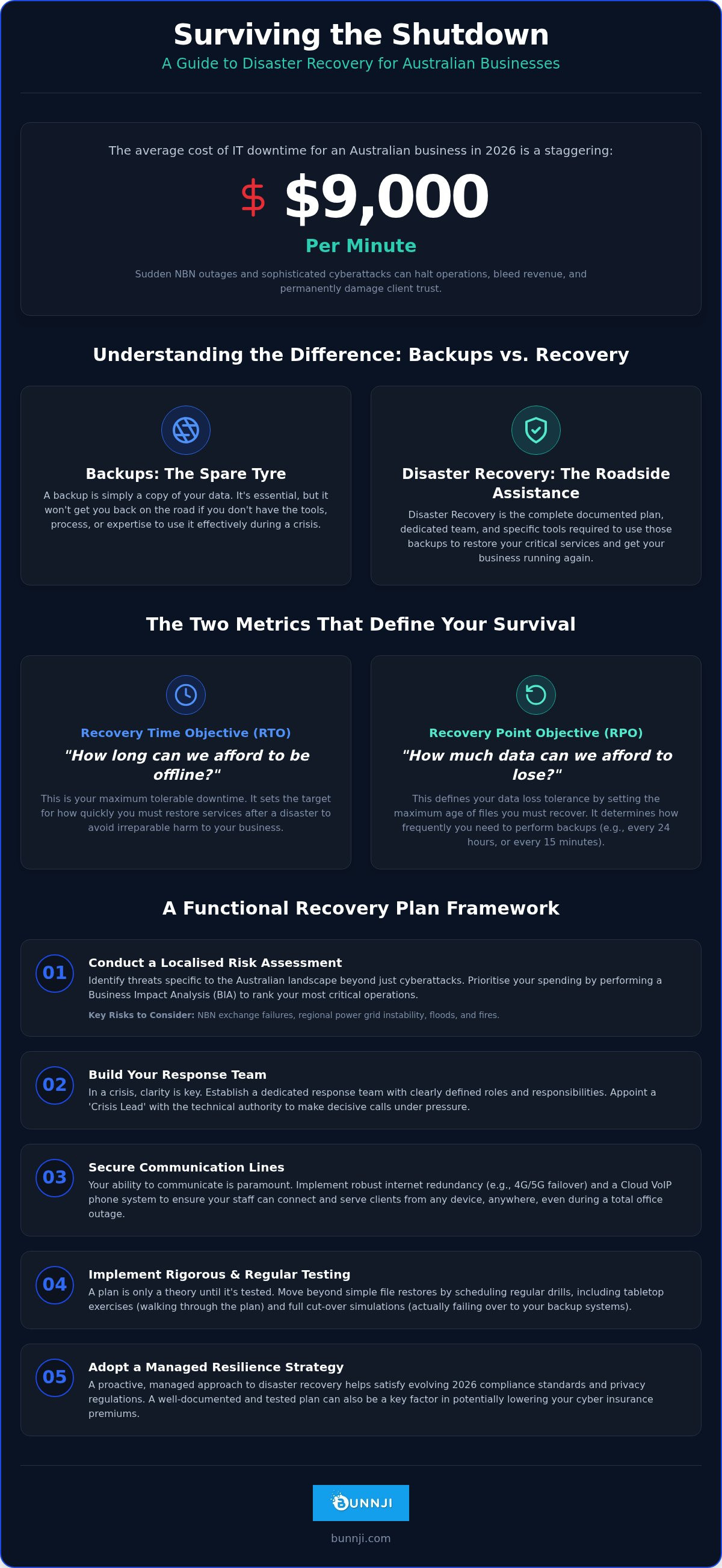
In 2026, disaster recovery planning isn't just an insurance policy; it's the technical engine that keeps your Aussie firm running when things go pear-shaped. Think of it as your detailed blueprint for resuming operations after a crisis. While often confused with Business continuity planning, which looks at the broader organisational strategy, disaster recovery focuses specifically on your IT and communication infrastructure. It's the "how-to" guide for getting your systems back online.
The stakes have never been higher for local businesses. Sophisticated AI-driven ransomware now targets Australian firms with surgical precision, and NBN infrastructure vulnerabilities can leave your office in the dark without warning. If your systems go down, research shows you face an average cost of $9,000 per minute in downtime. This isn't just a financial hit. You're facing the "cost of silence." Every missed call and offline service erodes the trust you've spent years building with your clients. In a competitive market, they won't wait for you to reboot; they'll simply call the next person on the list.
The Difference Between Backups and Disaster Recovery
A backup is simply a copy of your data, like a spare tyre in the boot of your car. It's essential, but it won't get you back on the road if you don't have a jack or know how to change the wheel. Disaster recovery is the roadside assistance team. It's the documented process and the specific tools required to use those backups to restore your services. By 2026, cloud-based backups have become the non-negotiable standard for Australian firms. They provide the speed and accessibility needed to ensure that when a server fails, your business doesn't fail with it.
RTO and RPO: The Two Metrics That Define Your Survival
To build a plan that actually works, you need to define two critical metrics: Recovery Time Objective (RTO) and Recovery Point Objective (RPO). These numbers dictate the technology you need to invest in.
- Recovery Time Objective (RTO): This is your "downtime limit." It answers the question: How many hours or minutes can we afford to be offline before the damage to the brand is irreparable?
- Recovery Point Objective (RPO): This is your "data loss limit." It determines how often you need to back up your data. If you back up every 24 hours, your RPO is one day. For mission-critical client services, you likely need an RPO of mere minutes.
Setting these targets allows you to tailor your disaster recovery planning to your actual business needs rather than guessing. It turns a vague hope for resilience into a concrete, measurable technical requirement.
The 5-Step Framework for a Functional Recovery Plan
A solid recovery plan isn't a thick binder gathering dust on a shelf. It's a living, breathing document that your team can execute under pressure. Moving from theory to action requires a structured approach that accounts for the specific technical and environmental hurdles of the Australian market. This framework ensures your disaster recovery planning covers every angle, from physical hardware to cloud-based continuity.
Conducting a Risk Assessment for the Aussie Landscape
A risk assessment is a proactive audit of your business's technical and physical vulnerabilities. In Australia, this means looking beyond cyber threats to account for regional power grid instability and NBN exchange failures. You need to weigh the likelihood of a localised flood or fire against the probability of a hardware failure. By identifying these specific threats, you can prioritise your budget toward the most likely scenarios, ensuring you aren't over-investing in unlikely events while ignoring glaring gaps in your internet redundancy.
Once you've identified the risks, perform a Business Impact Analysis (BIA). This step helps you rank your operations. Not every system needs to be back online in five minutes. Identifying "mission-critical" functions, like your client-facing payment portals or your primary communication lines, allows you to allocate resources where they'll have the biggest impact on your survival.
Building Your Disaster Recovery Response Team
When a crisis hits, you don't want people looking at each other wondering who's in charge. You need a dedicated response team with clear, no-nonsense roles. This starts with a "Crisis Lead." This person should be someone with the technical authority to make quick calls, and they don't necessarily have to be the business owner. Their job is to coordinate the recovery and manage the "Runbook" steps.
Clear communication is the backbone of any recovery effort. If your office is inaccessible, you'll need a reliable remote team phone system to keep everyone in the loop. Your team must be able to access the DRP and contact each other even if the main server is completely offline. Storing your plan in a secure, off-site cloud location ensures that the instructions are available the moment they're needed.
With your team in place, you must inventory every asset. This isn't just about counting laptops. You need a centralised list of cloud logins, SIP trunking details, and third-party fibre contracts. Knowing exactly who to call at your telco or software provider can save hours of frustration during a blackout. If you're struggling to track these moving parts, performing a quick telecommunications audit can help you organise your infrastructure before a disaster strikes.
Finally, document the "Runbook." This is the granular, step-by-step guide for your team. It should be so clear that a junior staff member could follow it if the Crisis Lead is unavailable. It covers the exact sequence for restoring data, switching to redundant internet lines, and notifying clients that you're still open for business.
Communication Continuity: VoIP and Internet Redundancy Strategies
Communication is the first thing to break during a crisis and the last thing a customer will forgive. If your office is inaccessible or a local NBN exchange fails, your clients don't care about the technical logistics; they simply want an answer. This makes internet redundancy the most frequently overlooked element in Australian disaster recovery planning. Many firms still rely on a single NBN connection, creating a dangerous single point of failure. To achieve true resilience in 2026, you need the "holy trinity" of connectivity: primary Business Fibre for speed, a secondary NBN line for diversity, and an automated 5G failover for absolute peace of mind.
The Power of Cloud Phone Systems in a Crisis
Cloud-based phone systems act as the ultimate bypass for physical infrastructure damage. Because business VoIP Australia operates entirely in the cloud, your business number isn't tied to a physical desk or a specific copper line. If a storm or a cyberattack forces your office to close, your team can stay connected using the "one number, every device" advantage. They can answer calls from home, a temporary site, or a mobile device without the client ever knowing there's a problem.
During the initial hours of a disaster, when your staff are busy executing recovery protocols, AI Receptionists become your most valuable assets. These AI voice agents can maintain a professional front by handling initial client intake, answering common questions, or logging support tickets. This ensures your brand stays responsive even if your entire human team is temporarily offline. It transforms a potential PR disaster into a demonstration of operational resilience.
Ensuring 100% Uptime with Internet Failover
Relying on a standard residential-grade NBN connection is a gamble that 2026 business standards don't support. Upgrading to Business Fibre with a dedicated 4G or 5G backup provides a seamless transition if your primary line is cut. Modern networking hardware can detect a drop in service in milliseconds, automatically rerouting your critical traffic to the mobile network before your staff even notice a flicker in their connection.
To find where your current setup is vulnerable, you should conduct a telecommunications audit for business. This proactive check identifies hidden bottlenecks, such as outdated routers that can't handle automated failover or restrictive contracts that offer no service-level guarantees. By organising your infrastructure now, you ensure that when the "you-know-what" hits the fan, your phones stay online, your data keeps flowing, and your business stays open.
Putting the Plan to the Test: Drills and Maintenance
Testing is where the rubber meets the road. If your team hasn't physically practiced switching to a backup 5G line or restoring a cloud volume, you don't have a plan; you have a hope. In the fast-moving 2026 tech space, an untested document is just a work of fiction sitting on a shelf. You need to know exactly how your systems behave under pressure before the pressure is real. It's about building the confidence that your business can survive a worst-case scenario without missing a beat.
Effective disaster recovery planning requires a mix of low-stress tabletop exercises and high-stakes full cut-over simulations. A tabletop exercise involves walking through a scenario in a meeting room, while a cut-over simulation involves actually failing over to your redundant systems to see if they hold the load. Given how quickly AI threats and NBN vulnerabilities evolve, we recommend auditing your plan at least twice a year. Use the feedback from these drills to refine your RTO and RPO targets. If a drill reveals your recovery takes four hours but your target is one, it's time to upgrade your infrastructure or adjust your expectations.
The 10-Minute Resilience Audit
You don't always need a full day to check your readiness. A quick-fire quarterly checklist can catch small gaps before they become chasm-sized failures. Start by checking your "dead man switches", those automated IT scripts and alerts that trigger when a system stops responding. Ensure your off-site cloud logins are still valid and that your primary contact at your telco hasn't changed. For a deeper dive into your technical health, follow our 10-Minute IT Audit to identify hidden vulnerabilities in your network.
Tabletop Exercises: The Low-Stress Way to Train
Running a "what if" scenario over coffee is the best way to build muscle memory without disrupting your daily operations. Gather your key staff and pose a specific 2026 challenge: "What if our AI voice agent gets compromised and starts giving out incorrect information?" or "What if the regional power grid fails for more than six hours?" These sessions expose gaps in your communication chain that a technical manual might miss.
The goal is to ensure every staff member knows the first three steps of an incident response without looking at a manual. This builds a culture of resilience where your team feels capable rather than panicked. If you're ready to move beyond theory and secure your firm's future, book a telecommunications audit with Bunnji to see how our managed IT services can automate your recovery and keep your Aussie business online.
Managed Resilience: How Bunnji Secures Your Firm’s Future
Building a resilient business isn't a DIY project you should tackle in your spare time. While the steps we've covered provide the roadmap, the actual execution of disaster recovery planning requires specialised technical expertise. This is where Bunnji steps in. We act as the capable partner that handles the technical heavy lifting, allowing you to focus on leading your team through the crisis. Our "Bunnji Resilience Suite" integrates high-speed Business Fibre, Cloud VoIP, and proactive Managed IT into a single, unified shield for your organisation.
One of the biggest hurdles during an outage is vendor finger-pointing. When your internet is down and your phones are silent, the last thing you need is your ISP blaming your IT provider while your hardware vendor remains unreachable. By partnering with us, you gain a single point of contact. We own the problem from the moment it's detected until your systems are fully restored. This accountability removes the friction from recovery and gives you the peace of mind that a local expert is already on the case.
Bespoke Solutions for Australian SMBs
Off-the-shelf recovery plans often fail because they don't account for the unique quirks of the Australian telecommunications market. A generic guide won't help you navigate the complexities of long-term NBN equipment contracts or regional infrastructure limitations. Bunnji's managed IT support acts as a specialised insurance policy, tailored specifically to the needs of local firms. We understand the local landscape because we live in it, providing the precision and stability that "one-size-fits-all" providers simply can't match.
Next Steps: From Planning to Protection
You don't have to overhaul your entire infrastructure overnight. The most effective approach is to start small by protecting your most vital lifelines: your phones and your internet. If these stay online, your business stays alive. A proactive audit is the first step toward true resilience, identifying vulnerabilities before they turn into expensive downtime. Don't wait for the next major NBN outage or cyberattack to find the gaps in your strategy. Organise your resilience strategy with Bunnji today and ensure your business is ready for whatever 2026 throws your way.
Future-Proof Your Aussie Business Against the Unexpected
Building a resilient organisation isn't about avoiding every crisis; it's about having the technical backbone to stand back up immediately. You've seen that disaster recovery planning is much more than a simple data backup. It's a comprehensive strategy that combines internet redundancy, cloud-based communication, and rigorous testing. By prioritising these technical foundations, you ensure your brand stays visible and your phones stay active, even when the local NBN infrastructure fails.
The peace of mind that comes with a tested recovery plan is invaluable for any business owner. Our specialists at Bunnji focus on 100% uptime and internet redundancy, providing AI-powered communication solutions that keep you connected through any storm. Don't leave your firm's survival to chance. Secure your business with a Bunnji Telecommunications Audit today and identify your hidden vulnerabilities before they become critical failures. You've done the hard work of building your business; now let's make sure it's protected for 2026 and beyond.
Frequently Asked Questions
What is the most common cause of business downtime in Australia?
Cybercrime and hardware failures remain the primary drivers of downtime for local firms. In the 2023-24 financial year, there were 87,400 cybercrime reports in Australia, representing a 7% increase from the previous year. Additionally, reliance on a single NBN connection often leads to outages during routine maintenance or exchange failures. Effective disaster recovery planning helps mitigate these risks by providing redundant pathways for both your data and voice communications.
How often should a small business update its disaster recovery plan?
You should review your plan at least twice a year to keep pace with the rapidly evolving 2026 tech landscape. Technology moves fast, and new threats like AI-driven ransomware emerge monthly. Quarterly "resilience audits" are also recommended to check cloud logins and verify that your contact lists for telco providers are current. Frequent updates ensure your RTO and RPO targets remain realistic as your organisation grows and changes.
Does having a cloud backup mean I do not need a disaster recovery plan?
No, because a backup is just a copy of your data, while a disaster recovery plan is the process of restoring it. Think of the backup as a spare tyre and the plan as the jack and tools needed to actually change it. Without a documented process, you might have the data but no way to bring your systems back online within your required Recovery Time Objective.
Can I use a 5G mobile hotspot as a legitimate disaster recovery internet solution?
While a manual hotspot is better than nothing, it isn't a professional-grade redundancy solution. Legitimate disaster recovery planning involves automated failover hardware that detects an NBN drop in milliseconds. A manual 5G hotspot requires human intervention and cannot always support your entire office's bandwidth needs. Automated 5G backup ensures your VoIP phones and cloud applications stay connected without any manual setup during a connectivity crisis.
How much does it cost to implement a basic disaster recovery plan for a small firm?
The cost varies significantly based on your specific infrastructure needs and the volume of mission-critical data you need to protect. Instead of looking at the initial setup fee, consider the cost of inaction. With the average cost of downtime for Australian firms reaching $9,000 per minute in 2026, even a basic plan usually pays for itself during its first hour of use. Focus on protecting your most vital functions first.
What is the role of an AI voice agent during a telecommunications outage?
An AI voice agent acts as your frontline receptionist when your physical office is unreachable. It can handle initial client intake, answer common queries, and log support tickets in your CRM while your team focuses on technical recovery. This ensures your business never misses a call, maintaining a professional image even if your staff are working from temporary locations or mobile devices during a primary line failure.
Is disaster recovery planning mandatory for Australian businesses under cyber laws?
While not every business faces a blanket mandate, the Privacy Act 1988 and the Notifiable Data Breaches scheme impose heavy obligations to protect personal information. Furthermore, the Security of Critical Infrastructure Act 2018 introduces prescriptive risk management requirements for entities in specific sectors. Failing to have a plan can result in serious penalties, which can be the greater of $50 million or 30% of your adjusted turnover during the breach period.
What is the first thing I should do if my business is hit by ransomware?
Your first priority is to isolate the infected systems to prevent the spread across your network. Immediately disconnect from the internet and trigger your pre-defined disaster recovery protocols. Do not pay the ransom, as this rarely guarantees data recovery and can mark you as a target for future attacks. Instead, rely on your clean cloud backups and follow the step-by-step restoration guide in your recovery runbook to resume operations.


