

What if the very wires connecting your office to the world are quietly sabotaging your 2026 growth strategy? Securing an nbn fibre upgrade for business is no longer just about faster downloads; it's a mandatory move for any firm using AI voice agents or cloud-first tools. You're likely already feeling the frustration of dropped VoIP calls and sluggish backups caused by unreliable copper lines. It's a common hurdle that shouldn't be holding your team back in a digital-first economy.
We've designed this guide to remove the friction from your network transition. You'll learn exactly how to navigate the shift from copper to full fibre, making sense of Business Fibre Zones and the latest 2026 "Targeted Upgrade" programs. We'll provide a clear roadmap to achieve a seamless switch that lowers your long-term costs and provides the stability your modern software demands. It's time to stop managing technical limitations and start focusing on your business growth.
Key Takeaways
- Understand why the 2026 copper retirement makes transitioning to full fibre a mandatory requirement for maintaining business continuity.
- Navigate the technical differences between FTTP and Enterprise Ethernet to select the specific performance tier your operations actually need.
- Learn how an nbn fibre upgrade for business provides the low-latency foundation required to run responsive AI voice agents and crystal-clear VoIP systems.
- Discover a five-step audit process to identify hidden contract costs and ensure your internal hardware can actually deliver fibre-speed performance.
- Master the role of internet redundancy by pairing your new fibre connection with automated 4G or 5G failover solutions for total peace of mind.
What is an nbn Fibre Upgrade for Business?
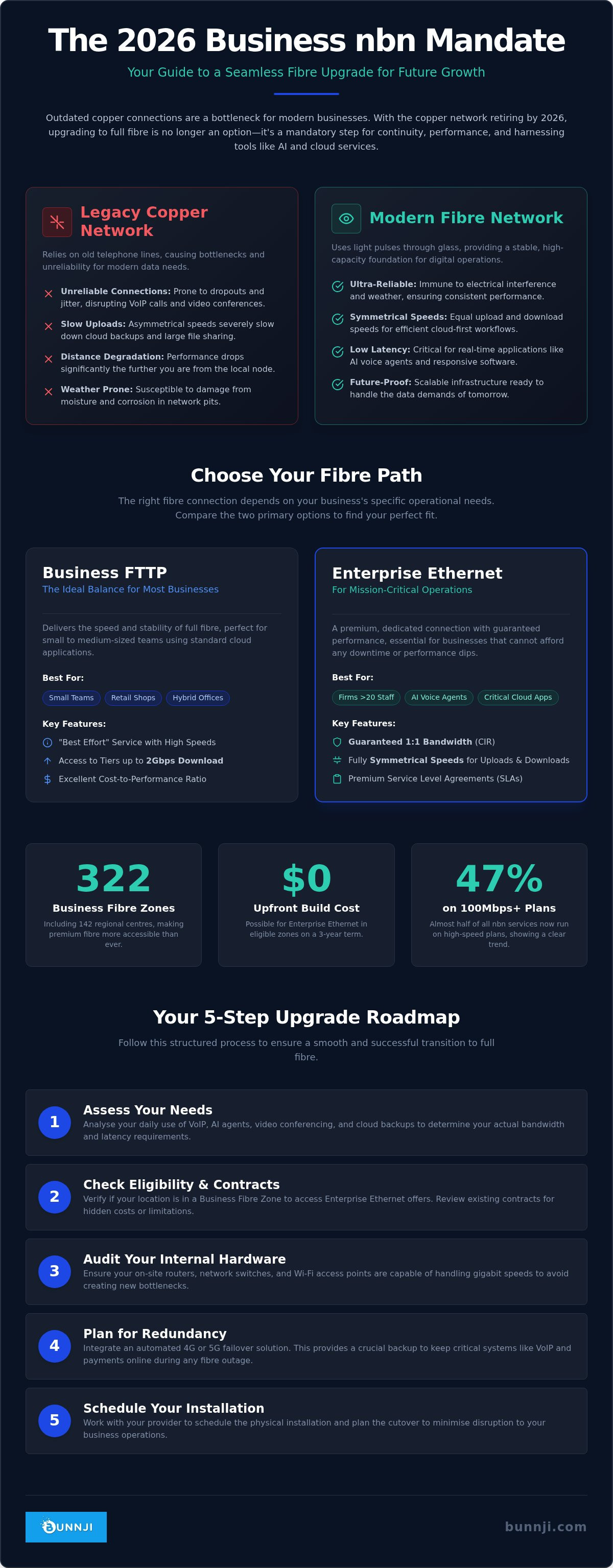
An nbn fibre upgrade for business is the physical process of replacing aging copper-based technologies, such as Fibre to the Node (FTTN) or Fibre to the Curb (FTTC), with a dedicated Fibre to the Premises (FTTP) connection. While legacy connections rely on electrical signals sent over copper wires, FTTP uses pulses of light through glass strands. This shift represents a fundamental change in how your office connects to the National Broadband Network (NBN). It moves your operations from a shared, distance-sensitive medium to a high-capacity infrastructure designed for the data demands of 2026.
The technical advantages of full fibre are immediate and measurable. You'll experience lower latency, which is the time it takes for data to travel between points. This is critical for real-time tools like AI voice agents and video conferencing. Fibre also supports symmetrical speeds, allowing for faster uploads that are essential for cloud backups and large file transfers. Most importantly, glass fibre is immune to the moisture and corrosion issues that frequently cause reliability problems in old copper pits.
The End of the Copper Era
Copper was originally laid for analogue voice calls, not the heavy data loads of modern cloud applications. It suffers from significant signal degradation; the further your office sits from the local node, the slower and more unstable your internet becomes. This leads to the frustrating "drop-outs" and jitter that plague traditional phone lines and slow down your team. By the end of 2026, NBN Co expects to have decommissioned vast sections of the copper network through its Targeted Upgrade program, making a transition mandatory for businesses that wish to remain connected.
Full Fibre vs Legacy Connections
FTTP is the gold standard for the modern Australian office because it eliminates the "peak hour" congestion common in older technologies. In a legacy setup, your bandwidth is often impacted by the activity of neighbouring businesses. Full fibre provides a more direct and stable path, ensuring your connection remains consistent even during high-traffic periods. This stability is the foundation for high-density Wi-Fi and unified communications. As of June 30, 2026, more than 3.3 million premises have already transitioned to fibre, with 47% of all NBN services now running on plans of 100Mbps or higher. Choosing an nbn fibre upgrade for business ensures your firm isn't left behind on an obsolete network that can no longer support your digital strategy.
FTTP vs Enterprise Ethernet: Choosing Your Fibre Path
Choosing an nbn fibre upgrade for business involves more than just picking the fastest number on a brochure. In 2026, the primary decision rests between Business FTTP and Enterprise Ethernet (EE). These two paths use the same physical fibre optic cables, but they treat your data very differently. Understanding these nuances is the key to ensuring your network supports your specific operational goals without overspending on unnecessary features.
Standard Business FTTP operates on a "best effort" basis. This means while the speeds are high, they can fluctuate slightly during peak periods. In contrast, Enterprise Ethernet offers a Committed Information Rate (CIR). This is essentially a private lane on the network where your bandwidth is guaranteed 1:1. For firms running mission-critical applications, this distinction is vital. Symmetrical speeds are another major factor. While many FTTP plans favour downloads, Enterprise Ethernet provides equal upload and download speeds. This is essential for hosting large video conferences, running off-site backups, and maintaining the low latency required for modern digital tools.
Eligibility is often the deciding factor. As of August 2026, NBN Co has established 322 Business Fibre Zones across Australia, including 142 regional centres. If your office sits within one of these zones, you can often secure an Enterprise Ethernet installation with $0 upfront build costs when signing up for a three-year plan. It’s a premium infrastructure move that has become significantly more accessible for the average firm.
When is Business FTTP Enough?
Small teams, retail shops, and hybrid offices often find that Business FTTP provides the best cost-to-performance ratio. It delivers the stability of full fibre without the enterprise price tag. With the introduction of the "2000 Pro" tier in 2026, businesses can now access 2Gbps download speeds on standard FTTP. This provides massive headroom for heavy cloud usage and high-density Wi-Fi. If your team primarily uses standard SaaS tools and doesn't require a strict uptime guarantee, this is likely your most efficient path forward.
The Case for Enterprise Ethernet
Firms with more than 20 staff or those relying heavily on AI voice agents should favour Enterprise Ethernet. The 99.95% uptime Service Level Agreement (SLA) ensures that your customer-facing systems stay online. EE also provides priority data handling, which prevents background updates from interfering with real-time CRM syncing or voice traffic. If you want to see which technology is available at your specific location, you can check your address eligibility with us to explore your upgrade options.
The Strategic Benefits of Fibre for Modern Operations
An nbn fibre upgrade for business isn't just about raw speed; it's about the fundamental stability of your daily communication. In a market where 47% of services are already on high-speed plans as of mid-2026, your competitive edge comes from reliability. High-quality Business VoIP Australia systems rely on a steady, uninterrupted stream of data. Fibre provides this by eliminating the packet loss that causes jitter and dropped calls on copper lines. It ensures your voice traffic is prioritised, giving your customers a professional experience every time they call.
This infrastructure is the backbone of the "One Number, Every Device" philosophy. It allows your unified communications platform to sync calls across desk phones, mobiles, and laptops without a hitch. Fibre also gives you the agility to scale. You can increase your bandwidth instantly as your headcount grows or your data needs expand. There's no need for expensive hardware changes or weeks of waiting for a technician; you simply adjust your plan to match your new requirements.
Foundation for AI and Automation
Modern AI Voice Agents need more than just a fast connection; they need extremely low latency. To sound natural and responsive, an AI receptionist must process voice data in milliseconds. If your connection lags, the conversation feels robotic or breaks down entirely, damaging your brand's reputation. Fibre removes this technical friction. It ensures your CRM and calendar sync in real-time with your automation tools. This eliminates the risk of double-bookings or lost customer data that occurs when slow legacy connections fail to update your cloud-based records.
Cloud Reliability and Data Security
Your data security is only as strong as your network's ability to run modern protective tools. Managed firewalls and complex cybersecurity software perform significantly better on stable fibre infrastructure. It also transforms your disaster recovery plan. On a copper connection, a full off-site backup might take hours and consume all your bandwidth; on fibre, it's done in minutes. This reliability also solves the hidden problem of "shadow IT". When office internet is slow or unreliable, staff often switch to personal 5G hotspots to get their work done. This bypasses your security protocols and leaves your firm vulnerable to attacks. An nbn fibre upgrade for business keeps your team on the secure, managed network you've invested in.
How to Organise Your nbn Fibre Upgrade: 5 Steps
Transitioning your office to full fibre requires more than just signing a new contract. It is a structured move that ensures your internal network can actually handle the massive increase in bandwidth. Managing an nbn fibre upgrade for business is about aligning your physical infrastructure with your 2026 digital goals to ensure every department benefits from the boost.
Step 1: The Telecommunications Audit
Before you order a single cable, you must understand your current environment. Many firms are still paying for legacy equipment or phone lines they no longer use. Mapping out your devices and cloud services allows you to choose a speed tier that matches your actual peak usage. A professional audit saves money by identifying redundant services and hidden exit fees before the upgrade even starts.
Once the audit is complete, checking eligibility is the next logical step. You need to select a speed tier that supports your 2026 strategy, whether that is the "500 Pro" or the ultra-fast "2000 Pro" tier. Placing your order through a specialist business provider is crucial here. They act as your advocate, managing the liaison with NBN Co so you don't have to navigate the wholesaler's bureaucracy yourself. This ensures your order is tracked and any site-specific issues are resolved quickly.
Step 4: Physical Installation Requirements
The arrival of an nbn technician is a key milestone. You need to decide on the best location for the Network Termination Device (NTD). This should be a cool, ventilated area near your primary server rack or router to maintain equipment health. Don't overlook your internal cabling; older Cat5 cables may bottleneck your new connection. Upgrading to Cat6 ensures you get the full benefit of fibre speeds at every desk. Coordinating this with your IT partner ensures the cut-over happens with minimal disruption to your staff.
The final step is establishing internet redundancy. A fast connection is useless if it has no backup. Implementing a 4G or 5G failover ensures your VoIP phones and cloud tools stay online if the primary line is accidentally cut during street works. You can start your transition today by booking a telecommunications audit with our team to identify your current network gaps and prepare for a seamless switch.
Beyond the Connection: Redundancy and Support
A successful nbn fibre upgrade for business doesn't end when the technician leaves. Fast internet is just the raw material. To turn that speed into a true operational advantage, you need to layer it with intelligent redundancy and expert local support. Without these, even the fastest fibre line remains a single point of failure that could halt your business. Integrating your new connection with a modern cloud phone system is the only way to reach its full potential, allowing your team to move seamlessly between office and remote work without losing functionality.
However, your hardware must keep pace. Routers and switches that served you well on copper will likely struggle with 1Gbps+ throughput. Managed IT support ensures your internal network and Wi-Fi actually deliver those fibre speeds all the way to the desk. It's about creating a bespoke environment where your technology works for you, rather than creating new bottlenecks.
Internet Redundancy: Your Safety Net
Downtime is more than an inconvenience; it's a massive financial drain. For a mid-sized Australian business in 2026, a single hour of disconnected service can cost thousands in lost productivity and missed sales opportunities. Automated failover is your insurance policy. If your primary fibre line is interrupted, your system instantly switches to a 4G or 5G backup. This keeps your VoIP phones and AI agents online without manual intervention. Setting up a robust disaster recovery plan as part of your migration ensures your customer service never falters, regardless of external network issues.
The Bunnji Difference: Expert Guidance
Moving away from generic, overseas call centres is the final step in a sophisticated digital strategy. At Bunnji, we provide a dedicated Australian partner who understands your specific business context. Managing an nbn fibre upgrade for business requires a partner who handles the end-to-end transition, from the initial audit to the final AI integration. This removes the technical burden from your shoulders, allowing you to focus on growth while we handle the wholesaler and the hardware. You can Contact Bunnji for a free telecommunications audit to start your upgrade and ensure your infrastructure is ready for the demands of 2026.
Secure Your Business Foundation for 2026
The retirement of the copper network is no longer a distant deadline; it's a current reality that requires immediate action to protect your operations. Transitioning to full fibre isn't just about speed. It's about providing the low-latency stability required for AI voice agents and cloud-first reliability. By choosing the right path between FTTP and Enterprise Ethernet, you're investing in a network that grows alongside your headcount and data needs.
An nbn fibre upgrade for business is most effective when paired with zero-downtime redundancy and expert local guidance. As specialists in 2026 business fibre transitions, we provide the Australian-based support you need to remove technical friction. We manage the wholesaler liaison so you can focus on your firm's growth without the bureaucratic headache. Book a 10-minute Telecommunications Audit with Bunnji today to identify hidden costs and start your seamless transition. Your future-proof network is closer than you think.
Frequently Asked Questions
Will my business experience downtime during the nbn fibre upgrade?
No, your existing service remains active until the new fibre line is fully commissioned. The technician installs the new Network Termination Device (NTD) alongside your current setup. You only experience a brief interruption when you physically move your router cable to the new port. We recommend scheduling this cut-over after hours or during a lunch break to ensure your team's workflow remains completely undisturbed throughout the entire process.
Is there an upfront cost for upgrading to nbn full fibre in 2026?
Most businesses qualify for a $0 upfront build cost if they are located within one of the 322 designated Business Fibre Zones. NBN Co has relaxed many of its previous upgrade requirements, though some providers may require a minimum contract term to waive the installation fee. It's essential to have a telecommunications audit conducted first to confirm your specific eligibility and identify if any internal cabling upgrades are needed for your premises.
What is the difference between Business NBN and Enterprise Ethernet?
While both use fibre, Enterprise Ethernet is a premium service offering a Committed Information Rate (CIR) and symmetrical speeds. Standard Business FTTP is a "best effort" service, meaning speeds can fluctuate during peak periods. Enterprise Ethernet also includes a 99.95% uptime Service Level Agreement, which is vital for firms running AI voice agents or mission-critical cloud tools. Choosing the right nbn fibre upgrade for business depends on your specific reliability requirements.
Do I need to replace my existing router when I upgrade to fibre?
You will likely need a new router if your current hardware cannot handle gigabit speeds or doesn't have a WAN port capable of high throughput. Many older routers were designed for copper speeds and will bottleneck a full fibre connection. We check your hardware's specifications during our audit to ensure your switches and Wi-Fi access points can actually deliver the increased bandwidth to your staff's devices without slowing down.
How long does the physical nbn fibre installation take?
A standard technician visit usually takes between two to four hours, depending on the complexity of your building's internal layout. This involves running the fibre optic cable from the street to your desired internal location and mounting the NTD. In some cases, nbn co may require a separate site visit to prepare the external lead-in conduits. We manage the liaison with the wholesaler to ensure these appointments are coordinated efficiently for you.
Can I keep my existing business phone numbers when I switch to fibre?
Yes, you can port your existing landline and 1300 numbers to a modern cloud-based VoIP system during the upgrade. This is the perfect time to move away from traditional copper-based phone lines which are being decommissioned. By porting your numbers to a digital platform, you gain the "one number, every device" functionality. This ensures your team can answer office calls from anywhere while maintaining a professional local presence for your customers.
What happens to my internet if the nbn fibre line is accidentally cut?
Your connection will drop unless you have an automated redundancy solution in place. We specialise in setting up 4G or 5G failover systems that activate the moment your primary fibre line loses signal. This keeps your VoIP phones, AI receptionists, and cloud tools online during street works or accidental outages. Having this safety net is a critical part of a professional nbn fibre upgrade for business strategy in 2026.
Is fibre necessary if my business only has five employees?
Yes, even small teams benefit from the stability and low latency that full fibre provides. If your five staff members are all using video conferencing, cloud-based CRM tools, and VoIP phones simultaneously, a copper connection will quickly become congested. Fibre ensures that your digital tools remain responsive and professional. It provides the necessary foundation for future-proofing your office as you adopt more advanced automation and AI-driven communication tools.


