
The 60-month telecommunications contract is the single biggest threat to your business agility in 2026. Most Australian leaders agree that managing a fragmented mess of Zoom links, Slack messages, and legacy desk phones is a recipe for operational burnout. You’ve likely felt the frustration of poor call quality during a pitch or the sting of hidden fees buried in a rigid, long-term agreement. It's a common struggle when navigating unified communications as a service australia, where technical complexity often masks simple inefficiency.
It doesn't have to be this way. We'll show you how to master the complexities of UCaaS to centralise your comms while side-stepping the traps of the local telco market. This guide promises to help you achieve a single business number across every device and lower your overheads through smart AI automation. We're providing a complete roadmap for 2026, covering everything from fibre redundancy to the specific audit questions you must ask before switching providers. By the end, you'll know exactly how to secure crystal-clear voice quality without the baggage of an outdated contract.
Key Takeaways
- Learn how to consolidate your voice, video, and messaging into a single interface to eliminate tool fragmentation and boost team productivity.
- Navigate the complexities of unified communications as a service australia by prioritising fibre redundancy to ensure crystal-clear voice quality across every device.
- Discover how to identify and avoid the "financial anchor" of 60-month equipment contracts that often lock Australian firms into outdated technology.
- Understand the critical differences between UCaaS and CCaaS so you can choose the right feature set without overpaying for unnecessary call centre tools.
- Explore how integrating AI voice agents can eliminate missed calls and automate your reception while syncing seamlessly with your existing CRM and calendar.
What is Unified Communications as a Service (UCaaS) in the Australian Context?
UCaaS isn't just a technical acronym; it's a fundamental shift in how Australian firms operate. At its core, Unified Communications as a Service is the consolidation of voice, video, messaging, and collaboration tools into a single, cloud-hosted platform. For years, businesses have struggled with siloed tools. You might have one app for chat, another for video, and a physical desk phone for calls. This fragmentation creates friction and slows down decision-making. By moving to a "single pane of glass" interface, your team can manage every interaction from one dashboard. This transition is particularly vital for unified communications as a service australia, where the vast distances between offices and the rise of hybrid work demand a more cohesive approach than traditional on-premise systems can provide.
We are seeing a rapid departure from the clunky desk phones that once dominated Australian offices. Modern teams are prioritising softphones and mobile apps that offer the same functionality without being tethered to a physical location. Unlike legacy hardware that requires expensive maintenance and onsite technicians, UCaaS is managed in the cloud. This means updates happen automatically. Scaling up for new staff takes minutes, not weeks. It removes the burden of managing complex technical infrastructure, allowing you to focus on growth rather than hardware troubleshooting.
The "Single Number" Revolution
The days of handing out personal mobile numbers to clients are over. With UCaaS, your business number follows you wherever you go. Whether you're at your desk, in a café, or working from home, your laptop and smartphone ring simultaneously. This ensures you maintain a professional presence regardless of your physical location. The "One Business Number" concept represents the end of missed calls and the confusing overlap of personal and professional mobile usage. It's about being reachable on your terms, ensuring that every client touchpoint is captured within your business ecosystem.
Cloud PBX vs. UCaaS: What’s the Difference?
It’s easy to confuse these terms, but the distinction is clear. A Cloud PBX primarily handles voice calls over the internet. While it’s a significant step up from old copper lines, it’s only one piece of the puzzle. UCaaS is the natural evolution; it adds video conferencing, real-time file sharing, and team collaboration into the mix. This integration allows your communication platform to talk to your other software, such as your CRM or project management tools. By choosing a comprehensive unified communications as a service australia strategy, you aren't just buying a phone system. You're building a platform that future-proofs your operations and streamlines your daily workflows.
The Core Pillars of a High-Performance UCaaS Strategy
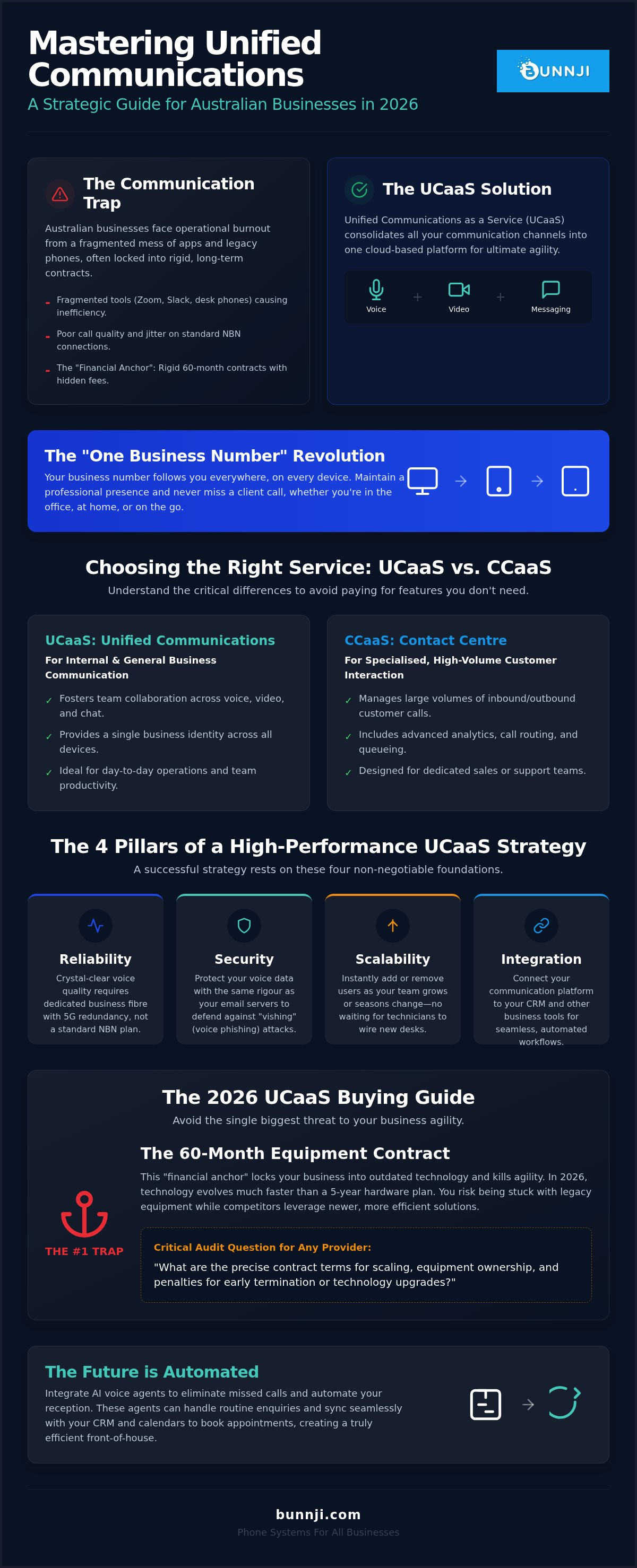
A successful strategy for unified communications as a service australia relies on four non-negotiable pillars: Reliability, Security, Scalability, and Integration. While Gartner defines Unified Communications as a way to facilitate the use of multiple enterprise communication methods, the Australian context adds unique layers of complexity. Reliability isn't just about software uptime; it's deeply tied to the quality of your business voip australia infrastructure and fibre connectivity. Without a stable foundation, even the most advanced features will fail when you need them most.
Scalability is where cloud systems outshine legacy hardware. You can add or remove users instantly. If your team grows during a busy quarter, you aren't waiting for a technician to wire up new desks. Integration ensures your phone system talks to your CRM, creating a seamless workflow where client details pop up before you even answer the call. Security acts as the final safeguard. With "vishing" (voice phishing) attacks becoming more sophisticated in 2026, your platform must protect voice data with the same rigour as your email servers.
Connectivity: The Foundation of Voice Quality
A standard home NBN plan rarely meets the demands of enterprise-grade communication. Jitter and latency can turn a professional call into a garbled mess. High-performance unified communications as a service australia requires dedicated business fibre with symmetrical speeds. We also recommend 5G internet redundancy as a failover. If the primary line goes down, your calls switch to a mobile network automatically. This level of internet redundancy ensures your operations continue without a second of downtime, keeping your staff connected even during local network outages.
Security and Compliance in a Hybrid World
Protecting your data is a legal necessity, not a choice. Encrypted calls and secure cloud storage are essential for meeting Australian regulatory standards. Managed firewalls and advanced network security layers prevent unauthorised access, while call recording features must be handled with strict data safety protocols. It's about building a defensive perimeter around your entire voice network to stop phone-based scams before they reach your staff. If you're unsure about your current setup, a quick telecommunications audit can reveal hidden vulnerabilities in your infrastructure.
UCaaS vs. CCaaS: Which Service Does Your Business Actually Need?
Choosing between Unified Communications as a Service (UCaaS) and Contact Centre as a Service (CCaaS) is a common crossroad for growing Australian firms. While UCaaS focuses on general business collaboration, CCaaS is purpose-built for high-volume customer interactions. Most organisations start with UCaaS to handle standard voice, video, and messaging. However, as customer expectations rise, the future of unified communications often involves a hybrid model. This allows you to provide advanced tools to your front-line support staff while keeping the rest of the office on a streamlined platform. Identifying your tipping point depends on whether your priority is internal teamwork or managing complex, multi-channel customer queues. For many Australian SMEs, the sweet spot is a unified communications as a service australia deployment that integrates with a smaller CCaaS module for the sales or support desk. This ensures you aren't paying a premium for every single employee when only a small team requires advanced queuing tools.
When UCaaS is Enough
For professional services like law firms or accounting practices, unified communications as a service australia usually provides everything needed to operate at an elite level. The primary goal here is seamless collaboration between staff and reliable client calling. You don't need complex omni-channel routing if your team mostly handles one-on-one appointments and internal project chats. If your workforce is frequently on the road or visiting clients, pairing your cloud system with Business Mobile SIM Only Plans ensures they stay connected without the need for a physical desk. It's a cost-effective way to maintain a professional presence without paying for contact centre features you'll never use. This approach keeps your overheads low while providing a "single pane of glass" for all your standard communication needs.
When to Upgrade to CCaaS
You’ll know it’s time to move to CCaaS when your basic call handling starts to feel overwhelmed or chaotic. CCaaS offers advanced analytics and call sentiment analysis, allowing you to see exactly how your team is performing in real-time. It handles large-scale customer support more effectively by using intelligent routing to send callers to the right specialist based on their specific needs. AI plays a massive role here, too. Modern contact centres use AI to automate routine enquiries, freeing up your human staff for more complex tasks that require a personal touch. If your business is managing hundreds of daily interactions across phone, email, and live chat, the upgrade to CCaaS provides the structure and data you need to scale without sacrificing service quality.
The 2026 UCaaS Buying Guide: Avoiding the "Contract Trap"
The 60-month telecommunications contract is the industry's best-kept secret, and it's one you must avoid. These long-term agreements often act as financial anchors for Australian firms. In a market where technology evolves every few months, locking your business into a five-year deal for hardware is a massive risk. You end up paying for outdated desk phones while your competitors leverage the latest AI features. A thorough telecommunications audit is essential before you sign anything. This process uncovers hidden costs like maintenance fees or inflated hardware markups that providers often bury in the fine print of their unified communications as a service australia agreements.
Ownership and portability are equally critical. Before committing, you must verify that you retain full rights to your business numbers. Some providers make it incredibly difficult to port numbers away, effectively holding your business identity hostage if you decide to switch. Ensure your agreement clearly states that you own your numbers and can move them to any provider without excessive "exit fees" or technical hurdles. This transparency is the difference between a partnership and a trap.
Questions to Ask Every UCaaS Provider
Clarity starts with the right questions. Ask your potential provider directly: "Do I own my numbers if I decide to leave?" You should also demand a full breakdown of any contract payouts or hidden termination fees. A reputable provider will be upfront about these costs. Finally, verify where their support team is based. You want on-the-ground Australian experts who understand local infrastructure, not an offshore call centre reading from a generic script. Local knowledge is invaluable when you need a fast resolution to a connectivity issue.
Microsoft Teams vs. Dedicated UCaaS
Many Australian firms default to Microsoft Teams because they already pay for the license. It’s a solid tool for internal chat, but it often lacks the reliability and feature depth required for a primary phone system. Teams can struggle with complex call routing or advanced reception features that a dedicated unified communications as a service australia platform handles with ease. The most effective approach is often integration. Bunnji works within the Teams ecosystem to provide a "best of both" solution. You get the familiar Teams interface backed by a high-performance voice engine and professional-grade reliability. Before you settle for a basic setup, you should book a telecommunications audit to see how a dedicated system can better support your specific operational needs.
Bunnji: Your Capable Partner for Unified Communications
Bunnji acts as the bridge between sophisticated global technology and the specific requirements of the local market. We simplify the complexities of unified communications as a service australia by removing the technical friction that often holds businesses back. Instead of generic, off-the-shelf bundles, we provide bespoke solutions built on high-speed fibre connectivity and robust internet redundancy. Our approach is direct and transparent. We don't believe in hiding behind bureaucratic layers or predatory 60-month contracts. We focus on providing a stable, elite service that respects your time and your bottom line while keeping your team connected on every device.
We position ourselves as a capable partner that retains a personal, boutique touch. While we have the resources to support national operations, we remain responsive and easy to reach. This commitment to transparency ensures that you always know exactly what you're paying for, with no hidden fees or "financial anchors" to weigh you down. By combining modern infrastructure with a no-nonsense attitude toward service, we help you master the intricacies of unified communications as a service australia without the usual corporate headache.
The AI Advantage: Beyond Just Calling
Our AI voice agents for business are changing how Australian firms handle their front-of-house operations. These aren't simple chatbots; they are sophisticated receptionists that sync directly with your CRM and calendar to manage bookings and enquiries in real-time. This automation significantly lowers operational overhead by handling routine appointment bookings without human intervention. AI agents provide a "fair go" for small teams by ensuring every call is answered, even when the office is closed or the team is on-site. It's about ensuring you never miss a lead while maintaining a premium, professional image for every caller who dials your number.
Getting Started with a Comms Audit
Most businesses are overpaying for outdated infrastructure without even realising it. Our process begins with a 10-minute telecommunications audit designed to identify immediate savings and performance gaps. We help you transition from unreliable copper connections to modern, high-speed fibre that actually supports enterprise-grade voice quality. This audit is the first step in future-proofing your business and escaping the contract traps that plague the industry. We look at your current usage, identify vulnerabilities, and provide a clear roadmap for modernisation. It's a no-nonsense look at your tech stack that places the power back in your hands. To see how we can streamline your setup, you should book a discovery call with the Bunnji team and start your journey toward a more agile, centralised communication platform.
Secure Your Communication Future
Moving to a centralised platform isn't just about modernising your phone system; it's about reclaiming your business agility. We've explored how a robust strategy for unified communications as a service australia eliminates tool fragmentation while protecting you from predatory 60-month contract traps. You now have the roadmap to integrate AI voice agents that sync with your CRM and ensure your voice quality is backed by proper fibre redundancy.
As an Australian-owned and operated provider, we pride ourselves on delivering local support that understands your specific infrastructure requirements. We are pioneers in AI integration, helping you answer every call without increasing your headcount. Don't let the "financial anchor" of an outdated contract hold your growth back in 2026. Take the first step toward a more transparent and efficient setup today. Book a 10-Minute Telecommunications Audit with Bunnji to identify immediate savings and performance gains. Your team deserves a system that works as hard as they do.
Frequently Asked Questions
What is the average cost of UCaaS per user in Australia for 2026?
Pricing for a comprehensive unified communications as a service australia strategy depends on your specific requirements for AI integration, fibre redundancy, and user volume. Rather than relying on generic industry averages, businesses should evaluate the total cost of ownership. This includes potential savings from eliminating legacy hardware maintenance and avoiding expensive long-term contract traps. A detailed telecommunications audit is the most accurate way to determine the specific investment required for your organisation.
Can I keep my existing business phone numbers when moving to UCaaS?
Yes, you can keep your existing numbers through a process called porting. It is vital to confirm that you retain full ownership of these numbers before signing any new agreement. Some providers make it difficult to move numbers later, effectively locking you into their service. We ensure that your business identity remains yours, allowing for a seamless transition from traditional copper lines or older VoIP systems to a modern cloud platform.
Do I need to replace all my desk phones to use a Unified Communications platform?
You don't necessarily need to replace your existing hardware. While many Australian firms are moving toward softphones and mobile apps for better flexibility, many modern desk phones are compatible with UCaaS through SIP trunking. If your current phones are outdated, you can replace them gradually. Most teams find that a "best of both" approach works best, keeping physical phones for reception desks while using mobile apps for staff on the move.
How does UCaaS improve productivity for remote Australian teams?
UCaaS centralises all communication tools into a "single pane of glass" interface. This allows remote staff to access voice, video, and messaging from any location using their business number. It removes the friction of switching between fragmented apps and ensures that team members stay professional without using personal mobile numbers. By providing a consistent experience across every device, your team can collaborate more effectively, regardless of where they are working across the country.
Is UCaaS secure enough for law firms and medical clinics?
Yes, enterprise-grade UCaaS platforms are built with high-level encryption and security protocols that meet Australian regulatory standards. For sensitive industries like law and healthcare, we implement managed firewalls and secure data storage to protect against cyberattacks and "vishing" scams. This ensures that client conversations and patient data remain confidential. Choosing a provider that prioritises cybersecurity and data sovereignty is essential for maintaining compliance and peace of mind in a hybrid work environment.
What happens to my phone system if the NBN goes down?
If your primary NBN connection fails, a high-performance system with internet redundancy will automatically switch to a backup, such as a 5G failover. This ensures your calls continue without interruption. Even without a dedicated hardware backup, cloud-based systems remain accessible via mobile data on your smartphone or laptop. This level of disaster recovery is a core benefit of unified communications as a service australia, ensuring your business stays reachable during local network outages.
Can UCaaS integrate with my existing CRM like Salesforce or HubSpot?
Integration is a fundamental pillar of a modern communication strategy. Most UCaaS platforms sync directly with popular CRMs like Salesforce, HubSpot, or Zoho. This allows for automated call logging and provides your staff with instant access to client details as soon as the phone rings. By connecting your phone system to your CRM, you eliminate manual data entry and ensure that every customer interaction is accurately recorded, which significantly improves your team's efficiency.
What is the difference between UCaaS and a standard VoIP phone system?
Standard VoIP focuses almost exclusively on delivering voice calls over the internet. UCaaS is the natural evolution of this technology, consolidating voice, video conferencing, team messaging, and real-time collaboration tools into a single platform. While VoIP replaces your traditional phone line, UCaaS replaces your entire communication stack. It provides a more holistic approach to business connectivity, allowing for deeper integrations with other software and providing a more flexible environment for modern Australian workforces.


