
How much did that last missed call actually cost your business? When a potential client hits a busy tone or a clunky voicemail, they don't usually wait; they simply call the next person on their list. If you're still battling dodgy internet or feeling trapped by a rigid 60-month hardware contract, you already know that traditional telecommunications aren't built for the way we work now.
Finding a reliable cloud pbx australia solution is no longer just about making calls. It's about building a strategic platform that supports your remote team and automates your front desk. You need a system that's sophisticated enough to handle AI voice agents but simple enough to be truly "set and forget."
In this 2026 buyer's guide, we'll show you how to choose a scalable, AI-ready phone system that integrates seamlessly with your existing CRMs. We'll explore how to ensure crystal-clear call quality through fibre redundancy and how to navigate the latest Australian SMS and privacy regulations. By the end, you'll have a clear roadmap to predictable billing and a communication setup that actually grows with you.
Key Takeaways
- Identify why retiring legacy hardware in favour of a cloud pbx australia setup is the first step toward a scalable, future-proof communications strategy.
- Uncover the critical evaluation criteria for providers, focusing on the necessity of local support teams over outsourced call centres.
- See how AI Voice Agents are transforming the traditional PBX into an automated platform that manages enquiries and bookings directly within your CRM.
- Learn to safeguard your operations against internet outages by implementing fibre redundancy and avoiding the risks of residential-grade NBN.
- Discover a simplified migration path that protects your existing Australian numbers and eliminates the complexity of long-term hardware contracts.
Understanding Cloud PBX in the Australian Business Landscape
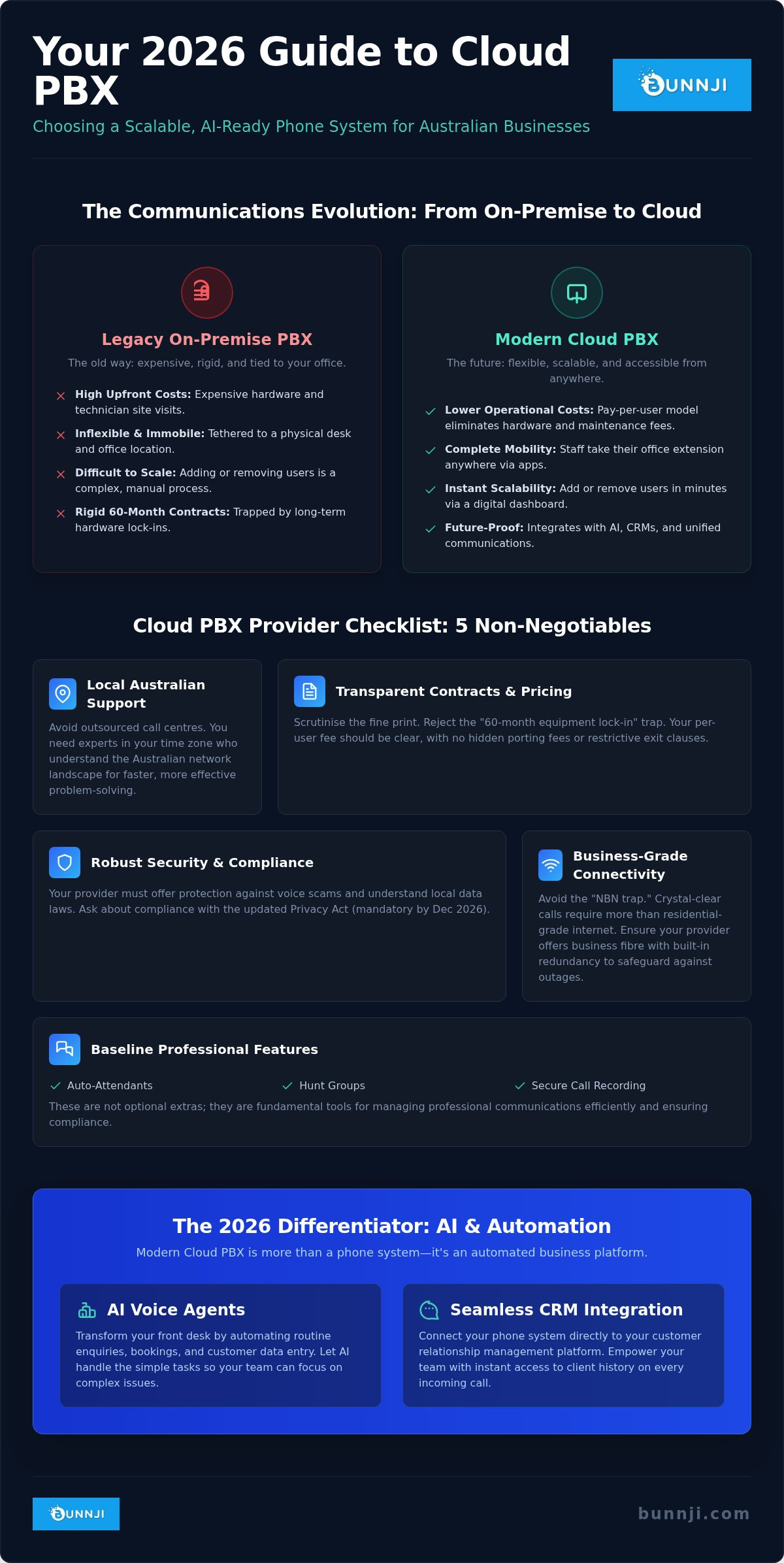
A cloud pbx australia solution is essentially a virtualised telephone exchange hosted in secure data centres rather than on your office wall. For decades, a business telephone system required a massive metal box in a server room and a web of complex wiring. Those days are over. Australian businesses are rapidly retiring on-premise hardware because it's expensive to maintain and impossible to scale quickly. Modern systems turn your communication into a software service, accessible from any location with a stable connection.
The rollout of the NBN and high-speed fibre has been the catalyst for this shift. In 2026, business-grade internet provides the reliable bandwidth needed for crystal-clear voice traffic, provided you have the right redundancy in place. This move to the cloud offers several immediate advantages:
- Scalability: Add or remove users in minutes through a digital dashboard.
- Mobility: Staff can take their office extension anywhere in the world.
- Lower Costs: Eliminate the need for expensive technician site visits and hardware upgrades.
The Shift from Hosted VoIP to Unified Communications
The technology has evolved far beyond basic internet calling. While early VoIP systems were simple, modern platforms act as an all-in-one communication centre. They integrate voice, video conferencing, and instant messaging into a single interface. For hybrid Australian teams, the "one number, every device" model is now essential. It ensures that a staff member is just as reachable at a local cafe as they are at their desk. For a deeper look at how this fits your broader digital goals, see our Business VoIP Australia: The Complete 2026 Strategy Guide.
Why Traditional Desk Phones are Becoming Optional
We're seeing a significant move toward softphones and mobile applications. Your workforce is mobile, and they don't want to be tethered to a physical handset. By using digital apps, your team can turn their laptop or smartphone into a fully functional business extension. This flexibility is a game changer for the "on-the-go" workforce. While some industries still prefer a physical phone, the cost implications are clear. Shifting from physical hardware maintenance to cloud-based licences reduces capital expenditure and simplifies your monthly billing. You pay for the capability, not the plastic on the desk.
Choosing the Right Cloud PBX: Key Evaluation Criteria
Selecting a provider for cloud pbx australia involves looking past the flashy marketing and scrutinising the operational reality. You need a system that works as hard as your team does. This starts with non-negotiable features like auto-attendants to direct traffic, hunt groups to ensure someone always answers, and secure call recording for quality and compliance. These tools aren't just "nice to haves" anymore; they're the baseline for professional communication.
Don't overlook the value of a local Australian support team. When a configuration issue arises, you want a technician who understands the local network and operates in your time zone. Overseas call centres often lack the granular knowledge of the Australian telecommunications landscape. Security is another major pillar. With the rise of AI-driven voice scams, your provider must offer robust protection. This is especially critical given the December 2026 mandatory disclosure requirements for automated decision-making under the updated Privacy Act. You need a partner who understands these local compliance hurdles and keeps your data secure.
Scalability and the Per-User Pricing Model
The beauty of cloud systems lies in their agility. You can add or remove extensions instantly as your head count changes. When evaluating costs, understand exactly what your per-user monthly fee covers. Does it include local calls, or are those metered? Sophisticated businesses are now integrating SIM-only business plans into their PBX strategy to create a unified mobile and desk environment. This approach is a key part of adopting digital tools that drive genuine efficiency and long-term growth.
Transparency in Telecommunications Contracts
The industry is notorious for the "60-month equipment lock-in." These long-term contracts for physical handsets often cost far more than the hardware is worth. Always check the fine print for hidden porting fees or restrictive exit clauses. According to the ACMA, porting a local number typically takes between 8 and 15 business days, though complex ports can take up to 30. A transparent provider will be upfront about these timeframes and any associated costs.
Some "free" hardware offers are simply a way to mask high monthly service fees. If you're unsure where your money is going, a specialised telecommunications audit can reveal hidden costs and help you reclaim your budget. Taking the time to audit your current setup ensures you aren't paying for "ghost" services or outdated infrastructure that no longer serves your organisation.
The 2026 Differentiator: AI Voice Agents and CRM Integration
In 2026, a competitive cloud pbx australia strategy relies on more than just dial tones. It's about turning your communication hub into an active participant in your business growth. An AI Voice Agent is a 24/7 digital receptionist that understands natural Australian speech, ensuring your callers never feel like they're talking to a rigid machine. This shift marks a major evolution in the On-Premises vs. Cloud PBX debate, moving the focus from simple connectivity to intelligent automation.
Missed calls are a silent revenue killer for local firms. AI receptionists eliminate this risk by answering every call instantly, regardless of the time or volume. They don't just take a name and number; they manage complex bookings and resolve frequent enquiries using your live data. This allows your skilled team to stop playing phone tag and focus on high-value projects that require a genuine human connection. By automating the "front door" of your business, you ensure that no lead is ever left waiting on a busy tone.
Connecting Phone Calls to Your CRM and Calendar
Manual data entry after a phone call is a significant waste of resources in a modern office. Leading systems now offer deep integration with platforms like Salesforce, HubSpot, and Zoho. When a client calls, their entire purchase history and previous notes pop up on your screen before you even say hello. This immediate context allows your staff to provide a personalised experience that feels elite rather than transactional. It also ensures that every interaction is logged automatically, maintaining a clean data trail without the administrative burden. For a deeper look at these emerging technologies, see our AI Voice Agents: 2026 Trend Report for Australian Firms.
Automating the Customer Journey
Automation allows you to qualify leads before they ever reach a human staff member. By asking a few diagnostic questions, the AI system determines the caller's specific needs and urgency. It then uses smart routing based on your CRM data to send the call to the most appropriate person or department. This level of sophistication improves the professional image of small Australian businesses, making them appear as responsive and organised as a global enterprise. It removes the friction from the customer journey, ensuring that urgent enquiries are prioritised and routine tasks are handled with robotic precision.
Avoiding the "NBN Trap": Connectivity and Redundancy
A cloud pbx australia system is only as reliable as the internet connection supporting it. While the shift to the cloud offers incredible flexibility, it also creates a single point of failure. If your office internet drops, your ability to communicate with clients drops with it. Many small firms fall into the "NBN Trap" by running business-critical voice services over a standard residential-grade connection. These residential plans often lack the stability and support required for professional use, leaving you vulnerable during peak times or local network outages.
Voice traffic requires very little bandwidth, but it demands high consistency. This is where Quality of Service (QoS) becomes vital. QoS settings on your router prioritise voice data over standard traffic, like large file downloads or software updates. Without this prioritisation, you'll experience jitter, lag, and dropped calls. Before migrating, you must assess your current upload and download speeds. VoIP is unique because it relies heavily on upload speed; if your connection is asymmetrical and weak on the upload side, your outgoing audio will suffer regardless of how fast your download speed appears.
The Importance of Internet Redundancy
What happens to your phones when a local construction crew accidentally cuts an NBN line? For businesses without redundancy, the answer is total silence. Implementing a 4G or 5G failover is the most effective way to ensure 100% uptime. If your primary fibre or NBN connection fails, the system automatically switches to the mobile network, keeping your calls active without interruption. While standard NBN is suitable for many, growing firms should consider dedicated Business Fibre. It offers symmetrical speeds and strict Service Level Agreements (SLAs) that residential plans simply cannot match.
Disaster Recovery Planning for Your Comms
Cloud systems provide a level of disaster recovery that traditional hardware never could. Because your "exchange" lives in the cloud, physical disruptions at your office don't take your system offline. You can set up automatic call re-routing to mobile devices or secondary locations the moment an outage is detected. This ensures your clients can always reach you, even if your building loses power. The peace of mind that comes with a managed connectivity solution allows you to focus on your core operations rather than worrying about technical downtime. It turns your communication setup from a potential liability into a resilient business asset.
Transitioning to Bunnji: A Smarter Approach to Comms
Legacy systems are often a tangle of outdated hardware and restrictive agreements. Transitioning to a modern cloud pbx australia shouldn't be a source of stress. Bunnji takes a hands-on approach to migration, ensuring your business stays online while we move your infrastructure to the cloud. We handle the heavy lifting of porting your existing Australian numbers, navigating the ACMA's technical requirements so you don't have to. Our process is designed to be transparent, removing the friction that usually accompanies a change in providers.
The Bunnji Telecommunications Audit
The first step in any successful modernisation is understanding exactly what you're currently paying for. Many organisations are burdened by "zombie" lines, or services that are still being billed but haven't been used in years. Our bespoke telecommunications audit identifies these hidden equipment charges and redundant services. This is how we help you escape the 60-month contract trap that many big telcos use to lock you into overpriced, ageing hardware. During the audit, we specifically look for:
- Zombie lines: Services you're still paying for that haven't been used in years.
- Contract traps: Hidden clauses in long-term agreements that make switching difficult.
- Usage mismatches: Plans that don't align with your actual call volumes or data needs.
Security is also a primary concern. With the December 2026 Privacy Act updates requiring stricter disclosure of automated systems, we ensure your cybersecurity is baked into your phone system from day one. We look at your entire communication stack to find vulnerabilities, protecting your team from the rising threat of voice-based scams.
Seamless Onboarding and Local Support
The first 30 days are critical for any new system. While big telcos often leave you with a pile of Critical Information Summaries and an offshore support ticket, we provide a dedicated account manager who actually knows your business. This local expert guides you through the transition, ensuring every staff member is comfortable with the new interface. Whether you're using softphones on mobile devices or traditional handsets, we ensure the setup is intuitive and functional.
Our onboarding process for cloud pbx australia is methodical yet fast-paced. We move quickly from identifying your requirements to delivering a concrete, stable solution. You won't be stuck in a bureaucratic layer; you'll have direct access to specialists who prioritise your uptime. It's time to stop overpaying for outdated tech and start using a platform that actually supports your growth. Book your free telecommunications audit with Bunnji today and take the first step toward a more efficient future.
Future-Proofing Your Business Communications
Transitioning to a modern cloud pbx australia platform is more than just a hardware upgrade. It's a strategic shift that places AI voice agents at the centre of your operations and secures your revenue against unexpected internet outages. By prioritising local expert support and implementing fibre redundancy, you eliminate the friction of missed calls and the complexity of legacy hardware contracts. You're not just buying a phone system; you're investing in a scalable platform that grows alongside your team.
At Bunnji, we specialise in seamless AI voice agent integration and no-nonsense telecommunications audits designed to find and fix hidden costs. Our Australian-based team provides the personal touch and technical precision needed to move your business forward with confidence. It's time to leave the rigid contracts of the past behind and embrace a communication strategy built for 2026 and beyond.
Upgrade your business with a Cloud PBX that actually works, get started with Bunnji. Your organisation deserves a communication system that is as ambitious and resilient as your team.
Frequently Asked Questions
Is Cloud PBX reliable for Australian businesses with standard NBN?
Cloud PBX is highly reliable on the NBN provided you have a business-grade connection with sufficient upload bandwidth. Standard residential NBN often lacks the prioritisation needed for clear voice traffic, which can lead to jitter or dropped calls. Implementing Quality of Service (QoS) on your router ensures that voice data takes precedence over other internet activity. For maximum stability, we recommend a connection with a dedicated Service Level Agreement and built-in redundancy.
Can I keep my existing Australian business phone numbers when moving to Cloud PBX?
You can absolutely keep your existing Australian business phone numbers when migrating to a new system. This process, known as porting, is regulated by the ACMA to ensure consumer flexibility. Most local number ports take between 8 and 15 business days, while more complex setups might take up to 30 days. We handle the technical coordination with your current provider to ensure a seamless transition without losing your established identity or contact details.
What is the difference between a Hosted PBX and a Cloud PBX?
While the terms are often used interchangeably, a cloud PBX is the modern evolution of hosted technology. A hosted system typically refers to a single physical server located off-site, whereas a cloud PBX runs across a cluster of virtualised servers. This makes a cloud pbx australia setup more resilient and scalable. It allows you to add users instantly and access advanced features like AI agents that older hosted systems simply cannot support.
How much does a Cloud PBX system typically cost per month in Australia?
Monthly costs for a cloud pbx australia solution vary based on the number of users and the specific features your business requires. Most providers offer tiered pricing that ranges from basic voice services to premium packages including CRM integration and advanced analytics. You'll typically pay a per-user licence fee, which simplifies your budgeting compared to traditional phone lines. We recommend a telecommunications audit to ensure your plan matches your actual usage patterns.
Do I need special IP handsets to use a Cloud PBX system?
You don't necessarily need physical IP handsets to use a cloud system. Many modern Australian teams prefer using softphones, which are applications installed on laptops or smartphones. This allows for total mobility without the cost of hardware. However, if your staff prefer a traditional desk experience, you can use compatible IP phones. These devices plug directly into your internet connection and offer high-definition audio quality for a professional office feel.
How does an AI receptionist integrate with my Cloud PBX?
An AI receptionist integrates directly into your phone system's call flow, acting as the first point of contact for every caller. It uses natural language processing to understand Australian speech and can sync with your CRM and digital calendars. This allows the agent to book appointments, qualify leads, and update client records in real time. It effectively bridges the gap between your communication platform and your core business software, ensuring no data is lost.
What happens to my phone system if the office internet goes down?
If your office internet fails, your cloud system remains active because the brain of the PBX lives in a secure data centre. You can set up automatic failover to 4G or 5G networks to maintain 100% uptime. Alternatively, calls can be instantly re-routed to mobile apps or secondary locations. This ensures your clients can always reach you, providing a level of resilience that traditional on-premise hardware simply can't match during a physical disruption.
Is Cloud PBX secure against hackers and voice scams?
Cloud systems are built with robust encryption and security protocols to protect against unauthorised access and voice scams. With the Privacy and Other Legislation Amendment Act 2024 now in effect, protecting client data is a legal necessity. We implement multi-factor authentication and regular security audits to safeguard your communications. Choosing a provider that understands the Australian regulatory landscape ensures your business remains compliant while defending against increasingly sophisticated AI-driven cyberattacks.


