

In 2026, a recorded phone call is no longer just a digital insurance policy; it's the most valuable data asset your firm owns. You've likely felt the headache of trying to keep up with Australia's fragmented Surveillance Devices Acts, where a single conversation might be legal to record in one state but a privacy breach in another. Implementing voip call recording for business shouldn't feel like a legal gamble or a drain on your storage budget. It's a common frustration for local directors who want to protect their teams without accidentally crossing a regulatory line while managing the shift from the old PSTN network.
We're here to clear the fog and help you turn these audio files into actionable growth. This guide will show you how to master Australian compliance across every territory, ensuring your record-keeping is airtight and your client data stays secure. You'll discover how to integrate these recordings with your CRM to automate staff training and leverage AI-driven insights to stay ahead of the competition. We'll explore the strategic advantages of modern cloud systems and provide a clear roadmap to achieving total legal peace of mind.
Key Takeaways
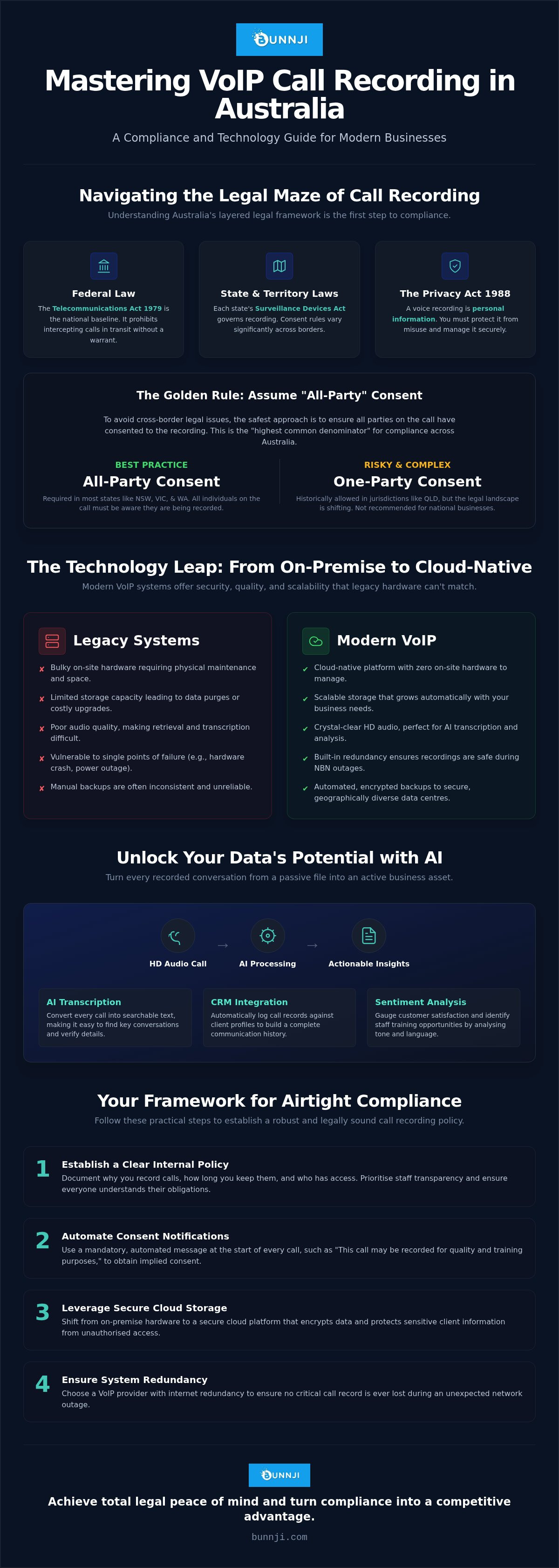
- Navigate the complex web of state-based surveillance laws to ensure your firm remains compliant across all Australian jurisdictions.
- Shift from outdated on-premise hardware to secure cloud storage that protects sensitive client data while reducing overheads.
- Discover how voip call recording for business integrates with AI to turn every conversation into searchable text and actionable customer insights.
- Establish a practical framework for internal policies that prioritise staff transparency and high-quality training outcomes.
- Leverage seamless CRM integrations and internet redundancy to ensure no critical record is ever lost during an unexpected outage.
Navigating Australian Call Recording Laws and Compliance
Setting up voip call recording for business isn't just about clicking a button in your software dashboard. It's about understanding a layered legal framework that spans both federal and state lines. In Australia, the rules aren't uniform. While the federal government oversees the network itself, each state dictates how you can legally capture a private conversation. This creates a complex environment where a call from one state to another might be subject to different rules than a local call within the same city. For business owners, the goal is simple: achieve total legal peace of mind without slowing down your operations.
Federal vs State Jurisdictions
The Telecommunications (Interception and Access) Act 1979 serves as the national baseline. It strictly prohibits the interception of any communication passing over a telecommunications system without a warrant. However, once the call reaches your device, state-based Surveillance Devices Acts take over. Most Australian states, including New South Wales, Victoria, and Western Australia, generally require the consent of all parties involved before a recording can take place. This is often referred to as "all-party" consent.
While some jurisdictions like Queensland have historically allowed "one-party" consent, the landscape is shifting. If your firm operates nationally or even calls customers across state borders, you must comply with the strictest state law applicable to the conversation. You can find a more detailed breakdown of Australian call recording laws to see how these nuances vary by territory. We often recommend that our clients adopt a "highest common denominator" approach to avoid the risk of accidental non-compliance during a telecommunications audit.
The Privacy Act and Data Storage
Under the Privacy Act 1988, a voice recording is classified as "personal information" because an individual's identity can be reasonably ascertained from their voice. This classification means your business must comply with the Australian Privacy Principles (APPs). You're legally required to protect this data from misuse, interference, or unauthorised access. It's not enough to just record the call; you must ensure the audio files are stored in a secure, encrypted environment that meets modern cybersecurity standards.
Retention policies are another critical factor. You shouldn't keep recordings indefinitely without a clear business purpose. Most firms establish a policy to keep recordings for a specific period, such as seven years for financial transactions, before securely deleting them. This proactive approach reduces your data footprint and limits your liability in the event of a security breach.
Compliance starts with transparency. Every modern VoIP system should include a mandatory notification prompt at the start of the call. A simple "This call may be recorded for quality and training purposes" satisfies the requirement for implied consent. If the caller continues the conversation after hearing this message, they've effectively agreed to the recording. This prompt is your first line of defence, ensuring that voip call recording for business remains a tool for growth rather than a legal liability.
How Modern VoIP Call Recording Outperforms Legacy Systems
The days of bulky on-site servers and magnetic tapes are well and truly behind us. In 2026, legacy hardware isn't just an eyesore; it's a liability. Traditional PBX recording systems often struggled with storage limits and poor audio quality, making it nearly impossible to retrieve specific conversations during a dispute. Modern voip call recording for business has flipped this script by moving the entire process to the cloud. This shift allows for high-definition audio that doesn't just sound better, it's actually clear enough for AI transcription engines to process with high accuracy.
The Shift to Cloud-Native Recording
Cloud-native platforms eliminate the friction of physical maintenance. You no longer need to worry about hard drive failures or manual backups at your office. Instead, your recordings are encrypted at the handset and transmitted directly to secure data centres. This scalability means your storage capacity adjusts automatically to your call volume. Whether you're a boutique agency or a national firm, the system grows with you without requiring a single hardware upgrade.
Redundancy and Reliability
One major concern for Australian businesses is the stability of the NBN. If your internet drops, your ability to record calls usually drops with it. This is where modern infrastructure proves its worth. By using systems designed with internet redundancy, you ensure that calls are captured even if your primary connection fails. This reliability is essential for staying on the right side of the Telecommunications (Interception and Access) Act 1979, which mandates how communications are handled across the national network.
Choosing between automatic and on-demand recording is also simpler now. You can set global defaults to ensure every client interaction is logged, or allow staff to trigger recordings manually for specific consultations. This level of control helps you balance compliance with privacy. If you aren't sure if your current setup is up to standard, a specialised telecommunications audit can help identify gaps in your recording strategy before they become costly problems.
The combination of HD audio and cloud reliability means your communication logs are always ready when you need them. It's a level of stability that legacy systems simply can't match, providing a solid foundation for the AI-driven insights that modern firms rely on to stay competitive.
Beyond Audio: Leveraging AI Transcription and Sentiment Analysis
Most businesses treat recording as a "set and forget" feature. In 2026, that's a wasted opportunity. Modern voip call recording for business is now the primary engine for high-level business intelligence. By converting every spoken word into structured data, you can move beyond simply storing audio and start understanding the "why" behind every client interaction. It's about turning a passive archive into an active asset that drives your firm's growth.
AI-Driven Business Intelligence
Automated transcription is the foundation of this shift. It turns hours of audio into searchable text, allowing you to track specific keyword mentions across your entire team. For example, you can instantly see how many callers are asking about a new competitor or a specific service feature without listening to a single minute of tape. AI also handles the heavy lifting of documentation. Automated call summaries provide concise bullet points of every conversation, saving staff from the manual grind of note-taking.
Beyond just words, sentiment analysis gauges the emotional tone of a call. By assigning a sentiment score, the system can flag frustrated customers in real-time, allowing senior management to prioritise high-risk follow-up calls before a client decides to churn. These insights are exactly how AI voice agents continue to refine their performance, learning from real-world human interactions to provide a more natural and helpful experience for your callers.
CRM and Workflow Integration
The real magic happens when your recording data lives where your team works. Modern systems bridge the gap between phone conversations and digital sales funnels by automatically attaching transcripts and audio files to client records. This ensures your staff always have a 360-degree view of the customer's history. When a team member picks up the phone, they aren't starting from scratch; they're continuing a documented journey.
You can also trigger specific workflows based on what happened during the call. If a transcript detects a request for a quote or a specific follow-up date, the system can automatically send a confirmation email or create a task in your CRM. This level of automation ensures nothing slips through the cracks, transforming a simple phone call into a powerful lead-nurturing tool. It's a proactive approach to record-keeping that values your staff's time and your clients' expectations.
Implementing a Call Recording Policy: A Practical Framework
Deploying the right technology is only half the battle. To truly protect your firm, you need a robust internal policy that governs how voip call recording for business is used on a daily basis. Without a clear framework, you risk alienating your team or failing a compliance check. A well-drafted policy defines your core purpose, whether that's for dispute resolution, quality assurance, or staff development. It transforms a technical feature into a transparent business process that everyone in the office understands and respects.
Staff Engagement and Ethics
Transparency is the bedrock of a healthy workplace culture. You should consult with your team before activating any recording features, explaining exactly how the data benefits their professional growth. Instead of using recordings solely for "policing" behaviour, use 'best-of' examples to highlight excellent customer service during team meetings. This turns a potentially intrusive tool into a positive training asset that rewards high performance. You should also ensure your employment contracts include clear clauses regarding call monitoring. This avoids any legal ambiguity and ensures every staff member knows their rights and responsibilities from day one. It's about building trust through open communication rather than hidden surveillance.
The Security Audit Process
A policy is only as effective as its enforcement. You must establish strict access controls, ensuring only authorised senior managers can listen to or download sensitive audio files. Every access event should be logged to create a clear paper trail. Regular internal audits are also necessary to verify that your system's 'pause' or 'opt-out' function works correctly. This is vital when staff handle credit card details or sensitive personal information that simply shouldn't be captured or stored.
Security isn't a one-time setup. It requires ongoing vigilance to ensure your encryption standards remain current and your storage locations are still compliant with Australian law. Conducting a regular telecommunications audit is the most effective way to identify hidden security gaps in your infrastructure. These reviews help you stay ahead of emerging threats and ensure your recording practices don't become a liability during an unexpected data breach. If you want to ensure your firm's communications are fully protected and compliant, book a specialised audit with the experts at Bunnji to secure your systems for the future.
Optimising Your Business Communications with Bunnji
Implementing a high-performance recording strategy requires more than just a software subscription. It demands a partner who understands the nuances of the Australian market and the technical hurdles of modern infrastructure. Bunnji operates as a bridge between sophisticated global technology and the specific needs of local firms. We specialise in helping you move away from the limitations of traditional office phone systems, ensuring your transition to the cloud is seamless, secure, and fully compliant with national standards. With the 2025 PSTN switch-off now behind us, the focus has shifted from simple connectivity to high-level data intelligence.
Our approach to voip call recording for business is built on the principle of removing friction. We don't just provide a dial tone; we deliver a unified communications platform that integrates your voice data with your broader business goals. Whether you're looking to protect your firm from legal disputes or unlock new training opportunities through AI-driven insights, we provide the expert guidance needed to navigate this complex landscape. We help you avoid the common pitfalls of rigid, long-term equipment contracts that often trap businesses in outdated technology.
Why Australian Firms Choose Bunnji
We pride ourselves on being a "capable partner" that offers the resources of a global player with the personal touch of a boutique provider. We know that for Australian businesses, reliability is everything. That's why we place a heavy emphasis on internet redundancy and disaster recovery. If your primary connection fails, our systems are designed to maintain your communication logs without interruption. This focus on stability ensures that your recording strategy remains airtight, providing peace of mind that "off-the-shelf" solutions from big telcos simply can't match. We don't believe in generic packages; we build bespoke systems that reflect how your team actually works.
Get Started with a Communications Audit
The first step toward a more efficient system is understanding where you stand today. Many firms are unknowingly overpaying for services or are locked into restrictive 60-month contracts that limit their ability to innovate. Our comprehensive telecommunications audit identifies these hidden costs and evaluates your readiness for advanced features like AI voice agent integration. We look at your current hardware, your data security protocols, and your workflow efficiency to provide a clear roadmap for improvement. If you're ready to protect your firm and start leveraging your call data for genuine growth, it's time to book a consultation with the Bunnji team today. We'll help you secure your communications and prepare your business for the next decade of digital evolution.
Future-Proof Your Firm's Communications
Mastering the legalities and strategic advantages of modern recording technology is no longer optional for Australian firms; it's the standard for excellence in 2026. You've seen how navigating the web of state-based surveillance laws ensures your firm stays on the right side of the law, while moving to cloud-native systems eliminates the friction of legacy hardware. Implementing voip call recording for business isn't just about ticking a compliance box. It's about unlocking a new layer of data intelligence that drives better staff training and deeper customer loyalty through every conversation.
The transition to a more sophisticated, AI-driven platform doesn't have to be a complex burden. By focusing on internet redundancy and seamless CRM integration, you can protect your records and your reputation simultaneously. We're here to guide you through every telecommunications audit and contract hurdle, providing the local expertise your business deserves. Ready to transform your phone system into a genuine growth engine? Secure your business with Bunnji's compliant VoIP solutions and experience the peace of mind that comes with expert Australian telecommunications audits, redundant high-speed business internet, and advanced AI voice agent integration. Your future-proof communication strategy starts today.
Frequently Asked Questions
Is it legal to record phone calls in Australia without telling the other person?
It is generally illegal to record a private conversation in Australia without the consent of all parties involved. While specific state laws have historically varied, the safest approach for any national firm is to provide a clear notification at the start of every call. This ensures you meet the requirements of both federal and state Surveillance Devices Acts, protecting your business from potential legal disputes or significant privacy breaches.
How long are VoIP call recordings typically stored in the cloud?
Most cloud-based systems offer flexible retention periods, ranging from 30 days to several years. For many Australian industries, a seven-year storage policy is common to align with financial record-keeping regulations. Your specific storage duration should be dictated by your internal data policy and the Australian Privacy Principles. Modern voip call recording for business allows you to automate this lifecycle, ensuring old files are securely deleted once they've served their purpose.
Can VoIP call recordings be used as evidence in Australian courts?
Legally obtained recordings are often admissible as evidence in Australian courts to verify agreements or resolve disputes. However, if a recording was captured without proper consent or in breach of state surveillance laws, a judge may rule it inadmissible. Ensuring your system includes mandatory notification prompts is the best way to guarantee your audio logs remain a valid legal asset rather than a liability during litigation or an official telecommunications audit.
Do I need a 'beep' tone for my business call recordings to be legal?
A 'beep' tone isn't strictly required by law if you provide a clear verbal notification at the beginning of the call. Most modern systems use a recorded prompt stating "this call may be recorded" to satisfy the requirement for implied consent. While the traditional beep was once a standard, verbal prompts are now preferred because they provide better clarity and ensure every caller is fully aware of your recording policy before the conversation begins.
How can I protect sensitive information like credit card numbers during recording?
You can protect sensitive data by using manual 'pause and resume' features or automated AI masking. When a customer provides credit card details, your staff can temporarily stop the recording to ensure no PCI-compliant data is stored in your cloud environment. Advanced platforms can also use keyword detection to automatically redact sensitive numbers from transcripts, providing an extra layer of security for both your firm and your clients' private financial information.
What is the difference between call recording and call monitoring?
Call recording involves capturing and storing the audio of a conversation for later retrieval and analysis. Call monitoring is a live feature that allows a manager to listen to a call as it happens, often used for real-time staff coaching through "whispering" or "barging" techniques. While both tools are essential for quality assurance, they serve different purposes. Monitoring is about immediate intervention, whereas voip call recording for business focuses on long-term training and compliance.
How does VoIP call recording integrate with my existing CRM?
VoIP systems integrate with your CRM by automatically syncing audio files and AI-generated transcripts directly to the relevant client record. This ensures your sales and support teams have a complete history of every interaction without manual data entry. By bridging the gap between your phone system and your database, you can trigger automated follow-up tasks and maintain a 360-degree view of the customer journey, significantly improving your firm's overall efficiency and record-keeping accuracy.


