

If you are still searching for what to replace isdn with in 2026, you are likely managing a legacy system on borrowed time. While the physical ISDN network was switched off years ago, many Australian firms still rely on transitional copper connections that face a mandatory phase-out starting in 2027. It's frustrating to deal with technical jargon while worrying that a simple mistake could see your business numbers locked in carrier quarantine for months.
We know the pressure of keeping a firm connected. The confusion between SIP trunks and Cloud VoIP is real, as is the anxiety over what happens to your phones if the internet drops out. This guide provides a clear migration path to help you transition without losing your numbers or your mind. You will discover how to lower your monthly telco bills and build a system that supports remote work and modern AI features. We will explore the most reliable alternatives to legacy lines and show you how to audit your infrastructure for a seamless, stress-free upgrade.
Key Takeaways
- Understand why the final phase-out of Australia's copper network makes legacy systems obsolete and how to prepare for the mandatory 2027 migration deadlines.
- Compare SIP Trunking and Cloud VoIP to determine whether keeping your existing hardware or switching to a fully hosted system is the best financial move for your firm.
- Discover exactly what to replace isdn with to maintain crystal-clear voice quality while enabling your team to work from anywhere with mobile extensions.
- Master the transition process with a clear audit strategy that ensures you never lose a business number or face unexpected downtime during a complex port.
- Address connectivity concerns by learning how business-grade NBN and automated failover solutions provide the redundancy needed for professional reliability.
The End of an Era: Why ISDN is No Longer Fit for Purpose in 2026
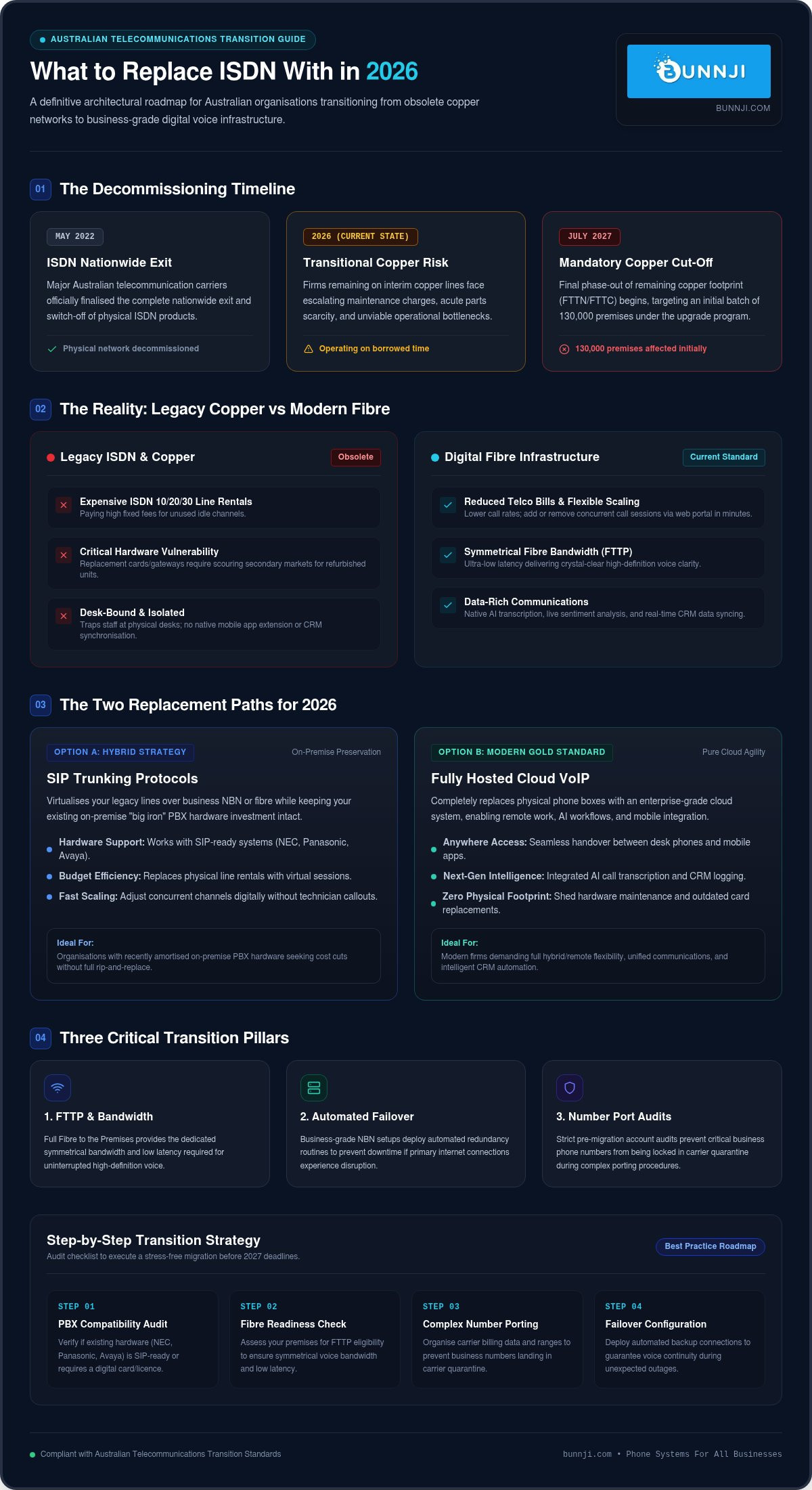
ISDN is a relic. It is copper-based technology that reached its use-by date years ago. While major Australian carriers officially finalised the nationwide exit of ISDN products in May 2022, many firms are still limping along on transitional services or ageing on-premise hardware. This isn't just a matter of technical debt; it's a massive operational bottleneck. Modern business calls are no longer just voice. They are data-rich interactions involving AI transcription, sentiment analysis, and real-time CRM syncing. Legacy lines simply cannot carry that load.
The Australian telecommunications landscape has moved on. NBN Co and private fibre providers have built a digital-first infrastructure that makes the old circuit-switched ways of working look prehistoric. If you are still trying to figure out what to replace isdn with, the clock is ticking. The remaining copper footprint, including FTTN and FTTC, is facing a mandatory phase-out. Sticking with the old ways doesn't just mean slower tech; it means your business is disconnected from the tools your competitors are already using to win.
The True Cost of Legacy Infrastructure
Maintenance fees for legacy copper services are skyrocketing in 2026. It's a simple case of supply and demand. As the physical network shrinks, the cost to keep the remaining fragments alive increases. There's also a significant risk of hardware failure. If an old gateway or a specific ISDN card dies, finding genuine replacement parts is nearly impossible. You're often left scouring secondary markets for refurbished gear that offers no guarantee of reliability.
Beyond the direct bills, consider the opportunity cost. Legacy systems trap your staff at their desks. They don't support the unified communications features that modern teams expect, such as seamless switching between a desk phone and a mobile app. You're also likely paying for channels you don't use, whereas modern alternatives allow for far more flexible scaling. The financial drain of staying on legacy tech is often higher than the cost of a full digital migration.
NBN Fibre and the Death of Copper
NBN Co's push for full-fibre upgrades has fundamentally changed the quality of voice services. Fibre to the Premises (FTTP) provides the symmetrical bandwidth and low latency required for high-definition voice. For firms wondering what to replace isdn with, the shift to fibre is the first step. The decommissioning of the remaining copper footprint is scheduled to initiate in July 2027, with the first batch of 130,000 premises already in the sights of the Targeted Upgrade program.
ISDN is a circuit-switched network that cannot compete with packet-switched VoIP in 2026. To bridge this gap, many organisations are adopting SIP trunking protocols to move their voice traffic onto high-speed fibre networks. This approach allows you to retain your existing PBX hardware while shedding the costs and limitations of physical copper lines. It's a calculated move that provides the stability of a dedicated line with the flexibility of the cloud.
SIP Trunking: The Logical Step for Existing On-Premise Hardware
SIP trunking is essentially a virtual version of your old physical lines. For many IT managers, it is the most practical answer when deciding what to replace isdn with because it allows you to keep the "big iron" PBX hardware you have already paid for. Instead of phone calls travelling over a dedicated copper wire, they travel as data packets over your business NBN or fibre connection. This swap eliminates the heavy monthly line rental fees associated with ISDN 10/20/30 services while offering significantly lower call rates.
The shift to SIP also solves the scalability nightmare. In the past, adding new lines meant waiting weeks for a technician and paying for physical installation. With a digital setup, you can add or remove concurrent call sessions in minutes through a web portal. This flexibility is vital for firms with seasonal peaks or those undergoing rapid expansion. You only pay for the capacity you actually need, which is a far more efficient way to manage your telecommunications budget.
Bridging the Gap: Is Your Current PBX SIP-Ready?
Before making the switch, you need to verify if your existing system can handle digital traffic. Most modern systems from brands like NEC, Panasonic, or Avaya are "SIP-ready," meaning they might only require a specific license or a SIP trunk card to get started. If your system is older and lacks these capabilities, you don't necessarily have to scrap it. It's about finding the most cost-effective path forward for your specific setup.
An Analogue Telephone Adapter (ATA) or a Media Gateway can act as a translator. These devices sit between your legacy PBX and your fibre connection, converting the old signals into modern data packets. This is a low-friction choice for large offices with complex internal wiring that would be prohibitively expensive to replace all at once. If you are unsure about your hardware's compatibility, a quick telecommunications audit can clarify your options and prevent costly mistakes.
Scalability and National Numbering
One of the biggest advantages of moving away from physical lines is the decoupling of your phone numbers from your physical location. You can maintain a local presence in every Australian state without needing a physical office in each one. This allows a firm based in one region to advertise a local number in another, with all calls routing back to a central team or a remote worker's laptop. It's a powerful tool for building trust in different markets across the country.
Retaining your existing identity is equally simple. Under the ACMA guidelines on number porting, Australian businesses have the right to move their numbers between providers. This ensures your clients can still reach you on the same familiar digits they have used for years. For those seeking SIP Trunking & Numbers that offer both reliability and national reach, the transition is often smoother than expected. It provides the stability of a traditional system with the intelligence of a modern network.
Cloud VoIP Systems: The Modern Gold Standard for Australian Firms
If SIP trunking is the bridge for legacy hardware, Cloud VoIP is the destination for those ready to ditch the hardware entirely. Also known as a Hosted PBX, this system lives in a secure, Australian-based data centre rather than a cupboard in your office. When you evaluate what to replace isdn with, the cloud offers a clean break from the past. You no longer need to worry about hardware maintenance contracts, power-hungry servers, or the risk of a physical unit failing during a storm. Everything is managed virtually, ensuring your business stays online even if your physical premises are inaccessible.
This shift represents a move toward Unified Communications (UC). It is no longer just about making a phone call. Modern cloud systems integrate voice, video conferencing, and internal chat into a single interface. It simplifies your workflow and removes the need for multiple, disconnected subscriptions. You gain a sophisticated platform that scales instantly as your team grows, without a technician ever needing to visit your site.
Why Remote and Hybrid Teams Prefer Cloud Voice
The greatest benefit of a hosted system is total mobility. Your office extension is no longer tied to a desk; it follows you on your smartphone, tablet, or laptop. This allows your staff to maintain a professional presence whether they are at a client site, working from home, or in the office. When a customer calls your main business number, it rings on whichever device you choose, ensuring you never miss a critical lead.
This seamless transition between devices is why so many firms are moving away from traditional handsets. For a deeper look at how to align your technology with your business goals, see our Business VoIP Australia: The Complete 2026 Strategy Guide. It covers the tactical steps needed to ensure your remote team remains as productive as they were in a central office.
Integrating AI and Automation
In 2026, the most compelling reason to consider what to replace isdn with is the access to advanced AI tools. Cloud VoIP systems now act as an intelligent layer for your business. AI voice agents can answer basic enquiries, route calls based on sentiment, and even book appointments directly into your team's calendars. This technology ensures that every caller receives an immediate response, even during peak times or after hours.
Efficiency doesn't stop at the call. These systems sync directly with your CRM, automatically logging call notes and updating client records in real time. This gives your staff the context they need to provide exceptional service the moment they pick up the phone. To understand how these tools are reshaping the local market, read our AI Voice Agents: 2026 Trend Report for Australian Firms. Embracing these features turns your phone system from a cost centre into a genuine growth engine.
Critical Considerations: Connectivity, Security, and Redundancy
The most common concern when discussing what to replace isdn with is the perceived fragility of the internet. Legacy ISDN lines were powered directly from the telephone exchange, meaning they often stayed live during local power cuts. Digital systems, however, rely on your local network and power supply. This shift requires a change in mindset; you aren't just buying a phone service, you're investing in the infrastructure that keeps your business audible. Relying on a standard residential-grade connection is a risk that most professional firms cannot afford to take.
Moving to a digital-first environment makes voice quality dependent on your bandwidth. Business-grade NBN or private fibre connections allow for Quality of Service (QoS) prioritisation. This ensures that your voice data always takes the "fast lane," preventing the jitter and lag that plague poorly configured systems. If you want to avoid the pitfalls of a rushed migration, you should start your telecommunications audit today to identify exactly what your current network can handle.
Internet Redundancy: The Safety Net Your Firm Needs
Internet redundancy is a non-negotiable part of any modern communication plan. If your primary fibre line is accidentally cut during roadworks, your phone system shouldn't go dark. A professional setup utilises 4G or 5G failover modems that trigger automatically the moment the main connection drops. This happens so quickly that active calls often stay connected without the user noticing a change. It provides the peace of mind that was once the sole domain of expensive, dedicated copper lines.
The difference between a basic connection and a business-grade service often comes down to Service Level Agreements (SLAs). While a residential outage might take days to resolve, business fibre plans typically include guaranteed uptime and faster restoration windows. To understand the full scope of these risks, read our guide on Internet Redundancy: What Happens to Your Business When the NBN Goes Down?. Investing in a dual-WAN strategy is the best way to ensure your firm remains reachable 24/7.
Securing Your Voice Traffic
Security is another area where modern systems outshine the past. ISDN traffic was largely unencrypted, making it vulnerable to physical interception. Modern VoIP and SIP systems use advanced encryption protocols to protect your conversations from eavesdropping. However, being connected to the internet introduces new risks, such as toll fraud, where hackers hijack your system to make expensive international calls. Managed firewalls and strict access controls are essential to keeping these threats at bay.
Compliance is equally critical for Australian firms, especially in the legal and financial sectors. You must ensure your system handles call recording and data storage in accordance with local privacy laws. Most cloud providers now offer Australian-based data centres to help you meet these requirements. Before you commit to a new provider, ensure you ask these 10 questions regarding their security and data sovereignty policies.
Making the Switch: A Step-by-Step Transition Strategy
Transitioning away from legacy tech is more than an unboxing event. It is a methodical process designed to protect your business continuity. When you have decided what to replace isdn with, following a structured path ensures you don't end up with a system that works on paper but fails in practice. The first move is always a comprehensive telecommunications audit. You need to identify every active line, hunt group, and fax service currently tied to your copper infrastructure.
Once your audit is complete, follow these five steps to a successful migration:
- Select your architecture: Decide if you will keep your PBX via SIP Trunking or move to a fully hosted Cloud VoIP environment.
- Verify your bandwidth: Ensure your NBN or fibre link has the capacity to handle voice traffic alongside your daily data needs.
- Build in redundancy: Deploy a secondary link, like a 5G failover, to act as a safety net for your voice calls.
- Execute the port: Move your existing numbers to the new platform while keeping both services active during the crossover.
- Onboard the team: Provide hands-on training for staff to ensure they are comfortable with softphones and AI tools.
The Number Porting Minefield
Porting is where most migrations hit a wall. In the Australian landscape, you will deal with Cat A (simple) or Cat C (complex) ports. Because ISDN services often involve 100-number ranges or hunt groups, they almost always fall into Category C. This process requires precision; if your registered address details don't match your current carrier's records exactly, the port will be rejected. This "rejection trap" can add weeks to your timeline. Most importantly, you must never cancel your old ISDN service before the port is finalised. Doing so risks losing your business numbers to permanent quarantine.
Choosing the Right Partner
Your choice of provider is just as critical as the technology itself. You need a partner that offers local Australian support rather than a global call centre that doesn't understand the nuances of the NBN. Avoid the trap of 60-month lock-in contracts for hardware that will be obsolete before the term ends. Look for transparency and a commitment to helping you navigate the technical hurdles of deciding what to replace isdn with. A successful transition should feel like a partnership, not a transaction. To ensure your migration is handled with precision, book a telecommunications audit with Bunnji to start your migration today.
Future-Proof Your Business Communications
Transitioning away from legacy copper isn't just a technical necessity; it's a strategic upgrade. Whether you choose SIP trunking to sweat your existing hardware assets or move to an AI-ready cloud phone system, the decision of what to replace isdn with will define your firm's agility for the next decade. Success hinges on a robust connectivity plan and a meticulous approach to number porting to ensure your clients never lose touch.
You don't have to navigate this transition alone. With expert Australian-based support and specialists in seamless number porting, you can modernise without the stress of downtime. A clear audit is the best way to avoid the traps of legacy contracts and outdated infrastructure. Ready to retire your legacy lines? Get a free Telecommunications Audit from the Bunnji team today.
Your new communication platform is the foundation for growth. It's time to build your business on a network that is faster, more secure, and ready for whatever comes next.
Frequently Asked Questions
Can I keep my existing phone numbers when I replace ISDN?
Yes, you can retain your numbers through the porting process. Most ISDN services use a 100-number range, which requires a Category C complex port. This process usually takes 4 to 8 weeks to complete. It's vital that you don't cancel your existing ISDN service until the port is confirmed and active on your new system, otherwise you risk losing your numbers to carrier quarantine.
Is VoIP as reliable as my old ISDN line?
Digital voice services are highly reliable when paired with business-grade infrastructure. While ISDN had its own dedicated power, modern systems rely on your internet connection. To match legacy reliability, you should use a business NBN or fibre link with a 4G or 5G failover modem. This ensures your phones stay online even if the primary cable is damaged, providing a level of redundancy that legacy copper couldn't always offer.
What is the difference between SIP trunking and VoIP?
SIP trunking is the digital version of a physical phone line used to connect your existing on-premise PBX to the internet. VoIP is a broader term, but in this context, it usually refers to a Hosted PBX where the entire system lives in the cloud. When deciding what to replace isdn with, choose SIP trunking if you want to keep your hardware, or Hosted VoIP if you want to remove on-site equipment entirely.
How much internet bandwidth do I need for a 10-person office?
A standard high-definition voice call requires approximately 100kbps of symmetrical bandwidth. For a 10-person office, the voice traffic itself uses very little data, but you must account for simultaneous internet use like video calls and cloud backups. We typically recommend a minimum of 50/20 Mbps or 100/40 Mbps on a business-grade NBN plan to ensure voice quality isn't compromised by other office data demands during peak times.
What happens to my emergency lift phones or alarms when I switch?
Emergency services like lift phones, fire alarms, and back-to-base security systems often require specialised migration paths. Because these devices traditionally relied on the power from the copper line, they may not function correctly on a standard VoIP setup during a power outage. You should consult with your lift or alarm provider to see if they require a dedicated NBN-compatible gateway or a wireless 4G/5G monitoring solution to maintain compliance.
Do I need to buy all new handsets to replace my ISDN system?
No, you don't always need to purchase new hardware. If you opt for SIP trunking, you can often continue using your current handsets and PBX. If you move to a cloud system, you can use softphones which are apps on your existing laptops and mobiles. However, if you prefer physical desk phones, you will need IP-enabled handsets. Analogue Telephone Adapters can also be used to connect older analogue phones to a digital network.
How long does it take to migrate from ISDN to a cloud system?
The technical configuration of a new cloud system or SIP trunk can often be completed in just a few days. However, the total migration timeline is usually dictated by number porting. A complex Category C port for a legacy ISDN range typically takes between 4 and 12 weeks. We recommend starting your telecommunications audit early to ensure all account details match perfectly, which prevents the rejection of your porting request by the losing carrier.
Will my faxes still work after replacing ISDN?
Traditional fax machines often struggle with the data packet loss inherent in digital voice lines. While you can use an Analogue Telephone Adapter to connect a physical fax machine, it is not always 100% reliable. The modern alternative is an e-fax or virtual fax service, which receives faxes as PDF attachments in your email. This is the most stable way to handle faxing after you decide what to replace isdn with.


