

Your finance manager receives a call from the CEO requesting an urgent transfer for a confidential acquisition. The voice, the tone, and even the background noise are perfect matches. By the time anyone realises it was an AI-generated deepfake, the funds have already left the country. This isn't a plot from a film; it's the reality of phone based phishing scams australian businesses are facing in 2026.
It's understandable if you feel overwhelmed by the sophistication of modern social engineering. You've worked hard to build your reputation, and the thought of a single fraudulent transfer is stressful. You aren't alone in feeling that traditional training isn't enough to beat a machine that sounds exactly like a human. We've seen this anxiety across the country, and a proactive approach is now essential for every local organisation.
This guide helps you take back control using the latest Australian security frameworks. You'll learn how to identify these threats and neutralise them before they reach your team. We'll provide a clear training framework and explain how modern cloud phone systems act as a digital shield. You'll gain a practical roadmap to secure your communication and the peace of mind that comes with a resilient business.
Key Takeaways
- Recognise that modern vishing threats have evolved beyond simple robocalls into highly targeted social engineering attacks designed specifically for the Australian market.
- Understand why staff can no longer trust their ears alone, as AI voice deepfakes and advanced caller ID spoofing become standard tools for sophisticated fraudsters.
- Implement a mandatory "Verification Protocol" to help your team neutralise phone based phishing scams australian businesses encounter by using out-of-band authentication.
- Apply the "Swiss Cheese Model" of security by merging continuous staff training with technical barriers like AI-driven call filtering and secure cloud VoIP.
- Future-proof your operations by leveraging managed IT and cybersecurity services that block malicious traffic before it ever reaches an employee's handset.
Recognising the 2026 Vishing Landscape for Australian Firms
Voice phishing, or voice phishing (vishing), is no longer just a nuisance call from a noisy offshore centre. In 2026, it's a precision strike. These phone based phishing scams australian businesses encounter are built on the back of sophisticated social engineering. This is the psychological manipulation of your staff to make them break normal security protocols. Attackers don't just guess your details; they research your LinkedIn profile, listen to your corporate webinars, and learn your internal jargon before they ever pick up the phone.
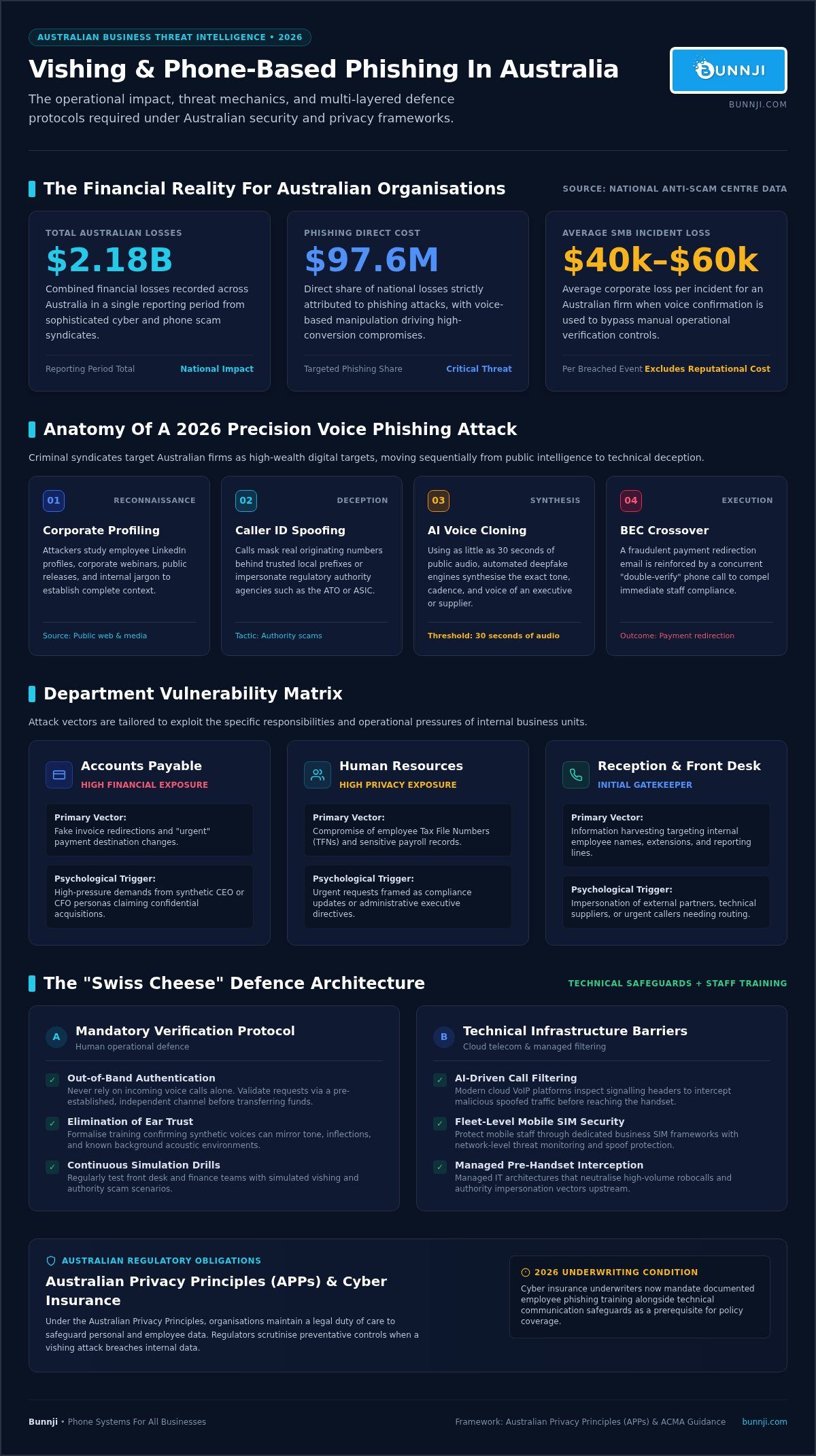
International crime syndicates specifically target Australian organisations because we are a high-wealth, highly digitised economy. The latest data from the National Anti-Scam Centre shows that combined losses across Australia reached $2.18 billion in a single reporting period. Phishing scams alone accounted for $97.6 million of that total. Criminals view our local businesses as "soft targets" because many still rely on outdated manual verification processes that are easily bypassed by a confident voice on the other end of the line.
The Cost of Complacency: Why Awareness Isn’t Enough
For an Australian SMB, the financial sting of a successful attack is sharp. Average corporate losses for incidents where voice confirmation was used to bypass manual controls now range between $40,000 and $60,000 per event. While the immediate cash drain is painful, the secondary costs often cut deeper. You have to consider the damage to your brand. Clients don't want to hear that their data or funds were compromised because a staff member was tricked.
- Accounts Payable: Frequently targeted with fake invoice redirections and "urgent" payment changes.
- Human Resources: Attacked to gain access to employee tax file numbers and sensitive payroll data.
- Reception: Targeted as the "gatekeeper" to gather internal names and extension numbers for more complex secondary attacks.
Regulatory Expectations and Your Duty of Care
Compliance has moved from a "best practice" suggestion to a legal necessity. Under the Australian Privacy Principles (APPs), your business has a clear duty of care to protect the personal information you hold. If a vishing attack leads to a data breach, regulators will look closely at what preventative measures you had in place. It's not just about the law; it's about insurance. Most cyber insurance providers in 2026 now mandate documented staff training and technical safeguards as a condition of your policy. Shifting to a proactive security posture isn't just a tech choice; it's a fundamental requirement for business continuity.
The Evolution of Phone Scams: From Spoofing to AI Deepfakes
Phone scams have mutated from generic mass-dialling to precision-engineered attacks. Caller ID spoofing remains a cornerstone, allowing fraudsters to mask their identity behind a trusted local prefix or a government agency's name. According to ACMA's phone and SMS scam guidance, these tactics are frequently used in "Authority Scams" where callers impersonate the ATO or ASIC to demand immediate compliance. These phone based phishing scams australian businesses face today use technical deception to lower the target's guard, making them more susceptible to the high-pressure social engineering that follows.
The most significant leap in 2026 is the weaponisation of AI voice cloning. With just 30 seconds of audio captured from a public source, attackers can generate a synthetic voice that is virtually indistinguishable from your CFO or a major supplier. This technology is often the catalyst for Business Email Compromise (BEC) crossover, where a fraudulent email is validated by a realistic phone call. This "double-verify" approach is a major factor in why Australian firms report massive losses to payment redirection. Securing your team's devices through business mobile sim only plans with fleet-level security is now a critical part of a modern defence strategy.
Spotting the "AI Glitch": Red Flags in 2026
Modern deepfakes are convincing, but they aren't perfect. Watch for unnatural pauses or a lack of emotional inflection that doesn't match the supposed "urgency" of the call. Synthetic voices may also struggle with complex questions, often falling back on a "Verification Loop" where they repeat scripted instructions regardless of your query. If the audio quality seems too pristine or, conversely, has a consistent digital hum, it's time to hang up and verify the request through an independent channel.
The "Friend in Need" and Executive Impersonation
Whaling attacks often use the "Friend in Need" angle to target mid-level staff. Scammers create a false sense of reality by layering in background noise, such as the ambient chatter of a busy local cafe or the announcements in an airport lounge, to explain away any audio artefacts. They claim to be in a rush and need an "urgent" transfer authorised. This is often the precursor to SIM swapping, where the attacker hijacks a staff member's mobile number to intercept MFA codes. It's a sophisticated chain designed to bypass traditional security layers. Ready to see where your gaps are? Book a quick telecommunications audit with our team.
Comparing Mitigation Strategies: Awareness vs. Technology
Relying solely on your team to catch phone based phishing scams australian businesses face is a high-stakes gamble. Even the most vigilant employee can have an off day or be caught off guard by a particularly convincing AI deepfake. We recommend adopting the "Swiss Cheese Model" of security. In this framework, every layer of defence has potential holes, but when you stack multiple layers together, the gaps don't align. This structure ensures that if a scammer bypasses your technical filters, your staff awareness acts as the next barrier. Conversely, if a staff member is momentarily tricked, your technical protocols should prevent the final unauthorised transfer.
While annual training is a common baseline, it often fails because it's reactive. In 2026, the speed at which scams evolve requires a more dynamic approach. Managed security services provide a much higher ROI by offering continuous protection. When you weigh the predictable cost of managed IT against the $40,000 to $60,000 average loss from a single successful breach, the technical perimeter becomes an obvious financial necessity. Modern business voip australia wide now incorporates traffic analysis tools that identify and flag suspicious call patterns before they reach your handsets.
The Human Element: Why Phishing Prevention Training for Employees is Vital
Why do smart, capable employees fall for vishing? It's rarely about a lack of intelligence. Scammers exploit the psychology of fear and the natural desire to be helpful. They use artificial urgency to bypass the brain's critical thinking centres. This is why regular phishing prevention training for employees must go beyond technical definitions. It needs to focus on current Scamwatch phone scam warnings and real-world scenarios. Building a "No-Blame" culture is equally critical. If a staff member feels they've made a mistake, they must feel safe reporting it immediately. Rapid reporting is often the only way to claw back funds before they vanish.
The Technical Perimeter: Blocking Scams at the Source
Technology should act as a silent guardian, filtering out the noise so your team can focus on legitimate work. Modern SIP Trunking protocols are now capable of flagging international traffic that attempts to spoof local Australian numbers. AI-driven call screening can also act as a buffer, forcing automated dialers to identify themselves before the call is put through to a human. By centralising your security logs through a unified communications platform, you gain a clear view of attempted fraud patterns. This visibility allows you to block malicious actors at the network level, stopping the threat before a single phone rings in your office. Furthermore, utilising specialised services like Anosim for secure SMS activations allows businesses to verify accounts without exposing their primary phone lines to potential data leaks or harvesting.
Generic security advice often fails sales-heavy organisations because your team is trained to be helpful and responsive. To defend against phone based phishing scams australian businesses face, you need a training framework that is practical and ongoing. Start by conducting a baseline assessment using simulated vishing calls. This isn't about catching staff out; it's about identifying which departments are most susceptible to high-pressure tactics. Once you have this data, you can tailor your approach to the specific risks your team handles daily.
The next step is to establish a clear "Verification Protocol". This must be a non-negotiable rule for any request involving financial transfers or sensitive data. Organise regular "Lunch and Learn" sessions to review the latest Scamwatch alerts. These short, informal meetings keep the threat top-of-mind without disrupting the workday. To keep engagement high, gamify the reporting process. Offer a small reward for the "catch of the month" to encourage staff to flag suspicious interactions. Finally, review your Disaster Recovery Plan. Ensure it includes specific steps for vishing scenarios so your team knows exactly who to contact if a fraudulent transfer is accidentally authorised.
Creating a "Security-First" Answering Script
Empower your staff with a script that makes security the default response. When a caller requests sensitive info, staff should say: "I'm happy to help, but our policy requires me to verify this request. I'll hang up and call you back on the official number we have on file for your organisation." This "Hang Up and Call Back" rule is the most effective way to neutralise spoofing. Teach your team that it's okay to politely decline "urgent" requests that bypass standard procedures. A legitimate caller will always respect a commitment to security.
Integrating Security with Your CRM
Modern technology can take the pressure off your human team. Integrating ai voice agents for business allows you to verify caller identity against your CRM records automatically. These agents can handle the initial screening, flagging any number that doesn't match a known contact before the call ever reaches an employee. Ensure your team logs every suspicious interaction in a central database to help identify patterns of attempted fraud. A Verification Loop is a mandatory step where staff must confirm any outbound transfer via a second, independent communication channel. Ready to secure your team? Book a telecommunications audit to identify your organisation's vulnerabilities today.
Future-Proofing Your Business Comms with Bunnji’s Secure Infrastructure
While training creates a culture of vigilance, your infrastructure should do the heavy lifting. Bunnji provides a comprehensive shield through Managed IT and Cybersecurity services specifically tailored for the Australian market. We focus on blocking phone based phishing scams australian businesses are plagued by at the network level. This means malicious traffic is intercepted before it ever rings a desk phone or a mobile handset. By shifting the burden from your staff to your systems, you reduce the margin for human error significantly. It's about building a technical perimeter that doesn't rely on a staff member having a perfect day every day.
Security shouldn't stop when your team leaves the office. Our business mobile sim only plans include fleet-level security to protect remote workers from SIM swapping and mobile-based vishing. However, you can't fix what you haven't identified. A Telecommunications Audit is essential for finding hidden security holes in legacy systems or unmonitored SIP trunks. We also deploy AI Receptionists as a sophisticated first line of defence. These agents act as a buffer, using automated verification to filter out noise and suspicious callers before they can attempt to socially engineer your reception staff.
The Bunnji Difference: Local Support, Global Protection
As a sophisticated local expert, we understand the specific pressures facing Australian firms. We combine the resources of a global player with the personal touch of a boutique provider. You get peace of mind through 24/7 network monitoring and built-in redundancy. We don't just set up your system and walk away. We stay present and responsive, ensuring your defences evolve as quickly as the scams do. A proactive audit allows us to stay ahead of 2026's evolving threats, keeping your business stable and secure.
Next Steps: Securing Your Firm Today
Protecting your organisation starts with a clear understanding of your current posture. Book a 10-minute telecommunications audit to identify vulnerabilities in your setup. It's also a good time to review your current equipment contracts. Many older agreements lack modern security features or trap you with outdated hardware that can't support AI-driven filtering. We invite you to explore our unified communications platforms. These systems provide better control and centralised logging, making it easier to spot and block phone based phishing scams australian businesses encounter. Take the first step toward a more resilient future today.
Take Decisive Action to Protect Your Team
The threat of phone based phishing scams australian businesses face is constant, but it isn't unbeatable. By merging a "No-Blame" culture with advanced technical barriers, you can significantly reduce your organisation's risk profile. Remember that while human vigilance is your last line of defence, your communication infrastructure should be your first. Implementing a multi-layered strategy that includes AI-driven screening and regular verification protocols ensures that a single mistake doesn't lead to a financial catastrophe.
As an Australian-owned and operated partner, Bunnji specialises in simplifying these complex security challenges. Our team of Managed IT and Cybersecurity experts provides the AI-driven voice solutions you need to stay ahead of sophisticated fraudsters. Secure your business with a Bunnji Telecommunications Audit today to identify your vulnerabilities and gain true peace of mind. Protecting your reputation and your bottom line is a journey, and we're here to guide you every step of the way.
Frequently Asked Questions
What are the most common phone scams targeting Australian businesses in 2026?
AI voice cloning is the standout threat in 2026. Scammers use short audio clips to impersonate executives and authorise fraudulent transfers. Authority scams where fraudsters pretend to be from the ATO or ASIC remain prevalent. These phone based phishing scams australian businesses deal with often combine voice calls with fake emails to create a sense of legitimacy that is hard to ignore without technical filters.
How can I tell if a voice on the phone is an AI deepfake?
Identifying a deepfake requires a sharp ear for the "AI glitch." Listen for a lack of natural breathing patterns or a slightly metallic tone in the voice. If the caller sounds like a trusted colleague but the request is unusual, use a "Verification Loop." Ask a question that only the real person would know. If the caller evades the question or repeats a script, hang up and call them back on a verified number.
Is phishing prevention training for employees actually effective?
Training is effective when it's continuous rather than a one-off event. It empowers your team to recognise the psychological triggers scammers use, such as artificial urgency or fear. While technology handles the bulk of the filtering, your staff remain the final line of defence. Effective training establishes clear verification protocols, ensuring that no sensitive data or funds are released without a secondary, out-of-band confirmation.
What should an employee do if they think they’ve been scammed?
Immediate action is vital to minimise damage. The employee should hang up the phone and report the incident to your internal security team or managed IT provider. If any financial details were shared or a transfer was initiated, contact your bank instantly to attempt a payment recall. Document the caller's number and the specific details of the request to help your security partner update their blocklists and prevent future attempts.
Can my business VoIP system block international scam calls automatically?
Modern cloud phone systems provide powerful automated defences. By using advanced SIP Trunking security, your system can identify and flag international calls that are attempting to spoof local Australian numbers. Bunnji’s AI-driven voice solutions go a step further by screening calls before they even ring. This technical perimeter acts as a silent guardian, ensuring that your team only spends time on legitimate business calls while malicious traffic is blocked at the source.
Are small businesses at higher risk of vishing than large corporations?
Scammers often view small businesses as "soft targets" because they might lack the dedicated cybersecurity resources of a large corporation. However, every organisation is at risk. Fraudsters use automated dialers to cast a wide net, looking for any gap in your procedures. Whether you're a boutique firm or a national enterprise, the goal is the same: to find one employee who is distracted enough to bypass your standard security checks.
How often should we conduct phishing simulation training?
We recommend conducting simulations and training updates at least quarterly. The landscape of phone based phishing scams australian businesses encounter changes almost monthly as AI technology improves. Frequent, bite-sized sessions like "Lunch and Learns" are more effective than annual marathons. Regular testing keeps security top-of-mind for your staff, ensuring they stay familiar with the latest red flags and don't become complacent during their daily routines.
Does the ACSC provide resources for vishing protection?
The ACSC provides essential frameworks like the Essential Eight, which offers a prioritised list of mitigation strategies. They also issue regular alerts through their Stay Smart Online program, detailing current social engineering trends. While these resources are excellent for building a foundational understanding, we recommend pairing them with a professional telecommunications audit. This allows you to apply government-standard advice specifically to your unique business infrastructure and communication needs.


