

The mobile phone in your pocket has officially outgrown its role as a simple calling device. By 2026, your choice of business mobile phone plans Australia wide determines whether your team stays productive in a 5G world or gets bogged down by legacy tech debt. You've likely felt the sting of a monthly bill riddled with hidden equipment fees or the frustration of regional staff losing signal when it matters most. It's a common headache for growing firms, but it shouldn't be your reality.
This guide cuts through the marketing noise to help you secure a plan that offers predictable monthly billing and high-speed 5G access for remote work. We'll show you how to move away from restrictive 60-month contracts and toward flexible SIM-only options that integrate seamlessly with your office VoIP system and AI voice agents. You'll learn how to simplify your mobile fleet management while giving your team the tools they need to work from anywhere without the usual friction or complexity.
Key Takeaways
- Shift your perspective from simple data packages to unified communication systems that integrate AI voice agents and office VoIP seamlessly.
- Avoid the "handset trap" by opting for SIM-only business mobile phone plans Australia wide, which eliminates hidden interest and long-term equipment debt.
- Prioritise low-latency 5G access to ensure your remote team remains productive with stable video conferencing and cloud-based applications.
- Discover how to link your mobile fleet directly to your CRM and calendar using AI receptionists to capture every lead.
- Learn why local, personalised support is the superior alternative to the bureaucratic hurdles of traditional big telco providers.
Navigating the 2026 Landscape of Business Mobile Phone Plans in Australia
The office desk phone hasn't just changed; it has effectively disappeared. By 2026, your mobile device is the primary gateway to your entire corporate infrastructure. Choosing between various business mobile phone plans australia wide is no longer a simple procurement task; it's a strategic decision that affects how your team accesses AI tools, cloud applications, and unified communication platforms. A modern plan must do more than provide a dial tone. It needs to act as a high-speed node in a digital ecosystem that follows your staff from the boardroom to the regional job site.
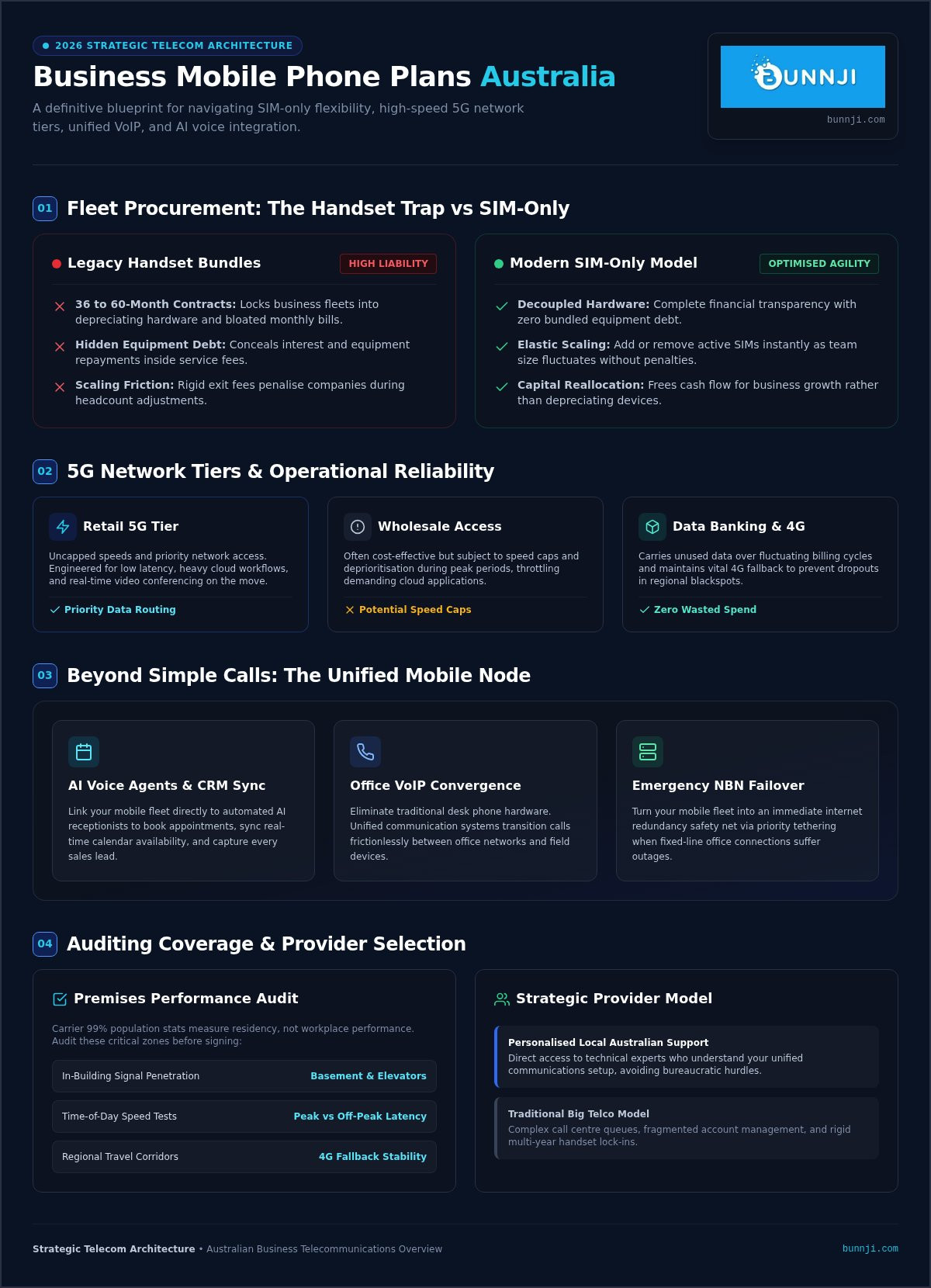
Rigid 36-month or 60-month handset contracts have become a significant liability for agile Australian firms. These long-term commitments often hide the true cost of hardware, bundling interest and equipment repayments into a bloated monthly bill. When technology cycles move this fast, locking your team into a five-year equipment cycle is a recipe for technical debt. Forward-thinking managers are moving toward decoupled arrangements that separate the service from the hardware, ensuring they never pay a "handset tax" for outdated gear.
The Shift Toward SIM-Only Flexibility
Australian businesses are increasingly opting for SIM-only plans as their "freedom choice." This model provides immediate financial transparency because you only pay for the data and connectivity you actually use. Without the weight of hardware repayments, your monthly overheads drop significantly. Scaling your team also becomes a frictionless process. You can add or remove SIMs as your headcount fluctuates without worrying about contract exit fees or equipment payouts. This flexibility allows you to invest your capital into growth rather than depreciating mobile assets.
Understanding 5G and Network Tiers in 2026
Not all 5G connectivity is equal in the current Australian market. The gap between wholesale and retail network access has widened, making it vital to understand what you're actually buying. Retail-tier access generally offers uncapped speeds and priority data, which are essential for staff who rely on tethering or high-definition video conferencing while on the move. Lower-tier plans often come with speed caps that can throttle productivity during peak periods or in crowded areas. Robust network connectivity creates a force multiplier where the collective speed of your team's access directly accelerates your business's overall output and responsiveness.
- Wholesale Access: Often cost-effective but may lack the raw speed required for heavy cloud-based workflows.
- Retail Access: Provides the lowest latency and highest priority, ensuring critical apps stay online.
- Data Banking: A vital feature for teams with fluctuating monthly usage, preventing wasted data spend.
Coverage and Reliability: What Actually Matters for Your Team
Carrier maps often promise 99% population coverage, but this statistic can be misleading for professional teams. It measures where people live, not where your business actually operates. When evaluating business mobile phone plans australia, you need to look beyond the shaded areas on a website. Real-world reliability depends on signal penetration inside office buildings and the availability of low-latency 5G. High-speed data is useless if the latency is too high to support a stable video call or a real-time CRM update.
A critical but often ignored feature is mobile failover. Your mobile fleet shouldn't just be for calls; it's your emergency backup for when the office NBN goes down. By choosing a plan with generous data and priority network access, you create a built-in safety net. You can tether your laptops to your mobile devices instantly, ensuring your team stays productive while the primary connection is restored. This approach is a vital component of internet redundancy that every modern firm should audit.
Testing network performance at your specific premises is a simple but necessary step before signing any agreement. Don't rely on the provider's word. Use a simple speed test app on different network bands at various times of the day. Check the signal strength in the elevator, the basement, and the furthest corner of the office. This small audit prevents you from being locked into a plan that doesn't work where you need it most.
Regional vs Metropolitan Performance
While 5G is expanding rapidly, blackspots still exist in both regional areas and dense urban corridors. A reliable 4G fallback is essential for field-based workers who travel between coverage zones. You don't want your staff losing access to cloud apps the moment they step off a main highway. True reliability comes from a network that manages these transitions seamlessly, maintaining a stable connection even when 5G signal strength fluctuates. This redundancy is the backbone of any disaster recovery plan.
VoLTE and Wi-Fi Calling: Essential 2026 Features
Modern office blocks are often built with materials that block traditional mobile signals. Wi-Fi calling solves this by allowing your team to make and receive calls over your office wireless network. It ensures perfect reception in the middle of a concrete building where bars are usually low. Similarly, Voice over LTE (VoLTE) has replaced older standards to provide high-definition voice quality. These features ensure your professional image isn't compromised by crackly audio or dropped calls during important client negotiations.
The Handset Trap: Why SIM-Only is Dominating Australian Business Fleets
The allure of a brand-new fleet of smartphones for zero dollars upfront is a powerful marketing tool. However, for most Australian firms, this "free" hardware is the entry point into a restrictive financial trap. When you bundle equipment into your business mobile phone plans australia wide, you aren't just paying for data; you're servicing a loan disguised as a monthly fee. This "Handset Tax" can inflate your overheads significantly compared to unbundled alternatives, often hiding the true interest rate within a bloated service charge.
Owning your hardware outright offers immediate advantages for asset management and IT audits. You have full control over the device lifecycle without being beholden to a carrier's restrictive upgrade schedule. From a fiscal perspective, purchasing handsets upfront often allows businesses to capitalise on instant asset write-offs. This provides a more immediate tax benefit than the slow, depreciating drip of monthly service deductions that include hardware repayments.
SIM-Only vs. Handset Contracts
A total cost of ownership (TCO) analysis over a 24-month period usually reveals that SIM-only plans offer superior value. By separating the hardware purchase from the network service, you avoid the hidden interest baked into "interest-free" repayments. You should be particularly wary of The Hidden Cost of 60-Month Telecommunications Contracts. These long-term agreements often leave your team using obsolete technology while you're still paying off the original debt years after the device has lost its peak performance.
Managing Device Lifecycles
Not every staff member requires the latest flagship model to be productive. Many agile firms are now opting for high-end refurbished devices for their fleets, which provides premium performance at a fraction of the cost. This approach allows you to allocate your budget toward better business mobile phone plans australia that offer higher data speeds and better 5G access. Establishing a clear "Bring Your Own Device" (BYOD) policy can also reduce capital expenditure, provided you have robust security protocols and a management system to keep corporate data separate from personal use. Balancing performance with hardware costs requires a strategic approach to when you upgrade, rather than following a carrier's arbitrary 36-month cycle.
Critical Features Beyond Data: AI, CRM, and Global Roaming
In 2026, the value of your mobile fleet isn't measured in gigabytes alone. It's measured by how well it talks to the rest of your business tools. Modern business mobile phone plans australia wide now serve as the connective tissue between your remote team and your central office infrastructure. Unified Communications (UC) has matured to the point where your mobile number and office VoIP system are effectively the same entity. This allows your staff to present a single professional identity to clients, regardless of whether they're at their desk or on a job site.
AI Voice Agents have become the standard solution for capturing opportunities that would otherwise be lost to voicemail. When you can't answer, an AI assistant can engage the caller, book a meeting, or update a record in your CRM. You can find more details on this in our AI Voice Agents: 2026 Trend Report for Australian Firms. This integration ensures that every client interaction is logged automatically in platforms like Salesforce or HubSpot. It removes the burden of manual data entry from your team and provides a clearer picture of your sales pipeline.
Global roaming has also evolved to prevent the 'bill shock' that once plagued Australian travellers. Modern plans often include flat-day rates or integrated global data pools that make international travel as predictable as local usage. If your team travels frequently for trade shows or client meetings, you should view our flexible business mobile options that offer transparent global voice and data. Predictive billing ensures your finance team isn't surprised by a massive invoice after a single overseas trip.
AI Receptionists on the Go
Your mobile device is no longer just a phone; it's an intelligent gateway. AI receptionists can now handle complex call routing based on your real-time availability. If you're in a scheduled meeting, the AI can inform the caller of your return time or offer to schedule a callback. This data syncs directly to your CRM, ensuring your records remain accurate without you lifting a finger. It transforms a missed call from a lost lead into a structured task that appears in your calendar automatically.
Security and Compliance
The rise of AI voice scams has made mobile security a top priority for 2026. Protecting your fleet requires more than just a passcode. Mobile Device Management (MDM) tools are now essential for remote wiping lost handsets and enforcing security protocols across the entire company. For firms in the financial or legal sectors, call recording compliance is also a non-negotiable feature. Modern plans must support secure, encrypted recording that meets Australian regulatory standards. This ensures your mobile communications are as protected and auditable as your office lines.
Choosing Your Provider: Why Bunnji is the Strategic Choice
Large telecommunications companies often treat Australian firms as just another account number in a vast, bureaucratic system. When you're managing a growing team, you can't afford to wait in a phone queue for hours just to adjust your data pool. Choosing the right business mobile phone plans australia wide requires a partner who understands that mobility is part of a larger technical ecosystem. We've built our service to remove the friction and complexity that usually comes with managing a mobile fleet; providing a local, personal touch that the industry giants simply can't match.
Transitioning to a new provider shouldn't involve downtime or technical drama. Our team specialises in porting numbers seamlessly, ensuring your staff stay connected throughout the entire process. We don't just hand you a stack of SIM cards and leave you to figure it out. Instead, we work with you to integrate your mobile fleet with your existing high-speed fibre and cloud VoIP infrastructure. This creates a unified communication environment where every device works in harmony, backed by a team that's present and responsive when you need support.
The Bunnji Difference: More Than Just a SIM
We provide tailored solutions that scale with your business, whether you're managing a handful of staff or a national fleet. Our strategy goes beyond simple connectivity; we focus on building resilience through internet redundancy and unified communications. By linking your mobile services to a broader Business VoIP Australia: The Complete 2026 Strategy Guide, we help you create a professional presence that isn't tethered to a physical desk. It's about giving your team the freedom to work from anywhere without compromising on security or call quality.
Starting Your Mobile Fleet Audit
Most Australian businesses are paying for data they never use or are being quietly penalised by hidden fees buried deep in their monthly bills. A thorough telecommunications audit is the first step toward identifying this waste and reclaiming your budget. We look for overages, "handset taxes," and outdated service charges that no longer serve your firm's interests. Evaluating your actual usage patterns allows us to recommend business mobile phone plans australia that offer the best balance of performance and value. Don't let legacy contracts drain your resources; book a 10-minute telecommunications audit with Bunnji today to see how much you could be saving.
- Identify Waste: Find and eliminate charges for inactive SIMs or unused data.
- Optimise Usage: Align your plan with how your team actually works in 2026.
- Modernise Tech: Move away from restrictive contracts and toward flexible, AI-ready solutions.
Future-Proof Your Business Mobility Today
Modern mobility is about more than just a signal; it's about creating a unified environment where your team can thrive. By shifting toward flexible SIM-only models and prioritising 5G reliability, your firm can finally escape the "handset tax" that inflates traditional telco bills. Integrating your mobile fleet with AI voice agents and CRM tools ensures that no lead is ever lost, transforming your phones from simple calling devices into powerful productivity engines.
Securing the best business mobile phone plans australia wide shouldn't involve navigating a bureaucratic maze. You deserve a partner that provides Australian-owned and operated support and rejects the restrictive 60-month contract traps common in the industry. It's time to reclaim your technical freedom with AI-integrated communication systems designed for the way we work in 2026. Take control of your overheads and empower your staff with a fleet that's as agile as your business.
Get a Custom Quote for Your Business Mobile Fleet
Your team's ability to stay connected is the foundation of your success. We look forward to helping you build a more efficient, transparent, and mobile future.
Frequently Asked Questions
What is the best business mobile network coverage in Australia for 2026?
The best network coverage depends on your team's specific geographic footprint. While the major carriers provide broad national coverage, the quality of your connection often relies on signal penetration inside office buildings and 5G availability. We recommend choosing a provider that offers retail-tier network access to ensure your data is prioritised during peak times. A site-specific audit is the most reliable way to confirm which infrastructure performs best at your primary operational locations.
Are SIM-only business mobile plans actually cheaper than handset contracts?
SIM-only business mobile phone plans australia wide are almost always the more cost-effective choice for agile firms. By separating the service from the hardware, you avoid the "handset tax" and hidden interest rates often bundled into long-term agreements. This approach allows you to own your devices outright and switch plans as your needs change. It eliminates the financial burden of paying off equipment loans for several years after the technology has become obsolete.
Can I keep my current business numbers if I switch to Bunnji?
You can absolutely keep all your existing business numbers when you move your fleet to Bunnji. The porting process is a standard technical procedure that we manage on your behalf to ensure there is zero downtime for your staff. We coordinate with your current provider to transition your services seamlessly. This ensures your clients can still reach your team on their familiar numbers without any interruption to your professional operations or marketing materials.
How much data does a typical Australian business mobile user need?
Data needs vary significantly depending on your team's workflow and reliance on cloud-based applications. A typical professional who uses video conferencing, real-time CRM updates, and occasional tethering generally requires between 40GB and 100GB per month. If your staff use their mobiles as an emergency internet failover for the office, you should consider plans with larger data pools. We help you audit your actual usage to ensure you aren't paying for massive allowances that go unused.
What is the difference between consumer and business mobile plans in Australia?
Business plans offer professional features that consumer options lack, such as centralised billing, shared data pools, and priority network access. They are designed to integrate with office VoIP systems and AI receptionists, creating a unified communication environment. Unlike consumer plans, business-grade services often include dedicated account management and support tailored to the needs of Australian firms. This ensures your team receives the responsiveness and reliability required to maintain a professional image and stay productive.
How do AI voice agents integrate with my mobile phone plan?
AI voice agents integrate with your mobile plan by acting as an intelligent receptionist that handles calls when you are unavailable. When a call is missed, the agent answers in a natural voice, captures the caller's intent, and syncs the details directly to your CRM. It can even book appointments into your calendar or route urgent enquiries to the right person. This integration ensures your business mobile phone plans australia capture every lead without requiring manual data entry.
Is 5G essential for my team, or is 4G still sufficient?
5G has become essential for teams that rely on low-latency connections for video conferencing and heavy cloud collaboration. While 4G is still a reliable fallback for basic voice calls and emails, 5G provides the bandwidth necessary for high-speed tethering and data-intensive tasks. Moving your fleet to 5G-enabled plans ensures your staff have the fastest possible access to corporate resources. This significantly reduces the technical friction often associated with remote work and field-based operations.
What are the tax benefits of business mobile plans for Australian companies?
Business mobile plans offer several fiscal advantages, as the monthly service fees are generally 100% tax-deductible as a legitimate business expense. By opting for SIM-only plans and purchasing handsets separately, your firm may also be eligible for instant asset write-offs on the hardware. This provides a more immediate tax benefit compared to the slow depreciation of devices bundled into a long-term contract. You should always consult with your accountant to confirm the specific benefits for your company structure.


