
Did you know the average Australian small business loses over $126,000 in revenue every year simply because they can't pick up the phone? It's a staggering figure, yet it's the reality for many local operators who are stuck between serving current clients and answering new enquiries. Implementing an ai voice assistant for small business is no longer a futuristic luxury; it's a vital tool for commercial survival in 2026.
We know the frustration of losing a lead to a competitor just because you were on the tools or in a meeting. You need a professional front-of-house presence, but with the true cost of a full-time receptionist now exceeding $74,000 annually, the overhead is often out of reach. This guide will show you how to eliminate missed calls and automate your bookings using integrated AI voice agents that sync directly with your CRM and calendar. We'll explore the latest Australian privacy standards, low-latency VoIP integrations, and the simple steps to scaling your business without increasing your headcount.
Key Takeaways
- Understand how 2026 natural language technology has replaced clunky "press 1" menus with fluid, human-like conversations.
- Learn how an ai voice assistant for small business bridges the gap between your VoIP system and CRM to automate bookings in real time.
- Discover the technical role of SIP trunking in allowing your digital agent to handle multiple concurrent enquiries without ever dropping a call.
- Follow a practical two-step framework to audit your existing call flows and script a persona that reflects your brand's unique voice.
- See why local expertise in business NBN and cloud VoIP is essential for ensuring your AI agent operates with ultra-low latency and total reliability.
What is an AI Voice Assistant for Small Business in 2026?
In 2026, an ai voice assistant for small business is far more than a digital gatekeeper. It's a sophisticated conversational partner capable of managing complex customer interactions without human intervention. Unlike the rigid systems of the past, these agents use Natural Language Processing (NLP) to listen, understand, and respond with the same nuance as a local receptionist. They don't force your customers through a "press 1 for sales" maze; instead, they ask how they can help and then actually do it.
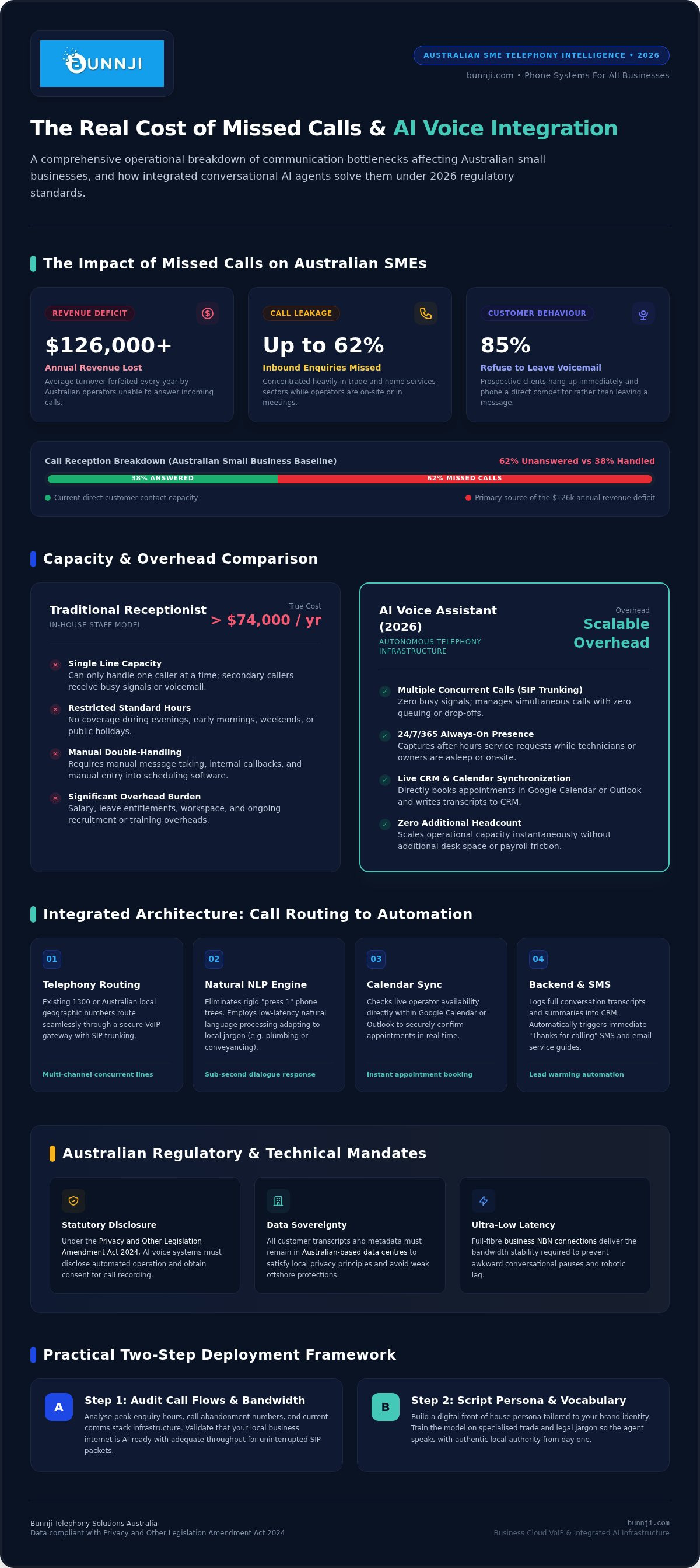
The financial stakes are high for local operators. According to 2026 SME research, Australian small businesses miss up to 62% of incoming calls, particularly in the trade and home services sectors. With 85% of callers refusing to leave a voicemail, these missed connections lead to an estimated annual revenue loss of over $126,000 per business. An AI voice agent solves this by providing an "always-on" presence that handles enquiries while you're on-site, in a meeting, or even asleep.
The Difference Between a Bot and a Voice Agent
Traditional bots follow a pre-determined script. If a customer veers off track, the system breaks. Modern voice agents are built on advanced virtual assistant technologies that understand context and intent. They use low-latency processing to ensure there's no awkward silence during the chat. These agents also adapt to your specific business vocabulary. Whether you're a plumber talking about "re-seating a tap" or a lawyer discussing "conveyancing", the agent learns the jargon and responds accurately.
Why 2026 is the Turning Point for Australian SMBs
The maturity of the NBN fibre rollout has changed the game for local connectivity. With high-speed, stable internet now standard across most business precincts, the technical barriers to hosting crystal-clear AI voice packets have vanished. Customers have also changed. By 2026, the average Australian consumer prefers a helpful, immediate AI interaction over waiting on hold for twenty minutes. When you combine this with the rising costs of traditional admin staff, automating your front-of-house isn't just a smart move; it's an economic necessity for staying competitive.
The Mechanics: How AI Voice Agents Integrate with Your Office
An ai voice assistant for small business isn't just a web app; it's a deeply integrated part of your telephony infrastructure. The bridge between your voice engine and the caller is usually built on SIP trunking. This technology allows the AI to manage multiple concurrent calls, meaning your business never gives a busy signal even if three people call at once. You don't need to change your existing Australian 1300 or local geographic number either. We simply route the voice traffic through a secure VoIP gateway to the AI processor.
High-speed business internet is the silent hero in this setup. To keep a conversation feeling natural, latency must be kept as low as possible. If your connection is sluggish, the AI might pause too long, making the interaction feel robotic. This is why a robust NBN fibre connection is non-negotiable for a professional setup. If you're unsure about your current bandwidth, you can audit your comms stack to ensure it's AI-ready.
Connecting to Your CRM and Calendar
The real magic happens when the agent talks to your backend systems. If a client wants to book a quote, the AI checks your actual availability in Google Calendar or Outlook in real-time. There's no back-and-forth. Once the call ends, the agent logs the transcript and a summary directly into your CRM. It can even trigger immediate follow-up actions like sending a "Thanks for calling" SMS or an automated email with your service guide, ensuring the lead stays warm while you're busy on-site.
Security and Privacy in the Australian Landscape
Compliance is paramount for local firms. Under the Privacy and Other Legislation Amendment Act 2024, Australian businesses must be transparent about automated decision-making. Your AI should always disclose that it's an automated system and that the call is being recorded to establish consent. Data sovereignty is another critical factor. We ensure conversation logs and customer metadata are stored in Australian-based data centres to satisfy local privacy principles. This protects your firm's reputation and keeps your customer data away from offshore jurisdictions with weaker legal protections. For more details on responsible deployment, check out the Australian Government's guide to artificial intelligence in business.
AI Voice Agents vs Traditional Receptionists: A Strategic Comparison
Choosing between a human receptionist and an ai voice assistant for small business isn't about replacement; it's about strategic allocation of resources. Hiring a full-time receptionist in Australia has become a significant financial commitment. By mid-2026, the true on-cost of a single entry-level staff member ranges between $74,000 and $88,000 annually. This figure includes the 12% superannuation guarantee, leave loading, and workers' compensation. For most small firms, this overhead is difficult to justify, especially when the role involves repetitive tasks like booking appointments or answering basic FAQs.
Consistency and scalability are where the digital agent excels. A human staff member might get stuck in traffic, feel unwell, or simply have a "bad day" that affects their phone manner. An AI agent delivers a perfect brand experience every time. It also solves the problem of concurrent calls. If a local marketing campaign or a seasonal surge triggers ten calls at once, a human receptionist can only answer one while the others go to voicemail. An AI platform handles all ten simultaneously, ensuring no lead is ever left waiting on a busy signal.
When a Human is Still Essential
Technology hasn't removed the need for human empathy. Complex emotional grievances or high-value bespoke negotiations still require the nuance of a person. The most effective 2026 business models use a hybrid approach. The AI acts as a triage filter, handling the high-volume, low-complexity enquiries. When the system identifies a high-priority lead or a sensitive issue, it performs a "warm transfer". It loops in a staff member and provides a context-rich summary via SMS, allowing you to step into the conversation with all the facts already in hand. This maintains your personal touch while removing the administrative noise.
The ROI of Never Missing a Call
The cost of a missed call in Australia is higher than many realise. Research from 2026 suggests the average missed lead represents between $100 and $1,200 in potential revenue, depending on your industry. If you miss just two or three calls a week while you're on a job site, you're effectively leaking over $100,000 in annual turnover. There is also a "distraction tax" to consider. Every time you stop billable work to answer a basic enquiry, it takes several minutes to regain your focus. By capturing every lead automatically, you reclaim your time and protect your bottom line. The ROI of an AI voice agent is the total value of captured leads and reclaimed billable hours minus the platform's operational cost.
How to Organise and Deploy Your AI Voice Assistant
Deploying an ai voice assistant for small business doesn't require an in-house IT department. The process is a logical progression from your current phone setup to an automated, intelligent platform. Success lies in the preparation phase. By following a structured rollout, you ensure your digital agent feels like a natural extension of your team rather than a clunky add-on.
- Step 1: Audit your call flow. Review your last month of voicemails. Identify the top five reasons people call. If 80% of enquiries are about your opening hours or booking a quote, these are the first tasks your agent should master.
- Step 2: Script the persona. Choose a voice and tone that matches your brand. A professional firm might want an authoritative tone, while a local trade business might prefer something more relaxed and direct.
- Step 3: Integrate your stack. Connect the agent to your VoIP system, CRM, and calendars. This allows the AI to log transcripts and book appointments without manual intervention.
- Step 4: Run the testing phase. Perform "dummy" calls with your staff. Try to interrupt the agent or ask questions in different ways to refine its natural language understanding.
- Step 5: Go live and monitor. Once you're confident, flip the switch. Use your performance dashboard to track resolution rates and identify any gaps in the agent's knowledge.
Scripting for Success
Brevity is vital. Your customers want answers, not a long-winded introduction. Ensure your agent gets to the point quickly. Transparency is also a non-negotiable part of the Australian business landscape. If a caller asks if they're talking to a machine, the agent should answer honestly. A "Fair Go" personality works best for local customers; it should be helpful and capable without being overly corporate. If you're ready to start building your persona, you can book a technical audit with our team today.
Technical Prerequisites for Australian Firms
Your AI agent is only as good as the connection supporting it. While NBN fibre has made cloud-based voice more accessible, you must ensure your plan has sufficient upload speed to handle voice processing without lag. We also recommend implementing internet redundancy. If your primary NBN connection goes down, an automated failover to 5G ensures your virtual receptionist stays online. Understanding these infrastructure needs is part of a broader Business VoIP Australia: The Complete 2026 Strategy Guide that every modern firm should follow.
Why Bunnji Leads the Pack for Australian AI Voice Solutions
Bunnji understands that an ai voice assistant for small business is only effective if the underlying infrastructure is rock solid. We don't just sell you a license and leave you to figure out the routing. Our approach starts with a comprehensive audit of your existing comms stack. We look at your current call volumes, your internet stability, and your CRM workflows to build a bespoke solution that actually works for your specific trade or professional firm.
We specialise in the "last mile" of implementation. Because we provide both Business NBN and Cloud VoIP, we can optimise your network traffic to ensure your AI agent never sounds laggy or distorted. This end-to-end control means we can troubleshoot issues across your entire connection, not just the software layer. It's the difference between a generic global bot and a local, carrier-grade solution that respects the nuances of the Australian telecommunications network.
Transparency is at the heart of our operations. Many providers in the Australian market try to lock firms into rigid 60-month equipment contracts that are impossible to escape. We don't do that. Our agreements are straightforward, and our support is entirely Australian-based. When you call us, you're talking to someone who understands the local business environment and the specific challenges of the NBN. We're a capable partner that combines global-scale technology with the attitude of a boutique provider.
A Holistic Approach to Business Comms
We view your AI transformation as part of a larger digital strategy. This includes providing high-speed fibre upgrades that offer the low-latency performance required for real-time voice processing. We also integrate managed IT services and cybersecurity to protect your customer data from evolving threats. You can read more about the future of this technology in our AI Voice Agents: 2026 Trend Report for Australian Firms.
Getting Started with Your AI Receptionist
Every business has different requirements. A legal firm needs a different persona and workflow than a plumbing business. We work with you to customise every response, ensuring the agent handles your specific industry jargon with ease. We'll show you the system in action and help you map out a call flow that captures every lead. It's time to stop losing revenue to missed calls and start scaling with a partner that values your growth as much as you do. Speak to a Bunnji expert today about automating your calls and securing your front-of-house.
Future-Proof Your Business Communications Today
The shift toward automated, intelligent telephony is the most significant change to the Australian business landscape in recent years. By choosing an ai voice assistant for small business, you're doing more than just answering the phone. You're building a scalable, professional brand that captures every lead while you focus on your core work. We've seen how these agents eliminate the revenue leak caused by missed calls and how they seamlessly sync with your CRM to handle the administrative heavy lifting.
Bunnji is here to guide you through this transformation. As specialists in Australian Business NBN and Cloud VoIP, we ensure your AI deployment is supported by carrier-grade infrastructure and expert telecommunications audits. Our solutions offer direct CRM and calendar integration, giving you the peace of mind that your business is always open. It's time to reclaim your time and stop letting valuable enquiries slip through the cracks.
Automate your business calls with Bunnji AI Voice Agents and start scaling your firm without the overhead of a traditional reception desk. Your future-ready front office is only a conversation away.
Frequently Asked Questions
Will an AI voice assistant sound robotic to my Australian customers?
No, modern AI agents utilize advanced natural language processing to deliver fluid, human-like conversations. These systems are specifically tuned to recognize Australian accents and local colloquialisms, ensuring your customers feel heard and understood. Unlike the clunky voice prompts of the past, 2026 technology uses low-latency processing to eliminate awkward pauses. This results in a professional brand image that feels personal rather than mechanical or detached.
Can the AI voice assistant book appointments directly into my Google or Outlook calendar?
Yes, direct calendar integration is a standard feature for a modern ai voice assistant for small business. The system checks your real-time availability in Google Calendar or Outlook and offers callers specific time slots that work for you. Once a booking is confirmed, the agent automatically updates your schedule and can even trigger a confirmation SMS. This eliminates the back-and-forth emails that often lead to lost leads.
Do I need to change my existing business phone number to use an AI receptionist?
No, you can keep your existing Australian business number when moving to an AI-powered system. We use SIP trunking and VoIP routing to direct your calls to the AI agent. Whether you have a local geographic number or a 1300/1800 number, the transition is seamless. You won't need to reprint business cards or update your website listings, as the technology works behind the scenes of your current telephony setup.
What happens if the AI voice assistant gets a question it cannot answer?
The agent is designed to perform a "warm transfer" or take a detailed message if it encounters a query outside its knowledge base. It identifies complex or emotional enquiries and can immediately route the call to a designated staff member. If no one is available, the AI takes a transcript of the request and sends a summary to your CRM. This ensures the customer is never left without a clear path forward.
Is my customer data safe when using an AI voice agent in Australia?
Customer data is highly secure when you partner with an Australian-based provider like Bunnji. We ensure that all call recordings, transcripts, and metadata are stored in sovereign Australian data centres to comply with the Privacy Act. This approach satisfies Australian Privacy Principles regarding data residency and security. We also implement robust cybersecurity measures to protect your firm from emerging threats like voice spoofing and unauthorised data access.
How much does an ai voice assistant for small business typically cost?
While specific costs depend on your call volume and integration needs, an ai voice assistant for small business costs a small fraction of a human salary. In 2026, the true on-cost of a full-time Australian receptionist exceeds $74,000 annually. An AI agent provides 24/7 coverage without the overhead of superannuation, leave loading, or weekend penalty rates. It offers a scalable solution that grows with your business without increasing your fixed headcount costs.
Can the AI agent handle multiple calls at the same time?
Yes, your AI agent can handle multiple concurrent calls without ever giving a busy signal. Traditional phone lines are limited by the number of physical handsets or channels available, but cloud-based AI uses SIP trunking to manage dozens of enquiries at once. This is particularly useful during marketing promotions or seasonal peaks. Every caller receives immediate attention, which significantly improves your lead capture rate and overall customer satisfaction levels.
Does the AI voice assistant work with the NBN?
Yes, the system is designed to work perfectly with business NBN connections, especially fibre upgrades. Because the AI processing happens in the cloud, a stable and high-speed internet connection is essential for maintaining low latency. Bunnji specialises in both business NBN and VoIP, so we can optimise your entire connection to ensure crystal-clear voice quality. We also recommend internet redundancy plans to keep your virtual receptionist online if your primary connection fails.


