
Did you know that by December 2026, more than 2.4 million Australian small businesses will lose their Privacy Act exemption? This shift means every local business must comply with strict data laws, making cybersecurity a mandatory legal duty regardless of your annual turnover. It's a significant change for owners who are already frustrated by the "break-fix" cycle, where IT costs are unpredictable and a single NBN outage can derail your entire afternoon.
You likely agree that tech should just work without the constant fear of AI-driven scams or dropped client calls. Securing reliable managed it support for small business australia is about more than just patching software. It's about finding a capable partner who provides fixed monthly costs and a single point of contact for both your IT and phone systems, removing the friction from your daily operations.
This guide reveals how to choose a partner that secures your data, integrates AI to streamline your workflow, and slashes hidden telecommunications costs. We'll explore the latest 2026 pricing models, explain your new privacy obligations, and show you how to build a seamless remote work environment that actually stays connected when it matters most.
Key Takeaways
- Stop relying on reactive "break-fix" technicians and switch to a proactive model that prevents tech issues before they stall your operations.
- Prepare for the 2026 Privacy Act changes by securing your data with AI-driven threat detection and robust cloud backups.
- Choose the right managed it support for small business australia by prioritising contract transparency and avoiding restrictive 60-month equipment leases.
- Identify hidden costs and connectivity bottlenecks in your office by performing a quick 10-minute telecommunications and IT audit.
- Boost efficiency by integrating AI voice agents and internet redundancy to ensure your business stays connected and never misses a customer call.
What is Managed IT Support for Small Business in Australia?
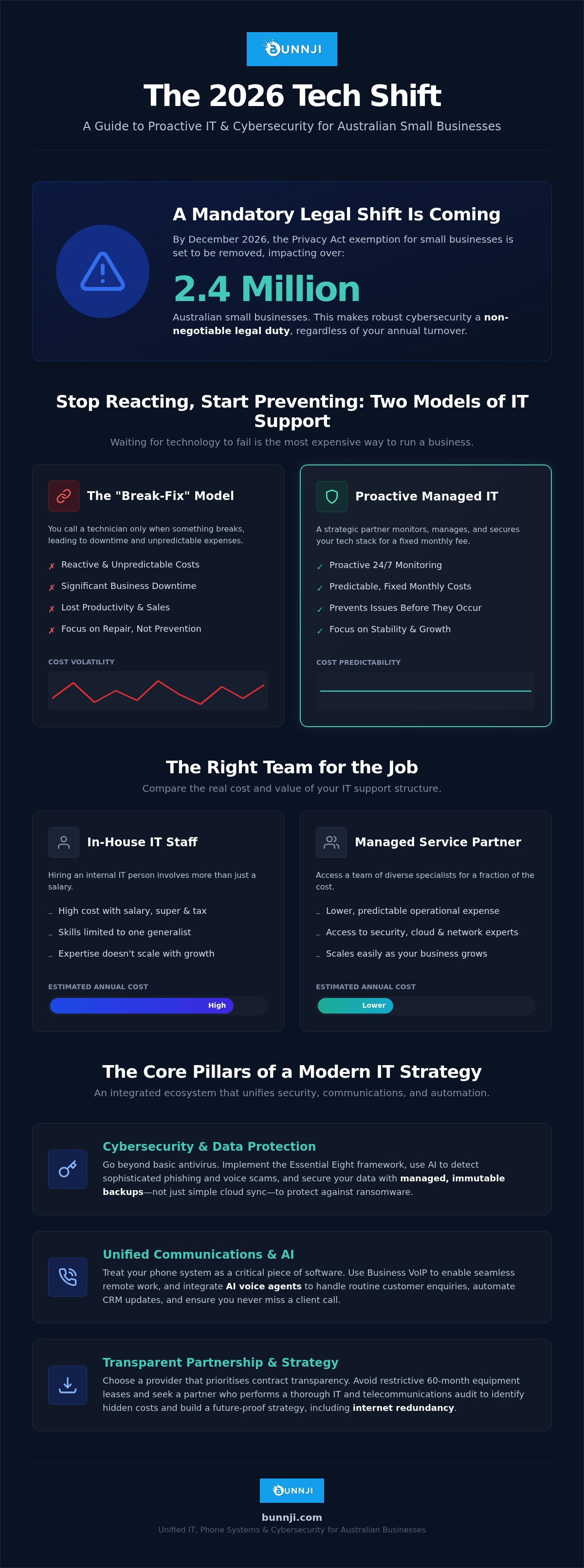
Understanding What is Managed IT Support starts with a shift in mindset. For years, many Australian businesses relied on a "break-fix" model. You called a technician only when something stopped working. Today, managed it support for small business australia has evolved into a strategic partnership. It's a proactive arrangement where a provider monitors, manages, and secures your entire technology stack for a predictable fee. Instead of reacting to disasters, this model focuses on preventing them entirely.
In the local Australian context, small to medium enterprises are moving away from ad-hoc technicians for a simple reason: reliability. Emergency repair bills are volatile and often arrive at the worst possible time. By contrast, managed services offer fixed monthly costs. This financial transparency allows you to treat IT as a utility rather than an unpredictable expense. It also introduces the concept of Unified Managed Services. This approach bundles your IT support, cloud phone systems, and cybersecurity into a single, cohesive service, eliminating the complexity of managing multiple vendors.
The Shift from Break-Fix to Proactive Management
Waiting for technology to fail is the most expensive way to run a business. When a server goes down or your internet drops, you aren't just paying for the fix. You're losing staff productivity and missing potential sales. Modern managed support uses 24/7 monitoring to identify hardware fatigue or software glitches before they cause downtime. This proactive management includes regular patching and updates. It's a critical layer of protection against the latest Australian cyber threats, ensuring your systems are never left vulnerable to known exploits while you focus on your core business.
Managed Services vs. In-House IT: A Comparison
Many owners wonder if they should just hire an internal IT person. However, the true cost of a full-time IT salary in Australia is substantial when you factor in superannuation, payroll tax, and training. Even with that investment, you're often limited to the skills of one generalist. A managed partner gives you access to a team of specialists for a fraction of the cost. You get the collective expertise of security analysts, network engineers, and cloud architects. This model provides the scalability you need to grow. You can expand your team or upgrade your infrastructure without the overhead of increasing your internal headcount.
The Core Pillars of a Modern IT Strategy in 2026
Technology in 2026 is no longer a collection of separate tools. It's a single, integrated ecosystem. A robust strategy for managed it support for small business australia must unify your security, cloud infrastructure, and communication channels into one seamless engine. When these pillars work together, you eliminate the technical friction that slows down your team and creates dangerous security gaps.
Cybersecurity and Data Protection
Basic antivirus tools are no longer a match for modern threats. Today, Cyber security for Australian businesses involves implementing the Essential Eight framework developed by the Australian Signals Directorate. This includes mandatory multi-factor authentication and restricted administrative privileges. However, the real threat in 2026 comes from AI-driven scams. Sophisticated voice and email clones can trick even the most cautious staff members into revealing sensitive data. Protecting your team requires managed firewalls and AI threat detection that identifies these attacks before they reach a user's device. It's also vital to distinguish between cloud storage and disaster recovery. A simple cloud sync doesn't protect you from ransomware; you need managed, immutable backups that ensure your data remains safe and recoverable.
Unified Communications and AI Integration
Modern IT strategies now treat your phone system as a critical piece of software. Transitioning to business VoIP Australia allows your staff to work from any location while staying connected to the office. This is about more than just voice calls. We are seeing a significant shift where AI voice agents for business handle routine customer enquiries and sync directly with your CRM. This automation ensures client data is updated in real-time without manual entry errors. A modern approach to managed it support for small business australia also ensures that your connectivity is as reliable as your servers. You need business NBN or Fibre with built-in redundancy. If your primary connection fails, a managed 5G backup should activate instantly to keep your VoIP lines and Microsoft 365 apps online. If your current setup feels disjointed, a specialised telecommunications audit can help bridge the gap between your IT and your phones.
Evaluating Managed IT Providers: What Actually Matters?
Choosing a partner for managed it support for small business australia is a decision that dictates your operational stability for years. It's easy to get distracted by flashy brochures, but you must focus on the fine print of Service Level Agreements (SLAs). Specifically, distinguish between response times and resolution times. A response is merely a ticket acknowledgement, while a resolution is when your staff are actually back to work. A capable partner should also offer vCIO services to help you plan for future growth, ensuring your tech stack scales alongside your business goals.
Transparency and Contract Lengths
Beware the 60-month equipment lease. This is a common tactic used to hide the true cost of hardware and lock you into an inflexible relationship. If a provider tries to sign you up for five years, ask yourself why they are so afraid of you leaving. Shorter-term or month-to-month agreements drive better service quality because the provider has to earn your business every single month. Before signing, clarify who owns the hardware and ensure you retain full porting rights for your phone numbers. You should never feel like a hostage to your own technology infrastructure.
The Importance of an Australian Helpdesk
When your internet goes down or a scam email bypasses your filters, you need someone who understands the Australian business landscape. Outsourced "follow the sun" support often leads to frustration due to time-zone lags and a lack of local knowledge. An Australian helpdesk ensures you're talking to someone who knows the difference between a standard NBN fault and a wider regional outage. They are also better equipped to help you manage the strict data obligations of the Privacy Act. For any managed it support for small business australia, local expertise isn't just a "nice to have" feature; it's a requirement for staying compliant and productive.
The 10-Minute IT and Telecommunications Audit
Most Australian business owners are unknowingly paying a "complexity tax" every month. This happens when your IT and phone systems aren't aligned, leading to overlapping services and redundant software. A periodic review is a core part of effective managed it support for small business australia. It allows you to reclaim wasted budget and reinvest it into growth-focused technology like AI integration. You can start this process yourself by following a simple checklist to identify where your money is leaking.
- Audit your SaaS sprawl: Review your bank statements for "zombie" software licences that are no longer used by staff.
- Verify your redundancy: Physically check if you have a secondary internet connection that activates automatically when the NBN fails.
- Assess scam risks: Check if your phone system has basic protections against AI voice clones and unauthorised international dialling.
- Review hardware age: Identify any workstations or routers older than four years that are likely slowing down your team.
Identifying Hidden Telecom Costs
Legacy business phone plans are often riddled with overcharges for features you don't use. Many providers still charge high rates for local calls or include expensive hardware maintenance fees that are obsolete in a cloud-based world. You should also evaluate your team's mobile usage. Switching to business mobile SIM only plans can often cut your monthly mobile spend by half compared to traditional handset-bundled contracts. Beyond direct costs, consider the revenue lost to missed calls. If your current setup doesn't have an AI receptionist to handle overflow, you're likely losing thousands in potential new business every month.
Testing Your Disaster Recovery Readiness
An internet outage is more than a nuisance; it's a direct hit to your bottom line. If the NBN goes down for four hours, can your staff still access Microsoft 365 or take customer calls? Consumer-grade backups, like a simple 4G dongle, often fail to support the bandwidth required for a full office. Business-grade redundancy ensures a seamless transition to a 5G or secondary fibre link without dropping active VoIP calls. In the context of an Aussie SMB, your Recovery Time Objective (RTO) is the maximum amount of time your business can afford to be offline before the lack of technology causes irreparable damage to your reputation or cash flow. If your current setup doesn't meet your RTO requirements, it's time to book a comprehensive 10-minute telecommunications audit to identify your vulnerabilities.
Future-Proofing with Bunnji’s Managed Solutions
Bunnji simplifies the complicated "mess" of modern technology by consolidating your IT, internet, and phone systems into one manageable service. Our approach to managed it support for small business australia focuses on the intersection of data security and high-speed communication. We don't just manage your servers; we ensure your AI voice agents are talking to your CRM while your fibre connection remains rock-solid. This integration removes the friction that usually occurs when multiple vendors fail to communicate with each other.
Why a Comms-First Approach Wins
Your phone system is often the weakest link in your IT stack. If your internet drops, your IT provider can't remote in to help. If your VoIP lines fail, your customers can't reach you. This is why we prioritise a comms-first strategy. By having one partner manage your NBN, VoIP, and Cybersecurity, you eliminate vendor finger-pointing. You receive no-nonsense, jargon-free Australian support from experts who understand the local market. We focus on transparency and reliability, ensuring you never face the hidden traps of restrictive 60-month contracts mentioned earlier in this guide.
Getting Started: The Transition Process
Switching to a new provider shouldn't cause business downtime. We manage the transition through a methodical process that starts with the "Bunnji Audit". This specialised deep-dive goes beyond a surface-level review to find hidden telecommunications costs and security vulnerabilities. We then modernise your infrastructure, ensuring your team is ready for the 2026 Privacy Act changes and AI integration requirements. Our goal is to move your business from a state of tech frustration to a high-performance office environment. Book your free technology audit with Bunnji today to see how we can streamline your operations.
Take Control of Your Business Technology Today
The landscape for Australian small businesses is shifting rapidly as we head toward the end of 2026. Between mandatory Privacy Act compliance and the rise of AI-driven scams, the old "break-fix" mentality isn't sustainable anymore. You'll need a proactive strategy that unifies your cybersecurity, high-speed connectivity, and communication tools into a single, high-performance ecosystem.
By choosing managed it support for small business australia that avoids predatory 60-month contract traps, you regain control over your overheads while gaining access to a 100% Australian owned and operated team. Our specialised approach includes seamless AI voice integration and robust internet redundancy. This ensures your office stays online and your customer data remains protected at all times.
It's time to stop fighting with your tech and start using it as a competitive advantage. Take the first step toward a friction-free workplace by identifying your hidden costs and security gaps. Book Your Free 10-Minute Telecommunications and IT Audit and discover how a capable partner can simplify your operations.
Frequently Asked Questions
What is the average cost of managed IT support for small business in Australia?
Most providers use a per-user, per-month pricing model. This usually scales based on the level of security and support required. Basic packages often cover business-hour helpdesk access, while premium tiers include advanced cybersecurity and constant monitoring. Some firms also offer per-device or all-inclusive monthly flat fees for small teams. This allows you to forecast your tech spend accurately without the shock of emergency repair bills or unexpected technician call-out fees.
Do I really need managed IT if I only have five employees?
Yes, because the complexity of modern technology isn't determined by your headcount. Even with five staff, you handle sensitive customer data and rely on cloud systems that require constant patching. Securing managed it support for small business australia ensures your five employees stay productive rather than wasting time trying to fix connectivity issues. The 2026 Privacy Act changes mean small teams face the same legal obligations for data protection as larger corporations.
What is the difference between managed IT and a helpdesk?
A helpdesk is a reactive service that fixes problems after they occur. Managed IT is a proactive partnership that aims to prevent those problems from happening in the first place. While a helpdesk might reset a password, managed IT includes strategic planning, cybersecurity monitoring, and regular infrastructure audits. It's the difference between calling a mechanic when your car breaks down and having a team that services it regularly to ensure it never stalls on the motorway.
Can a managed IT provider help with my NBN connection issues?
A comprehensive provider manages the relationship between your local network and your internet service provider. Instead of you spending hours on hold with a telco, your managed IT partner troubleshoots the connection and coordinates repairs. They also implement redundancy solutions, such as 5G backups or secondary fibre links. This ensures your office stays online and your cloud VoIP systems continue to function even if the primary NBN line experiences an unexpected regional fault.
How does managed IT protect my business from AI voice scams?
Protection involves a combination of technical filters and staff training. Managed IT providers implement advanced security layers that detect unusual patterns in communication and block known malicious sources. They also configure your phone system to prevent authorised international dialling and provide protocols for verifying identity. Because AI voice clones are becoming highly realistic, having a partner who understands the intersection of IT and telecommunications is essential for identifying these sophisticated threats before they cause financial damage.
What should I look for in a Managed Service Provider (MSP) contract?
Prioritise transparency and flexibility. You should avoid predatory 60-month equipment leases that lock you into outdated hardware. Look for clear Service Level Agreements (SLAs) that define resolution times, not just response times. Ensure the contract specifies who owns the hardware and confirms your right to port phone numbers if you ever choose to leave. A good agreement focuses on delivering value every month rather than relying on restrictive legal clauses to keep your business as a hostage.
Does Bunnji provide on-site support or is it all remote?
Most managed it support for small business australia is delivered remotely to ensure the fastest possible response times. This allows experts to access your systems instantly and resolve software or configuration issues without travel delays. While we focus on high-efficiency remote management and cloud-based solutions, we coordinate with local technicians if physical hardware installations are required. This hybrid approach provides the resources of a national player with the responsiveness needed for modern, flexible workplaces.
How quickly can a managed IT provider respond to a critical outage?
Response times vary based on the severity of the issue and your specific SLA. For a critical outage that stops all business operations, most providers aim to respond within 15 to 30 minutes. However, the more important metric is the resolution time. A proactive partner monitors your systems constantly, often identifying and fixing a potential failure before you even notice your systems are down. This predictive approach is the best way to minimise actual downtime.


