
The lowest monthly quote for a business phone system is often the most expensive choice your small business will ever make. When you're calculating the cost of voip phone system for small business, it’s easy to get distracted by flashy per-user stickers while ignoring the fine print that locks you into a 60-month hardware contract. You've likely felt the sting of a 'simple' bill that arrives with a maze of hidden call charges or, worse, a dodgy NBN connection that drops out just as a client is about to sign.
We agree that business technology shouldn't feel like a trap. This guide promises to help you master the true total cost of ownership for Australian business VoIP, ensuring you get crystal-clear reliability without the predatory contracts. We’ll break down monthly subscriptions versus setup fees, show you how to scale without massive capital expenditure, and explain why your internet redundancy is just as important as the handset on your desk. By the end, you'll have a clear roadmap to organise a system that actually works for your bottom line.
Key Takeaways
- Calculate the true total cost of ownership by looking beyond monthly plans to include hardware, internet reliability, and setup fees.
- Avoid the trap of 60-month equipment contracts and learn how to maintain ownership of your numbers through proper porting processes.
- Master the cost of voip phone system for small business by comparing the long-term savings of cloud-based apps against the maintenance of physical desk phones.
- Boost your ROI by integrating AI voice agents that eliminate missed calls and handle enquiries without the overhead of additional staff.
- Secure your operations by choosing a partner that provides local Australian support and a dedicated focus on internet redundancy.
Understanding the Total Cost of Ownership (TCO) for Business VoIP
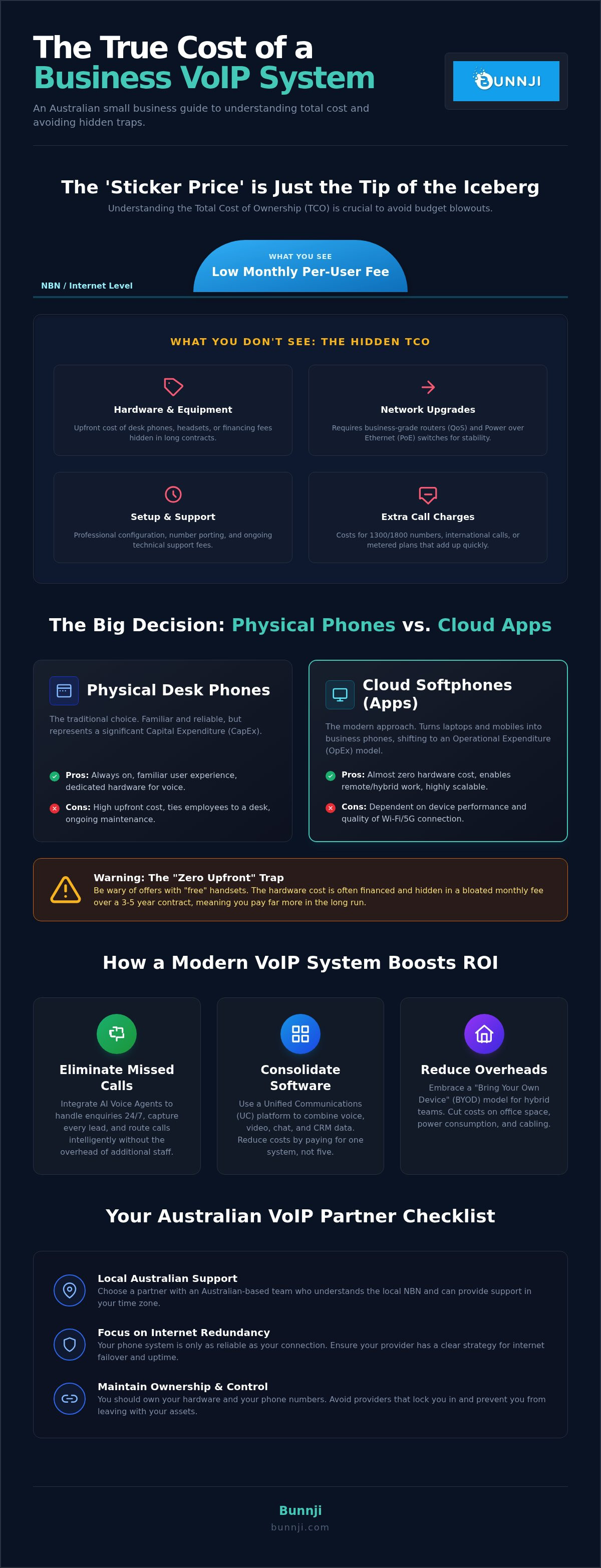
The true cost of voip phone system for small business is rarely the number you see on a checkout page. Total Cost of Ownership (TCO) includes your monthly subscription, hardware, internet bandwidth, and ongoing technical support. By adopting Voice over Internet Protocol (VoIP), you transition from traditional capital expenditure (CapEx) to an operational expenditure (OpEx) model. Instead of buying a $15,000 PBX box for the office wall, you pay a predictable monthly fee. However, the sticker price often ignores the labour required for setup or the network upgrades needed to keep calls from dropping.
In 2026, most Australian providers offer per user pricing, which is ideal for small teams. Larger organisations might look at per channel models, which limit how many simultaneous calls can occur regardless of staff count. Choosing the wrong model can lead to unexpected bottlenecks or paying for seats you don't actually use. Understanding these distinctions is the first step toward a transparent budget.
Subscription Fees vs. Call Charges
Unlimited local and national call plans are the standard, but they aren't always the best value. If your team mostly handles incoming enquiries, a metered plan might actually lower your monthly bill. International rates vary wildly between providers; if you have overseas suppliers, these costs can accumulate quickly. Additionally, 1300 and 1800 numbers often carry separate monthly rental fees and per-minute inbound charges that aren't included in your base user licence. You need to audit your typical monthly call volume before signing a contract to ensure the inclusions match your reality.
The Infrastructure Investment
Your office router is often the weakest link. A basic residential-grade router cannot prioritise voice traffic, leading to jitter and echo. Upgrading to a business-grade router with Quality of Service (QoS) capabilities is a necessary investment. Stable setups also require Power over Ethernet (PoE) switches to power your desk phones without a mess of individual power bricks. While softphones (apps on your computer or mobile) eliminate handset costs, they rely heavily on your device's processing power and a rock-solid Wi-Fi connection. Balancing these infrastructure choices will determine whether your system feels like a professional tool or a constant technical headache.
The Hardware vs. Cloud Debate: What Should You Pay For?
Many Australian business owners assume a new phone system requires a desk full of new plastic. It doesn't. When calculating the cost of voip phone system for small business, the biggest variable is your choice of hardware. Physical handsets are reliable and familiar, but they come with upfront costs and ongoing maintenance. Conversely, cloud-based softphones allow your team to answer calls on laptops or smartphones, effectively wiping out the hardware budget and reducing your office footprint.
Be wary of "zero upfront" offers. These are essentially finance deals where the cost of the handset is hidden in a bloated monthly subscription. Over a three or five-year term, you often end up paying double what the hardware is worth. Ownership matters; buying your equipment outright or sticking to softphones keeps your monthly overhead low and your flexibility high. If you're unsure which path fits your office, a telecommunications audit can reveal where you’re overspending on redundant tools.
Modern systems also offer more than just voice through unified communications (UC). By integrating video, chat, and CRM data into one platform, you reduce the need for separate software subscriptions. This consolidation is where the real ROI lives. Instead of paying for three different collaboration tools, you pay for one robust system that handles everything. This streamlined approach simplifies your billing and makes it easier to organise your team's workflow.
Softphones and Mobile Integration
Transitioning to a "Bring Your Own Device" (BYOD) model offers significant cost benefits for remote or hybrid teams. You aren't just saving on the physical phone; you're also reducing the power consumption and cabling requirements of your office. Licensing fees for softphone apps are typically included in your base user cost, making it a highly scalable option. However, call quality on mobile data can be hit-or-miss. We recommend ensuring your staff have access to high-quality Wi-Fi or 5G to maintain professional standards.
Legacy Equipment and SIP Trunking
If you've already invested heavily in an on-premise PBX system, you don't necessarily have to bin it. SIP trunking acts as a digital bridge, allowing your legacy hardware to use a modern VoIP connection. This approach saves on initial capital expenditure but carries higher long-term maintenance costs. Older systems lack the automatic updates and security patches of cloud-native platforms, meaning you might spend more on IT support over time than you would on a total cloud migration. For most firms, the bridge is a temporary measure rather than a final destination.
Hidden Traps in Australian Telecom Contracts
Many Australian providers still push 60-month telecommunications equipment contracts. Five years is an eternity in the tech world. By the time you're halfway through, your handsets are obsolete, but you're still paying premium rates. This is a massive factor in the total cost of voip phone system for small business. These long-term commitments often include hardware "rent-to-own" schemes that cost far more than buying outright. They serve the provider's bottom line, not your business agility.
Porting fees are another common trap. While taking your existing numbers with you is a right, some providers charge exorbitant administrative fees per number. If you have a large block of 100 numbers, this can become a significant exit cost. You should always check the porting schedule before you sign. It is your data; you shouldn't have to pay a ransom to keep it.
Contract buyout clauses are designed to prevent you from switching to a better deal. If you need to scale down during a slow period or want to move to a more modern platform, you might face a bill for the remaining months of the contract. This lack of flexibility can stifle a growing business. A professional telecommunications audit is the best way to identify these risks before they become expensive liabilities.
Internet Dependency and the Cost of Outages
VoIP is only as good as your internet connection. A cheap, residential-grade NBN plan might save you $20 a month, but a single afternoon of downtime can cost thousands in lost leads and frustrated customers. Reliability has a price, but it is an investment in your reputation. We recommend 4G or 5G failover solutions to ensure your phones stay online when the primary connection falters. Many premises are now eligible for NBN fibre upgrades, which provide the stable bandwidth required for crystal-clear voice traffic without the jitter associated with old copper lines.
The Audit Process: Finding Leaks
A thorough audit usually finds "zombie" services. These are lines for old fax machines, EFTPOS terminals, or security alarms that no longer exist but still appear on your monthly bill. These leaks inflate your expenditure for no reason. Comparing your current contract against 2026 market rates often reveals you're paying for legacy features that are now standard inclusions. To learn more about building a robust setup, check out Business VoIP Australia: The Complete 2026 Strategy Guide. Identifying these inefficiencies allows you to redirect your budget toward technology that actually grows your business.
Calculating ROI: AI Voice Agents and Missed Calls
Calculating the true cost of voip phone system for small business requires looking at what happens when you don't answer the phone. A missed call is more than a minor inconvenience; it is a lead that has likely just moved on to your closest competitor. If your average lead value is high, missing just two or three calls a month can cost you more than your entire annual phone bill. In 2026, the most successful Australian firms are viewing their phone system as a revenue generator rather than a utility bill.
AI voice agents have changed the mathematics of business communication. These systems don't just take messages; they qualify leads, book appointments, and answer common enquiries in natural language. By automating these initial interactions, you ensure that every caller is greeted instantly, regardless of how busy your team is. This technology allows you to maintain a professional front without the massive capital investment of a traditional call centre setup.
Beyond answering calls, the real ROI comes from integration. When your phone system talks directly to your CRM, you eliminate the need for manual data entry. Every call, recording, and transcript is automatically logged against the client's profile. This saves your sales team hours of administrative work every week and ensures no detail is lost in transition. If you want to see how these tools are being deployed locally, you can book a telecommunications audit to identify where automation can trim your overheads.
AI Receptionists vs. Traditional Staffing
Traditional receptionists are vital for high-touch customer service, but they are limited by standard business hours and human capacity. Comparing monthly AI agent fees to part-time receptionist wages reveals a stark difference in operational costs. An AI agent provides 24/7 availability without overtime pay or holiday loading. It handles the "simple" enquiries, like checking order status or booking a desk, leaving your human staff to focus on complex, high-value client relationships. For a deeper dive into the technology, read our AI Voice Agents: 2026 Trend Report for Australian Firms.
CRM Integration and Workflow Automation
Manual errors in booking and intake are expensive. A mistyped phone number or a forgotten follow-up can kill a deal before it starts. Workflow automation ensures that every call triggers a specific action, such as sending a confirmation SMS or creating a task in your project management tool. This level of precision reduces staff overheads by streamlining the path from first contact to final sale. Using AI to qualify leads before they ever reach your sales team ensures your most expensive employees are only talking to prospects who are ready to buy.
Choosing the Right VoIP Partner for Your Small Business
Selecting a provider is about more than just finding the lowest cost of voip phone system for small business. It is about who answers the phone when yours stops ringing. Local Australian support isn't a luxury; it is a necessity for business continuity. If your system goes down on a Tuesday morning, you need a partner who understands the local NBN landscape and can resolve issues without you sitting in a global support queue for hours. Technical expertise is only valuable if it is accessible when you need it most.
A reliable partner must provide clear redundancy and disaster recovery plans. This involves geographically redundant servers and automatic failover options. If one data centre experiences an issue, your calls should route through another without your clients noticing a thing. Transparency here is vital. Your provider should explain exactly how they keep your business online during an exchange outage or a hardware failure. Reliability is a core component of your total cost of ownership.
Your contract needs to be as flexible as your business. Avoid providers that lock you into rigid tiers where you pay for twenty users when you only have twelve. The financial agility of cloud systems means you should be able to add or remove users in seconds. This ensures your monthly overheads always match your actual headcount. A flexible agreement allows you to scale up for seasonal peaks and dial back during quieter months without penalty.
Scalability and Future-Proofing
Modern systems should be built for 2030, not 2020. This means ensuring your platform can handle the next wave of AI integrations and unified communications without a total hardware overhaul. At the same time, you must avoid "feature bloat." Many providers bundle expensive tools your team will never use. A capable partner helps you strip back the noise so you only pay for the capabilities that drive your specific workflow. This bespoke approach keeps your budget lean while keeping your technology current.
The Bunnji Difference
Bunnji operates at the intersection of VoIP, high-speed NBN, and Managed IT. We don't just sell you a plan; we build a communication foundation. Our approach focuses on eliminating hidden costs through transparent auditing. We ensure you aren't paying for the "zombie" services or predatory 60-month contracts that often plague the Australian market. We specialise in custom builds that prioritise internet redundancy and crystal-clear call quality for local firms. To see how we can streamline your setup, Book a telecommunications audit with Bunnji today.
Secure Your Business Communication Strategy for 2026
Mastering the cost of voip phone system for small business requires a shift from viewing telecommunications as a static utility to seeing it as a dynamic growth tool. By prioritising flexible cloud infrastructure over restrictive hardware contracts, you protect your cash flow and ensure your team remains agile. The integration of AI voice agents and robust internet redundancy transforms your phone system from a cost centre into a reliable lead-capture engine that works around the clock.
You don't have to navigate these technical transitions alone. At Bunnji, we specialise in removing the friction of legacy systems through transparent audits and bespoke builds. We provide expert Australian-based support and AI-integrated systems that grow with you, ensuring you never get caught in hidden 60-month hardware traps. It is time to move away from generic solutions and build a platform that truly serves your bottom line.
Get a Transparent VoIP Quote for Your Business and take the first step toward a more reliable, future-proof communication setup. Your business deserves a partner that values transparency and local expertise as much as you do.
Frequently Asked Questions
How much does a VoIP phone system cost for a small business per month?
The cost of voip phone system for small business is typically structured as a per-user, per-month subscription. This model ensures you only pay for the specific number of staff members using the system. While prices vary based on features like call recording or CRM integration, most small businesses find this OpEx model more manageable than the large upfront capital costs associated with legacy hardware. You should also factor in call inclusions and any separate fees for 1300 numbers.
Is it cheaper to use VoIP than a traditional landline in Australia?
Yes, switching to a cloud-based system is often more cost-effective than maintaining traditional copper landlines. You eliminate the expensive maintenance of on-premise PBX boxes and benefit from lower call rates. Since traditional copper networks are being decommissioned across Australia, moving to VoIP also removes the need for multiple separate line rentals. Consolidating your voice and data over a single business NBN connection reduces your monthly overheads while providing better functionality.
Do I need to buy new hardware to switch to a VoIP system?
You don't necessarily need to purchase new handsets to make the switch. Many Australian firms are moving away from desk phones entirely, opting instead for softphone applications on laptops and smartphones. If you prefer physical phones, you can buy VoIP-compatible handsets outright to avoid being locked into long-term equipment contracts. For businesses with relatively new legacy hardware, SIP trunking can sometimes act as a bridge, though a full cloud migration is usually more efficient.
What happens to my business phone system if the NBN goes down?
If your primary NBN connection fails, a system without redundancy will go offline. However, a professional setup includes 4G or 5G failover to keep your voice traffic flowing. Because cloud systems are hosted off-site, calls can also be automatically routed to mobile apps or other locations. We emphasise internet redundancy because a reliable connection is the foundation of clear call quality. A 10-minute telecommunications audit can help you identify if your current setup is ready for an outage.
Can I keep my existing Australian phone numbers when I switch to VoIP?
You can absolutely keep your existing local and national phone numbers through a process called porting. This allows you to maintain your established business identity while moving to a more modern platform. It is essential to check for any administrative porting fees before you start the transition, as some providers use these as a final exit cost. Once ported, you retain full ownership of your numbers, giving you the freedom to move providers in the future.
Is there a setup fee for business VoIP systems?
Setup fees vary based on the complexity of your office environment and whether you require professional onsite configuration. Some providers offer zero upfront deals, but these often hide the true cost of voip phone system for small business inside higher monthly subscription rates. A transparent setup fee usually covers number porting, hardware configuration, and the initial audit of your network. Investing in a professional setup ensures your router and switches are correctly optimised for voice traffic from day one.
How does an AI receptionist reduce the cost of my phone system?
AI receptionists lower costs by automating the handling of high-volume, repetitive enquiries that would otherwise require human staff. These agents work 24/7 without holiday loading or overtime pay, ensuring you never pay the hidden cost of a missed lead. By qualifying prospects and syncing data directly to your CRM, they reduce the administrative burden on your sales team. This allows you to scale your call capacity without increasing your monthly headcount expenses.
What is the difference between a 36-month and a 60-month telecom contract?
The main difference is the length of your financial liability and the risk of hardware obsolescence. A 60-month contract is a common industry trap that locks you into paying for handsets long after they have become outdated. While a 36-month term is shorter, it still limits your ability to scale down during quiet periods. We advocate for shorter, more flexible agreements that allow your technology to evolve alongside the latest AI advancements and your changing business needs.


