

Your business internet shouldn't be a gamble where the house always wins. While most providers hide behind layers of technical jargon, the reality of business nbn enterprise ethernet pricing is that you're often paying for priority and location rather than just raw speed. It's frustrating to sign a long-term contract only to find your speeds still crawl during the mid-afternoon rush. You need a connection that stays fast when your team is actually working, not just at midnight. We've seen too many firms settle for "best effort" links that fail them when it matters most.
We understand that deciphering "Class of Service" and "Symmetrical Speeds" feels like learning a second language just to keep your office online. This guide strips away the complexity to show you exactly what drives costs in 2026 and how to ensure your firm gets the performance it pays for. We'll explore the real-world price drivers, the contract traps to watch out for, and a framework to justify this investment to your board. You'll learn how to navigate the build cost maze and why redundancy is your best insurance against downtime.
Key Takeaways
- Learn why a dedicated 1:1 fibre connection eliminates the peak-hour slowdowns common with shared residential-grade services.
- Discover how business nbn enterprise ethernet pricing is influenced by your specific fibre zone and chosen Class of Service (CoS) tier.
- Understand the critical difference between "Best Effort" and "Committed Information Rate" to ensure your VoIP and cloud apps never lag.
- Identify the common contract traps that lead to "bill shock" and learn how to qualify for $0 upfront fibre build costs.
- Use a professional telecommunications audit to uncover hidden savings in your current spend that can fund a significant speed upgrade.
Beyond the Standard NBN: Why Enterprise Ethernet Commands a Premium
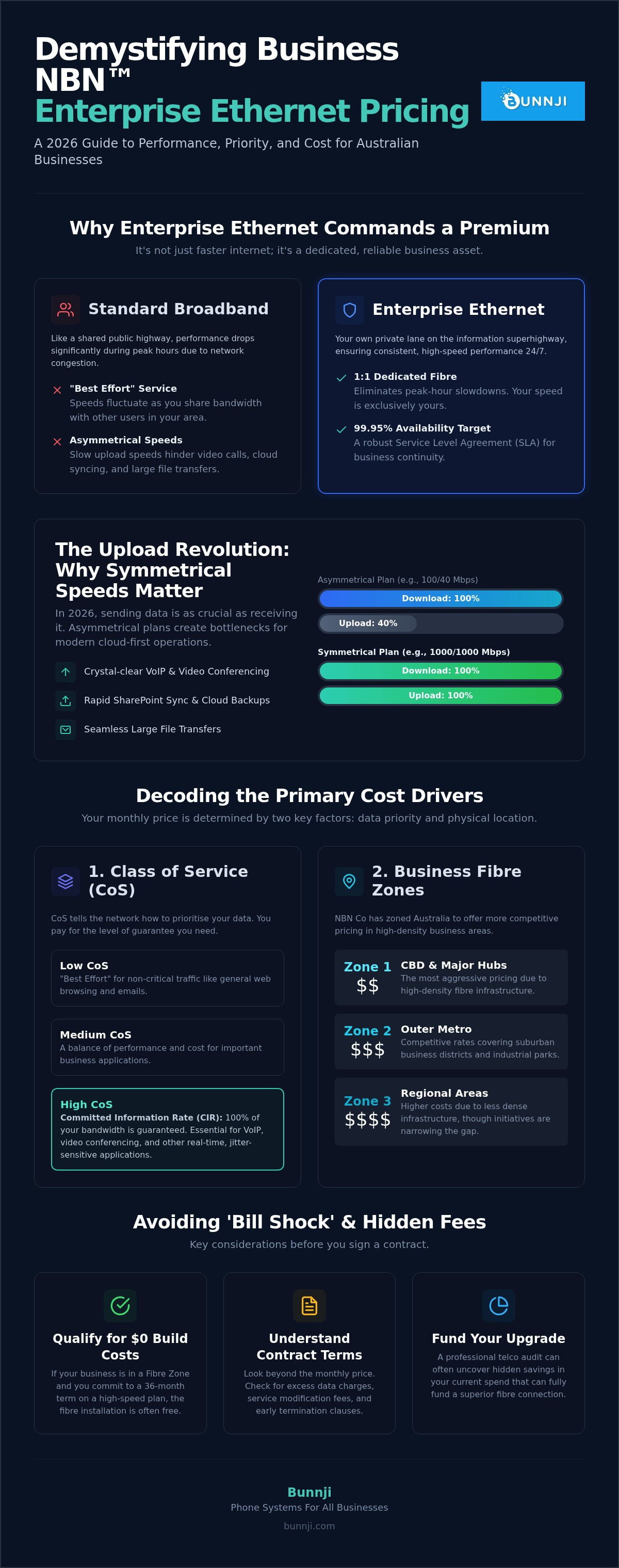
Standard broadband is like a shared highway. During peak hours, everyone slows down. Enterprise Ethernet (EE) is different. It provides a dedicated, 1:1 uncontended fibre path. This means your bandwidth isn't shared with the cafe next door or the apartments down the street. When evaluating business nbn enterprise ethernet pricing, you're investing in a private lane that remains open regardless of what the rest of the National Broadband Network (NBN) is doing.
Most residential-grade services offer "best effort" speeds. EE flips this on its head with a 99.95% network availability target. It's built for organisations where five minutes of lag is five minutes too many. Enterprise Ethernet is the gold standard for Australian firms requiring 24/7 connectivity.
The Cost of Downtime vs. The Cost of Fibre
Calculating the impact of an outage is simple but sobering. Multiply your team's average hourly wage by the number of staff, then add your estimated lost revenue per hour. If a team of twenty is idle for two hours, the cost often runs into thousands of dollars. "Cheap" plans look affordable until the first major outage hits. We view EE as a business continuity insurance policy. It protects your reputation and your bottom line. Understanding how business nbn enterprise ethernet pricing fits into your risk management strategy helps justify the shift from consumer-grade tech. Our team often helps firms audit their existing telecommunications spend to find the budget required for this crucial upgrade.
Symmetrical Speeds: Why Upload Matters in 2026
In 2026, your upload speed is just as vital as your download. Standard NBN plans are often asymmetrical, meaning they throttle your ability to send data. This causes stuttering video calls and slow SharePoint syncs. With symmetrical speeds up to 1Gbps/1Gbps, large file transfers and cloud backups happen in seconds. Your VoIP quality remains crystal clear because the data has a dedicated, high-priority path. The shift to cloud-first operations makes symmetrical performance a necessity, not a luxury. It ensures your office stays productive even when every staff member is on a simultaneous video conference.
Decoding the Primary EE Cost Drivers: CoS and Fibre Zones
Your monthly investment isn't a random figure. It's built on two specific pillars: how your data is treated and where your office sits. Mastering business nbn enterprise ethernet pricing requires a clear look at how your traffic is prioritised. Unlike standard plans where every packet of data fights for space, Enterprise Ethernet allows you to choose your lane. This choice dictates both your performance and your final bill.
Class of Service: Paying for the Priority Lane
Class of Service (CoS) is the mechanism that tells the network which data matters most. NBN Co offers three tiers: Low, Medium, and High. Low CoS is a "best effort" service. It's reliable for general web browsing and emails, but it doesn't offer a guarantee on bandwidth during congestion. For most growing firms, this is the entry point.
High CoS is a different beast entirely. It provides a Committed Information Rate (CIR), which means 100% of your purchased bandwidth is available to you every second of the day. This is mandatory for jitter-sensitive applications. If your office relies heavily on VoIP, video conferencing, or Citrix, High CoS ensures these services don't drop out when the rest of the network gets busy. The ACCC wholesale service standards inquiry has previously examined how these service levels impact business reliability. Choosing the right tier prevents you from overpaying for high-end priority you might not actually need.
Fibre Zones: Why Your Address Dictates the Price
Location is the second major driver of business nbn enterprise ethernet pricing. NBN Co has established over 300 Business Fibre Zones across Australia to encourage competitive pricing. If your office is in Zone 1 (typically a CBD or major business hub), you'll likely see the most aggressive rates. Zone 2 and Zone 3 cover outer metro and regional areas where the infrastructure is more costly to maintain.
The closer you are to a fibre exchange, the lower the wholesale cost to your provider. This is why two identical businesses in different suburbs can receive vastly different quotes for the same 1Gbps link. Regional firms often face higher monthly costs, but the nbn® Business Fibre Zone initiative has significantly narrowed this gap. Before you commit to a long-term contract, it's vital to verify which zone your building falls into. If you're unsure where your address sits, a professional telecommunications audit can clarify your eligibility and help you find hidden room in your budget for the upgrade.
Enterprise Ethernet vs. Business NBN FTTP: A Pricing Comparison
Choosing between Business NBN FTTP and Enterprise Ethernet often comes down to a simple question: what is the cost of your team sitting idle? While Business NBN FTTP offers impressive speeds for a lower monthly overhead, it remains a shared service. Enterprise Ethernet, by contrast, is a contractual commitment to performance. When reviewing business nbn enterprise ethernet pricing, the premium you pay covers more than just speed; it buys you a superior Service Level Agreement (SLA). Standard business fibre plans often target a 12 hour restoration time, whereas EE aims for a 4 hour window. For a firm running mission critical applications, those eight hours of difference represent a significant financial risk.
Scalability also sets these two apart. Upgrading an FTTP connection often involves navigating plan limits or hardware constraints. With EE, your infrastructure is built to grow. You can often increase your bandwidth from 100Mbps to 1Gbps with a simple configuration change. This makes it the smarter long term play for fast growing organisations that don't want to outgrow their tech every two years.
When to Stick with Business NBN FTTP
For smaller teams of ten to fifteen people with modest data needs, Business NBN FTTP is usually sufficient. It handles standard web browsing, email, and occasional video calls without breaking the bank. If you're concerned about reliability but aren't ready for the leap in business nbn enterprise ethernet pricing, a middle ground exists. We often recommend pairing a high speed FTTP plan with a 4G or 5G backup. This provides a safety net for basic connectivity without the enterprise price tag.
When the Upgrade to Enterprise Ethernet is Non-Negotiable
Certain industries simply cannot function on shared contention ratios. If your firm operates in engineering, media, medical, or finance, the data demands are too high for standard NBN. These sectors rely on massive file transfers and real time data processing that require the 1:1 uncontended nature of EE. It's about ensuring your tools work as hard as your staff do.
It's also the backbone for modern communication. The role of EE in supporting Business VoIP Australia and unified communications cannot be overstated. When your phone system is entirely cloud based, any jitter or latency on a shared line translates to dropped calls and frustrated clients. Once your headcount exceeds twenty staff, the risk of "bandwidth hogging" on a standard plan becomes too great. At this stage, the move to a dedicated fibre link becomes a logical step for business stability.
Avoiding 'Bill Shock': Installation, Contracts, and Hidden Fees
The headline rate on a quote is rarely the final story of your investment. While business nbn enterprise ethernet pricing looks straightforward on paper, the setup phase is where most firms encounter unexpected hurdles. The most common surprise is the "build quote." Even if your office is located within a designated fibre zone, nbn co must perform a site qualification. If your building lacks the necessary internal cabling or lead-in conduits, you might face significant upfront costs. Most providers mitigate this by offering to waive these fees in exchange for a long term commitment, but you must understand what you're signing before the technicians arrive.
Hidden termination fees are another trap for the unwary. If you cancel an order after the design phase but before activation, "in-flight" cancellation charges can range from $750 to $15,000 depending on the complexity of the work already performed. Transparency in these early stages is vital to avoid a budget blowout before you've even sent your first email over the new link.
The 36-Month Contract: Is it Worth the $0 Install?
The 36 month contract is the industry standard for securing a $0 fibre build. For 90% of eligible premises, this term eliminates the initial construction costs entirely. It's a calculated trade-off. You gain a premium connection with no capital outlay, but you lose the ability to pivot if your business needs change. If you plan to move offices within the next three years, the relocation fees or contract payout figures can be staggering. We always suggest calculating the Total Cost of Ownership (TCO) across the full term. Sometimes paying a higher upfront fee for a 12 month or 24 month term offers better long term value for agile firms. If you're feeling locked into an existing arrangement, we can help you audit your current telecommunications spend to find a way out of restrictive contracts.
Managed Hardware and Maintenance Costs
Your existing hardware probably isn't ready for a dedicated fibre link. A standard home office router lacks the processing power to handle symmetrical gigabit speeds and enterprise security protocols. You'll need an enterprise grade gateway that can manage complex firewall rules and high throughput without bottlenecking. You have two choices here: buy the hardware outright or opt for a managed router service. Managed services provide peace of mind because the provider handles updates and troubleshooting, but they add to your monthly overhead. Don't forget to factor in the cost of cybersecurity management. A high speed link is a powerful tool, but it also requires robust protection to keep your data secure from external threats. Avoid the temptation of 60 month equipment bundles, as these often leave you paying for obsolete hardware long after its useful life has ended.
Navigating the 2026 Market: How to Secure the Best EE Quote
Don't accept the first quote that lands in your inbox. Major telcos often rely on bureaucratic layers that inflate their pricing models. To secure the best business nbn enterprise ethernet pricing, you must look beyond the sticker price. We help you audit your current infrastructure to find efficiencies that others miss. It's about building a bespoke service that respects your budget while delivering elite performance. Bunnji bridges the gap between complex technical requirements and your bottom line. We provide the resources of a global player with the personal touch of a local partner.
The 10-Minute Telecommunications Audit
A 10-minute audit is your most powerful negotiation tool. Check your latest bill for services you no longer use. You might find legacy landlines or slow DSL links that have been outmoded for years. Consolidating these costs allows you to afford a premium upgrade without increasing your total overhead. When you run AI Voice Agents or high definition video conferencing, every bit of saved budget counts toward a more stable connection. It's a strategic move that turns wasted spend into a competitive advantage for your firm.
Building an Internet Redundancy Strategy
Redundancy is your final safeguard against the unexpected. Even the best fibre link needs a 5G failover to protect your operations. We manage this transition seamlessly so your VoIP calls never drop. While you're upgrading your office link, it's the perfect time to review your mobile fleet. Bundling your connectivity with Business Mobile SIM Only Plans simplifies your administration and often leads to better fleet rates across the organisation. Our team ensures your migration is fast and tailored to your specific needs.
A seamless migration requires a clear checklist. Start with a site survey to confirm your building's fibre readiness. Next, ensure your internal hardware is capable of routing symmetrical gigabit traffic without bottlenecks. Finally, plan your cutover during a window that minimises staff impact. We act as your no-nonsense guide through each step. We've learned through experience how to avoid the common delays that plague larger providers. This direct approach ensures you get a sophisticated connection without the usual friction or technical complexity.
Secure Your Firm's Digital Future Today
Navigating the complexities of business nbn enterprise ethernet pricing doesn't have to be a solo mission. You now understand that while dedicated fibre sounds technical, it's actually about guaranteeing your team's productivity. By selecting the right Class of Service and understanding your building's fibre zone, you can avoid the common pitfalls of shared contention and peak-hour slowdowns. It's the difference between a connection that just works and one that drives your business forward.
At Bunnji, we specialise in Australian business fibre and redundancy solutions that keep you connected when it matters most. We'll help you navigate the fine print to avoid 60 month contract traps and ensure your new link integrates seamlessly with Cloud VoIP and AI Voice Agents. It's about providing the elite infrastructure you need with the personal touch you deserve. We've learned through experience how to remove the friction from technical upgrades.
Ready to find the hidden savings in your current spend? Book a free telecommunications audit with Bunnji today to see how we can streamline your connectivity. We're here to help you build a faster, more resilient office.
Frequently Asked Questions
How much does nbn Enterprise Ethernet cost per month in 2026?
Business nbn enterprise ethernet pricing isn't a one size fits all figure because it's calculated based on your specific location, speed requirements, and chosen Class of Service. It commands a premium over shared services because you're paying for a private, 1:1 fibre path. Most firms find the most competitive rates by opting for a 36 month term. Bunnji recommends a telecommunications audit to determine the exact investment required for your unique office setup.
What is the difference between nbn Enterprise Ethernet and standard Business NBN?
The primary difference is that Enterprise Ethernet provides a dedicated fibre link while standard Business NBN is a shared service. On a shared plan, your speeds can slow down during peak times as other local users consume bandwidth. Enterprise Ethernet eliminates this contention. It also features a 99.95% network availability target and significantly faster fault restoration times, making it the preferred choice for organisations where downtime equals lost revenue.
Is the installation of Enterprise Ethernet really free?
Installation is often available at $0 for businesses that sign a 36 month contract within an eligible Business Fibre Zone. NBN Co frequently waives construction costs to encourage firms to upgrade to high speed fibre. However, "free" doesn't cover internal cabling or complex civil works if your building isn't fibre ready. Bunnji helps you verify eligibility before you commit to ensure you don't face unexpected build quotes after the order is placed.
What are nbn Business Fibre Zones and how do they affect my price?
Business Fibre Zones are designated areas across Australia where NBN Co has invested in infrastructure to reduce wholesale costs for service providers. These zones directly influence your business nbn enterprise ethernet pricing by making premium connectivity more affordable. Offices located in these zones typically qualify for lower monthly rates and $0 fibre builds. If you're located outside a zone, your costs may increase due to the distance from the nearest fibre exchange.
Do I need a special router for nbn Enterprise Ethernet?
You definitely need an enterprise grade router to manage a dedicated fibre link effectively. Standard residential or home office hardware can't handle the high processing demands of symmetrical gigabit traffic. Without the right gateway, you'll experience bottlenecks that negate the benefits of your premium connection. Bunnji offers managed hardware solutions that include firewall protection and ongoing maintenance, ensuring your network remains secure and performs at its full potential without technical friction.
What is a symmetrical internet connection and why does a business need it?
A symmetrical connection provides identical speeds for both uploading and downloading data. Standard NBN plans are often asymmetrical, meaning they prioritise downloads while throttling uploads. This becomes a problem when your team uses cloud based tools like SharePoint, Zoom, or VoIP phone systems. Businesses need symmetrical speeds to ensure that sending large files or hosting video conferences doesn't slow down the rest of the office. It keeps your cloud operations running smoothly.
Can I get Enterprise Ethernet on a no-lock-in contract?
You can get Enterprise Ethernet on shorter terms, but it's rarely the most cost effective choice. Opting for a no lock in or 12 month contract usually triggers significant upfront installation and build fees that can run into thousands of dollars. Most organisations choose a 36 month term to secure the $0 installation offer and lower monthly rates. Bunnji helps you audit your current spend to ensure the contract length aligns with your long term growth.
How long does it take to install nbn Enterprise Ethernet at my office?
The installation process generally takes between 30 and 60 business days from the time your order is confirmed. This timeline accounts for the site survey, design phase, and the physical construction required to bring dedicated fibre to your premises. If your building is already "fibre ready," the activation might be quicker. Bunnji stays in constant communication with you throughout the build to manage the transition and ensure your office remains productive during the changeover.


