

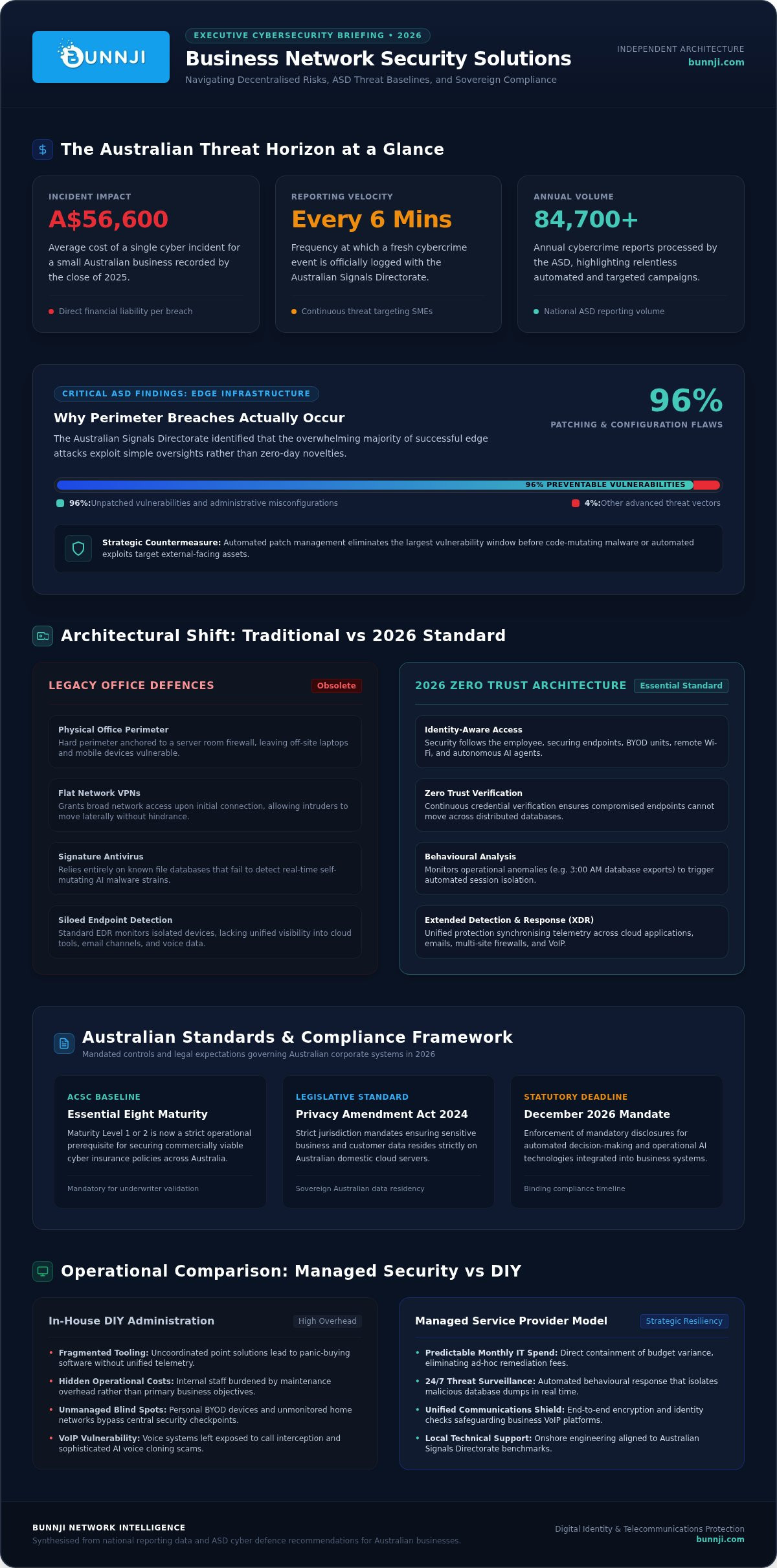
Did you know that by the end of 2025, the average cost of a single cyber incident for a small Australian business climbed to A$56,600? With a cybercrime reported every six minutes to the Australian Signals Directorate, the "it won't happen to us" mindset has become a dangerous liability. You've likely noticed that your network is no longer just a physical office. It's a sprawling ecosystem of remote devices, cloud-based VoIP systems, and AI tools that requires robust business network security solutions to stay operational.
We understand that managing this complexity feels like a full-time job you didn't sign up for. Between skyrocketing cyber insurance premiums and the pressure to meet Essential Eight maturity levels, finding the right path forward can feel overwhelming. This guide cuts through the jargon to provide a no-nonsense roadmap tailored for the Australian market in 2026. We'll explore how to protect your cloud infrastructure, secure your AI-driven voice data, and move toward predictable monthly IT costs. By the end, you'll have the clarity needed to transform your security from a source of stress into a competitive advantage.
Key Takeaways
- Understand why the traditional office firewall is obsolete and how to secure your team’s digital identity across a distributed, cloud-first environment.
- Identify the core components of modern business network security solutions, including the strategic shift from standard endpoint protection to comprehensive XDR.
- Evaluate the hidden operational costs of DIY security management versus the predictable, 24/7 peace of mind offered by a managed service model.
- Discover how to harden your communications infrastructure against emerging threats like AI-driven voice scams and call interception.
- Use our 2026 buyer’s checklist to ensure your chosen provider offers genuine local support and seamless integration with your business VoIP setup.
Beyond the Firewall: Redefining Business Network Security Solutions in 2026
Modern business network security solutions are no longer defined by the physical walls of your office. In 2026, security is the holistic protection of every digital and voice interaction point your team touches. The traditional "perimeter" has effectively dissolved. It's shifted from a server room firewall to the individual identity of your employees. This means your network now lives wherever your staff are working, encompassing a complex web of laptops, smartphones, cloud applications, and even autonomous AI agents that act on your behalf. Zero Trust is the non-negotiable standard for Australian firms today, operating on the principle that no user or device is trusted by default, regardless of their location.
The Death of the Traditional Office Perimeter
Hybrid work has permanently decentralised the business network. When your team accesses sensitive corporate data from home Wi-Fi or public hotspots, the old ways of "locking the door" don't work. Personal devices used for work (BYOD) introduce unmanaged risks that can bypass traditional network security controls if they aren't properly integrated into your stack. We've found that legacy VPNs are often the weakest link in this chain; they provide a false sense of security while creating a "flat" network that allows hackers to move laterally once they gain a single foothold. Replacing these with identity-aware access ensures that a breach on one device doesn't lead to a total system compromise.
Why Antivirus Alone is No Longer Fair Dinkum
Relying on basic antivirus software in 2026 is like bringing a knife to a drone fight. Old-school security relied on "signatures" or known lists of bad files, but modern threats evolve too fast for these lists to stay current. AI-generated malware now changes its own code in real time to evade detection, making traditional software updates nearly useless. The shift must move toward behavioural analysis, where business network security solutions monitor for unusual activity rather than just known threats. If an AI agent suddenly starts exporting your entire database at 3:00 AM, your system needs to isolate that session instantly. Real-time monitoring and automated response are now essential to stop breaches before they have a chance to spread through your infrastructure.
The 2026 Security Stack: Essential Features for Australian Firms
Choosing the right business network security solutions is about more than just buying software; it's about building a layered defence that works across your entire digital environment. Endpoint Detection and Response (EDR) provides deep visibility into individual laptops and phones, but Extended Detection and Response (XDR) is the 2026 standard for holistic protection. XDR integrates data across your cloud apps, email, and network, allowing your team to spot complex attack patterns that EDR might miss. For multi-site firms, managed firewalls act as a vital bridge, ensuring remote staff remain protected without the performance lag of traditional hardware.
Don't overlook the operational basics. The Australian Signals Directorate (ASD) found that 96% of successful attacks on edge infrastructure were due to unpatched vulnerabilities or misconfigurations. Automated patch management is no longer optional; it's the most efficient way to close these loopholes before they're exploited. Keeping your data on local Australian servers also remains critical for compliance with the Privacy and Other Legislation Amendment Act 2024. This ensures your sensitive information stays within our legal jurisdiction and meets the mandatory disclosure requirements for automated decision-making systems taking effect in December 2026.
Essential Eight Maturity: The Aussie Gold Standard
The ACSC Essential Eight framework serves as the definitive baseline for Australian cybersecurity. It isn't just a suggestion for government departments anymore. In 2026, reaching Maturity Level 1 or 2 is a strict prerequisite for securing affordable cyber insurance. Underwriters now treat these controls as a baseline for risk management. By prioritising your spend around these eight areas, you build a resilient foundation that can withstand the 84,700+ cybercrime reports the ASD receives annually. This structured approach helps you move away from "panic buying" tools and toward a strategy that actually reduces your risk profile.
AI-Powered Threat Intelligence and Automated Response
Machine learning has transformed threat detection from a manual slog into a real-time shield. Modern business network security solutions use behavioural analysis to identify "weird" network activity in seconds, such as a staff member suddenly accessing unusual databases at midnight. Global threat feeds ensure that an attack spotted in London or New York is blocked in Australia within minutes. You also need to secure your internal AI interactions; preventing sensitive data from leaking through staff prompts is a new but vital layer of the security stack. If you're looking to simplify this complex environment, our Managed IT Services can help you integrate these features into a single, predictable monthly plan.
Managed IT vs. DIY Security: Choosing Your Operational Model
Deciding how to run your business network security solutions often comes down to a choice between internal control and external expertise. The DIY model seems cost-effective on paper, but it usually hides a tangle of expensive software licences and fragmented support contracts. Buying hardware upfront creates a heavy Capex burden that ties you to outdated technology within three years. In contrast, the managed model shifts your security to an Opex structure. You get predictable monthly costs and access to the latest tools without a massive capital outlay. This scalability is vital for growing Australian firms; you can add ten new staff members tomorrow without needing to hire a dedicated security analyst to watch their devices.
The Risk of Alert Fatigue in Small Teams
Internal IT teams are often buried under a mountain of notifications. When every login attempt or software update triggers a "high priority" alert, real threats get lost in the noise. Ignored security notifications are a leading cause of preventable breaches in 2026. Managed providers solve this by using a Security Operations Centre (SOC) to filter the background static. This is where modern business network security solutions prove their value. They provide a team that watches the screen while you sleep, ensuring that a 3:00 AM breach attempt is isolated before your staff even start their morning coffee.
Integrating Security with Your Managed IT Strategy
Security shouldn't be a bolt-on extra. It works best when it's baked into your broader managed IT services. A unified strategy reduces the friction that often happens when different vendors point fingers at each other during a system slowdown. By adopting a NIST Zero Trust Architecture, you ensure that identity verification is consistent across your network, cloud apps, and phone systems. This approach treats every access request as a potential risk, regardless of whether it comes from inside the office or a remote site. A great first step is conducting a telecommunications audit. This process uncovers legacy security gaps in old contracts and hardware that could be leaving your business exposed to modern AI-driven attacks. By aligning your IT and security goals, you create a more resilient environment that supports growth rather than hindering it.
The Australian Buyer’s Checklist: Evaluating Potential Providers
Selecting business network security solutions requires a discerning eye for local relevance. A global tool might look impressive, but it won't help much if its support desk is asleep during an Australian morning. Always verify that your provider has experts on the ground in Australia who understand our specific threat environment. You also need to ensure the solution integrates seamlessly with your business VoIP Australia setup. Security that breaks your phone system or causes call lag is a liability, not an asset. Performance impact is equally critical. Robust business network security solutions shouldn't "bloat" your team's laptops or slow down their workflows. Finally, look for reporting features that allow you to show your board or insurance provider exactly where your security stands with a single click.
Critical Questions to Ask Any Security Vendor
Start by asking exactly where your data is stored and who has access to it. Knowing your data stays on local servers is a legal necessity for compliance with modern Australian privacy standards. Ask how their solution aligns with the ASD Essential Eight maturity levels. A provider that can't map their tools to these benchmarks isn't ready for the Australian market in 2026. Lastly, demand a guaranteed response time. In the event of a suspected breach, you need to know exactly how fast a human expert will be assisting you. A vague "best effort" response is no longer acceptable when your operations are on the line.
Understanding Total Cost of Ownership (TCO)
The initial per-user licence fee is just the tip of the iceberg. True TCO includes the cost of staff training and the technical configuration required to make the system work effectively. If your team doesn't know how to use the tools, the investment is wasted. You must also account for mobile security. As staff increasingly work from anywhere, your business mobile sim only plans must be included in your security budget. Securing the device in a staff member's pocket is just as vital as securing the server in your office. If you want a partner that understands these local complexities, view our Managed IT packages to see how we simplify your security spend.
Securing the Future: Integrating Security with AI and Unified Comms
The intersection of AI and communications has created a new frontier for risk. While AI voice agents offer incredible efficiency for Australian firms, they're also becoming prime targets for hackers. These agents often have deep access to your CRM and scheduling tools, meaning a single exploit can give an attacker the keys to your entire client database. Modern business network security solutions must account for these autonomous "employees" by applying the same Zero Trust principles we use for human staff. Protecting the voice channel is no longer just about call quality; it's about preventing AI-driven vishing and call interception that can bypass traditional text-based security.
Reliable connectivity is the backbone of this protection. High-speed business fibre allows your security stack to perform real-time data inspection without slowing down your operations. Speed is only half the battle, though. You also need built-in redundancy to ensure your security tools stay online even when the NBN goes down. If your primary connection fails, an automatic failover to a secondary link keeps your cloud-based defences active and your business protected. Without this fallback, an internet outage doesn't just stop your work; it leaves your entire network blind to emerging threats.
The Convergence of IT and Telecommunications
In 2026, the line between your IT department and your phone system has vanished. VoIP is simply data, and that data needs the same level of protection as your financial records. A secure network provides the foundation for crystal-clear, safe communication by prioritising voice traffic while scrubbing it for malicious activity. Unified communications platforms help simplify this by centralising identity and access management. When your phone system, email, and file sharing all use the same security protocols, you reduce the "attack surface" available to hackers. This unified approach also makes disaster recovery planning much more effective, as you only have one ecosystem to protect and restore.
Next Steps: Organising Your Bespoke Security Roadmap
A proactive audit is always more cost-effective than a reactive recovery. Waiting for a breach to happen before you update your tech is a high-stakes gamble that few Australian firms can afford to lose. Transitioning from legacy, unmanaged systems to a secure cloud environment doesn't have to be a headache. It's about finding a capable partner who can guide you through the transition with transparency and precision. Choosing the right business network security solutions is a strategic investment in your firm's longevity. If you're ready to move beyond off-the-shelf fixes, reach out for a no-nonsense evaluation of your firm's specific needs. We'll help you build a roadmap that protects your team, your data, and your future.
Securing Your Firm's Growth in a Digital-First Australia
The security landscape in 2026 demands more than just a firewall. It requires a unified approach that protects every device, cloud application, and AI agent your team interacts with. By prioritising the ASD Essential Eight and moving toward an identity-based Zero Trust model, you don't just protect your data; you build a resilient foundation for future growth. Implementing robust business network security solutions is a strategic move that turns technical complexity into a clear operational advantage.
As a 100% Australian-owned and operated provider, Bunnji specialises in the intersection of AI-driven communication and network security. We provide proactive 24/7 monitoring and local support to ensure your systems remain stable and secure. Don't wait for a breach to discover the gaps in your legacy infrastructure. Organise a no-nonsense security audit for your business with Bunnji today and gain the peace of mind that comes from having a capable local partner in your corner. We're here to simplify your tech so you can focus on what you do best.
Frequently Asked Questions
What is the difference between antivirus and business network security solutions?
Antivirus is a single tool that guards against known malicious files, whereas business network security solutions represent a complete defensive strategy. While antivirus focuses on the device, a full security stack monitors your entire network, cloud apps, and identity protocols. In 2026, you need behavioural analysis that identifies weird activity in real time. It's the difference between a simple door lock and a fully monitored security system for your whole business.
Does my Australian small business really need to follow the Essential Eight?
Every Australian firm should follow the ASD Essential Eight framework to build a resilient defence. It's no longer just for government agencies or large corporations. Small businesses are frequent targets for automated attacks and ransomware. Beyond the security benefits, reaching specific maturity levels is now a standard requirement for obtaining affordable cyber insurance in Australia. It provides a clear roadmap to ensure your limited security budget is spent on the most effective controls.
How much do business network security solutions cost per user in 2026?
The cost of business network security solutions depends on your specific maturity requirements and the complexity of your distributed team. Most Australian firms prefer a predictable monthly subscription over large upfront capital costs. This model typically bundles licensing, 24/7 monitoring, and expert support into one fee. It's a scalable approach that grows with your headcount, ensuring you don't pay for more than you need while maintaining compliance with local regulations and insurance prerequisites.
Will installing high-level security slow down my employees’ computers?
Modern security solutions are designed to be lightweight and shouldn't noticeably slow down your team's work. Unlike old-school software that performed heavy local scans, 2026 tools use cloud-based analysis to handle the intensive processing. This keeps the impact on your laptops and smartphones to a minimum. If you do notice performance issues, it's often due to unpatched legacy systems or outdated hardware that isn't compatible with modern, identity-based security protocols.
Can network security protect my staff when they are working from home?
Network security definitely protects your staff when they work from home by securing the user's identity rather than just the office building. By using cloud-hosted security tools and Zero Trust access, your protection policies follow your employees wherever they log in. Whether they are on home Wi-Fi or using a mobile hotspot, their connection to corporate data remains encrypted and monitored. This ensures your business network stays safe even when your team is distributed.
How do I secure my business VoIP system against hackers?
You can secure your business VoIP system by integrating it into your overall business network security solutions stack rather than treating it as a separate silo. This involves using encrypted SIP trunking, enforcing strong multi-factor authentication, and monitoring for AI-driven voice scams. Hackers often target phone systems as an easy entry point to your data. A proactive telecommunications audit can help you identify hidden vulnerabilities in your current setup and ensure your voice calls remain private.
What is Zero Trust and why is it important for Aussie firms?
Zero Trust is a security framework based on the principle of "never trust, always verify." It's vital for Aussie firms because it removes the old assumption that anything inside your office network is safe. Every time a user or device tries to access your data, their identity and location are checked. This prevents hackers from moving through your systems if they steal a single password, which is essential for protecting distributed teams and cloud apps.
What happens to our security if the office internet connection goes down?
Your security stays active during an outage through local device protection and automatic internet redundancy. If your office NBN fails, a secondary 5G or fibre link should take over instantly to keep your cloud defences online. Even if the office is completely disconnected, your staff using SIM-only business plans remain protected by the security agents on their devices. This ensures your business network security solutions continue to monitor and block threats, regardless of your local connection status.


