
If your desk phone is just a plastic box gathering dust while you miss critical enquiries on your mobile, your communication strategy is actively costing you money. You've likely felt the frustration of juggling three different numbers or the nagging worry that a single NBN outage could bring your entire operation to a standstill. Finding a reliable business phone system that Australian businesses can actually trust shouldn't feel like a gamble with your reputation. We understand that you want sophisticated technology without the cold, corporate bureaucracy or the trap of a 60-month equipment contract.
You deserve a setup where one number works seamlessly across every device and your team stays connected even when the local grid doesn't. This 2026 guide will help you master the transition to AI-driven cloud communications. You'll discover how to eliminate missed calls through automated handling and reduce your overheads by ditching outdated hardware. We'll walk you through the essentials of internet redundancy, CRM integration, and the simple steps to ensure your business remains online, responsive, and ready for growth.
Key Takeaways
- Transition from rigid physical handsets to software-driven platforms that unify your team's communications across every device.
- Discover how AI voice agents act as intelligent receptionists, handling complex enquiries and booking appointments directly into your calendar.
- Evaluate whether Microsoft Teams or a dedicated VoIP provider is the right business phone system melbourne firms need for advanced call reporting and queue management.
- Protect your bottom line by identifying hidden line rental fees and avoiding the restrictive 60-month equipment contracts that often trap local businesses.
- Build a resilient infrastructure with 5G and fibre redundancy to ensure your voice services stay online even during a primary internet outage.
Beyond the Dial Tone: Why Australian Firms are Modernising Communications
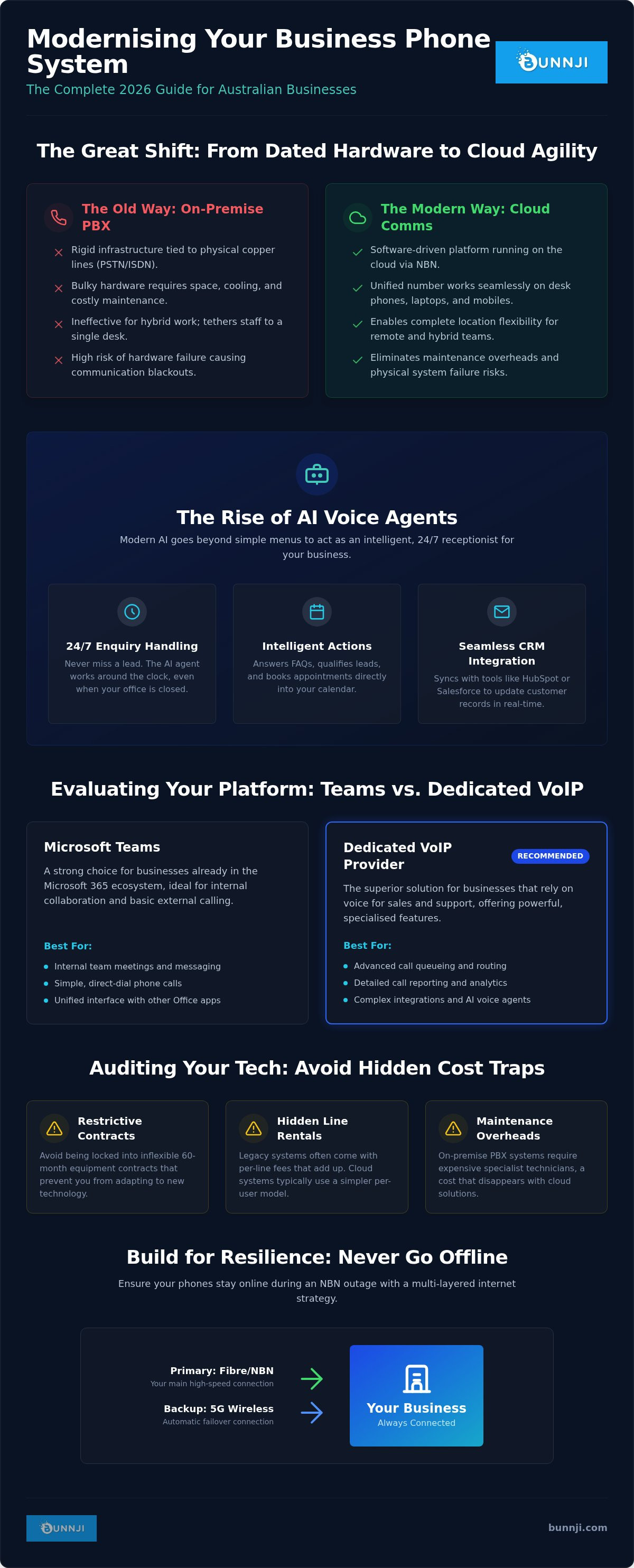
The traditional desk phone is no longer the heartbeat of a modern Australian office. For years, businesses relied on rigid copper lines and bulky hardware tucked away in a server cupboard. Today, the landscape has shifted entirely. A modern business phone system melbourne companies now deploy is a software-driven platform that lives in the cloud, not a collection of wires under a desk. This transition isn't just about following tech trends; it's about survival in a market where the PSTN and ISDN networks are rapidly becoming relics of the past.
Moving to NBN-based unified communications allows your team to operate with a level of agility that was previously impossible. When you rely on outdated infrastructure, a missed call isn't just a minor inconvenience. It's a direct hit to your bottom line. For small-to-medium enterprises, every unanswered enquiry represents a potential customer who has already moved on to a competitor. Modern systems ensure that "available" means reachable, whether your staff are at their desks, on a site visit, or working from a home office. The desk phone has become a choice rather than a requirement for the modern professional.
The Death of Legacy Hardware
Maintaining an on-premise PBX (Private Branch Exchange) has become a significant financial drain. These systems require physical space, constant cooling, and expensive specialist technicians for even the simplest configuration changes. In 2026, the limitations of this hardware are glaring, especially for teams that embrace hybrid work. Traditional lines simply can't bridge the gap between locations effectively. Unified communications is the integration of voice, video, and messaging into a single, cohesive interface. By removing the physical anchors of legacy hardware, you eliminate the maintenance overheads and the risk of hardware failure that could silence your business for days.
One Number, Every Device
The rise of the softphone has transformed the "office phone" into an app on a laptop or a mobile device. This mobility is essential for maintaining a professional presence. Your clients don't need to know your personal mobile number, and your staff don't need to be tethered to a physical location to answer a call. Whether you're in a boardroom or a coffee shop, you present a unified front with a single business number. To truly understand how this fits into your broader digital transformation, you should explore our Business VoIP Australia: The Complete 2026 Strategy Guide. This approach ensures your team stays responsive without sacrificing their privacy or their ability to work flexibly. Choosing a business phone system melbourne businesses can rely on means prioritising this level of seamless connectivity over the limitations of old-fashioned handsets.
The Rise of AI Voice Agents and Intelligent Receptionists
The "press 1 for sales" menu is rapidly becoming a relic of the past. Modern Australian firms are replacing these clunky, frustrating systems with AI voice agents that actually listen and respond. Unlike a basic voicemail that merely records a message for someone to ignore later, an intelligent receptionist takes immediate action. It can answer specific questions about your services, qualify incoming leads, and even book appointments while your team is busy or the office is closed. This level of responsiveness is now a standard feature for any competitive business phone system melbourne companies implement to stay ahead of the curve.
These agents don't work in isolation. They sync directly with your existing business tools like HubSpot or Salesforce. When a customer calls, the AI can recognise the caller, pull up their interaction history, and update their records in real-time. This 24/7 capability ensures you never miss a revenue-generating enquiry, even at 2 AM on a Sunday or during the frantic peak of a seasonal rush. By the time your team starts their shift, the heavy lifting of lead qualification and data entry is already finished.
Can AI Actually Answer Your Phone Better Than a Human?
By 2026, natural language processing has advanced to a point where the old "robotic" stigma is a thing of the past. Modern AI agents handle conversations with a natural cadence and tone that feels helpful rather than mechanical. While a human receptionist remains invaluable for complex, high-empathy situations, AI agents resolve routine enquiries end-to-end by providing instant answers to FAQs and processing simple transactions without any human intervention. This allows your staff to focus on high-value tasks while the AI manages the repetitive volume. Selecting a sophisticated business phone system melbourne providers offer today means choosing a platform that understands these technical nuances and delivers a seamless experience for every caller.
Integrating Voice with Your Business Workflow
Automation is the key differentiator for modern firms. An intelligent agent doesn't just take a name and number; it qualifies the lead by asking specific questions based on your unique business rules. If a caller wants to book a consultation, the AI checks your team's live calendar and secures the slot instantly. You can see the full details of this technological shift in our AI Voice Agents: 2026 Trend Report for Australian Firms. If you aren't sure how these tools fit into your current setup, you can audit your existing voice infrastructure to find the gaps. By capturing notes and updating CRM records automatically, these systems remove the administrative burden that usually follows a phone call, ensuring your data is always accurate and up to date.
Evaluating the Options: Microsoft Teams vs. Dedicated VoIP
Many Australian businesses already use Microsoft 365, so jumping into Microsoft Teams for voice calls feels like a logical step. It's convenient. It puts everything in one place. However, as many firms grow, they often find that the default choice lacks the depth required for high-volume customer service. A dedicated business phone system melbourne companies choose usually provides more robust call handling than a standard Teams setup. When you compare complex call queues, multi-level IVRs, and live reporting, the differences become clear.
When Microsoft Teams is the Right Choice
If your team spends most of their time talking to each other rather than external clients, Teams is often the ideal solution. It simplifies your tech stack by keeping chat, video, and voice under one roof. You'll need the specific Teams Phone add-on licence, which integrates directly with your existing Microsoft 365 subscription. For small, straightforward teams where call volume is low and routing is simple, this single pane of glass approach reduces complexity and keeps your digital environment tidy.
The Case for a Dedicated Cloud Phone System
A dedicated VoIP platform is built for external communication. While Teams is a collaboration tool that happens to do voice, a dedicated system is a voice platform from the ground up. You get granular call centre analytics that show exactly where you're losing callers and how your staff are performing in real-time. The voice quality is often superior because the traffic is prioritised for voice rather than competing with large file transfers or video streams within the same app.
Reliability is another factor. The Microsoft ecosystem is massive, which means when a service disruption occurs, you're just one of millions waiting for a fix from a global helpdesk. A dedicated provider offers a local, personal touch. You can actually talk to a human who understands your specific setup. If you love the Teams interface but need professional-grade power, hybrid models allow you to integrate a high-performance system directly into the Teams app. This gives you the best of both: the familiar Microsoft environment and the advanced capabilities of a specialist business phone system melbourne firms rely on for revenue-critical calls.
Auditing Your Tech: Avoiding the Hidden Cost Traps
Many providers still rely on the "hardware lease" model to lock clients into long-term agreements. A 60-month contract for physical desk phones is a significant risk for any modern firm. By the time you're halfway through the term, the technology is often obsolete. You're left paying for plastic boxes while your competitors use agile cloud tools. This is a common trap when searching for a business phone system melbourne businesses can rely on without being weighed down by depreciating assets.
Beyond hardware, you must check your monthly bill for "hidden" line rental and individual feature costs. Many legacy providers still charge for items that are standard in a modern business phone system melbourne providers offer today. Features like call recording, mobile app access, and advanced IVRs should be part of your core plan, not an expensive add-on that inflates your monthly overheads.
The 10-Minute Telecommunications Audit
Before making any changes, you need to understand exactly what you're currently paying for. Start by identifying redundant NBN lines or old PSTN services that were never properly cancelled. Evaluate the age of your current hardware and your dependency on a single internet connection. Contract flexibility is the defining feature of 2026 telecommunications because it allows businesses to scale their software-driven platforms without being anchored to depreciating physical assets. If you're struggling to decipher your current bill, you can request a professional telecommunications audit to identify immediate savings.
Porting and Ownership: Protecting Your Numbers
Your business phone number is a vital asset. When moving to a new provider, you must ensure you retain full ownership of every number in your range. The process of moving these numbers, known as porting, requires precise coordination to avoid downtime. Ask any potential partner about their specific track record with Australian number porting and how they handle complex "Cat C" ports. A capable partner manages the coordination with your old telco to ensure your lines stay active throughout the transition. Never sign with a provider who claims ownership of your numbers or makes the exit process intentionally difficult; transparency is the only way to protect your long-term interests.
Internet Redundancy: Ensuring Your Phone Never Goes Down
Speed is a vanity metric if your connection isn't stable. A business phone system melbourne teams rely on requires more than just a fast NBN plan. If your primary link fails, your voice traffic must have a secondary path to travel. Redundancy is the difference between a minor glitch and a total communication blackout. Automatic failover ensures that your system switches to a backup link instantly, often without the caller even noticing a change in quality. This proactive approach to disaster recovery is what separates professional operations from those that risk their reputation on a single point of failure.
Fibre Upgrades and the NBN Roadmap
By 2026, the NBN roadmap has made fibre-to-the-premises (FTTP) upgrades accessible to most commercial precincts across Australia. Copper-based connections like FTTN remain the number one risk to business continuity because they're susceptible to weather damage and electrical interference. Transitioning to full fibre isn't just about downloading files faster; it's about the symmetrical speeds and lower latency that high-quality voice calls demand. For firms with high-volume data needs, Enterprise Ethernet offers a dedicated, uncontended pipe that guarantees performance regardless of how many other businesses in your area are online.
Building a Resilient Network
A truly resilient network uses diverse technologies to protect your voice services. Pairing your primary fibre connection with a 5G backup provides a cost-effective redundancy layer that operates independently of the physical cables in the street. If a technician accidentally cuts a line or a local exchange has an issue, your business phone system melbourne setup stays live via the cellular network. This happens automatically, ensuring your "open for business" status is never compromised by external infrastructure failures.
Cloud-based architecture also provides a built-in disaster recovery plan that traditional systems can't match. Because your phone system isn't tied to a physical box in your office, your staff can simply log in from home or a different location and continue taking calls using their business number. This flexibility removes the anxiety of local outages. We recommend choosing a partner who manages both your IT infrastructure and your telecommunications. This unified approach eliminates the friction between different providers and ensures you have one direct line to a team that takes full responsibility for your connectivity and uptime.
Future-Proof Your Business Communications Today
Modernising your voice infrastructure is no longer just a technical upgrade; it's a strategic move to protect your revenue and improve team agility. By embracing AI voice agents that sync with your CRM and ensuring your network has robust 5G redundancy, you eliminate the risk of missed opportunities and service blackouts. You've seen how avoiding restrictive 60-month contracts and auditing your current bills can immediately improve your bottom line. Transitioning to a sophisticated business phone system melbourne firms can rely on ensures your communication remains human, accessible, and ready for the future.
At Bunnji, we provide no-nonsense expert guidance and specialise in AI voice integration with local, Australian-based support. We're here to remove the friction from your technical setup so you can focus on growth. Request a 10-Minute Telecommunications Audit from Bunnji to uncover hidden costs and secure your uptime. Your path to a more reliable, efficient communication platform starts with a single, simple conversation.
Frequently Asked Questions
How much does a business phone system cost in Australia in 2026?
Entry-level packages average AU$21.27 per user per month as of September 2026, while premium tiers can reach AU$60.72. These costs typically include local and national calls but exclude advanced AI features or dedicated hardware. When budgeting for a business phone system melbourne firms should also account for internet redundancy and potential NBN fibre upgrade costs to ensure the infrastructure supports high-quality voice traffic without interruption.
Can I keep my existing business phone numbers if I switch to the cloud?
You can keep all your existing Australian business numbers by using a process called porting. This involves moving your numbers from your current carrier to your new cloud provider. We manage this coordination to ensure there is no downtime during the switch. It is vital to confirm you have full ownership of your numbers before starting the process to avoid any administrative roadblocks or service delays.
What happens to my phone system if the NBN goes down?
Your system stays online through automatic failover to a secondary connection like a 5G backup or a separate fibre link. Because a cloud-based business phone system melbourne companies use isn't tied to a physical office, your staff can also use mobile apps or softphones to stay connected. This ensures that even if the local NBN grid fails, your customers can still reach your team on their usual business numbers.
Is an AI receptionist better than a traditional answering service?
AI receptionists offer a 24/7 advantage that traditional answering services often struggle to match at scale. While human services take messages, an AI agent takes immediate action by booking appointments into your calendar and updating your CRM records. This eliminates the delay between a call and a response. It is a more cost-effective way to ensure every enquiry is handled professionally without the high overheads of a dedicated call centre.
Do I still need physical desk phones for my staff?
Physical handsets are now a choice rather than a requirement for modern offices. Many teams prefer using softphones on their laptops or mobile apps on their smartphones to maintain a professional presence from any location. This unified communications approach reduces hardware costs and eliminates the need for complex wiring. However, high-quality desk phones are still available for staff who prefer a traditional tactile experience or dedicated hardware for high call volumes.
What is the difference between VoIP and a cloud phone system?
VoIP is the underlying technology that converts your voice into digital data packets for transmission over the internet. A cloud phone system is the complete software platform that manages your calls, queues, and integrations. While VoIP is the engine, the cloud system provides the dashboard and features like AI receptionists and CRM syncing. Most modern solutions combine both to offer a flexible, hardware-free communication environment for Australian businesses.
How long does it take to install a new business phone system?
Setting up the software components of a cloud system can often be completed within a few business days. The longest part of the process is usually porting your existing numbers, which can take anywhere from a few days to several weeks depending on the complexity of your current setup. We focus on a staged transition to ensure your team is trained and ready before the final switchover occurs to prevent any disruption.
Can I integrate my phone system with my CRM like HubSpot or Salesforce?
You can integrate your phone system directly with platforms like HubSpot, Salesforce, and Zoho to automate your workflow. This allows your system to recognise incoming callers and pull up their records instantly. Every call is logged automatically, and notes captured by AI voice agents are synced to the correct contact record. This removes the administrative burden of manual data entry and ensures your sales and support teams have accurate, up-to-date information.


