

What is the most cost-effective and reliable mobile connectivity setup for a modern Australian workforce? If you're comparing business mobile data plans au wide, the smartest answer rarely involves tying your team to restrictive 36-month handset repayment contracts. You already know the frustration of watching unused gigabytes expire on one staff account while another racks up unexpected bill shock from excess data or international roaming. Juggling fragmented telco accounts without responsive, local support only compounds the friction, leaving finance teams with unpredictable telecommunications invoices each month.
This guide shows you how to choose, structure, and scale flexible business mobile data plans across Australia without rigid lock-in contracts. We examine the practical advantages of shared data pooling to eliminate wasted spend, explain why SIM-only fleet deployments outperform bloated hardware agreements, and walk through how to establish predictable expenditure across every staff device.
Key Takeaways
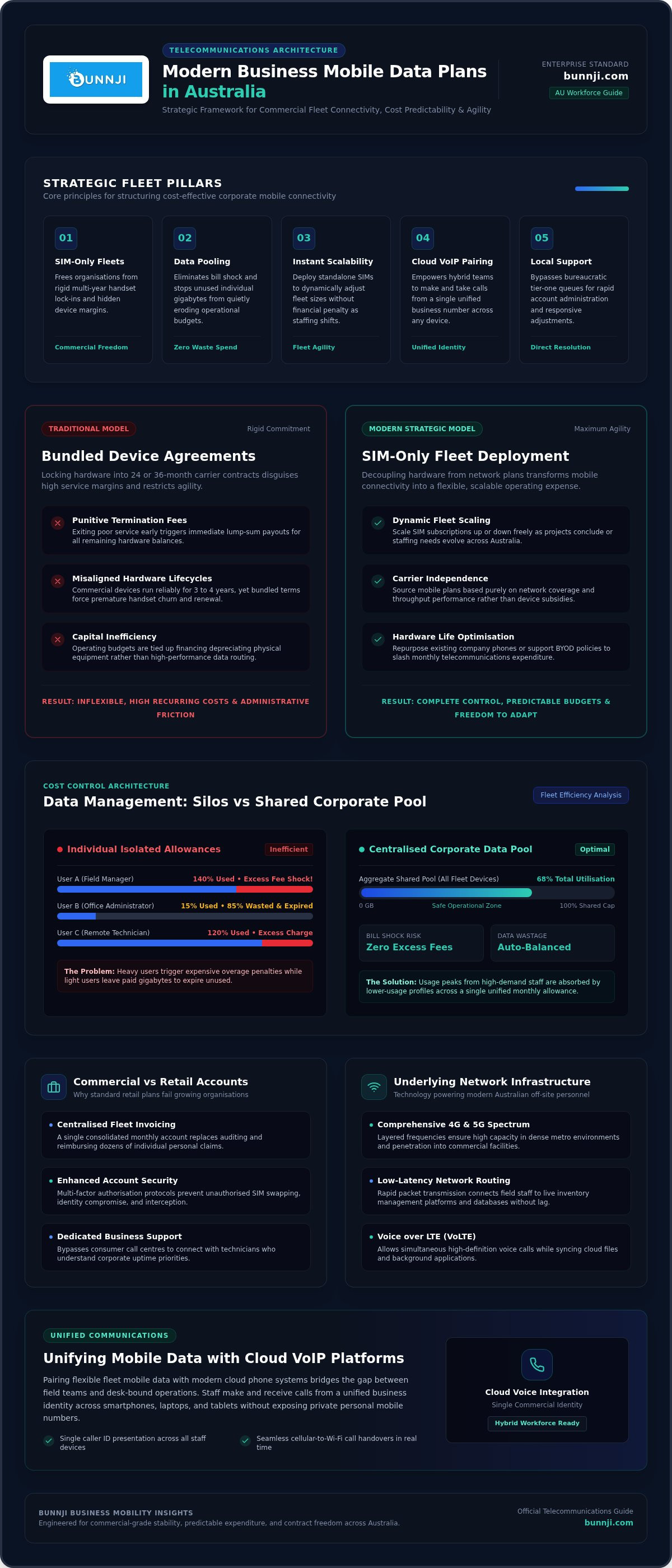
- Structuring modern business mobile data plans au wide around SIM-only fleet options frees your organisation from rigid multi-year handset contracts and hidden device margins.
- Centralised data pooling eliminates bill shock and stops unused individual data allowances from quietly eroding your monthly operating budget.
- Deploying standalone business SIMs delivers immediate commercial agility, allowing you to adjust fleet sizes without penalty as your staffing requirements shift.
- Pairing fleet mobile data with cloud VoIP platforms empowers hybrid staff to make and take calls from a single unified business number across any device.
- Prioritising direct, local business support over bureaucratic tier-one call centres ensures rapid fleet adjustments and straightforward account administration.
Understanding Business Mobile Data Plans in Australia
A business mobile data plan provides commercial-grade cellular connectivity engineered specifically to support corporate operations. While consumer connections focus on individual streaming and casual browsing, commercial accounts prioritise network routing stability, rigorous security controls, and consolidated fleet billing. As outlined in the broader framework of Telecommunications in Australia, enterprise connectivity operates under distinct industry standards designed to keep commercial organisations dependable. Modern businesses rely heavily on real-time cloud software, mobile project hubs, and remote databases, meaning cellular bandwidth directly dictates daily productivity.
Key Distinctions Between Consumer and Commercial Cellular Plans
Relying on standard retail mobile accounts across a growing team creates administrative friction. Commercial arrangements eliminate these bottlenecks through structured corporate management tools:
- Centralised fleet invoicing: A single consolidated monthly account replaces the headache of approving, auditing, and reimbursing dozens of fragmented personal phone bills.
- Enhanced account security: Commercial profiles require strict multi-factor authorisation protocols, preventing unauthorized SIM swaps, identity compromise, and data interception.
- Dedicated business support: Staff bypass standard consumer call-centre queues, connecting directly with dedicated specialists who understand commercial infrastructure priorities.
Core Network Technologies Powering Australian Workforces
Modern mobile infrastructure gives off-site teams the same operational capability as desk-bound staff. Selecting business mobile data plans au organisations can trust means assessing the technology that underpins real-time collaboration:
- Comprehensive 4G and 5G spectrum: Layered cellular frequencies provide high-capacity throughput in dense settings alongside dependable signal penetration inside concrete commercial facilities.
- Low-latency network routing: Rapid packet transmission keeps field personnel connected to live inventory management platforms and enterprise databases without disruptive lag.
- Voice over LTE (VoLTE): Advanced radio networks allow staff to conduct high-definition voice calls while continuing to sync large cloud files and background applications simultaneously.
SIM-Only vs Device Bundles: Evaluating Fleet Cost Structures
Hardware leasing models often disguise inflated cellular service margins behind seemingly generous equipment subsidies. When major telecommunications carriers bundle the latest smartphones into 24-month or 36-month contracts, they aren't offering charity; they are securing guaranteed long-term revenue. As policy discussions around universal telecommunications services continue to reshape the domestic communications environment, commercial buyers must look critically at the total cost of ownership. Uncoupling your handsets from your network provider provides instant commercial agility, allowing you to source business mobile data plans au wide based entirely on carrier performance rather than hardware lock-in.
The Long-Term Risks of Bundled Device Agreements
Bundling handsets across an entire organisation introduces operational friction that outlasts the initial excitement of unboxing new gear:
- Punitive termination fees: Exiting a poor service provider early triggers immediate payouts for remaining hardware balances across every active service, freezing corporate agility.
- Misaligned operational lifecycles: Enterprise smartphones often run reliably for three or four years, yet structured handset cycles force premature device churn and contract extensions.
- Capital tie-ups: Lengthening handset commitments forces telecommunications budgets into financing depreciating physical assets rather than prioritising high-performance connectivity.
Strategic Benefits of Fleet-Wide SIM-Only Deployment
Decoupling physical phones from monthly data allowances transforms mobile operations into an agile operational expense. Your organisation retains complete freedom to scale subscriptions up or down as project demands and headcount change. By repurposing functioning company hardware or adopting sensible bring-your-own-device policies, businesses routinely slash recurring carrier spend without sacrificing coverage.
Most importantly, SIM-only connectivity restores your leverage. If your network provider fails to deliver responsive service, you can migrate your fleet without navigating bureaucratic cancellation fees. To explore structured procurement methods, read our comprehensive business mobile sim only plans guide. If you want a more transparent fleet model built around flexibility, take a look at the tailored options available through Bunnji to keep your mobile operations completely unencumbered.
Data Pooling vs Individual Allowances: Managing Corporate Usage
Assigning fixed data limits to individual staff accounts almost always produces two simultaneous problems: wasted capacity and unexpected penalties. One employee might use barely five gigabytes of their monthly quota while connected to head-office networks. At the same time, a field technician uploading site surveys exhausts their allocation in a fortnight. Under traditional mobile arrangements, the unused data simply vanishes at the billing cut-off, while the active connection triggers expensive top-up charges or crippling speed throttles. Enterprise data pooling eliminates this imbalance entirely by collecting total gigabytes across all active fleet services into a single central reservoir.
How Corporate Data Pooling Prevents Bill Shock
Pooling shifts your communications expenditure from unpredictable line-item volatility to a steady operating cost. When choosing business mobile data plans au organisations find that pooled frameworks deliver immediate financial stability:
- Shared bandwidth buffers: Moderate users naturally subsidise heavy consumers across the enterprise, preventing single-device spikes from driving up the total bill.
- Predictable monthly forecasting: Instead of reviewing volatile bills packed with ad-hoc top-ups, finance departments can project connectivity overheads with complete accuracy.
- Automated threshold management: Fleet-wide usage monitoring alerts administrators before total capacity limits are approached, allowing deliberate adjustments without downtime.
Calculating Ideal Bandwidth Across Diverse Roles
Building an efficient data pool requires auditing operational patterns across different business roles rather than purchasing identical allowances for everyone. A mobile workforce does not consume bandwidth evenly:
- Field technicians and mobile sales reps: These teams routinely tether laptops to mobile hotspots, conduct high-definition video calls from vehicles, and upload large files to remote servers. They require significantly larger contributions to the shared pool.
- Desk-bound hybrid employees: When staff spend most of the working week connected to corporate Wi-Fi or fixed home broadband, their cellular data requirements drop dramatically. Their allocations quietly reinforce the pool's safety margin.
- Shared operational devices: Warehouse barcode scanners, dispatch tablets, and site telemetry gear consume modest, highly predictable amounts of data. Including them in the pool prevents unnecessary plan bloat.
Conducting quarterly usage audits uncovers over-provisioned lines that quietly drain your operational resources. By dynamically right-sizing the aggregate capacity of your business mobile data plans au fleet, your company stops overpaying for unused gigabytes while ensuring every mobile employee stays reliably connected.
Five Steps to Select the Right Business Mobile Plan
Defaulting to legacy telco brands based solely on familiar marketing often costs organisations dearly in flexibility and support. Selecting the right carrier requires balancing network reach, commercial agility, and account administration. Rushing into an agreement without structured evaluation locks your organisation into years of sub-par performance and administrative drag. Follow these five proven procurement steps to implement business mobile data plans au workforces can depend on without signing up for unnecessary overheads.
Step 1 & 2: Audit Workforce Needs and Map Network Footprints
Due diligence begins by examining historical reality rather than vendor promises:
- Step 1: Audit past billing history: Analyse three to six months of previous telecommunications invoices. Determine actual average monthly data consumption per user, identifying dormant connections alongside consistent high-volume users.
- Step 2: Map actual operational coverage: Verify real carrier performance across your primary operating facilities, travel corridors, and remote client sites rather than relying on generalised coverage maps. Clarify operational necessities early, such as static IP configurations, corporate APNs, or priority data routing for field technicians.
Step 3, 4 & 5: Evaluate Features, Roaming, and Support
Once you understand your technical requirements, turn your focus toward contract governance and operational support:
- Step 3: Review international roaming policies: Frequent overseas business travel shouldn't generate catastrophic surprise invoices. Ensure your provider offers transparent daily passes or straightforward international data roaming packages that activate seamlessly abroad.
- Step 4: Scrutinise agreement commitments: Reject 24-month or 36-month hardware repayment locks that prevent you from adjusting services. Insist on flexible, SIM-only terms that allow you to add or remove connections as your staff numbers change.
- Step 5: Test support responsiveness: Ring the provider's business support desk before porting any active corporate numbers. If you're forced through an automated tier-one call labyrinth before reaching an onshore technical specialist, expect similar delays when urgent operational issues arise.
A capable mobile partner treats fleet management as a collaborative relationship rather than an impersonal billing account. If you're ready to ditch bloated contracts and build an agile corporate fleet, speak with the Bunnji team to design a connectivity model that fits your operational rhythm.
Unifying Mobile Data with Modern Cloud Telephony
Treating corporate mobile fleets as isolated communication islands creates needless operational silos. For years, traditional carriers sold mobile data plans purely as standalone cellular pipes, separate from head-office switchboards and unified communications platforms. Today, high-capacity mobile networks turn ordinary handhelds into full-featured business extensions. By routing voice traffic over robust cellular data connections via softphone applications, organisations merge field flexibility with central office control. To explore underlying infrastructure designs, consult our detailed guide to business VoIP in Australia. Bunnji simplifies this convergence by delivering fast cellular data alongside intelligent voice platforms under one responsive support roof.
Running Softphones and Virtual Numbers Over Cellular Data
Integrating cloud phone platforms with reliable data allowances gives distributed workforces immense operational advantages:
- Consistent professional identity: Staff make outbound calls showing the organisation's primary landline number directly from their mobile devices, reinforcing brand trust while safeguarding personal phone numbers.
- Uninterrupted call handoffs: Team members can start a phone conversation on corporate office Wi-Fi and continue speaking as they walk out the door, smoothly shifting to national 4G and 5G cellular data without dropping the line.
- Comprehensive boundary protection: Routing company communications through dedicated mobile applications ensures staff can disconnect after hours, maintaining healthy work-life balance without carrying two separate handsets.
The Role of Mobile Data in AI-Driven Workplaces
Modern field staff rely heavily on real-time data throughput to interact with automated enterprise systems. Low-latency cellular connections allow field agents to update centralised customer records instantly, feed on-site imagery into machine learning appraisal tools, and interact with automated voice platforms. Many Australian enterprises are rolling out smart call handling systems, as outlined in our latest AI voice agents report. These automated workflows require dependable background mobile bandwidth to capture call transcripts, log customer requirements, and coordinate calendar bookings without manual admin friction.
Pairing reliable business mobile data plans au wide with unified communications turns every smartphone into an integrated endpoint. Rather than managing fragmented phone systems, forward-thinking organisations deploy agile SIMs that connect staff directly to their broader digital workplace.
Modernise Your Corporate Fleet Communications
Structuring business mobile data plans au wide around agile SIM-only services gives your organisation predictable monthly expenditure and total commercial freedom. By replacing rigid multi-year handset repayment contracts with shared data pooling, you eliminate bill shock while ensuring field teams and hybrid staff stay continuously connected. More importantly, treating cellular connectivity as a core component of your broader cloud telephony ecosystem turns every company device into a unified extension of your office.
Bunnji operates as a specialised Australian telecommunications provider built to simplify corporate mobile fleets. With transparent SIM-only arrangements free from multi-year hardware locks, seamless compatibility with cloud VoIP platforms, and direct onshore support that bypasses traditional call-centre queues, upgrading your connectivity is straightforward. Simplify your fleet connectivity with Bunnji SIM-only business plans and give your workforce the reliable communication tools they need to thrive.
Frequently Asked Questions
What is the difference between a consumer and a business mobile data plan?
Commercial services provide centralised corporate billing, business-grade network priority, and enhanced security controls rather than individual consumer accounts. With business mobile data plans au companies gain unified fleet administration, higher account security to block unauthorized SIM swaps, and direct access to dedicated corporate support desks. This eliminates the compliance risks, chaotic reimbursements, and long queue times associated with standard consumer retail mobile connections.
Can our business share a pooled data allowance across all team members?
Yes, modern corporate mobile plans let you aggregate data across your entire workforce into one collective bandwidth reservoir. Instead of managing fixed individual quotas, high-consumption staff members such as mobile salespeople or field technicians draw on data left unused by office personnel. This dynamic sharing model flattens monthly operational expenditure, simplifies administrative auditing, and shields your business from costly individual data top-up fees.
How does international roaming operate on Australian business mobile plans?
Most Australian providers offer straightforward international roaming passes that activate automatically upon arrival in eligible countries. These day passes grant daily allocations of cellular data and standard calling minutes for a set daily rate, replacing excessive pay-as-you-go global roaming charges. Corporate administrators can pre-configure roaming permissions across active business profiles, ensuring traveling executives maintain global connectivity while preventing surprise international billing spikes.
Is it possible to port existing company mobile numbers without experiencing downtime?
Yes, Australian telecommunications regulations ensure smooth mobile number portability between carriers without operational interruption. The porting process runs quietly in the background while your team continues using their existing SIM cards. Once your new corporate SIM cards arrive on site, you trigger the final cutover, which typically completes within a few minutes. Staff experience zero dropped calls or administrative downtime throughout the transition.
What happens if our fleet exceeds its monthly pooled mobile data allowance?
Most modern providers prevent unexpected excess charges by capping cellular download speeds across the fleet rather than billing punitive per-megabyte rates. When choosing business mobile data plans au organisations can set automated usage threshold alerts that flag approaching capacity limits at 50, 85, and 100 percent. This early visibility gives administrators plenty of time to add extra pooled capacity before performance throttling impacts daily business operations.
Why should Australian businesses choose SIM-only plans instead of handset bundles?
SIM-only agreements separate network service charges from expensive hardware repayments, giving you total freedom over your fleet lifecycle. Bundling handsets frequently locks companies into restrictive 24-month or 36-month contracts with hefty early termination fees. Standalone business SIMs let you scale staff connections up or down as operational needs change, repurpose functional company devices, and switch providers whenever better terms emerge without paying out depreciating hardware.
Can we connect business mobile data directly to our cloud phone system?
Fast mobile data connections allow team members to run dedicated softphone applications directly on their smartphones. This integration links mobile devices straight to your cloud VoIP platform, letting employees make and receive calls using your main corporate phone number anywhere across Australia. Staff present a unified business identity, protect personal mobile numbers, and seamlessly switch ongoing calls between corporate office Wi-Fi and mobile networks.


