

Paying for a standby mobile dongle doesn't mean your organisation is genuinely protected against network downtime. Far too many companies discover their backup link has failed the moment their primary fixed line drops, instantly halting EFTPOS terminals, freezing cloud workflows, and dropping inbound client calls mid-conversation. Evaluating modern business internet backup solutions isn't simply about having an idle secondary service on your bill; it's about deploying intelligent, autonomous architecture that keeps your operations running without manual intervention. You already know that every minute of unexpected offline disruption damages cash flow, customer trust, and team productivity.
This 2026 guide reveals how to safeguard your operations with automated failover that preserves live voice calls, protects transaction streams, and eliminates the risk of relying on consumer-grade hardware. We'll explore how to achieve genuine medium diversity and reliable failover design, giving you the practical criteria needed to maintain uninterrupted continuity across your entire business.
Key Takeaways
- Understand why genuine continuity demands physical path diversity, protecting your operations from civil line tears that bring down shared local conduit infrastructure.
- Discover how intelligent business internet backup solutions use dynamic health checks to reroute traffic seamlessly without severing active sessions or dropping calls.
- Compare the distinct performance characteristics of cellular wireless, secondary fixed fibre, and satellite options across bandwidth stability, latency, and installation realities.
- Evaluate your core application dependencies, voice systems, and static IP requirements to determine the optimal redundancy tier for your operational profile.
- Learn how an integrated telecommunications architecture delivers automated failover under a single contract, removing the operational headaches of managing multiple providers.
The Operational Cost of Downtime: Why Primary Business Internet Fails
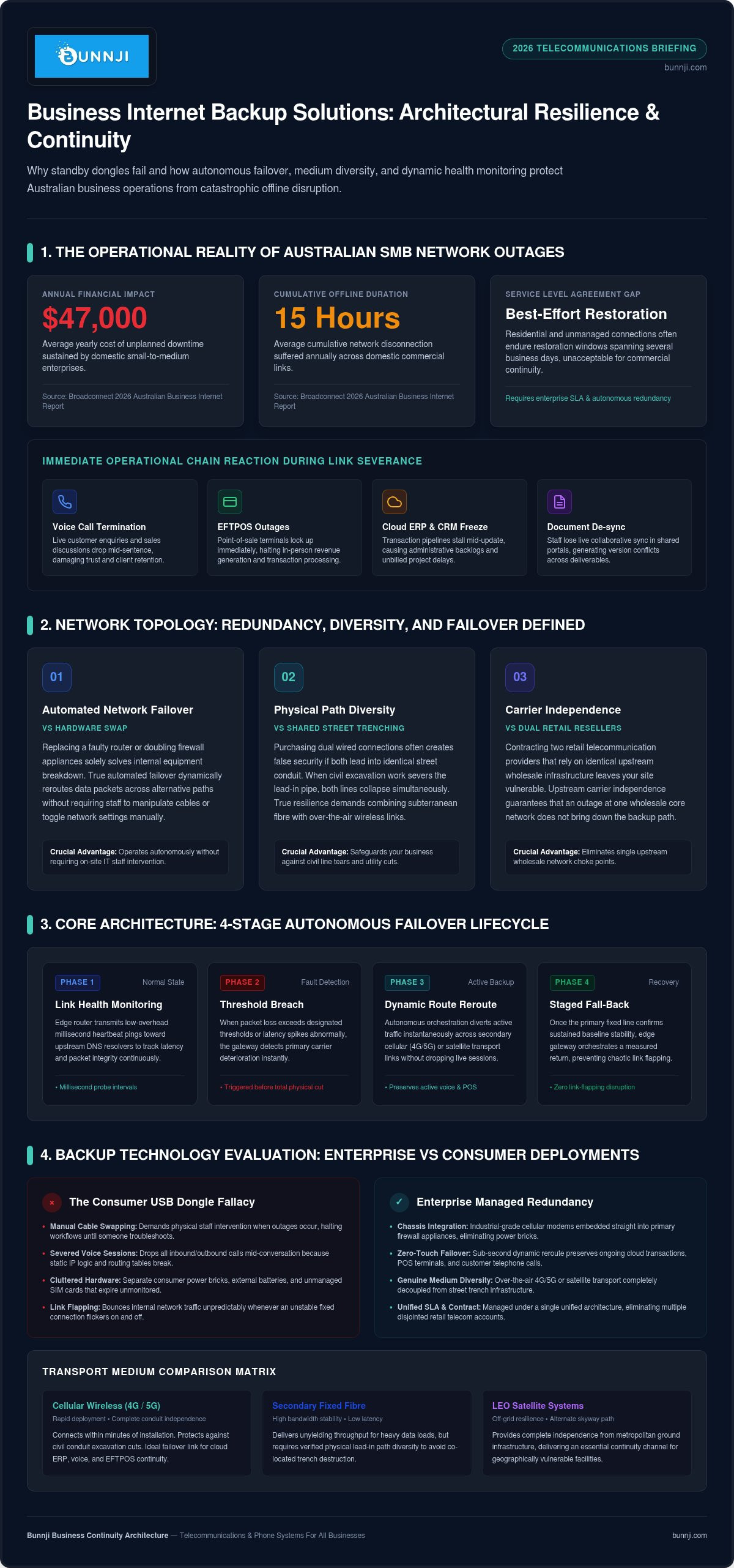
Modern workplaces run almost entirely on real-time data exchange. An enterprise-grade business internet backup solution acts as an autonomous, secondary data path designed to preserve operational continuity the instant a primary link drops. While standard residential connections frequently operate on best-effort restoration windows stretching across several business days, commercial operations cannot absorb extended periods of disconnection. A single physical failure severs cloud ERP platforms, accounting systems, and digital point-of-sale terminals without warning.
The true liability of network downtime extends far beyond direct hardware damage. Stalled staff, paused order processing, and unbilled service hours rapidly erode operating margins. Broadconnect's 2026 Australian Business Internet Report highlights this reality, finding that unplanned network downtime costs domestic small-to-medium businesses an average of $47,000 each year across roughly 15 hours of cumulative disconnections. Effective business internet backup solutions prevent these compounding losses by maintaining active business logic when local fixed-line connections drop out.
How Outages Cripple Modern Cloud Tools, EFTPOS, and Telephony
Network disruptions trigger an immediate chain reaction across front-facing and internal communications. Incoming customer calls terminate instantly, cutting off active sales conversations and support enquiries mid-sentence. At the same time, staff lose real-time synchronisation across shared document repositories and project management portals, leading to version conflicts and stalled deliverables. Critical CRM transaction pipelines freeze mid-update, creating administrative backlogs that disrupt order processing long after the physical connection recovers.
The Crucial Difference Between Redundancy, Diversity, and Simple Failover
True operational resilience requires a clear understanding of network topology:
- Hardware failover vs network redundancy: Swapping a faulty router or deploying redundant firewall appliances only protects against internal hardware faults. It does not resolve upstream line breaks. Implementing automated network failover ensures data packets automatically redirect to an alternate, live pathway without requiring staff to swap cables or toggle network settings manually.
- Physical path diversity: Many organisations purchase a secondary internet plan only to discover both connections enter the premises via the same physical street conduit. If civil excavation work severs the lead-in pipe, both connections fail at the exact same moment. Resilient design requires path diversity, such as combining subterranean fibre with fixed wireless or cellular links.
- Carrier independence: Relying on two separate retail providers that ultimately route through identical wholesale infrastructure leaves your site exposed. Upstream carrier diversity ensures a core network outage on one provider's network does not knock out your secondary line simultaneously.
Core Architecture: How Business Internet Backup Solutions Function
Plugging an unmanaged 4G USB dongle into an office modem does not constitute corporate resilience. Professional business internet backup solutions rely on continuous link health monitoring. The primary edge router sends low-overhead network heartbeat pings at designated millisecond intervals toward upstream DNS resolvers. The moment packet loss breaches pre-set thresholds or latency spikes abnormally, dynamic route orchestration activates.
Traffic diverts across secondary transport links instantaneously. Once primary fixed-line services return to stable operational baselines, the edge gateway executes an automated, staged fall-back sequence. This careful return avoids flapping, which occurs when an unstable link repeatedly drops and reconnects, throwing internal traffic into continuous disarray.
Automated 4G and 5G Cellular Failover Systems
Enterprise setups integrate industrial-grade cellular modems directly within the primary firewall appliance. This approach eliminates the separate power bricks and manual interventions typical of consumer hotspots. Cellular hardware connects within minutes of installation, giving sites immediate operational protection while aligning with standard Australian Government telecommunications outage preparedness advice. Organisations operating multi-site branch networks can also implement pooled corporate data allocations, preventing unexpected burst penalties when a single premises experiences an extended carrier drop.
Dual Fixed-Line Routing via Physically Diverse Infrastructure
High-volume commercial sites often deploy a hybrid terrestrial model, pairing enterprise business NBN with a private direct fibre link. True protection requires separate street trenches. If civil works sever one subterranean pathway, the independent physical entry point remains fully intact. Network teams configure these dual connections into active-active paths, balancing concurrent data loads during standard operations, or active-passive topologies where the secondary line remains fully dedicated as an emergency failover channel.
Intelligent SD-WAN Orchestration and Session Persistence
Deploying secondary transport is only half the battle. Bandwidth often narrows during a failover event, making application intelligence essential. Software-Defined Wide Area Networking (SD-WAN) monitors performance across every active link to deliver granular traffic prioritisation:
- Sub-second packet steering: Advanced SD-WAN appliances migrate voice and video calls between links without tearing down the underlying TCP/UDP socket. This capability guarantees that live business VoIP calls stay connected without jitter or awkward dropouts.
- Policy-based bandwidth controls: The system automatically throttles background application updates, social feeds, and non-essential streaming media the moment your connection switches to backup mode. Critical EFTPOS queues and cloud accounting software receive 100% of available capacity.
Organisations looking to audit their single points of failure can explore how managed network solutions from Bunnji design and coordinate custom dual-WAN architectures across Australian business precincts.
Evaluating Backup Technologies: 5G Failover vs Secondary Fibre vs LEO Satellite
Selecting between secondary connectivity mediums requires balancing deployment lead times, capital investment, and throughput stability under load. No single transport fits every operational profile. Fixed terrestrial lines offer high bandwidth parity, while wireless and satellite pathways deliver independence from street-level civil works. Commercial operations must weigh peak-hour latency and weather vulnerabilities when structuring modern business internet backup solutions.
5G Business Wireless: Speed, Latency, and Deployment Agility
Cellular 5G provides swift deployment without civil trenching delays. Download speeds frequently reach several hundred megabits per second, supporting standard workplace operations immediately. However, commercial buildings constructed with reinforced concrete or low-emissivity glass can attenuate mobile signals significantly, making high-gain external roof antennas necessary. Integrating fixed wireless failover alongside coordinated business mobile SIM only plans allows organisations to maintain broader workforce communication if an entire district experiences a tower outage.
Secondary Fibre and Dual-NBN: Bandwidth Parity and Reliability
Organisations handling continuous multi-gigabit workloads depend on symmetrical upload throughput. Secondary fibre paths match your primary line's performance, but purchasing two standard NBN plans frequently creates false security. If both services connect through the exact same physical optical distribution node or local splitter, a single upstream hardware failure takes down both connections. Enterprise ethernet services provide contractual 99.95% network availability and accelerated 4-hour restoration commitments backed by financial rebates, whereas standard best-effort broadband can leave sites offline for days.
Low-Earth Orbit Satellite Links for Remote Commercial Sites
Low-Earth Orbit (LEO) constellations provide practical redundancy for regional depots, logistics yards, and commercial facilities situated far from dense mobile towers. Independent ACCC Measuring Broadband Australia data confirms LEO satellite services deliver average latencies between 26.7 ms and 28 ms. This performance easily handles cloud telephony and video calls, unlike legacy geostationary satellite services that regularly exceed 660 ms. Deployment requires clear line-of-sight to the southern sky, dedicated roof mounts, and deliberate consideration of severe storm rain fade.
The matrix below outlines key operational differences across each secondary transport option:
| Transport Medium | Typical Latency | Physical Path Diversity | Deployment Timeline | Primary Operational Risk |
|---|---|---|---|---|
| 5G Business Wireless | 15–35 ms | Complete (Over-the-air) | 1–3 business days | Tower congestion during localized grid outages |
| Secondary Dedicated Fibre | <10 ms | Medium (Requires unique trench) | 4–8 weeks | Shared lead-in conduit tears during street civil works |
| LEO Satellite | 25–30 ms | Complete (Orbital) | 1–2 weeks | Line-of-sight obstructions and heavy storm fade |
Understanding these variables helps organisations comply with evolving network reliability benchmarks, including mandatory ACMA regulations for major network outages that demand greater operational accountability from infrastructure operators.
The Strategic Selection Framework: Choosing the Right Business Redundancy Tier
Selecting the ideal redundancy model requires a methodical operational audit. Organisations must calculate their maximum tolerable downtime and quantify baseline data requirements. Sizing an automated backup system isn't about mirroring raw peak download bandwidth for non-essential traffic. It's about engineering guaranteed throughput for revenue-critical tasks so your firewall processor doesn't choke under unexpected session states. Evaluating business internet backup solutions against operational priorities ensures your capital delivers resilient uptime rather than bloated idle bills.
Assessing Application Bandwidth and Mission-Critical Prioritisation
Start by isolating applications that underpin direct cash flow and customer trust. Cloud accounting platforms, centralised inventory databases, and point-of-sale terminals demand minimal throughput but zero latency disruption. By benchmarking baseline data requirements during peak trading, you can size an emergency link accurately. Implementing automated traffic-shaping rules instructs the edge router to shed non-essential media and streaming during cutover events, preserving clean bandwidth for primary business functions.
Static IP Preservation and Voice Call Integrity
A common pitfall with standard consumer failover is IP address switching. When an unmanaged link engages, the public IP shifts immediately, breaking existing IPSec VPN tunnels, remote desktop sessions, and secure banking portals. Enterprise-grade business internet backup solutions preserve the same public static IP across primary and secondary media via upstream carrier routing. Maintaining static IP consistency prevents session drops and keeps automated platforms like AI voice agents and unified PBX channels completely operational during network transitions.
Evaluating Managed Telco Support and Service Level Agreements
Service reliability hinges on contractual accountability. Standard residential broadband relies on best-effort repair targets that leave issues unaddressed over weekends and public holidays. Enterprise continuity demands contractual SLAs with proactive carrier monitoring that alerts your technical team before staff notice an issue. Review hardware lease conditions closely to avoid being trapped in rigid multi-year agreements that bundle obsolete networking gear.
Take control of your infrastructure resilience today. Schedule a telecommunications audit with Bunnji to identify network single points of failure and architect a tailored redundancy framework across your operations.
Deploying Managed Network Redundancy with Bunnji: Seamless Business Continuity
Managing disconnected vendor contracts for fibre, cellular backup, and office telephony creates unnecessary administrative friction and technical vulnerability. Effective business internet backup solutions demand complete integration rather than piecemeal hardware assembly. Bunnji engineers bespoke managed connectivity architectures that pair high-speed business fibre or enterprise NBN with intelligent, automated wireless failover across Australian business precincts. Uniting voice, data, and mobile fleet management within a single managed ecosystem eliminates finger-pointing between carriers when disruptions occur.
Carrier-Diverse Infrastructure Engineered for Zero Disruption
True operational resilience requires genuine independence between primary and secondary pathways. Bunnji provisions secondary backup links across alternative wholesale carriers, guaranteeing physical and logical diversity rather than relying on shared local conduit infrastructure. Edge hardware arrives fully pre-configured to execute autonomous, zero-touch switching the moment packet anomalies appear. This unified approach keeps cloud workflows intact and protects unified communications, ensuring your team won't drop active phone calls during network transitions.
Comprehensive Telecommunications Audits and Proactive Management
Many organisations unknowingly carry single-point risks, from outdated copper connections to standby cellular modems that fail to trigger automatically. Bunnji's specialists conduct comprehensive telecommunications audits to uncover hidden vulnerabilities, untangle restrictive long-term equipment contracts, and eliminate unexpected idle data fees. Your organisation gains predictable telecommunications management, proactive carrier monitoring, and dedicated Australian support without navigating bureaucratic support queues.
Protect your operational revenue and keep your organisation trading through any unexpected network disruption. Schedule an infrastructure audit with Bunnji today to evaluate your connectivity risk profile and deploy enterprise-grade business internet backup solutions tailored to your operational scale.
Secure True Business Continuity for Your Organisation
Relying on luck or unmanaged standby modems leaves your daily revenue exposed to unpredictable street-level disruptions. True operational resilience requires proactive architecture. By combining physical path diversity, upstream carrier independence, and intelligent packet steering, your organisation can preserve voice calls and cloud transactions without missing a beat. Investing in modern business internet backup solutions transforms passive bandwidth into an autonomous safeguard, keeping staff productive and cash flow stable when primary connections drop.
Bunnji delivers nationwide enterprise network management, offering integrated data and unified communications engineered for genuine zero-downtime failover. You gain complete operational confidence through transparent agreements without predatory equipment lock-ins or multi-vendor blame games. Don't wait for a severed street cable to expose gaps in your continuity strategy. Protect your operations with Bunnji business internet redundancy and keep your business trading smoothly through any external disruption.
Frequently Asked Questions
How fast does an automated business internet backup connection kick in?
Autonomous failover systems engage within two to ten seconds of detecting line degradation, while advanced SD-WAN hardware switches data paths in less than a second. Continuous heartbeat pings monitor the primary connection's packet flow around the clock. The moment loss thresholds are breached, the edge gateway redirects outbound traffic to the secondary service, ensuring staff and transactions experience no perceptible interruption.
Will our cloud phone calls drop when switching to a backup connection?
Cloud phone calls won't drop if your network features session-persistent routing and carrier-grade IP preservation. Basic modems tear down active VoIP connections because changing the public IP address resets the SIP registration. Enterprise business internet backup solutions preserve active communication sessions by steering packets seamlessly over secondary transport without breaking the underlying voice stream.
Can my business use a mobile phone hotspot instead of a dedicated backup solution?
Mobile hotspots cannot replace an enterprise backup connection. Tethering requires manual setup, drains personal mobile batteries, and lacks the processing power to handle concurrent office traffic. Hotspots also cannot route traffic to wired network infrastructure like networked EFTPOS terminals, on-premises printers, or server hardware. A managed failover router automatically sustains the entire office network without manual reconfiguration.
What is the main difference between 4G and 5G internet failover?
The difference centres on bandwidth capacity and latency. A 4G connection delivers reliable emergency throughput suitable for processing card payments, handling email, and maintaining voice lines. 5G failover provides multi-hundred megabit bandwidth and low latency matching fixed broadband. This ensures large teams can continue heavy file uploads, video conferencing, and intense cloud processing without throttling non-critical tasks.
Do I need a static IP address on my business backup connection?
A static IP address is critical if your organisation relies on remote access VPNs, local firewall policies, on-site hosting, or IP-whitelisted cloud portals. If your backup connection issues a dynamic IP, remote security tunnels collapse and cloud tools lock staff out until settings update. Carrier-routed static IPs guarantee external services recognise your network seamlessly across either pathway.
Can backup internet keep our EFTPOS machines and card terminals functioning?
Automated backup connectivity keeps networked and standalone payment terminals transacting normally throughout an outage. When primary fixed-line broadband goes offline, your router instantly directs local payment traffic through the cellular or secondary link. Because financial terminals require negligible bandwidth, transaction approvals continue processing in real time, protecting retail and hospitality revenue from sudden payment blackouts.
What is carrier diversity, and why is it vital for redundancy?
Carrier diversity means sourcing your primary and secondary pathways from separate network providers operating independent wholesale backhaul. If your primary fibre and secondary cellular service rely on the same upstream provider, a core carrier outage knocks out both links at once. True business internet backup solutions use genuinely distinct wholesale networks to eliminate single-carrier failure points across your operations.


