

A SIP trunk is only ever as reliable as the underlying data connection and carrier architecture behind it. When robotic audio strikes or critical client calls drop, the knee-jerk reaction is often to blame the phone hardware. In reality, the issue almost always traces back to unmanaged routing and packet jitter across congested networks. If you have ever lost hours sitting in offshore tier-one support queues or worried about costly downtime during a complex number port, you know the stakes. Finding the right fit among the leading sip trunking providers Australia has to offer shouldn't feel like a gamble with your business continuity.
You shouldn't have to compromise between voice clarity and responsive technical support. Discover how to evaluate Australian SIP trunking providers to achieve crystal-clear voice quality, carrier-grade uptime, and seamless PBX integration. This evaluation guide breaks down the essential technical criteria, from underlying data redundancy and codec selection to smart AI voice integrations, helping you deploy a reliable phone architecture that protects your bottom line.
Key Takeaways
- Assess how the top sip trunking providers Australia depends on use multi-site carrier redundancy and local data centres to prevent voice dropouts.
- Discover why dedicated business internet links and correct firewall traversal settings are vital for stopping packet jitter and call degradation.
- Compare self-service wholesale portals with fully managed carriage partnerships to determine the right level of technical support for your team.
- Follow a proven migration framework to handle complex number porting smoothly without risking business downtime or missed customer enquiries.
- Learn how combining enterprise SIP infrastructure with business fibre unlocks modern cloud PBX integration and automated AI voice agents.
What Is SIP Trunking and How Does It Power Australian Businesses in 2026?
At its core, SIP trunking delivers digital voice channels directly over data networks using Session Initiation Protocol. Rather than relying on physical copper wires terminated into a wall, it transmits packetised voice data straight to your cloud PBX or on-premises IP-PBX system. This virtual architecture allows your team to handle dozens of simultaneous concurrent calls across a single high-speed internet link without provisioning separate physical telephone lines. Evaluating the leading sip trunking providers Australia relies on requires looking past simple channel counts; it demands understanding how voice traffic travels across carrier networks to maintain call clarity.
How SIP Trunks Replace Legacy Copper and ISDN Services
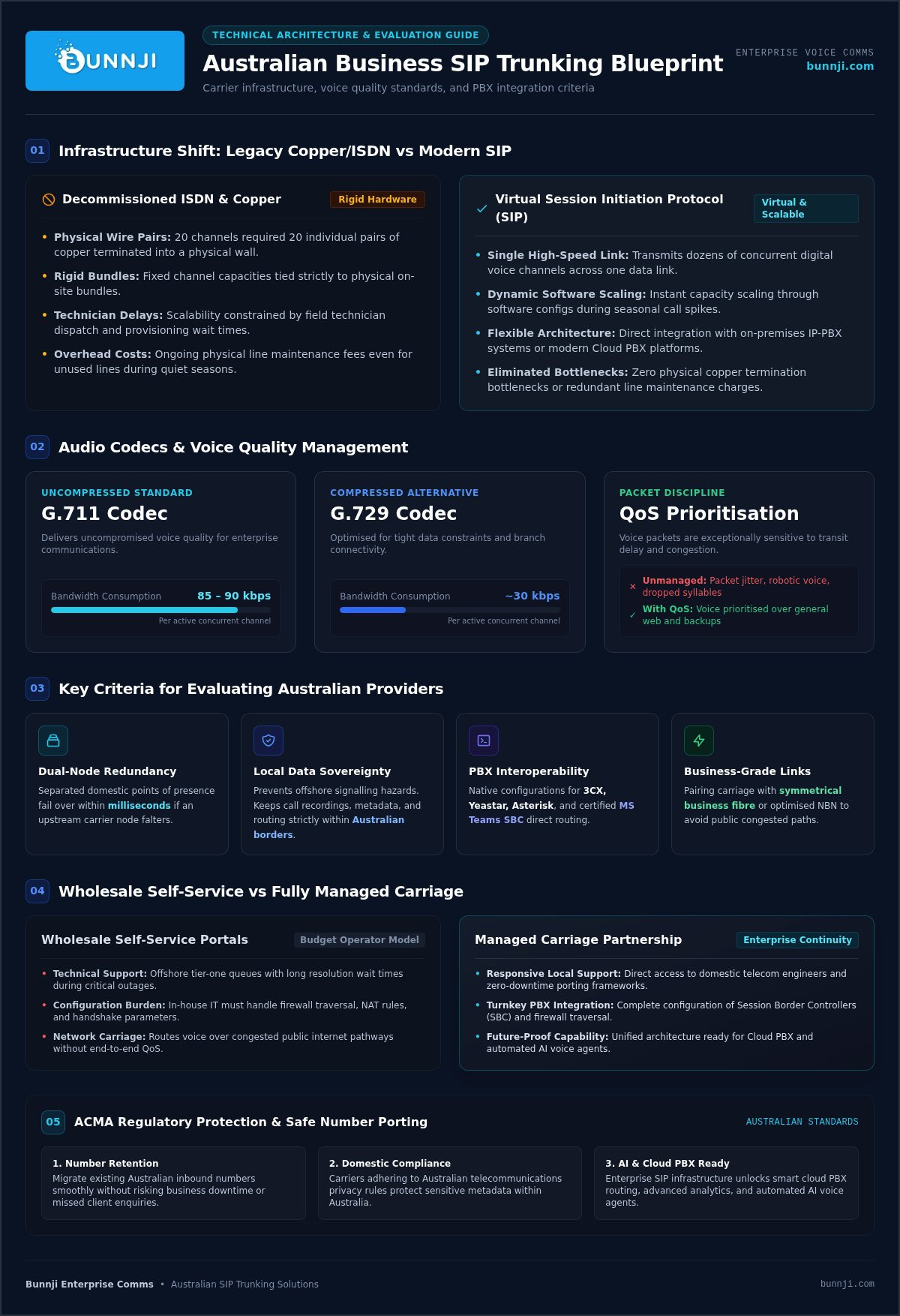
The retirement of legacy copper networks and the nationwide decommissioning of ISDN services turned virtual trunking from an optional upgrade into essential infrastructure. Traditional phone lines tied organisations to rigid physical bundles. If your business required twenty channels, you paid to install and maintain twenty individual pairs of wire. Virtual SIP channels eliminate those hardware bottlenecks completely. Capacity scales dynamically through software configurations, allowing companies to add or reduce channels instantly during seasonal call spikes without waiting for field technicians or paying ongoing line maintenance fees for unused copper.
Voice Packets, Codecs, and Quality of Service (QoS)
Digital voice transmission requires disciplined data management. During every call, continuous audio signals are compressed and broken down into rapid data packets via specific audio codecs. Uncompressed codecs like G.711 provide uncompromised voice quality at roughly 85 to 90 kbps per channel, while compressed alternatives like G.729 lower bandwidth consumption to approximately 30 kbps for locations with tighter data constraints.
Raw bandwidth alone cannot guarantee flawless audio. Voice packets are exceptionally sensitive to transit delays. Without strict Quality of Service (QoS) routing rules prioritising voice packets over regular web browsing and cloud backups, packets arrive out of order, causing audible jitter, robotic speech, and dropped syllables. Securing clear voice carriage requires pairing your setup with symmetrical, business-grade fibre or optimised business NBN links. That disciplined data carriage is precisely what separates the premium sip trunking providers Australia depends on from budget wholesale trunk sellers that route voice calls over congested public internet pathways.
Key Criteria for Evaluating Australian SIP Trunk Providers
Selecting voice carriage requires looking beyond superficial channel pricing. Because voice traffic demands low latency and high availability, the underlying infrastructure of sip trunking providers Australia businesses partner with directly determines daily operational stability. Thorough vetting protects your organisation from avoidable line dropouts, regulatory headaches, and protracted downtime.
Carrier-Grade Redundancy and Local Data Sovereignty
Offshore routing remains a quiet hazard. Budget operators often reduce costs by passing call signalling through overseas data centres, introducing massive latency and compliance exposures. The Australian telecommunications sector operates under strict standards regarding privacy and critical infrastructure. Premium carriers maintain dual-node architectures across separated domestic points of presence. If an upstream carrier node falters, calls fail over automatically to alternate routes within milliseconds, keeping your call metadata and call recordings strictly within Australian borders.
Compatibility Across PBX Platforms and Microsoft Teams
Your trunking must align natively with your communications software, whether you run 3CX, Yeastar, Asterisk, or cloud direct routing. Misconfigurations cause one-way audio, failed handshakes, and registration dropouts. Microsoft Teams environments require certified Session Border Controller (SBC) routing to bridge external public lines directly into employee chat channels. For a broader look at designing this operational stack, review our business VoIP complete strategy guide.
Number Porting Standards and ACMA Protections
Retaining your inbound numbers is non-negotiable during a migration. The Australian Communications and Media Authority (ACMA) enforces rigid anti-theft rules that require precise verification before releasing lines:
- Category A (Simple Porting): Applies to single standalone numbers or basic line groups, typically clearing within a few business days.
- Category C (Complex Porting): Governs multi-line Indial 100-number ranges and complex business accounts, requiring rigorous audits of account numbers and service IDs.
A single typo on an authorised signatory or service address triggers an outright rejection, pushing port dates back by weeks. Reliable carriers assign dedicated onboarding specialists rather than routing requests through anonymous ticketing portals. If you want seamless carrier transitions with zero downtime during cutover, you can speak with Bunnji about managed voice carriage.
Wholesale Self-Service vs Managed SIP Providers: Evaluating the Business Impact
Deciding between an unmanaged wholesale portal and a fully supported carrier partnership shapes your daily communications overhead. Many sip trunking providers Australia operates feature rock-bottom channel rates, but they shift the entire administrative and operational burden onto your internal team. For organisations without full-time voice engineers, unbundled self-service models frequently become an expensive drain on technical resources.
The True Cost of Self-Managed Budget SIP Trunks
Budget portals look economical on paper until configuration faults emerge. Internal IT engineers often spend hours diagnosing mysterious one-way audio, troubleshooting upstream packet jitter, or configuring elusive session border controllers. Endpoint security represents an even larger exposure. An inadequately secured IP-PBX open to the public internet can be compromised by automated scripts within hours. Hackers route high-volume international calls through vulnerable endpoints, leaving the subscriber liable for thousands of dollars in toll fraud before anyone notices the breach.
Support latency is another major pitfall. When an unmanaged trunk fails during busy operational periods, help is often locked behind asynchronous ticket systems. Waiting days for an offshore support desk to acknowledge a critical outage damages customer trust and halts core operations.
The Enterprise Value of Managed Carriage
Managed carriage changes the operational relationship completely. Rather than handing over basic portal credentials, a dedicated provider actively provisions, secures, and oversees the voice link. Key advantages include:
- Proactive Network Monitoring: Continuous packet delivery and jitter surveillance flags trunk degradation before staff notice distorted audio.
- Carrier Coordination and Compliance: Managed partners ensure alignments with official Australian SIP regulations, maintaining proper emergency service access and data residency protections without administrative friction.
- Unified Infrastructure: Pairing voice carriage with symmetrical business fibre simplifies billing and ensures direct Quality of Service configurations across the entire routing path.
Contract Terms, Transparency, and Scalability
Beware of legacy telecommunications agreements disguised as modern cloud solutions. Rigid, 36-month minimum term contracts that lock your organisation into fixed channel counts stifle agility. Modern elastic trunking lets you dynamically adjust concurrent channels up or down to mirror organisational headcount and seasonal call surges. Ensure your supplier provides fully itemised calling transparency, eliminating unexpected line fees or charges for basic administrative tasks like adding direct indial extensions.
How to Migrate to Modern SIP Trunking Without Downtime
Migrating live business communications requires strict operational discipline. Shifting active phone numbers between carriers without dropping inbound customer calls demands far more than flipping a simple software switch. The experienced sip trunking providers Australia businesses trust follow a phased, methodical migration framework that eliminates connectivity blindsides.
Auditing Call Concurrency, Bandwidth, and Firewalls
Start by auditing concurrent call volumes during your busiest monthly operating hours. Allocate roughly 100 kbps of symmetrical bandwidth per concurrent call channel to guarantee headroom for uncompressed audio. On your network perimeter, inspect your edge router settings immediately and disable SIP Application Layer Gateway (SIP ALG). While originally designed to assist NAT traversal, SIP ALG routinely modifies packet headers incorrectly, causing one-way audio and dropped registrations. Always isolate voice traffic onto an independent VLAN with strict upstream prioritisation.
Managing Number Porting and Disaster Recovery Failovers
The most vulnerable phase of any deployment is the scheduled carrier cutover window. To protect customer reachability during complex Cat-A or Cat-C number porting, execute staged testing using dedicated temporary pilot numbers first. Confirm inbound and outbound signalling through your PBX before touching live production lines.
Establish automated disaster recovery rules within your carrier management portal beforehand. If your primary PBX registration unlinks during cutover, incoming calls must fail over instantly to secondary mobile numbers or alternate cloud endpoints. Simultaneously ensure every ported number updates accurately inside the Australian Integrated Public Number Database (IPND) to maintain emergency service address compliance.
Configuring Security, Encryption, and Access Control
Lock down your signalling channels before routing live commercial traffic:
- Signalling and Media Encryption: Implement Transport Layer Security (TLS) for SIP signalling and Secure Real-Time Transport Protocol (SRTP) to encrypt the audio stream itself.
- IP Access Control Lists (ACL): Restrict trunk registration strictly to your provider's verified gateway IP addresses, blocking unauthorised scanning tools.
- Velocity Outbound Limits: Configure strict rate limits on concurrent international dialling to automatically shut down anomalous call patterns before toll fraud incurs costs.
Executing live cutovers during scheduled after-hours maintenance windows alongside responsive carrier engineers protects your revenue and customer reputation. To take the administrative friction out of your telecom upgrade, partner with Bunnji for zero-downtime voice migration and managed SIP deployment.
Future-Proofing Your Business Comms with Bunnji SIP Trunking Solutions
Modern telephony is no longer an isolated utility. As cloud tools advance, voice carriage must integrate directly with fast internet infrastructure and automated workflows. While many sip trunking providers Australia businesses encounter offer standard dial tone, true business resilience requires a carrier partner capable of unifying connectivity, hardware interoperability, and intelligent call handling under one roof.
Unified Carriage: Pairing SIP Trunks with Business-Grade Internet
Splitting voice channels and internet access between separate vendors creates friction when faults arise. Sourcing carrier-grade SIP trunking alongside dedicated business fibre or high-speed business NBN eliminates finger-pointing between competing support desks. Bunnji manages the entire packet journey across a single network backbone. With automated 4G or 5G backup links configured for clean failover, voice streams remain protected even if physical broadband lines suffer accidental severance.
Supercharging Phone Lines with AI Voice Agents and CRM Sync
SIP lines do far more than ring desk phones. By linking modern voice channels directly with artificial intelligence platforms, organisations can automate frontline phone traffic with unprecedented speed. Automated AI receptionists handle routine enquiries, triage incoming calls after hours, and book client appointments directly into your team calendar. Every interaction syncs back to your CRM instantly, logging clean call summaries without manual staff entry. For a deeper look at this technological shift, explore our research on AI voice agents for Australian firms.
Seamless Onboarding with Dedicated Telecom Specialists
Migrating your voice network shouldn't tie up internal resources or disrupt trading hours. Bunnji delivers full white-glove onboarding, managing complex Cat-A and Cat-C number porting from start to finish. Our engineers provide hands-on configuration assistance across 3CX, Microsoft Teams Direct Routing, and legacy IP-PBX appliances to ensure optimal handshake protocols and crystal-clear voice clarity.
Ready to deploy resilient, intelligent voice infrastructure that scales alongside your organisation? Modernise your business telecommunications with Bunnji today.
Building a Resilient Voice Network for Your Business
Modern telecommunications demand far more than basic dial tone. Sustained call clarity relies on combining high-availability carrier routing with dedicated business data links, clean firewall traversal, and responsive engineering support. When evaluating the leading sip trunking providers Australia has available, choosing end-to-end infrastructure oversight over unmanaged budget portals protects your operational continuity and shields your team from disruptive downtime.
A unified communications setup gives your organisation room to thrive. Bunnji delivers carrier-grade Australian voice architecture, hands-on Cat-A and Cat-C porting management, and seamless integration across business fibre, cloud PBX systems, and intelligent AI voice receptionists. Take the complexity out of your telephone network and invest in lasting call reliability. Upgrade your business voice carriage with Bunnji and set your organisation up for long-term growth.
Frequently Asked Questions
What is the difference between a SIP trunk and an ordinary VoIP line?
A standard VoIP line generally refers to a single virtual extension configured for an individual handset or softphone user, whereas a SIP trunk acts as a virtual pipe linking an entire PBX phone system to the public telephone network. SIP trunks bundle multiple concurrent voice channels over one internet link. This setup lets dozens of staff make simultaneous outbound calls using direct inward dials without needing separate, isolated subscriptions for every desk.
How many concurrent calls can an Australian business run over a single SIP trunk?
A single SIP trunk can support virtually unlimited concurrent calls, constrained only by your data bandwidth and carrier channel subscription. For each active call using uncompressed audio codecs, plan for approximately 100 kbps of symmetrical bandwidth. A typical business fibre connection easily supports hundreds of simultaneous channels without degradation. Leading sip trunking providers Australia businesses rely on offer elastic pooling to scale channel capacity up or down as call volume fluctuates.
How long does number porting take when switching Australian SIP trunk providers?
Simple number porting (Category A) generally clears within five to seven business days, while complex multi-line porting (Category C) typically requires two to four weeks. Timelines vary depending on whether you are shifting standalone numbers or dense 100-number Indial ranges across carrier networks. Submitting accurate regulatory documentation and matching authorised account details precisely prevents administrative rejections from the losing carrier, ensuring your cutover date proceeds smoothly without unexpected delays.
Can I keep our existing phone numbers when migrating to a new SIP provider?
Yes, Australian regulatory protections grant businesses the legal right to retain their existing geographic and toll-free numbers through local number portability. Your numbers simply transfer across carrier networks to your new trunking provider without altering how customers reach you. Dedicated engineers manage the migration behind the scenes, verifying service addresses and account numbers with the losing carrier so that your published business lines continue ringing without disruption throughout the switch.
What happens to our incoming business calls if our office internet connection drops?
Inbound calls automatically redirect according to pre-configured carrier disaster recovery rules if your office internet connection fails. Because SIP routing lives at the carrier core rather than on your local equipment, incoming traffic reroutes upstream. Calls can instantly roll over to secondary mobile numbers, alternate office locations, or cloud-hosted softphones. Pairing your phone trunks with 4G or 5G backup links provides immediate failover protection on premises.
Why does SIP ALG need to be turned off on business office routers?
SIP Application Layer Gateway (SIP ALG) must be disabled because it actively inspects and alters voice packets, frequently corrupting the session data. While intended to prevent network address translation issues, consumer and commercial router implementations often break call handshakes. This corruption causes common telecom headaches like one-way audio, silent inbound calls, and unexpected registration drops. Disabling SIP ALG allows voice data packets to pass cleanly between your PBX and the carrier.
Can Australian SIP trunks be connected directly into Microsoft Teams?
Yes, you can integrate Australian SIP trunks directly into Microsoft Teams by deploying certified Direct Routing or modern Operator Connect infrastructure. This connection bridges Teams user licenses to carrier voice trunks through a session border controller. Staff can make and receive external telephone calls straight from their Teams interface across laptops, desk phones, or mobile apps. Premium sip trunking providers Australia trusts provide native configuration guidance to streamline this setup.


