

If you're still paying a human to answer every phone call, you're likely overspending by thousands of dollars every month without even realising it. It is a frustrating reality for many local firms who feel trapped between the high cost of an in-house receptionist and the low quality of traditional offshore call centres. You probably agree that the current model of "per-minute" or "per-call" billing is broken. It creates a budget blowout every time you have a busy week, leaving you with a bill that is as unpredictable as the weather.
Understanding virtual receptionist pricing australia doesn't have to be a headache. This 2026 guide is designed to help you navigate the shifting costs of call handling and explain why automated voice agents are now the smartest choice for your bottom line. We will show you how to move away from robotic, low-IQ bots toward sophisticated systems that sync directly with your CRM and calendar. You will learn how to achieve zero missed calls and a fixed monthly cost that finally puts you back in control of your overheads.
Key Takeaways
- Understand the 2026 shift toward subscription-based automated call handling that eliminates the budget volatility of traditional models.
- Decode virtual receptionist pricing australia by identifying the critical differences between per-call billing and scalable automated subscriptions.
- Learn how to calculate the true ROI of your phone system by comparing the high cost of missed leads to the infinite scalability of AI voice agents.
- Protect your business from predatory 60-month equipment contracts and hidden porting fees that often lurk in standard telecommunications agreements.
- Discover why local, Australian-sounding AI is essential for building rapport and maintaining a professional image without the high cost of human staff.
What is an Automated Call Answering Service and How is it Priced?
The landscape of business telecommunications has changed. In 2026, the industry has moved away from simple "call taking" toward comprehensive automated call handling. Historically, an Automated attendant was just a menu of buttons. Today, it is a sophisticated system that manages your entire intake process. When looking at virtual receptionist pricing australia, you will find most providers still use a "subscription plus usage" model. This typically includes:
- A base monthly subscription for the phone number and platform access.
- Variable usage charges based on total call volume or minutes.
- Optional add-ons for after-hours support or bespoke scripts.
While this seems standard, modern firms are increasingly looking for ways to cap these variable costs to prevent budget blowouts during peak seasons. Automation allows you to move away from paying for "time spent" and instead pay for "outcomes achieved."
The Basic Tier: Message Taking and Call Forwarding
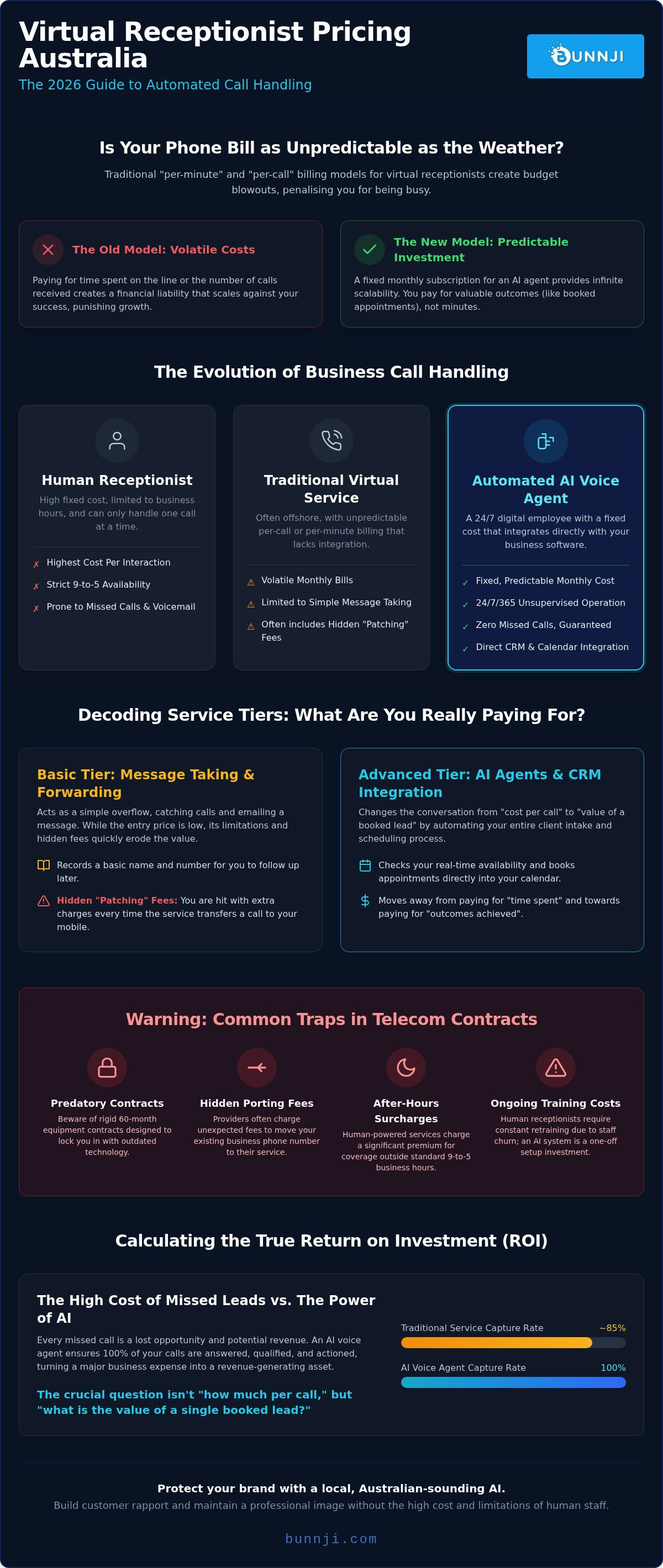
Low-cost plans usually focus on the bare essentials. These services act as an overflow valve, catching calls when your team is busy and recording a basic message to email you later. While the entry price looks attractive, the limitations often outweigh the savings. Many basic plans include hidden "patching" fees. This means every time the service transfers a call to your mobile or office line, you're hit with an extra charge. For a growing Australian firm, these small fees add up quickly. You aren't just paying for the call; you're paying for the connection, which makes the true cost of "cheap" plans much higher than they first appear.
The Advanced Tier: AI Voice Agents and CRM Integration
The real shift in 2026 is toward intelligence. High-tier services now utilise AI voice agents for business to do more than just take a name and number. These agents can check your availability and book appointments directly into your calendar. This changes the virtual receptionist pricing australia conversation from "how much per call" to "what is the value of a booked lead." Instead of a static message, you get a synchronised update in your CRM. This level of automation allows you to bypass the traditional per-call fee trap entirely. You gain a predictable cost structure that scales with your business without requiring more human hours. An automated call answering service is a 24/7 digital employee that integrates with your tech stack.
The Components of Virtual Receptionist Pricing in Australia
Understanding virtual receptionist pricing australia requires looking past the headline rate. Most quotes are a jigsaw of fixed and variable costs that can fluctuate wildly depending on your monthly call volume. A standard monthly subscription is your baseline. This fee secures your local number and ensures your management portal is always active and accessible. It is the price of keeping the "lights on" for your communication infrastructure and maintaining high uptime for your callers.
Decoding 'Per-Call' vs. 'Per-Minute' Billing
Per-minute billing is a high-stakes game for businesses with detailed enquiries. One chatty caller can turn a quiet afternoon into a budget blowout because you are paying for every second they spend on the line. Per-call models are better for simple message taking, but they still lack the depth needed for complex bookings. Automated services solve this by providing a predictable usage model that doesn't penalise you for having long, helpful conversations. The Australian Government's AI Adopt Program highlights just how much value is placed on modernising these workflows through smarter technology.
Setup Fees and Scripting Costs
Onboarding fees are often the most misunderstood part of a quote. Human providers charge to train their operators on your brand voice and scripts. AI providers charge to program the logic and sync it with your CRM. While human training is an ongoing expense due to staff churn, AI setup is a one-off investment. It builds a permanent digital asset for your firm. You should focus on organising your call flow to be as direct as possible. This reduces the time callers spend in menus and gets them to a solution faster. If you want to see how these fees compare to your current bill, a simple telecommunications audit can clear up the confusion.
Expect to pay a premium for human coverage outside the standard 9-to-5 window. Surcharges for weekends and public holidays can double your effective rate, making 24/7 coverage prohibitively expensive for many SMEs. Automated systems eliminate this friction by providing round-the-clock availability at a flat price point. This reliability ensures you never miss a lead, regardless of the time or day, without the stress of unpredictable surcharges.
Comparing ROI: Human Virtual Receptionists vs. Automated AI Agents
Calculating the true return on investment for your front-of-house operations requires looking beyond the monthly invoice. The math is simple. If you miss a single call from a prospective client worth fifty dollars, that five dollar per-call fee you were trying to avoid suddenly looks like a bargain you should have taken. Virtual receptionist pricing australia is often framed as a cost to be minimised, but the real goal is lead retention. Human operators are limited by their own physical capacity. They take breaks, they get sick, and they can only handle one conversation at a time. AI agents, however, provide 100% call capacity regardless of volume spikes.
The "human touch" is often cited as a reason to stick with traditional services, yet modern customers often prioritise speed and accuracy over small talk. If a caller wants to book an appointment or check an order status, they prefer a fast, efficient automated answer over being placed on hold by a busy human. When reviewing service agreements, be wary of unfair contract terms that lock you into high-volume tiers even when your business hits a quiet patch. Transitioning to an automated model ensures your costs remain aligned with the actual value delivered to your firm.
Cost Savings through CRM and Calendar Integration
Manual data entry is a silent profit killer. When a human receptionist takes a message, someone on your team still has to type those details into your database and send a follow-up. Utilising a virtual receptionist for CRM integration eliminates this double-handling entirely. The system captures the caller's data and populates your fields in real-time. This automation extends to your diary management, where the AI can book sessions, take intake information, and send automated SMS confirmations. This doesn't just save time; it significantly reduces "no-shows" by keeping your clients informed without any manual intervention from your staff.
Scalability for Peak Periods
Every business experiences seasonal surges. Traditional virtual receptionist pricing australia models often force you to choose between paying for a high-tier plan you don't always need or risking busy signals during your most profitable weeks. Automated services act as the ultimate insurance policy. They allow you to handle 100 simultaneous calls for the same price as one, ensuring that no marketing dollar is wasted on a call that goes to voicemail. You can scale your response capacity instantly without hiring temporary staff or navigating the complexities of new employment contracts. It is about having a system that is as elastic as your business needs it to be.
Hidden Costs and Common Traps in Telecom Contracts
Securing a competitive rate for virtual receptionist pricing australia is only half the battle. You must also navigate the complex web of the underlying telecommunications contract. Many Australian firms find themselves trapped in 60-month equipment contracts that look affordable on day one but become a heavy anchor by year three. A five-year term is an eternity in the technology sector. By the time you reach the midpoint of such an agreement, your hardware is often obsolete, yet you remain legally bound to pay for it. These long-term commitments are a significant red flag that usually signals a provider is prioritising their own lock-in over your business's flexibility.
You should also be wary of hidden "porting" fees. These are the charges some providers levy when you decide to take your existing phone number to a different service. It is a common tactic used to create friction and discourage you from switching to a more cost-effective automated solution. Before signing any new service agreement, conducting a thorough telecommunications audit is essential. This process reveals exactly where your money is going and helps you identify predatory terms before they impact your bottom line.
Identifying 'Ghost' Fees in Your Monthly Bill
Ghost fees are small, recurring surcharges that quietly inflate your monthly expenses. Common examples include extra costs for call recording, data storage, and detailed reporting. While these features are valuable, they should be transparently priced rather than tacked on as "administrative" extras. You might also find that your "free" local number actually carries a monthly maintenance fee. It is also worth checking if you are overpaying for your NBN or fibre connection. Many businesses pay for enterprise-grade bandwidth they simply don't use, adding hundreds of dollars to their annual telecommunications spend without any practical benefit.
The Importance of Internet Redundancy
A sophisticated virtual receptionist is useless if your office internet connection fails. Because modern automated services run in the cloud, your ability to receive calls is entirely dependent on your connectivity. Relying on a single NBN link is an "all eggs in one basket" risk that can lead to expensive downtime. The cost of a backup 5G or secondary NBN link is minimal compared to the revenue lost during a half-day outage. Redundancy ensures that your AI voice agents remain active and reachable, providing peace of mind that your front door is always open to new leads.
If you suspect your current provider is hiding costs in the fine print, you can request a telecommunications audit to uncover the truth and streamline your overheads.
Choosing the Right Virtual Receptionist for Your Business
Selecting a provider involves balancing your daily call volume against your need for technical integration. If your firm handles a high number of routine enquiries, bookings, or intake questions, automated solutions offer the most stable virtual receptionist pricing australia. You shouldn't stay with a human service if your growth is being throttled by unpredictable per-call fees. However, the technology must sound right. An "Australian-sounding" AI is non-negotiable for local firms. It builds immediate rapport and ensures your customers feel heard and understood without the robotic friction of older systems.
Your choice should also depend on how well the system talks to your existing software. A receptionist that cannot check your real-time availability is just a glorified message-taker. By choosing a system that integrates with your tech stack, you transform your phone line from a cost centre into a proactive tool for business growth.
Checklist for Evaluating a Virtual Reception Provider
Before committing to a contract, verify if the provider understands your entire communications infrastructure. A standalone service that doesn't talk to your CRM creates more work than it saves. Use this checklist to filter your options:
- Is there a clear path for replacing your office phone system with a unified cloud alternative?
- Does the provider offer a transparent audit of your current call flows and hidden costs?
- What is the true "all-in" monthly cost once you include CRM and calendar sync?
The goal is to find a partner who views call answering as part of a broader strategy. You want a solution that scales automatically during busy periods without requiring you to renegotiate your subscription tier every month.
The Bunnji Advantage: Unified Communications and AI
Bunnji is the logical conclusion for tech-forward firms that want to simplify their infrastructure. We don't just provide a digital voice. We combine high-speed fibre, VoIP, and AI voice agents into one manageable bill. This unified approach removes the friction of dealing with multiple vendors and ensures your system is redundant and reliable. You get the peace of mind that comes from a locally managed partner who understands the Australian business landscape. Taking the first step is simple. Book a telecommunications audit with the Bunnji team to see how we can streamline your operations and eliminate missed calls forever.
Modernise Your Call Handling and Protect Your Bottom Line
The days of accepting unpredictable bills and missed opportunities are over. By understanding the true components of virtual receptionist pricing australia, you can move away from the "per-minute" trap and embrace the scalability of automation. We have explored how sophisticated AI agents don't just answer phones; they book appointments and sync directly with your CRM to eliminate manual data entry. You now know how to spot the red flags in long-term contracts and why internet redundancy is the silent partner of a successful cloud phone system.
It's time to stop overpaying for "old school" call centres that can't scale with your growth. As an Australian-owned and operated partner, Bunnji is here to help you navigate these technical shifts with transparency and precision. Our advanced AI agents are ready to integrate with your existing tech stack, ensuring your firm never misses another lead during business hours or after dark.
Ready to uncover the "ghost" fees lurking in your current bill? Book a 10-Minute Telecommunications Audit with Bunnji today. We will provide expert guidance on identifying hidden costs and help you build a communication strategy that is ready for 2026. Your business deserves the peace of mind that comes with a predictable, high-performance front desk.
Frequently Asked Questions
How much does a virtual receptionist cost per month in Australia?
Virtual receptionist pricing australia varies based on the level of automation and service required. Traditional human-led services often use a base subscription paired with variable per-call or per-minute fees. Automated AI agents typically offer more predictable monthly costs. It's important to calculate your average call volume to see which model prevents budget blowouts. Choosing a service with a fixed subscription often provides better financial security for growing Australian firms.
Is an automated call answering service better than a human receptionist?
Automated services are often better for businesses that value scalability and round-the-clock reliability. While human receptionists offer a personal touch, they are limited by their physical capacity and can only handle one call at a time. AI agents can manage dozens of simultaneous enquiries without ever placing a customer on hold. They don't take breaks or sick leave, ensuring your business never misses a lead due to staffing shortages or peak volume.
Can an AI receptionist really book appointments in my calendar?
Modern AI voice agents integrate directly with your existing calendar and CRM software to manage bookings autonomously. They don't just take messages; they check your real-time availability and secure appointments for your team. This eliminates the need for manual data entry and reduces the back-and-forth emails often associated with scheduling. It's a seamless way to turn every phone call into a confirmed business opportunity without any human intervention.
What are the hidden costs of virtual receptionist services?
Hidden costs frequently include patching fees for transferring calls to your mobile and setup charges for scripting. You should also watch for surcharges applied to after-hours, weekend, or public holiday coverage. Some providers hide costs in monthly maintenance fees for "free" numbers or charge extra for basic reporting and call recording storage. Conducting a thorough audit of your current service agreement is the best way to identify and eliminate these ghost fees.
Do I need to change my phone number to use a virtual receptionist?
You don't need to change your existing business number to start using these services. Most providers allow you to either port your number over to their network or use simple call forwarding for overflow calls. Porting gives you more long-term control over your infrastructure, while forwarding is a fast way to ensure your calls reach an automated receptionist when your internal team is busy or unavailable to answer.
Can an automated service handle multiple calls at the same time?
Yes, an automated service can handle an unlimited number of simultaneous calls. This is a primary benefit over human-led reception, where capacity is limited by the number of staff on the clock. With an AI voice agent, you never have to worry about callers receiving a busy signal or being placed in a long queue. Your business maintains 100% call capacity regardless of how many people dial in at once.
What happens to my calls if the internet goes down?
Calls are answered in the cloud, so an office internet outage won't prevent your virtual receptionist from working. Customers can still interact with the AI agent or leave messages as usual. However, your team will need a connection to receive these updates or take transfers. This is why we recommend internet redundancy, such as a backup 5G link, to ensure your firm remains fully operational even when the primary NBN connection fails.
Are there no-contract virtual receptionist options in Australia?
Flexible no-contract options are widely available, allowing you to pay for the service on a month-to-month basis. This is a much safer alternative to 60-month equipment contracts that can leave you trapped with outdated technology. When comparing virtual receptionist pricing australia, look for providers that offer transparency and the ability to change your plan as your business needs evolve. Flexibility is key to maintaining a healthy and scalable communications budget.


