
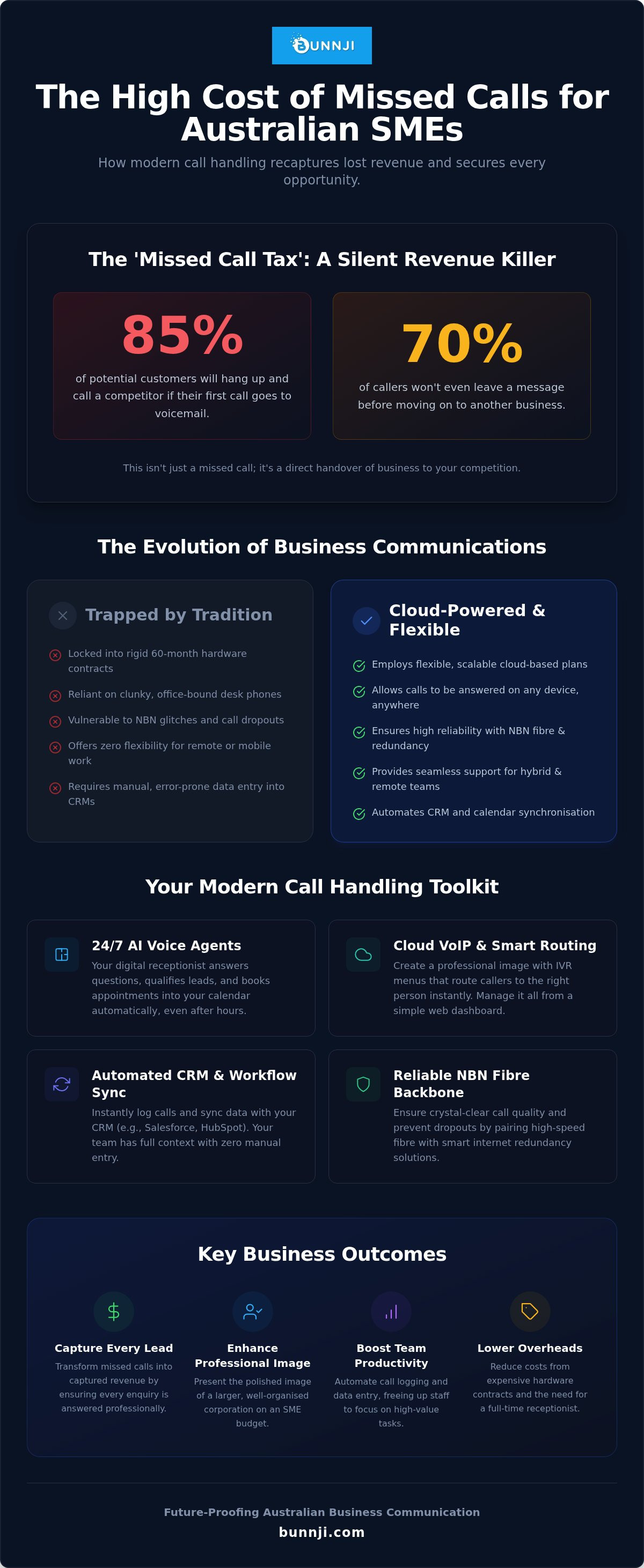
Did you know that 85% of potential customers will simply hang up and call a competitor if their first call goes to voicemail? For many Australian SMEs, this represents a massive drain on revenue that often goes unnoticed until the end of the financial year. You likely already know the frustration of losing leads to an unmonitored inbox or watching a call drop out during a standard NBN glitch. It's exhausting to maintain a professional front when you're trapped in complex 60-month hardware contracts that offer zero flexibility.
The good news is that the technology has finally caught up to your needs. This guide reveals how the latest call handling solutions for small business can eliminate missed opportunities while actually lowering your overheads. We'll explore how AI-driven receptionists and cloud-based systems can manage your enquiries 24/7, sync call data with your CRM automatically, and provide your business with a premium image on a modest budget. From navigating NBN fibre upgrades to auditing your current telecommunications costs, we're providing a clear roadmap to streamlined operations in 2026.
Key Takeaways
- Calculate the true cost of your "missed call tax" and discover why 85% of callers won't try again if their first enquiry goes to voicemail.
- Explore modern call handling solutions for small business that leverage AI voice agents to provide 24/7 coverage without the overheads of a full-time receptionist.
- Learn how to identify and avoid predatory 60-month telecommunications contracts by opting for flexible, cloud-based VoIP and unified communications.
- Ensure your operations stay online by pairing high-speed NBN fibre upgrades with smart internet redundancy to prevent call dropouts.
- Streamline your workflow by automatically syncing customer call data directly with your CRM and calendar for a more professional and organised image.
Why Modern Call Handling is Non-Negotiable for Australian SMEs
In 2026, the phone remains the most direct line to your revenue. However, the way Australians interact with businesses has fundamentally changed. We've entered an era where "leave a message after the tone" is effectively a polite way of telling a lead to go elsewhere. For local SMEs, implementing an advanced business telephone system isn't just about answering calls; it's about capturing every single opportunity that comes your way. Modern call handling is no longer a luxury reserved for large corporations. It's a suite of tools designed to ensure your small team punches above its weight and stays responsive in a fast-moving market.
The True Cost of a Missed Opportunity
Research indicates that 85% of callers won't call back if their initial enquiry goes unanswered. This "missed call tax" is the silent revenue killer for Australian small businesses. When a potential client hits your voicemail, they rarely wait for a return call; they simply tap the next result on their smartphone. In fact, roughly 70% of Australian callers won't even bother leaving a message before moving on to a competitor. This shift in behaviour is driven by a modern expectation for 24/7 responsiveness. If you aren't available to answer, your competitor likely is. Beyond lost sales, your response time directly influences your Google Business Profile rankings. Google's algorithms favour businesses that demonstrate high levels of engagement. Consequently, a high rate of missed calls can actually push your listing further down the search results. Call handling is a strategic business asset that transforms every incoming enquiry into a measurable opportunity for growth.
From Desk Phones to Cloud Platforms
Traditional copper-based infrastructure has become a significant liability for modern firms. These legacy systems are prone to reliability issues and lack the agility required for a mobile workforce. Transitioning to cloud-based call handling solutions for small business allows your team to maintain a professional presence from any device, whether they're in the office, on-site, or working from home. This flexibility is a core component of a Business VoIP Australia: The Complete 2026 Strategy Guide, which outlines how unified communications can professionalise a small team. By moving your voice services to the cloud, you eliminate the friction of legacy hardware and gain access to powerful tools. You're no longer buying a phone; you're investing in a platform that grows with you. Unified communications allow your staff to sync their mobile devices with the main office line, ensuring that "out of office" never means "out of reach".
- Automated call routing ensures enquiries reach the right person the first time.
- Instant call data syncing with your CRM removes manual entry errors.
- Professional IVR menus provide the image of a much larger organisation.
- AI-assisted lead qualification filters out spam before it reaches your staff.
The Tech Stack: VoIP, AI Agents, and Fibre Connectivity
Cloud VoIP is the engine room of modern call routing. Unlike the clunky, fixed hardware of the past, cloud-based call handling solutions for small business allow you to organise complex Interactive Voice Response (IVR) menus with a few clicks. This ensures callers reach the correct department without delay, creating a seamless first impression that mirrors a much larger organisation. By moving the logic of your phone system to the cloud, you gain a level of control that traditional copper lines simply cannot match.
AI Voice Agents: Your 24/7 Digital Receptionist
Forget the frustrating "press one for sales" menus of a decade ago. Modern AI agents use natural language processing to understand intent, answer common questions, and even book appointments directly into your calendar. These agents align with initiatives like the Australian Government's AI Adopt Program, which supports SMEs in integrating smarter technology to drive efficiency. By syncing call data with CRMs like HubSpot, Salesforce, or Pipedrive, your team starts every follow-up with full context. For a deeper look at how this technology is evolving, check out our AI Voice Agents: 2026 Trend Report for Australian Firms.
The Backbone: Why Fibre Matters for Voice
Your phone system is only as good as your internet connection. While residential NBN plans are fine for streaming, they often lack the stability required for crystal-clear voice traffic. Latency is the silent killer here. Even a micro-delay can cause jitter and dropped words that make your business sound unprofessional. Business-grade fibre offers symmetrical speeds and lower latency, ensuring your voice data receives the priority it requires.
True reliability requires a robust insurance policy. Internet redundancy, such as a 4G or 5G failover, ensures that if your primary NBN line goes down, your phones stay active. It's about removing the single point of failure that could otherwise silence your business during a local outage. You might consider checking your fibre eligibility to ensure your infrastructure can handle these modern voice demands without compromise. This foundation is what allows your team to remain responsive, regardless of external network conditions.
Comparing Call Handling Models: Which Fits Your Business?
Choosing the right operational model is a critical decision that impacts both your bottom line and your brand reputation. While the traditional front desk approach was once the only path, modern call handling solutions for small business now offer several distinct avenues based on your specific growth stage and service requirements. It's about finding the balance between a personal touch and operational efficiency.
The in-house receptionist remains the gold standard for high-touch service. This model provides a dedicated person who knows your regulars by name. However, the overheads are significant; beyond the base salary, you're managing superannuation, workers' compensation, and the logistical challenge of lunch breaks or annual leave. Outsourced call centres offer a middle ground by providing 24/7 human coverage via a third party. While they ensure a live voice always answers, these services often lack deep integration with your internal workflows and can feel scripted to a savvy customer.
By 2026, automated AI solutions have become the standard for SMEs looking to scale without adding headcount. These systems provide instant responses and deep CRM integration at a fraction of the cost of traditional models. Many Australian firms now opt for a hybrid model. This approach uses AI to handle routine triage, FAQ, and appointment booking, while complex or sensitive enquiries are seamlessly escalated to your senior team members. It ensures that your human expertise is only used where it adds the most value.
Cost vs. Performance Analysis
When you compare the monthly overhead of a full-time staff member against an AI agent, the financial gap is undeniable. An AI solution doesn't require sick leave or office space. Scalability is another major factor. If a marketing campaign goes viral, a human receptionist can still only handle one call at a time, leading to busy signals and lost leads. An AI agent scales instantly to handle hundreds of concurrent calls without a drop in quality. It provides a consistent brand experience every time, ensuring your business never has a "bad day" on the phones.
Industry-Specific Requirements
Different sectors have unique needs that dictate their choice of technology. Medical clinics require strict privacy compliance and live calendar syncing to reduce no-shows and manage patient data securely. For trades, the priority is filtering and urgency. An AI agent can distinguish between an emergency burst pipe at 2 am and a request for a renovation quote, prioritising the former for immediate notification. Professional services, such as law or accounting firms, use smart routing to ensure VIP clients are recognised instantly and fast-tracked to their specific consultant, maintaining a boutique feel through sophisticated technology.
Avoiding the 'Contract Trap' and Hidden Infrastructure Costs
Many Australian business owners find themselves trapped in 60-month telecommunications contracts that felt like a bargain at the time. These five-year agreements are a relic of a legacy era, often used by large telcos to subsidise "free" hardware that becomes technically obsolete within eighteen months. When you're locked in for half a decade, you lose the ability to pivot to more efficient call handling solutions for small business. You end up paying premium monthly fees for yesterday's technology while your competitors move to faster, cheaper cloud platforms.
True operational freedom comes from owning your assets. This includes your handsets and, most importantly, your phone numbers. Always ensure you have full porting rights for your local geographic and 1300 numbers. If a provider makes it difficult to move your numbers to a new service, they're effectively holding your brand identity hostage. Avoid any agreement that doesn't explicitly state you retain ownership of your numbers from day one.
Auditing Your Current Telco Spend
Stop paying for "zombie" services that offer no value to your daily operations. A thorough telecommunications audit often reveals redundant lines, unused fax channels, or "premium" support features that your team never utilises. Check the fine print for automatic renewal clauses that can reset your contract term without your express consent. Exit costs for legacy PBX systems are frequently obscured in complex terms, often requiring full payouts of all remaining monthly rentals regardless of whether you keep the hardware. Identifying these hidden traps early allows you to plan a clean break to a more modern system.
Flexible Mobile Integration
Handset bundles are rarely the most cost-effective choice for a growing team in 2026. Opting for Business Mobile SIM Only Plans: The 2026 Australian Buyer’s Guide allows you to separate your hardware costs from your service fees, giving you the power to upgrade devices on your own schedule. This flexibility makes it much easier to integrate your mobile fleet into your central call handling system. Your staff can use their preferred devices while maintaining a professional office number through a unified app. This creates a seamless experience where a call to the main office can be answered on a mobile in the field without the customer ever knowing the difference. If you're ready to stop overpaying for outdated hardware, you should request a contract audit to see exactly how much you could save by switching to a flexible cloud model.
Implementing Your Call Handling Strategy with Bunnji
Bunnji acts as your sophisticated local expert, removing the friction typically associated with technical infrastructure. We specialise in replacing restrictive 60-month contracts with agile call handling solutions for small business that actually work. Our approach prioritises clarity and directness. We ensure you understand the value of your tech stack without getting bogged down in corporate jargon. It's about providing the resources of a global player with the personal touch of a boutique provider who understands the Australian market.
We don't believe in off-the-shelf experiences. Every organisation has a unique workflow, so we customise your AI voice agents to reflect your specific brand voice and tone. Whether you need a formal register for a professional services firm or a friendly, no-nonsense guide for a local trade business, we build the logic that fits your culture. This ensures that every customer interaction remains human and accessible, even when it's automated. By the time we're finished, your digital receptionist will feel like a genuine extension of your team rather than a disconnected bot.
The 3-Step Migration Process
Moving your communications to the cloud doesn't have to be a headache. We follow a methodical three-step sequence to ensure a seamless transition that respects your time and protects your revenue.
- Step 1: The Audit. We perform a deep-dive telecommunications audit to identify hidden costs, "zombie" services, and verify your current NBN fibre upgrade eligibility for 2026.
- Step 2: The Design. Our team maps out your ideal call flow, designing the AI agent integration to handle your specific appointment bookings or enquiry types.
- Step 3: The Launch. We manage the technical porting of your existing numbers and provide hands-on staff training so your team feels confident and capable from day one.
Future-Proofing Your Communications
Reliability is our core promise. We address the common industry gap of internet dependency by implementing robust redundancy plans as a standard part of our infrastructure. By pairing business-grade fibre with 4G or 5G failover, we ensure that a local NBN outage never silences your business. As we move through 2026, we also focus on protecting your staff from emerging cybersecurity threats like AI voice scams. Our managed IT services provide the necessary security layers to keep your voice network private and secure. We conduct regular system reviews to ensure your technology continues to grow alongside your business goals. If you're ready to secure your revenue and streamline your operations, you can Book a call handling audit with the Bunnji team today.
Securing Your Revenue for 2026 and Beyond
The landscape of customer engagement has shifted, and relying on outdated hardware is no longer a viable option for Australian SMEs. We've explored how transitioning to cloud-based call handling solutions for small business allows you to reclaim lost revenue by ensuring every enquiry is captured. By leveraging AI voice agents and business-grade fibre, you can provide a premium experience that rivals the largest corporations without the burden of predatory 60-month contracts.
The path to streamlined operations starts with understanding your current infrastructure and eliminating hidden costs. You deserve a system that offers seamless CRM and calendar integration, backed by expert Australian-based support that understands your local challenges. It's time to move beyond the "missed call tax" and embrace a more agile, responsive way of doing business.
Ready to see where your current setup is holding you back? You can Start your 10-minute telecommunications audit with Bunnji today. We're here to help you simplify your tech and focus on what you do best.
Frequently Asked Questions
What is the best call handling solution for a one-person business?
The most effective choice for a solo operator is a cloud-based VoIP system paired with an AI voice agent. This setup allows you to maintain a professional office number while answering calls on your mobile device through a unified communications app. AI agents can triage enquiries and book appointments 24/7, ensuring you never miss a lead while you're on-site or in a meeting. It's a cost-effective way to scale your presence without hiring staff.
Can AI receptionists really understand Australian accents?
Modern AI receptionists are specifically trained on diverse linguistic patterns, including broad and regional Australian accents. By 2026, natural language processing has advanced to a point where these agents can accurately interpret local slang and unique pronunciations. This ensures your customers feel heard and understood, regardless of their dialect. We customise these agents to reflect your brand voice, providing a seamless and professional experience that feels grounded and local rather than robotic.
Do I need to buy new desk phones to use a cloud call handling system?
You don't necessarily need to invest in new hardware to transition to a cloud-based system. Most modern call handling solutions for small business work perfectly via softphone applications on your existing laptop or mobile device. If you prefer a physical desk phone, many legacy IP-enabled handsets can be repurposed. However, many Australian firms are moving away from traditional desk phones entirely, opting for the flexibility of unified communications that follow your team wherever they work.
How does a call handling solution integrate with my existing CRM?
Integration occurs through secure API connections that link your phone system directly to platforms like HubSpot, Salesforce, or Pipedrive. When a call arrives, the system automatically identifies the contact and displays their history to your team. After the call, logs and recordings are synced to the customer's profile without manual entry. This ensures your data remains accurate and your workflow stays organised, allowing you to focus on high-value tasks instead of administrative paperwork.
What happens to my calls if the office internet goes down?
Your calls remain active through a combination of cloud routing and internet redundancy. If your primary NBN connection fails, a 4G or 5G failover system automatically kicks in to keep your hardware online. Because the "brain" of the system lives in the cloud, calls can also be instantly rerouted to staff mobile apps. This disaster recovery planning ensures that a local outage never results in a total communications blackout for your business.
Is it possible to keep my existing business phone number when switching?
You can absolutely retain your existing business numbers through a process called porting. This applies to your local geographic numbers as well as 1300 and 1800 services. It's vital to ensure your new provider supports full number portability so you maintain ownership of your brand identity. We manage the technical migration with the carriers to ensure there is no downtime, allowing your customers to reach you on the same familiar digits.
Are AI voice agents compliant with Australian privacy laws?
AI voice agents are designed to be fully compliant with the Australian Privacy Act and relevant telecommunications regulations. These systems use encrypted data transmission and can be configured to store data within Australian-based servers to meet data sovereignty requirements. We also implement robust cybersecurity measures to protect against emerging threats like AI voice scams. It's important to work with a provider that prioritises transparency and security in how customer interactions are recorded and stored.
How much does a professional call handling solution cost per month?
Costs are typically structured as a monthly subscription based on the number of users and the specific features you require. This model is generally much more affordable than traditional hardware-based systems because it eliminates the need for expensive on-site PBX maintenance. By avoiding predatory 60-month contracts and using modern call handling solutions for small business, you can often find a solution that fits a modest budget while providing significantly more value than a legacy landline.


