

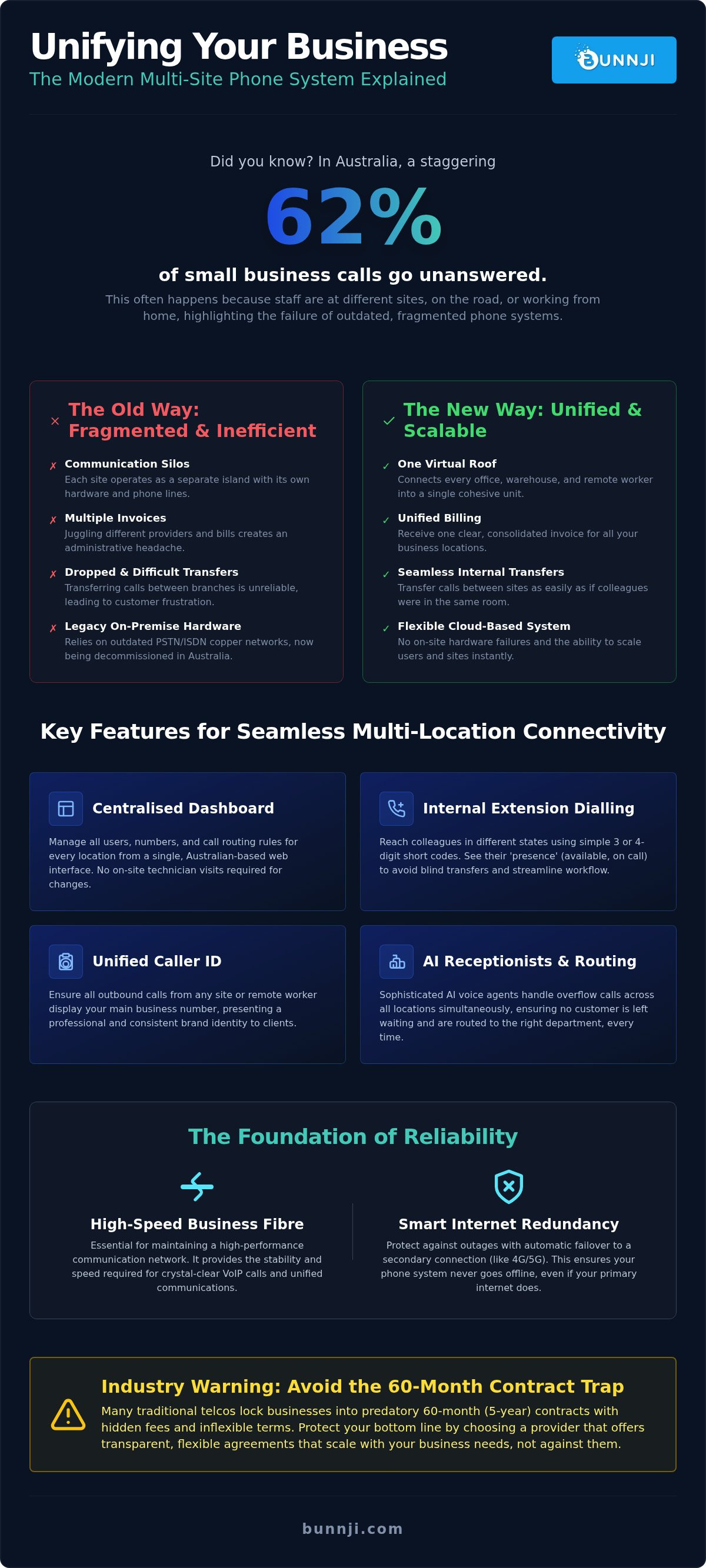
Did you know that 62% of small business calls in Australia go unanswered? Most of the time, it isn't for a lack of trying; it's because the right staff member is at a different branch, on the road, or working from home. If your current setup feels like a fragmented mess of dropped transfers and inconsistent customer service, you're likely feeling the strain of outdated infrastructure. Transitioning to modern multi-site business phone systems is no longer just an IT upgrade; it's a strategic move to reclaim control over your brand's voice.
We understand the headache of juggling multiple providers and the dread of opening a dozen different invoices every month. You want a system that works as one cohesive unit, regardless of how many warehouses or offices you run. This guide will show you how to unify your team into a single, high-performance network without getting stuck in a predatory 60-month contract. We'll walk through the essentials of centralised dashboards, the rise of AI receptionists, and how to secure your communication with business-grade fibre and smart redundancy.
Key Takeaways
- Unify your offices, warehouses, and remote teams under one virtual roof to provide a consistent and professional customer experience across all sites.
- Explore how modern multi-site business phone systems utilise centralised Australian-based dashboards to simplify user management and internal extension dialling.
- Recognise why high-speed business fibre and internet redundancy are essential for maintaining a high-performance communication network that never goes offline.
- Protect your bottom line by learning how to spot the "60-month contract trap" and other hidden fees often found in traditional telco agreements.
- Discover the value of a comprehensive telecommunications audit to ensure your migration to a unified system is seamless and free of technical friction.
What is a Multi-Site Business Phone System?
A multi-site business phone system is a unified communication platform designed to connect every office, warehouse, and remote workspace under one virtual roof. Instead of each location operating as a separate island with its own hardware and phone lines, these systems centralise your entire voice network. This allows your team to function as a single unit, regardless of the physical distance between branches. It replaces the fragmented approach of the past with a streamlined, cloud-hosted environment that prioritises accessibility and ease of management.
The year 2026 represents a major turning point for Australian telecommunications. With the final decommissioning of the legacy PSTN and ISDN copper networks completed in April, on-premise systems that rely on traditional infrastructure are no longer viable. Australian firms are now retiring these legacy setups in favour of digital solutions that offer greater stability. Transitioning to multi-site business phone systems allows businesses to enjoy several immediate advantages:
- Unified billing: You receive one clear invoice for all locations, eliminating the administrative burden of managing multiple telco providers.
- Shared receptionists: A single receptionist or an AI voice agent can manage incoming calls for every branch from one central point.
- Seamless internal transfers: Staff can transfer calls between offices in different states as easily as if they were sitting in the same room.
Cloud VoIP vs. Traditional On-Premise PBX
Traditional setups often involve a physical Business telephone system box installed at every site. These boxes create "communication silos" because they are difficult to link together and require expensive on-site technician visits for maintenance. Cloud VoIP serves as the backbone of modern multi-site operations, replacing heavy hardware costs with flexible, seat-based pricing. By moving the "brain" of the phone system to the cloud, you remove the risk of hardware failure at individual sites and gain the ability to scale your user count instantly.
The Rise of Unified Communications (UCaaS)
Modern communication has moved beyond simple voice calls. Unified Communications as a Service (UCaaS) integrates video conferencing, instant messaging, and file sharing into your multi-site business phone systems. This allows your staff to move between branches or work from home without changing their setup or losing access to their tools. Their extension, contacts, and call history follow them to any device they log into. To understand how this fits into your broader digital transformation, read our Business VoIP Australia: The Complete 2026 Strategy Guide.
Essential Features for Seamless Multi-Location Connectivity
Managing a distributed workforce requires more than just a dial tone. To truly unify your operations, multi-site business phone systems must offer tools that bridge the gap between physical locations. A centralised, Australian-based dashboard is the first step. This allows you to organise all your users, numbers, and routing rules from a single interface without needing a technician on-site for every minor change. It gives you the power to scale your team up or down instantly, ensuring your communication infrastructure matches your business growth across every branch.
Internal communication becomes instantaneous with short-code extension dialling. Instead of dialling a full mobile or landline number, you can reach a colleague at a regional warehouse from your head office using just three digits. When paired with presence indicators, your team can see who is currently on a call, in a meeting, or away from their desk before attempting a transfer. This prevents the frustration of blind transfers and ensures a smoother workflow across different sites. For a broader look at the technology driving these features, you can consult this authoritative guide to UCaaS providers.
Consistency is equally vital for your external brand image. Unified caller ID ensures that when a staff member calls a client from a remote site or an interstate branch, the customer sees your primary business number. This presents a professional, cohesive identity that isn't tied to a specific geographical location, reinforcing trust with every interaction.
AI Receptionists and Smart Call Routing
Modern systems are moving away from basic auto-attendants. Sophisticated AI voice agents now handle overflow calls across all your locations simultaneously, ensuring no customer is left waiting during peak periods. By integrating these agents with your CRM, the system can recognise VIP customers the moment they call any branch and route them to their dedicated account manager automatically. To see how these technologies are evolving, check out the AI Voice Agents: 2026 Trend Report for Australian Firms.
Advanced Call Transfer and Parking
We've all experienced the frustration of being asked to hang up and redial a different branch number. This manual process kills customer satisfaction and risks losing the lead entirely. High-performance multi-site business phone systems solve this with "Call Park" functionality. You can put a caller on hold at one location and have a specialist at an interstate office pick up the call instantly by selecting the corresponding "park" slot on their handset. This level of flexibility ensures your brand image remains professional and consistent, regardless of which site answers the initial call. If you're unsure if your current setup supports these advanced workflows, a quick telecommunications audit can reveal exactly where your connectivity gaps are hiding.
Ensuring Reliability: Internet Redundancy and Fibre
Reliability isn't just a technical specification. It's the lifeblood of your customer service. For multi-site business phone systems, your communication network is only as strong as its weakest internet connection. Because cloud-hosted systems rely entirely on a digital path, a single site with poor latency can degrade the experience for your entire organisation. If your internet drops, your business effectively disappears from the phone lines, leaving customers in the dark and staff unable to collaborate.
High-performance communication requires a stable foundation. Dedicated business fibre provides the symmetrical speeds and low latency necessary for primary office hubs to sync voice data without interruption. When your network is designed correctly, it includes built-in disaster recovery. If one branch faces a local power outage, your system should automatically reroute incoming calls to staff mobile devices or to another available branch. This ensures continuity and prevents callers from ever hearing a disconnected tone.
Business NBN and Fibre Upgrades
For primary locations, NBN Enterprise Ethernet is often the superior choice over standard Business NBN. While standard plans are excellent for smaller branches, Enterprise Ethernet offers symmetrical upload and download speeds backed by a formal Service Level Agreement. Upload speed is the secret to crystal-clear voice quality. When multiple sites are syncing data, video, and voice simultaneously, standard residential-grade uploads will often choke. This leads to jitter, lag, and dropped packets during critical client calls. High-speed fibre is now a non-negotiable requirement for head offices that manage high call volumes across a distributed network.
Failover Solutions: 4G and 5G Backups
Even the most reliable fibre link can be compromised by unexpected roadworks or network maintenance. Automatic failover solutions keep your phones ringing by detecting a primary link failure and switching to a secondary 4G or 5G path in seconds. This "Always On" promise protects your brand reputation by ensuring you never miss a lead due to technical downtime. Customers rarely care about the cause of an outage; they only care that they can't reach you when they need support. Bunnji manages internet redundancy by configuring smart hardware that prevents communication blackouts through seamless secondary path switching.
Maintaining this level of uptime requires a proactive approach to network design. By prioritising redundancy, you ensure that your multi-site business phone systems remain a strategic asset rather than a point of failure. This stability allows your team to focus on growth while the technology works silently in the background to keep everyone connected.
Cost Analysis: Avoiding the 60-Month Contract Trap
Signing a 60-month telecommunications contract is one of the most restrictive decisions a growing firm can make. While big telcos often pitch these long-term agreements as a way to lower upfront equipment costs, they effectively lock you into yesterday's technology. In the fast-paced Australian market, a five-year commitment is an eternity. If your business expands from two sites to five within three years, you'll likely find your legacy hardware is already obsolete, yet you're still stuck paying for it until the term expires.
Beyond the basic monthly fee, multi-site business phone systems can attract significant charges for number porting, hardware maintenance, and complex licensing. For instance, porting premium numbers like 1300 or 1800 can cost between $50 and $150 per number, according to current industry averages. Consolidating your services into one transparent monthly invoice removes this administrative friction. It allows you to see exactly where your budget is going across every warehouse and office location without decoding a dozen different bills. The debate between "Bring Your Own Device" (BYOD) and hosted hardware is central here; while BYOD reduces capital expenditure, buying hardware outright gives you the freedom to switch providers if your service levels drop.
The Hidden Cost of Legacy Equipment
Legacy equipment often carries a heavy financial burden that isn't immediately obvious on a balance sheet. Old PABX systems are a money pit for maintenance and often lead to "ghost" charges—recurring fees for lines or features that haven't been used in years. A professional telecommunications audit can often uncover hundreds of dollars in monthly wastage by identifying these redundant services. For remote staff who don't require a physical desk phone, transitioning to Business Mobile SIM Only Plans: The 2026 Australian Buyer’s Guide provides a far more flexible and cost-effective solution.
Transparent Pricing Models for 2026
Modern communication thrives on a per-user pricing model. This allows you to scale up instantly when opening a new branch or scale down for seasonal sites without facing heavy penalties. When you're reviewing a Service Level Agreement (SLA), look for guarantees that cover multi-site support and rapid response times across all geographic locations. Month-to-month or shorter-term contracts are now the gold standard for flexibility. They provide the leverage to ensure your telco remains a partner rather than a burden. To see how much you could save by cutting the cord on predatory long-term contracts, book a telecommunications audit with Bunnji today.
Implementing Your Multi-Site Strategy with Bunnji
Transitioning to multi-site business phone systems shouldn't feel like a high-risk operation. At Bunnji, we approach implementation with a "measure twice, cut once" philosophy. We don't just plug in new handsets and hope for the best. Instead, we start with a comprehensive analysis of your existing infrastructure to ensure the migration is seamless and your downtime is non-existent. Our local expert support means you aren't dealing with a nameless call centre overseas; you're talking to real people who understand the Australian business landscape and the unique challenges of connecting regional and metro sites.
Future-proofing is a core part of our strategy. We integrate AI voice agents and high-speed unified fibre networks to ensure your communication platform grows alongside your ambitions. Whether you're moving numbers across various interstate branches or integrating remote teams into a warehouse network, our process is designed to remove technical friction. We handle the heavy lifting of porting and configuration so your staff can stay focused on their daily operations without interruption.
The 10-Minute Telecommunications Audit
Before any rollout begins, we conduct a 10-minute telecommunications audit. This isn't a generic sales pitch. It's a targeted investigation into your current contract expiry dates, bandwidth bottlenecks, and redundant lines that might be draining your budget. We identify if your current NBN plan has the capacity for a high-performance VoIP rollout or if an upgrade is required to prevent call quality issues between your primary office and satellite locations. This audit prepares your IT infrastructure for a unified communications transition, ensuring every site is ready for the switch from day one. We look for the "ghost" charges and predatory terms that often hide in legacy contracts, giving you a clear path to a more efficient system.
Scaling Your Business Nationally
Growth should be exciting, not a logistical nightmare. Our cloud-hosted platform allows you to add a new location to your network in minutes, not weeks. You don't need to wait for a technician to visit a new interstate branch; you simply provision the users through our centralised dashboard and ship the pre-configured hardware. This agility is essential for firms that need to move fast in a competitive market.
We champion the "One Number" philosophy. This gives every staff member access to their business extension via mobile and desktop apps, regardless of where they are working. It ensures your team remains reachable on a single professional number, whether they are in a regional showroom or a home office on the other side of the country. If you're ready to unify your communications and eliminate hidden costs, Book a free multi-site audit with the Bunnji team today.
Ready to Unify Your Business Communications?
Modernising your infrastructure is about more than just switching hardware. It is about creating a seamless experience for your customers and a friction-free environment for your staff. By moving away from restrictive long-term contracts and embracing cloud-hosted technology, you gain the agility needed to scale across Australia without technical baggage. The transition to unified communication is a strategic investment in your brand's future stability.
Choosing the right multi-site business phone systems ensures your team stays connected through dedicated fibre and smart redundancy. Whether you need AI-driven voice solutions that integrate with your CRM or a no-nonsense 2026 telecommunications audit to find hidden savings, Bunnji is your capable local partner. We specialise in high-performance Australian business NBN and fibre redundancy to keep your brand online, regardless of local outages or maintenance schedules.
Get a Custom Multi-Site Quote from Bunnji today and take the first step toward a more reliable network. Your team deserves a communication system that works as hard as they do, and we're here to make that happen.
Frequently Asked Questions
Can I keep my existing phone numbers if I move to a multi-site cloud system?
Yes, you can keep all your existing phone numbers when migrating to modern multi-site business phone systems. This process, known as porting, allows you to move your landline, 1300, 1800, and mobile numbers to the cloud. Our team manages the technical transition to ensure your business identity remains intact. While standard numbers often port for a small fee, premium numbers like 1300 or 1800 typically incur costs between $50 and $150 per number to transfer.
What happens to our phones if the internet goes down at one of our locations?
Your system should include automatic failover to prevent communication blackouts. If the primary NBN link at a specific location fails, a secondary 4G or 5G connection takes over in seconds. This redundancy ensures your phones remain active even during network maintenance or local outages. Additionally, disaster recovery settings can automatically reroute incoming calls to staff mobile devices or an alternative branch, protecting your brand reputation and ensuring no customer is left unanswered.
How much does it cost to set up a phone system for three different offices?
Implementation costs vary based on your specific requirements, such as the number of users and the type of hardware selected. Most Australian businesses now favour a per-user monthly subscription model, which replaces heavy upfront capital expenditure with predictable operating costs. This approach allows you to scale your system as you add new locations. Because every organisation has unique connectivity needs, we provide 100% tailored plans after conducting a thorough telecommunications audit of your current infrastructure.
Do I need special hardware at every site for a multi-location system?
You don't necessarily need physical desk phones at every site. Modern cloud systems allow staff to use softphones on their laptops or mobile apps on their smartphones. If you prefer traditional handsets, you can use VoIP-compatible hardware that simply plugs into your internet connection. This flexibility reduces the need for expensive on-site PBX boxes at each location. By using a "one business number, every device" philosophy, your team stays connected without being tethered to a desk.
Is it possible to have a single receptionist answering calls for all our branches?
Yes, a centralised receptionist can manage calls for all your branches from any location. Because the system is hosted in the cloud, incoming calls can be routed to a single point of contact who can then transfer them to any staff member across your network using short-code extension dialling. This setup improves consistency in your customer service and reduces overheads by eliminating the need for a dedicated receptionist at every physical warehouse or office.
How do AI voice agents help businesses with multiple locations?
AI voice agents provide a high-performance solution for handling high call volumes across multiple locations. These agents can answer calls simultaneously, book appointments, and answer common enquiries without human intervention. By integrating with your CRM, they recognise returning customers and provide a personalised experience regardless of which branch the customer originally intended to call. This ensures that every enquiry is captured, even during peak periods or after-hours, preventing lost revenue from missed calls.
What is the difference between SIP trunking and a hosted multi-site PBX?
SIP trunking provides the digital connection for an existing on-premise phone system, allowing it to make calls over the internet. In contrast, a hosted multi-site PBX is a complete cloud-based platform where the "brain" of the system lives in the provider's data centre. Most Australian firms are moving toward hosted solutions because they offer better flexibility for remote work and remove the maintenance burden of physical hardware. Hosted systems are generally easier to manage across several geographic sites.
Can I integrate my multi-site phone system with my existing CRM?
Yes, integrating your phone system with your CRM is a standard feature for modern multi-site business phone systems. This connection allows for "screen pops" that display customer details as soon as the phone rings, enabling your staff to provide more informed service. It also automates call logging and activity tracking, which is essential for maintaining accurate records across a distributed team. This integration ensures that your sales and support data remains synchronised, no matter which office answers the call.


