

What if your most valuable business asset, your phone number, was actually being held hostage by an outdated contract or a legacy provider? You’ve spent years ensuring customers know exactly how to reach you, so the anxiety surrounding a botched transfer or missed sales is completely valid. Learning how to port a business phone number in australia shouldn't feel like a high-stakes gamble with your reputation. We know that your number is your digital identity, and moving it to a more agile provider is a strategic step toward better reliability and bespoke service.
You probably want a transition that happens quietly in the background without a single second of downtime. This 2026 guide provides the roadmap to master the Australian number porting process, ensuring you retain full ownership and control of your assets. We will demystify the complex CAT A and CAT C categories governed by the Telecommunications Numbering Plan 2025. You’ll learn how to audit your current services to avoid rejection fees and how to optimise your cut-over timing. By the end, you’ll have the confidence to upgrade to a cloud VoIP system while keeping your customer lines wide open.
Key Takeaways
- Recognise that you hold 'Rights of Use' rather than outright ownership, meaning you must keep your current service active until the transfer is fully finalised.
- Identify whether your services fall under Category A or Category C to ensure your 2026 migration aligns with ACMA mandated timeframes and technical requirements.
- Master the technical steps of how to port a business phone number in australia to eliminate downtime and avoid the common pitfalls of legacy carrier rejections.
- Gather specific account strings and site address data before submission to ensure your gaining provider can initiate a seamless, error-free request.
- Leverage the porting window as a strategic opportunity to move away from outdated copper lines and embrace a unified cloud system that works across every device.
Understanding Local Number Portability (LNP) in Australia
Understanding how to port a business phone number in australia starts with the technical framework that lets you switch providers while keeping your identity. In the Australian market, Local Number Portability (LNP) ensures that your business isn't tethered to a specific telco just because of a phone number. The Australian Communications and Media Authority (ACMA) oversees this through the Telecommunications Numbering Plan 2025. This regulation exists to promote competition, giving you the power to find better service or lower costs without losing your established brand. It removes the friction of switching, ensuring that the "gaining provider" can request your number from the "losing provider" on your behalf.
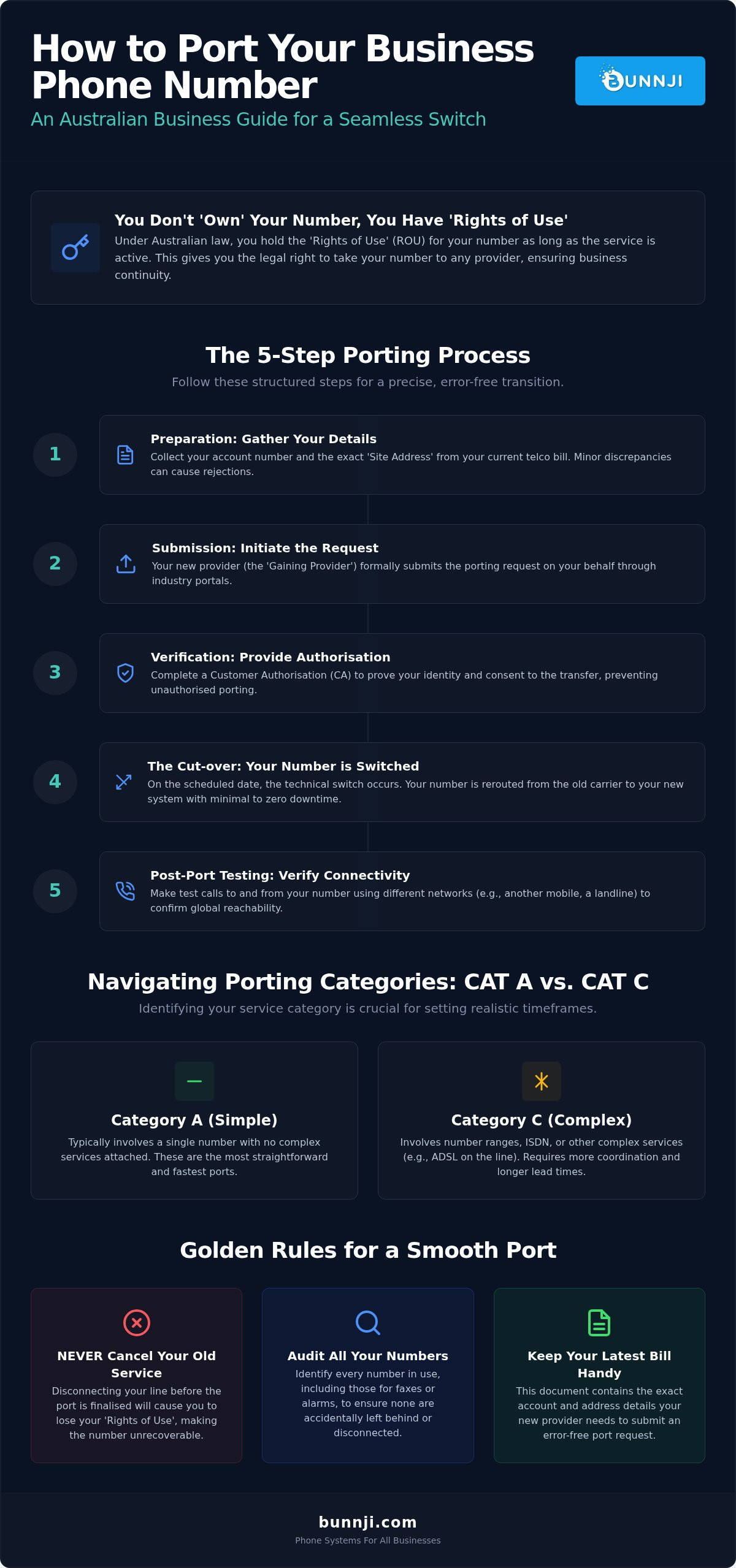
You don't actually own your business number in the traditional sense. Under Australian law, you hold the 'Rights of Use' (ROU). Think of it like a long-term lease on a prime piece of real estate. As long as the service is active and the bills are paid, you have the legal right to take that number with you to any provider. This is essential for maintaining customer trust. If you change your number, you risk missing calls from long-standing clients who have your old details saved. Maintaining the same number across a transition signals stability and reliability to your market.
Which Numbers Can You Port?
Most business numbers are eligible for transfer. This includes geographic landlines starting with 02, 03, 07, or 08 and mobile numbers starting with 04. Mobile transfers are significantly faster than fixed lines, with 90% of ports completed within three hours according to the Mobile Number Portability Code. Inbound services like 13, 1300, and 1800 numbers follow a different set of rules under the Inbound Number Portability Industry Code. While the technical cutover for inbound numbers is fast once approved, the end-to-end verification and routing setup can take up to two weeks.
Active vs Disconnected Numbers
The golden rule of learning how to port a business phone number in australia is simple: never cancel your existing service before the port is finalised. If you disconnect the line, you effectively relinquish your Rights of Use. The number goes back into a quarantine pool, and retrieving it is often impossible. Your service must be active at the moment the port request is submitted.
If a number is accidentally disconnected, it creates a massive technical hurdle. We recommend a thorough telecommunications audit before you start. This identifies every number in your range, including those hidden on fax lines or security alarms. Checking if your numbers are 'port-ready' ensures you don't face rejections from the losing carrier later in the process. A rejection often happens because of a mismatched account number or an incorrect site address, so having your latest bill handy is a critical first step.
The 5-Step Process to Porting Your Business Numbers
Mastering how to port a business phone number in australia involves a structured five-step sequence. It's not a dark art, but it does require precision to avoid the administrative rejections that plague many businesses. The process follows a logical path from preparation to final testing, ensuring your brand remains reachable throughout the transition.
- Preparation: You must gather your specific account strings and the 'Site Address' exactly as it appears on your current telco's records. Even a minor discrepancy in the address format can halt the process.
- Submission: Your new provider, known as the 'Gaining Provider', initiates the request through industry-standard portals. They act as your advocate, managing the technical handshake with your old carrier.
- Verification: This is where you provide Customer Authorisation (CA). The industry follows strict rules for porting a phone number to prevent unauthorised transfers, requiring a clear identity check.
- The Cut-over: On the scheduled date, the technical switch occurs. This is the moment your number is routed away from the old infrastructure and into your new system.
- Post-Port Testing: Once the switch is live, you must verify both inbound and outbound routes. We recommend testing from various networks to ensure global reachability is intact.
If you're feeling overwhelmed by the technicalities, a quick telecommunications health check can clarify your current setup before you begin.
The Importance of Account String Accuracy
An Account String is the unique identifier used by Australian carriers to validate port requests. A single typo in this string is the most common reason for a port rejection. These strings aren't always your standard account number; they are often hidden deep within your old telco bills or legacy contracts. Finding these identifiers early prevents the frustration of a failed submission. We often find that businesses with multiple sites have different strings for different locations, making a thorough review of your last three months of billing essential.
Customer Authorisation (CA) Requirements
The CA is a legal document that proves you have the right to move the number. In the 2026 landscape, digital signatures have become the gold standard, though some carriers still allow verbal verification for simple services. The person signing must be an authorised representative listed on the original account. To simplify this, Bunnji offers a guided telecommunications audit that identifies exactly who needs to sign and which numbers are ready for the move. This proactive approach removes the guesswork and ensures your authorisation is bulletproof from day one.
CAT A vs CAT C: Navigating Porting Categories
One of the biggest hurdles in how to port a business phone number in australia is identifying which regulatory bucket your service sits in. The Local Number Portability Code splits transfers into two distinct categories: Category A (Simple) and Category C (Complex). Choosing the wrong one is a recipe for instant rejection. It's not about the size of your business, but rather the technical architecture of the phone lines you're moving. Getting this right from the start saves you weeks of administrative back-and-forth.
CAT A Porting: Speed and Simplicity
Category A ports are designed for small businesses with single, standalone services. If you have a single PSTN line, a standard NBN phone service, or a basic VoIP line, you'll likely fall into this group. These are often completed within 48 to 72 hours, though the industry standard allows for up to 8 business days for the majority of simple transfers. Mobile porting is even faster, often finishing in just a few hours. Even with this simplicity, rejections are common. They usually happen because of a mismatch in the account string or because the service has a complex feature like a line hunt attached to it, which automatically bumps it to Category C.
CAT C Porting: Managing Multi-Line Systems
Category C ports handle everything else. This includes multi-line systems, sequential indial blocks, and legacy ISDN services. Because these systems are more intricate, the timeframe expands significantly, typically taking between 10 and 30 business days. Large enterprise migrations often require a 'Project Port' approach. This involves a coordinated effort between carriers to ensure that hundreds of numbers switch over simultaneously without a hitch. It's a strategic moment to align your transition with your managed IT services to ensure your internal network is ready for the new traffic. Complex ports require a higher level of technical oversight to prevent calls from dropping during the migration.
To determine your category, look at your latest bill. If you see a range of numbers, such as 10, 20, or 100 numbers, billed under a single pilot number, you're looking at a Category C port. If you're only moving a single, independent number, it's likely CAT A. Understanding how to port a business phone number in australia effectively means being honest about your current technical debt. If your system has 'line hunting' or complex routing, don't try to force it through as a simple port. It'll only lead to delays and potential downtime for your team.
Avoiding Downtime and Porting Pitfalls
The most stressful part of learning how to port a business phone number in australia is the fear of 'The Gap'. This is the technical window between your old service being disconnected and your new system becoming fully reachable. While the industry aims for seamless handovers, routing updates across the national network can sometimes take a few minutes. If your hardware isn't configured or your NBN connection is unstable during this window, that silence can cost you significant revenue and customer trust.
A thorough pre-porting checklist is your best defence. You must verify that your handsets, cabling, and network switches are compatible with your new provider's specifications. Don't wait until the cut-over day to discover your office wiring doesn't support Power over Ethernet (PoE) or that your firewall is blocking SIP traffic. We recommend running a full connectivity test at least 48 hours before the scheduled port date. Mastering how to port a business phone number in australia requires this level of proactive technical verification to ensure you don't miss a single call.
Internet Redundancy and Porting Safety
Your new cloud phone system is only as reliable as your internet connection. If your primary NBN line fails during the migration, your business goes dark. Establishing internet redundancy is the secret to a successful VoIP port. This typically involves a secondary connection, such as a high-speed 5G backup or a separate fibre line from a different carrier. We also suggest setting up temporary call diversions to mobile devices. This ensures that even if there is a local hardware issue, your team can still answer calls. Integrating business mobile SIM only plans into your disaster recovery strategy provides an extra layer of protection during the transition.
Dealing with Contract Payouts
Legacy telcos often lock businesses into 60-month equipment contracts with heavy early termination fees. Before you initiate a port, you must identify these hidden costs. Timing your move to align with the end of a billing cycle or a contract anniversary can save you thousands. Some modern providers may offer incentives to offset these porting costs, but you need to have the exact payout figures ready for negotiation. Many businesses are surprised by the complexity of these agreements. If you're unsure about the fine print in your current contract, we can help you identify potential savings with a telecommunications audit.
Transitioning to a Modern Cloud Phone System
Porting your number is the perfect catalyst for a complete communications overhaul. Once you have mastered how to port a business phone number in australia, you shouldn't just settle for another basic service provider. This is the moment to ditch traditional desk phones and embrace a system that scales with your growth. Moving to the cloud ensures your business identity is no longer tied to a physical wall socket in a specific office. It transforms your number from a static line into a dynamic business asset.
The 2026 landscape offers tools that were previously reserved for global giants. You can now deploy AI voice agents as soon as your port is finalised. These agents handle high call volumes and connect directly to your booking systems, ensuring you never miss a lead during the transition. Setting up these cloud-based auto-attendants and call flows takes minutes, providing a premium experience for every caller. This level of automation ensures your business remains responsive even during peak periods or after hours.
The Rise of Unified Communications
Unified Communications is about presence and accessibility. By porting your numbers to a modern platform, you gain the ability to answer calls via softphones or mobile apps. This ensures your team stays connected whether they are in the office or working remotely. Integrating these lines with your CRM and calendars creates a bespoke workflow that eliminates manual data entry. It is a strategic departure from off-the-shelf solutions, offering a level of stability and customisation that legacy systems simply cannot match. The future of the business phone system in Australia is mobile, integrated, and location-independent.
Getting Started with Bunnji
We understand that technical infrastructure can feel like a headache. Our team specialises in how to port a business phone number in australia with zero downtime, managing the entire sequence on your behalf. Our local experts handle the carrier negotiations and technical handshakes so you can focus on running your business. We provide the resources of a major player with the personal, responsive touch of a boutique provider. There are no bureaucratic layers here; just direct, transparent support from a team that values your time and your brand's reputation.
Don't let your business identity be held back by outdated technology. We invite you to book a free telecommunications audit to identify your number assets and find potential savings. Let us show you how a seamless transition can turn your phone system into a modern AI platform that works as hard as you do.
Secure Your Business Identity for a Cloud-First Future
Navigating the technicalities of the Australian telecommunications landscape doesn't have to be a source of anxiety. By focusing on data accuracy and identifying whether your services fall into the CAT A or CAT C categories, you eliminate the most common causes of migration failure. Mastering how to port a business phone number in australia is your opportunity to shed legacy copper restrictions and embrace a unified, AI-ready platform that grows with your team. Precision during the preparation phase ensures your brand remains reachable and your customer trust stays intact.
Our Australian-based support team is here to manage the heavy lifting. We provide expert guidance on complex CAT C migrations and deploy redundant internet solutions to ensure you experience zero downtime during the cut-over. We believe in a no-nonsense approach that removes the friction from technical infrastructure. Book a free telecommunications audit with Bunnji and simplify your number porting today. You’ve built your business reputation; let us help you protect it as you move toward a more agile and reliable future.
Frequently Asked Questions
How long does it take to port a business phone number in Australia?
Learning how to port a business phone number in australia involves understanding that timeframes vary by service type. Simple Category A ports usually complete within 48 to 72 hours, though industry standards allow up to 15 business days. Complex Category C migrations for multi-line systems typically take between 15 and 30 business days. Mobile transfers are faster, with most finishing in under three hours. We recommend allowing a month for complex transitions.
Will my business phones go down while the number is porting?
Your phones shouldn't experience significant downtime if the process is managed correctly. The actual technical cutover usually happens in a matter of minutes. However, a brief gap can occur while routing updates across the national network. We eliminate this risk by implementing internet redundancy and temporary diversions to mobile devices. Having a backup 5G connection ensures your team stays reachable even if your primary NBN line experiences a hiccup.
Is there a fee to port my business number to a new provider?
There is no government-mandated fee for porting, but most gaining providers charge an administrative fee to cover the technical setup. These costs vary based on whether you are moving a single line or a complex indial range. Rejection fees may also apply if the information provided to the losing carrier is incorrect. We suggest a telecommunications audit to verify your account details early, which helps avoid unnecessary administrative errors.
Can I port a 1300 or 1800 number to a VoIP system?
Yes, 13, 1300, and 1800 numbers can be ported to a modern VoIP system. This process follows the Inbound Number Portability Industry Code rather than standard landline rules. While the technical switch is almost instantaneous once approved, the full verification process usually takes between several business days and two weeks. Moving these services to a cloud platform allows you to manage routing and AI receptionists through a centralised dashboard.
What happens if my current telco refuses to release my number?
A telco cannot legally refuse to release a number if you hold the Rights of Use and the service is active. Rejections usually happen because of mismatched account strings or incorrect site addresses rather than a flat refusal. If a dispute arises that cannot be resolved through standard channels, you can lodge a complaint with the Telecommunications Industry Ombudsman (TIO). We handle the negotiations with your losing provider to clear technical hurdles.
Do I need new hardware to port my numbers to the cloud?
You don't necessarily need new physical handsets to move your numbers to the cloud. Many businesses choose to manage their ported numbers via softphones on computers or mobile apps. If you prefer traditional desk phones, you will need hardware that is SIP-compatible and supported by your new network. We check your existing cabling and network switches during our audit to ensure your office infrastructure can support high-definition voice traffic.
Can I port my number if I am still under contract with my current provider?
You can initiate a port even if you are currently under contract, but you will likely face early termination fees from your existing provider. It is vital to check the fine print of any long-term equipment contracts before starting. Learning how to port a business phone number in australia involves timing your move to minimise these payouts. We help clients calculate these costs to determine the most viable moment to transition.
Can I port an out-of-area local number to a different interstate location?
Cloud VoIP systems allow you to keep your geographic number regardless of your physical office location. This means you can keep an interstate local number even if your team is based in a different region or working remotely. This location independence is a major benefit of modern systems, allowing you to maintain a local presence in multiple markets. It ensures your established business identity remains consistent even if you move across the country.


