

By the end of 2026, the traditional desk phone will be little more than a decorative paperweight for most Australian SMEs. You've likely felt the frustration of being tethered to a physical handset while your work takes you everywhere else. It's expensive to maintain and complex to manage, which is why a softphone for business use has become the essential tool for the modern hybrid workplace. We know you need a system that's as mobile and agile as your team.
This guide will show you how to retire restrictive hardware contracts and replace them with a stable, bespoke cloud solution. You'll discover how to maintain a consistent business presence on the go, reduce your monthly telecommunications overheads, and ensure your team never misses a critical client call again. We'll break down the latest NBN speed tiers and the AI-driven features making softphones the standard for every modern Australian workplace. It's time to turn your existing devices into a professional phone system that actually works for you.
Key Takeaways
- Eliminate the significant overheads of 60-month hardware contracts by transitioning to a flexible, software-based communication model.
- Empower your team to work from anywhere while maintaining a professional presence with a softphone for business use on any device.
- Ensure crystal-clear call quality by aligning your VoIP system with business-grade NBN and robust internet redundancy.
- Leverage AI voice agents and automated sentiment analysis to streamline customer service and capture every lead without manual effort.
- Maximise efficiency by integrating your phone system directly with your CRM to automate data entry and enhance caller insights.
What is a Softphone for Business Use?
A softphone is essentially a software application that mimics the functionality of a traditional desk phone on your computer, smartphone, or tablet. Instead of relying on copper wires or physical handsets, it uses Voice over Internet Protocol (VoIP) to transmit your calls as data packets over the internet. When we talk about a What is a Softphone?, we are describing a shift from hardware-centric communication to a flexible, app-based model. This technology turns any internet-connected device into a professional workstation. It allows your team to stay reachable whether they're working remotely or meeting clients across the country.
The primary appeal of a softphone for business use is the ability to maintain a professional Australian presence without being tethered to a physical desk. You can answer calls made to your 02, 03, or 08 landline number directly on your mobile device. This is a significant step up from consumer apps like WhatsApp or Skype. While those apps are fine for catching up with mates, they lack the essential features businesses require. A dedicated business softphone provides professional call transfers, hold music, and secure call recording, ensuring your brand remains polished and compliant.
The Anatomy of a Modern Softphone App
Modern softphone interfaces are designed for familiarity and speed. Most apps feature a standard dial pad that looks just like the one on your smartphone, making the transition seamless for your staff. These applications are built for cross-platform compatibility, meaning they run natively on Windows, macOS, iOS, and Android. A key feature is the deep integration with your company's contact directory. You don't need to manually enter phone numbers; you simply search for a colleague's name or a client's record and click to call. This creates a unified experience where your laptop, tablet, and mobile all share the same call history and contact list.
Softphone vs. Hardphone: Which is Right for Your Office?
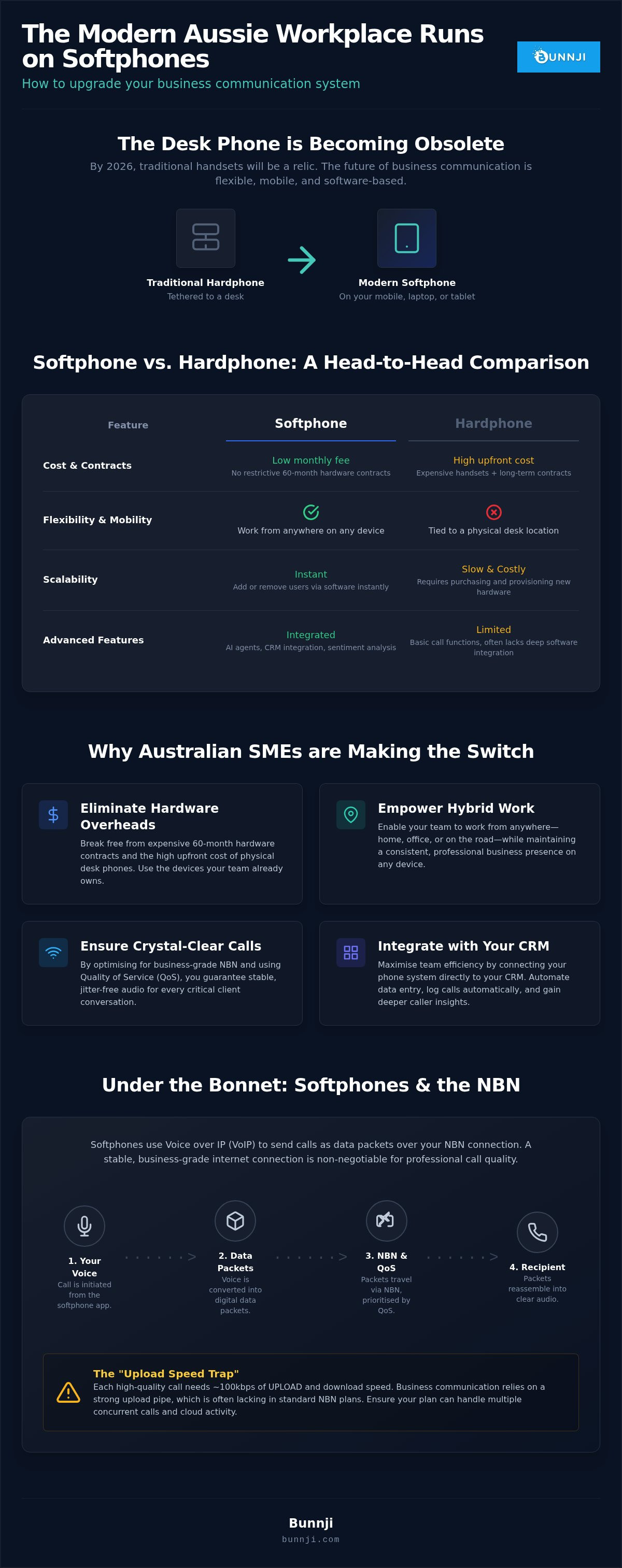
Choosing between a softphone and a traditional hardphone often comes down to your specific operational needs and budget. For many Australian businesses, the cost savings are the deciding factor. Hardphones require a significant upfront investment in handsets, often costing hundreds of dollars per unit, plus the ongoing headache of 60-month hardware contracts. Softphones eliminate this overhead entirely by using the devices your team already owns.
Flexibility is another major win for the softphone. It perfectly supports the hybrid "work from anywhere" lifestyle that has become standard across Australia. However, there are still scenarios where a physical desk phone makes sense. Reception desks or high-volume call centres often prefer the tactile reliability of a dedicated handset. For most other roles, the agility of a softphone for business use provides a superior, clutter-free alternative that scales instantly as your team grows.
Under the Bonnet: How Softphones Work with Australian NBN
To understand how a softphone for business use maintains crystal-clear audio, we have to look at the underlying plumbing of the National Broadband Network (NBN). Voice over Internet Protocol (VoIP) works by slicing your voice into tiny digital data packets. These packets travel across your NBN connection to the receiver, where they are reassembled into sound. If your internet connection is unstable, these packets arrive out of order or go missing entirely, resulting in "jitter" or dropped words. This is why business-grade NBN is non-negotiable for professional teams who can't afford a patchy connection.
Success depends heavily on your office router's Quality of Service (QoS) settings. Think of QoS as a VIP lane for your voice traffic. Without it, a large file download or a high-definition video stream in the breakroom could crowd out your phone calls. By prioritising voice packets, your router ensures that your softphone always has the bandwidth it needs. Modern apps also handle the transition between office Wi-Fi and 5G mobile data seamlessly. If you walk out of the office mid-call, the software intelligently switches networks without dropping the line, keeping you connected as you move.
Bandwidth Requirements for Jitter-Free Calls
Calculating your needs is straightforward. A standard high-quality voice call requires roughly 100kbps of both upload and download speed. While a 50/20 Mbps NBN plan sounds plenty, the "Upload Speed Trap" often catches Australian businesses out. Home-grade plans prioritise download speeds for streaming, but business communication relies on the upload pipe. If your team is running 20 concurrent calls while syncing large files to the cloud, a standard home connection will buckle. Latency refers to the time delay in data transmission, which causes frustrating voice lag during real-time conversations. To ensure your network is up to the task, you might consider a professional telecommunications audit to identify potential bottlenecks before they impact your clients.
Internet Redundancy: Keeping Your Phone Line Online
The biggest concern for any Australian business is what happens when the NBN goes down. Because your softphone relies on the internet, a local outage could silence your entire office if you haven't prepared. Reliable systems solve this through 4G or 5G failover solutions. When your primary fibre connection drops, your router automatically switches to the mobile network, keeping your calls active without interruption. For a deeper look at building a resilient network, check out our Business VoIP Australia: The Complete 2026 Strategy Guide. This redundancy ensures that your professional presence remains intact, regardless of local infrastructure hiccups or maintenance work.
Key Benefits of Switching to a Softphone System
Transitioning to a softphone for business use represents a fundamental shift in how your company operates and spends. The most immediate impact is the total elimination of the heavy overheads associated with traditional desk phones. You no longer need to worry about the maintenance of physical handsets or the restrictive nature of 60-month telecommunications equipment contracts. By moving your voice services to the cloud, you replace unpredictable repair bills and expensive hardware refreshes with a predictable, scalable software subscription. This allows you to reallocate capital into areas that actually grow your business.
Scalability is where the softphone model truly shines for growing Australian enterprises. In the old world, adding a new staff member meant ordering a handset, waiting for delivery, and often paying a technician to configure a physical port. With a modern cloud system, you can provision a new user in minutes through a central dashboard. Whether you are hiring a local team in Perth or a remote specialist in Hobart, they can be online and making professional calls almost instantly. This agility is paired with unified communications, bringing your voice calls, team chat, and video conferencing into a single, cohesive interface.
Professionalism on the Go
Maintaining a professional image is difficult when your team is forced to use their personal mobile numbers for client follow-ups. A softphone solves this by ensuring that every outbound call displays your official business number, regardless of which device is being used. It protects your staff's work-life balance by allowing them to set custom business hours; once the day is done, the app can automatically route calls to an AI voice agent or a shared voicemail box. Features like shared call appearance also mean that if one team member is busy, another can step in to answer a ringing line, ensuring no customer query goes unanswered.
Advanced Features You Won't Get on a Landline
Modern softphone applications offer a suite of data-driven tools that traditional landlines simply cannot match. Visual voicemail is a prime example, transcribing audio messages into text so you can read them in your inbox during a meeting. For businesses in regulated industries, one-click call recording provides an easy way to ensure compliance and gather material for staff training. You also gain access to real-time presence indicators. Instead of walking across the office or calling an extension only to find it's busy, you can see exactly who is "on a call," "away," or "available" directly from your contact list. This level of transparency streamlines internal communication and boosts overall team efficiency.
Choosing the Right Softphone: A 5-Step Selection Framework
Selecting a softphone for business use is a strategic decision that goes beyond just picking an app from an app store. To ensure you get the stability and functionality your team needs, we recommend a methodical five-step selection framework. First, audit your calling patterns. Don't just guess your requirements; look at your peak call volumes, the average length of conversations, and which features like call queues or hunt groups are non-negotiable for your daily operations.
Second, prioritise CRM integration. If your phone system doesn't talk to Salesforce, HubSpot, or your specific industry database, you're missing out on vital data automation. Third, evaluate mobile performance with a focus on battery optimisation. A poorly coded app will drain a smartphone in hours, which is a deal-breaker for a mobile workforce. Fourth, verify Australian-based support and data sovereignty. You need a partner who understands the local NBN landscape and keeps your voice data stored securely on Australian soil. Finally, test the interface with a small pilot group. If your staff find the software clunky or confusing, adoption will fail regardless of the technical specs.
Security and Compliance for Australian Firms
Security is a critical pillar for any Australian firm handling sensitive client data, yet it's often overlooked in generic software guides. Your softphone must offer end-to-end encryption to protect conversations from interception. We also recommend enforcing Multi-Factor Authentication (MFA) for all softphone logins to prevent unauthorised access to your corporate directory. Compliance with the Australian Privacy Principles (APPs) is essential, particularly regarding how voice data and call recordings are stored and accessed. Choosing a provider that understands these local regulatory requirements provides the peace of mind that your communications remain both private and legal.
Integration with Your Existing Tech Stack
True efficiency gains come from how well your phone system integrates with your existing tech stack. Click-to-dial functionality allows your team to make calls directly from a browser or CRM, saving seconds on every interaction that add up to hours of productivity every month. When a call ends, the system should automatically sync call logs and recordings with the relevant client record. This ensures your data is always current without manual entry. For a broader look at how these tools fit into your digital infrastructure, see our guide on the Cloud Communication Platform Australia: The Complete 2026 Business Guide.
If you're ready to see how this selection framework applies to your specific business needs, you can request a bespoke telecommunications audit to identify the best fit for your team.
The Future of Softphones: AI and Unified Communications
2026 marks the year that Australian businesses finally move past the concept of a "phone" and embrace the "communication platform." A modern softphone for business use is no longer a simple dialler; it's the interface for an intelligent ecosystem. AI receptionists are now being built directly into these platforms, providing a level of service that was previously impossible for small teams to maintain. These systems do more than just route calls. They use automated sentiment analysis to gauge a caller's emotional state, allowing your team to prepare for a difficult conversation before they even say hello.
AI Voice Agents have evolved into capable digital team members. Instead of a basic "press one for sales" menu, these agents engage in natural language conversations to handle basic enquiries or qualify leads. This technology ensures that your professional presence is active 24/7, capturing opportunities that would otherwise be lost to a voicemail box. By 2026, the distinction between a software app and a business strategy has blurred, making the softphone the central hub of your digital office.
Bunnji's Approach to Intelligent Communication
Bunnji focuses on making this sophisticated technology accessible to local firms. Our AI voice agents don't just answer the phone; they sync with your calendar to book appointments while your team focuses on high-value tasks. This reduces the significant costs associated with missed calls and ensures every enquiry receives an immediate response. To understand how this compares to old-school methods, read our analysis on AI Voice Agents vs Traditional Receptionists. We believe in providing tools that remove friction, allowing you to focus on growth rather than infrastructure.
A 10-Minute Telecommunications Audit
If you're still tethered to physical hardware, you're likely paying for a legacy model that no longer serves you. We've developed a 10-minute telecommunications audit to help you identify hidden costs in outdated equipment contracts. This process assesses whether your team is ready for a full softphone transition and highlights where you can trim unnecessary overheads. It's a straightforward way to see if your current setup is holding you back. You can book a no-nonsense telecommunications audit with Bunnji today to start your transition toward a more agile and profitable future.
Step Into the Future of Australian Business Communication
The transition from physical handsets to agile, cloud-based applications is the most effective way to modernise your workplace today. You've seen how a softphone for business use eliminates the burden of restrictive 60-month hardware contracts while empowering your team with AI-driven tools that capture every lead. By aligning your communication with business-grade NBN and intelligent redundancy, you ensure that your professional presence remains unbreakable regardless of where your team is located.
Bunnji is a proud, Australian-owned and operated provider specialising in AI voice integration and expert NBN connectivity support. We understand the local landscape and are committed to helping you move from outdated infrastructure to a sophisticated, bespoke platform. It's time to reclaim your time and budget while delivering a superior experience to your clients. Upgrade your business communication with Bunnji's cloud phone systems and take control of your office's digital future. Your journey toward a more flexible and professional workplace starts right here.
Frequently Asked Questions
Is the call quality on a softphone as good as a desk phone?
Call quality is equal to or better than a traditional desk phone when supported by a stable internet connection. Because a softphone for business use relies on VoIP technology, audio clarity depends on your network's stability and upload speeds. Using business-grade NBN with Quality of Service (QoS) settings ensures your voice traffic takes priority over other data. This prevents the jitter or lag sometimes associated with home-grade connections.
Can I keep my existing Australian business phone number?
You can absolutely keep your existing Australian business phone number. The process, known as porting, allows you to move your current local or 1300/1800 numbers from a traditional provider to a cloud-based system. This transition is seamless and ensures your clients can continue reaching you on the familiar contact details they already have saved. We manage the technical handover to ensure there is zero downtime for your incoming calls.
Do softphones use a lot of mobile data when I'm out of the office?
Softphones are remarkably efficient and use very little mobile data. A standard high-definition voice call typically consumes around 100kbps, which equates to roughly 45MB per hour of talk time. For most Australian mobile plans, this usage is negligible. You can confidently handle a full day of client calls over a 4G or 5G connection without worrying about hitting your data cap or compromising the stability of your mobile device.
What happens to my softphone if my internet goes down?
Your communication remains active even if your primary NBN connection fails. Most modern softphone apps automatically switch to your smartphone's 4G or 5G data if the office Wi-Fi drops out. Additionally, because the system is cloud-based, calls can be instantly rerouted to other team members or an AI voice agent. This built-in redundancy ensures your business stays reachable during local outages or maintenance work on the NBN infrastructure.
Is it difficult for non-technical staff to learn how to use a softphone?
Most staff find the transition intuitive because the interface mirrors the dial pad on a standard smartphone. There is very little learning curve for non-technical team members. Features like your company contact directory, call history, and visual voicemail are organised logically. We provide simple onboarding sessions to ensure everyone feels confident using advanced features like call transfers and conferencing, making the move from physical handsets a stress-free experience for the whole team.
Do I need special headsets for my team to use softphones effectively?
While you can use standard headphones, we recommend high-quality business headsets for the best results. These devices offer superior noise cancellation, which is essential for maintaining a professional presence in busy or home environments. Whether your team prefers wireless Bluetooth models for mobility or wired USB versions for desk-bound roles, a dedicated headset ensures crystal-clear audio and all-day comfort. This small investment significantly enhances the overall experience of using a softphone for business use.
Can a softphone replace my entire office PBX system?
A softphone system completely replaces the need for a physical on-site PBX. All the advanced features you expect from a high-end office system, such as auto-attendants, call queues, and hunt groups, are hosted securely in the cloud. This shift removes the need for expensive hardware maintenance and site visits. You gain a more powerful, flexible system that scales instantly as your business grows, all managed through a simple web-based dashboard.
Are softphones secure enough for legal or medical businesses in Australia?
Softphones are highly secure and suitable for industries with strict privacy requirements. They use end-to-end encryption to protect sensitive client conversations from unauthorised access. For Australian legal and medical firms, we ensure the system complies with the Australian Privacy Principles (APPs). By implementing Multi-Factor Authentication (MFA) and ensuring data sovereignty, you can maintain a secure communication environment that meets the rigorous standards of your profession while providing the flexibility of modern cloud technology.


