
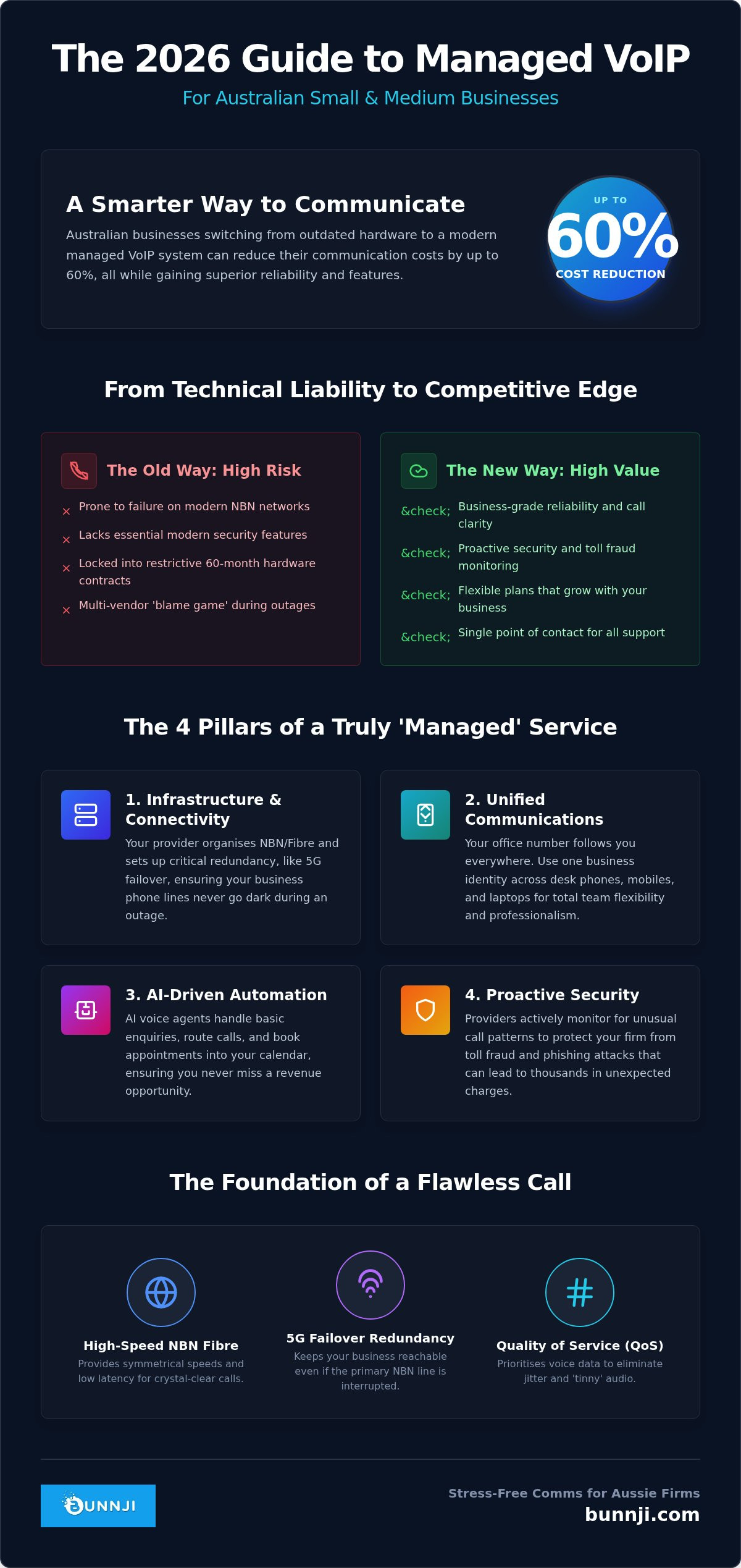
Did you know that Australian businesses switching from traditional hardware to hosted systems can reduce their communication costs by up to 60%? For many local owners, the phone remains the primary lifeline to customers, yet it's often a major source of technical frustration. You've likely felt the sting of missed calls costing you revenue or the headache of complex NBN connectivity issues that leave your team stranded. Adopting managed VoIP services for small business isn't just about saving money; it's about building a reliable digital backbone that finally works as hard as you do.
It's exhausting being locked into nasty 60-month equipment contracts or struggling without local support when things go pear-shaped. You deserve seamless communication across every device without the technical headache. This guide explores how to integrate AI and security to give your business a genuine competitive edge. We'll walk through the 2026 strategy for future-proofed connectivity, covering everything from AI receptionists that sync with your CRM to the latest ACMA regulatory changes that are finally shifting power back to the consumer.
Key Takeaways
- Understand why legacy phone systems are now a liability and how a managed partner can take the technical load off your shoulders.
- Learn how managed voip services for small business integrate NBN fibre and redundancy to keep your team connected even when the network falters.
- Discover the power of unified communications by using one business number across mobiles, laptops, and desk phones for total flexibility.
- Stop losing revenue to missed calls by using AI voice agents that handle basic enquiries and book appointments directly into your calendar.
- Identify the hidden risks in 60-month equipment contracts and learn how to choose a provider that prioritises your business growth over long-term lock-ins.
Why Managed VoIP is Non-Negotiable for Australian Small Business in 2026
Managed VoIP is a proactive service where a specialist partner organises your hardware, software, and connectivity under one roof. While understanding what is VoIP technology? helps you grasp the basics, the "managed" component is what actually keeps your business operational. In 2026, the traditional office phone is no longer just a relic; it's a liability. With the completion of the NBN rollout and the decommissioning of older copper-based networks, legacy systems are increasingly prone to failure and lack the security features required for modern Australian firms.
Opting for managed voip services for small business ensures you avoid the "tinny" audio and dropped calls that often plague DIY setups. When you manage your own system, you're usually left juggling multiple vendors when a fault occurs. You might call your software provider only for them to blame your internet, while your internet provider blames your hardware. A managed approach provides a single point of accountability and a communication environment designed for business-grade reliability, rather than residential-grade compromise.
Moving Beyond the 'Plug and Play' Trap
Off-the-shelf retail VoIP plans often look attractive on a spreadsheet, but they frequently buckle under the pressure of a busy office. These generic services usually lack critical Quality of Service (QoS) configurations on your office router. Without QoS, a simple large file download or a staff member streaming a video can starve your voice data of bandwidth. This results in jitter and frustrated clients who can't hear you properly. Managed services eliminate the "who do I call?" merry-go-round during outages by taking full ownership of the technical stack, ensuring your voice traffic always takes priority.
Connectivity: The Foundation of Every Call
Your phone system is only as good as the connection feeding it. There is an inseparable link between a robust business NBN plan and the clarity of your customer conversations. Fibre upgrades are the "secret sauce" for high-performance voice services, providing the symmetrical speeds and low latency that copper simply cannot match. For added peace of mind, 5G has now matured into a viable backup for voice redundancy. This ensures that even if the primary NBN line is interrupted, your business remains reachable. This layered approach to connectivity is why managed voip services for small business have become the standard for firms that treat communication as a mission-critical function.
What Does 'Managed' Actually Mean? 4 Key Pillars
Many vendors treat phone systems as a simple list of software features. However, true managed voip services for small business focus on the holistic delivery and maintenance of your communication stack. It isn't just about having a dial tone; it's about the expertise that keeps that dial tone secure, high-quality, and integrated into your daily workflow. When reviewing a consumer guide to VoIP, you'll notice that technical basics are only the starting point. The real value lies in the ongoing management of these four critical pillars:
- Pillar 1: Infrastructure & Connectivity. This involves more than just a standard connection. A managed provider organises your NBN or Fibre and sets up redundancy, such as 5G failover, so your business never goes dark.
- Pillar 2: Unified Communications. This ensures your office number follows you everywhere. Whether you're at your desk, in a home office, or on-site, you have one identity across all devices.
- Pillar 3: AI-Driven Automation. Modern systems use AI voice agents to handle basic enquiries and book appointments directly into your calendar, ensuring you never miss a lead.
- Pillar 4: Proactive Security. Providers monitor for unusual calling patterns to protect your firm from toll fraud and phishing attempts that could lead to thousands of dollars in unexpected charges.
Unified Communications: Your Office in Your Pocket
Softphones have changed the way local teams operate. These applications allow your staff to make and receive calls on their mobiles using the business number, keeping personal numbers private and professional. Integrating business VoIP Australia with platforms like Microsoft Teams creates a single interface for all your calls, chats, and meetings. Features like 'Follow Me' ensure that calls ring across multiple devices simultaneously or in sequence. This means a client never hits a dead-end voicemail because someone stepped away from their desk.
Proactive Security and Compliance
Security is no longer optional for professional services. In 2026, the Australian Communications and Media Authority (ACMA) has moved toward stricter direct regulation to protect businesses from emerging threats. Managed providers use encrypted voice traffic to ensure conversations in law, finance, and health sectors remain confidential. They also help you manage call recording compliance under Australian privacy laws, which is vital for dispute resolution and training. If you're unsure how your current setup stacks up against these new standards, a telecommunications audit can reveal where your connectivity might be vulnerable.
AI Voice Agents: The Managed VoIP Game-Changer
Missed calls are costing Australian small businesses far more than they realise. For a boutique firm or a local trade business, every unanswered ring is a potential lead walking straight to a competitor. While most owners understand what VoIP technology is, they often overlook how AI layers on top of it to solve staffing gaps. Modern managed voip services for small business have evolved beyond simple call routing; they now act as an intelligent extension of your team that never sleeps or takes a lunch break.
The rise of the AI Receptionist has changed the expectations for customer service. These agents don't just take messages; they handle basic enquiries and book appointments directly into your calendar. By integrating your phone system with your CRM, the AI can automatically log call notes and update client records in real-time. This reduces the administrative burden on your staff and ensures your data is always accurate. Finding the right balance between AI and traditional reception is about using technology to handle high-volume, repetitive tasks so your human team can focus on the complex, high-value conversations that define your brand's personality.
Automating the 'Front Desk' Experience
Deploying ai voice agents for business allows you to maintain a professional front 24/7 without the staggering cost of a round-the-clock call centre. These systems sync effortlessly with tools like Calendly or industry-specific practice management software. You can customise the voice and tone to match your Australian brand identity, ensuring the interaction feels helpful and local rather than robotic. It's a no-nonsense way to ensure that even a call at 9:00 PM on a Sunday results in a booked job or a satisfied customer enquiry.
Real-Time Data and Analytics
Beyond answering the phone, AI provides deep insights into your business operations. It can transcribe every call and identify customer sentiment trends, helping you spot common pain points before they become problems. You can track your marketing ROI with precision by seeing exactly which phone numbers are driving the most high-value conversions. This data-driven approach turns your phone system into a strategic asset rather than just a utility. Agentic Voice AI represents the next evolution of business comms in 2026, shifting from simple automated menus to intelligent systems that can reason and execute complex tasks independently.
Choosing Your Provider: Avoiding the 'Hidden Cost' Trap
Selecting a provider based solely on the lowest monthly per-user price is a common mistake that often leads to long-term frustration. In the Australian market, some vendors attempt to lock firms into rigid 60-month telecommunications equipment contracts. A five-year commitment is an eternity in the tech world; by year three, your "modern" hardware may be obsolete, yet you'll still be paying premium rates for it. Flexibility is your best friend when scaling a firm, and true managed voip services for small business should offer terms that reflect the fast-paced nature of modern commerce.
You also need to weigh the difference between a Managed Service Provider (MSP) and a direct software vendor. Direct vendors usually provide a login and a "good luck" email, leaving you to handle the complex setup and troubleshooting. An MSP acts as your local partner, taking full responsibility for the hardware, software, and connectivity. This "one throat to choke" approach is the ultimate time-saver for owners. When something goes pear-shaped, you have one local contact to call rather than being bounced between global support queues. Before committing, perform a 10-minute telecommunications audit of your current bill to identify unused lines, hidden "service fees", and out-of-contract rates that might be inflating your costs.
The True Cost of a Business Phone Line
Understanding the Total Cost of Ownership (TCO) means looking beyond the "per seat" sticker price. A complete communication strategy often requires more than just desk phones. You should factor in the cost of business mobile sim only plans to ensure your remote team remains part of the unified system without racking up massive roaming or data charges. Be wary of "free" hardware offers. These costs are almost always recovered through higher monthly subscriptions and iron-clad contract lengths. It's usually more cost-effective to pay for hardware upfront or choose a provider with transparent, short-term rental options.
Questions to Ask Before Signing
Don't get caught out by the fine print. Ask these three critical questions to ensure your provider is a "capable partner" rather than just another biller:
- Who owns the hardware at the end of the term? Ensure you aren't paying forever for devices you'll never own.
- What happens to my calls if the office NBN goes down? A professional provider must have an automated failover plan, such as 5G redundancy or instant mobile routing.
- Is technical support based in Australia? Check if you'll be talking to a local expert who understands the NBN landscape or an offshore agent reading from a generic script.
If you aren't sure where your current contract stands, it's time to book a telecommunications audit to uncover potential savings and performance gaps.
The Bunnji Way: Stress-Free Comms for Aussie Firms
Bunnji understands that Australian business owners are tired of being treated like just another account number by global telco giants. We've built our reputation on being a capable partner that retains a local, personal touch. While others focus on selling software, we focus on delivering a complete communication environment. This includes handling the stressful transition from outdated copper lines to high-speed fibre, ensuring your business is ready for the digital demands of 2026. Our team acts as a friendly, no-nonsense guide through the complexities of modern infrastructure.
Choosing managed voip services for small business is about more than just buying a phone system; it's about securing a digital backbone. We integrate AI voice agents into your existing workflow without the fuss, allowing you to capture every lead while your team focuses on growth. Our approach is direct and transparent, designed to remove the friction often associated with technical infrastructure. As a national partner, we have the resources to support your growth across the country while maintaining the attitude of a boutique provider that values directness over bureaucratic layers.
Your Partner in Connectivity and Growth
We handle the NBN heavy lifting so you don't have to. From coordinating fibre upgrades to managing complex porting processes, our team ensures your transition is seamless. We customise a unified communications strategy that scales as your team grows, providing a single point of contact for your VoIP, business internet, and cybersecurity needs. This consolidated approach eliminates the blame-game between vendors and gives you the peace of mind that your tech just works. You get the elite service of a global player with the responsiveness of a local expert who actually picks up the phone.
Get Started with a Comms Audit
Many firms are overpaying for services they no longer use or are trapped in legacy contracts that hinder their flexibility. A Bunnji telecommunications audit is a straightforward, low-friction process. First, we review your current billing to identify redundant services and hidden fees. Next, we assess your actual connectivity needs based on your team size and growth goals. Finally, we provide a clear, no-nonsense roadmap to optimise your costs and performance. It's the easiest way to reclaim your budget and ensure you have the best managed voip services for small business without any technical headache.
Book your 10-minute telecommunications audit with Bunnji today.
Future-Proof Your Business Communication
The landscape of Australian telecommunications has shifted. Relying on legacy systems or basic retail plans is no longer a viable option for firms that value growth and reliability. By adopting managed voip services for small business, you gain more than just a dial tone; you secure a system that integrates cutting-edge AI voice agents and robust NBN fibre connectivity. You now understand how avoiding restrictive 60-month contracts and prioritising local, human support can save your business from technical headaches and hidden costs.
Bunnji is a proudly Australian-owned and operated partner. We specialise in navigating complex NBN and fibre transitions while integrating the latest AI tools into your daily workflow. It's time to move beyond the friction of outdated tech and embrace a unified platform that works as hard as you do. We provide the elite resources of a global player with the grounded, supportive touch of a boutique provider.
Ready to modernise your comms? Speak with a Bunnji expert today. Your journey toward seamless, professional communication starts with a simple conversation. Let's get your business talking.
Frequently Asked Questions
What is the difference between VoIP and managed VoIP for a small business?
VoIP is the underlying technology that carries calls over the internet, while managed voip services for small business involve a partner taking full responsibility for the hardware, software, and connectivity stack. Instead of you troubleshooting call quality or security, a managed provider monitors the system proactively. This approach eliminates the technical burden on your staff, ensuring that your communication environment remains stable, secure, and specialised without requiring internal IT expertise.
Do I need to upgrade my NBN plan to use a managed VoIP service?
You don't always need a faster plan, but you do need the right type of connection. Residential NBN often lacks the Quality of Service (QoS) settings required to prioritise voice traffic over other data, which can lead to jitter or dropped calls. We often recommend a business-grade NBN or Fibre connection to ensure call clarity. A managed provider will assess your current bandwidth and determine if your existing infrastructure can support high-volume voice traffic reliably.
Can I keep my existing Australian business numbers when I switch?
Yes, you can keep all your existing Australian business numbers through a process called porting. This includes your main landline numbers, 1300 or 1800 numbers, and even individual direct-in-dial (DID) extensions. Your managed provider handles the technical coordination with your current carrier to ensure the transition is seamless. It is vital to keep your current services active until the porting process is complete to avoid any unnecessary downtime or loss of number ownership.
How does an AI receptionist integrate with my current CRM?
An AI receptionist integrates with your CRM via secure API connections, allowing it to read and write data in real-time. When a client calls, the AI can identify them, log the interaction details, and even book appointments directly into your calendar. This automation ensures that your client records are always up to date without manual entry. It transforms your phone system from a simple utility into a strategic tool that actively manages your customer relationships.
What happens to my phone system if the internet goes down?
If your primary internet connection fails, a managed system with built-in redundancy will automatically reroute calls. This often involves a 5G failover that kicks in instantly, or routing calls to mobile applications on your staff's smartphones. Because the system lives in the cloud rather than on a physical box in your office, your callers will never hear a busy signal. Your business remains reachable regardless of local connectivity issues, ensuring you never miss a client.
Is managed VoIP more secure than a traditional landline?
Managed VoIP is more secure than traditional landlines because it uses advanced encryption to protect your voice data. Modern managed voip services for small business also include proactive monitoring to detect and block toll fraud or unusual calling patterns. While traditional lines are vulnerable to physical tampering, a managed cloud system is defended by multi-layered cybersecurity protocols. This ensures your sensitive business conversations and client data remain protected from modern digital threats and phone-based scams.
Can I use my existing desk phones with a new managed cloud system?
You can often use existing desk phones if they are SIP-compatible, though older proprietary hardware may not work with modern cloud systems. Many firms now choose to move away from traditional desk phones entirely, opting for softphones on laptops or mobile apps. If you prefer physical handsets, we can supply pre-configured devices that offer better integration with features like AI receptionists. We'll audit your current hardware to see what is compatible with your new system.
How long does it typically take to transition to a managed VoIP provider?
A typical transition takes between two to four weeks, primarily depending on the complexity of porting your existing numbers from your current carrier. The actual technical setup of the cloud environment and hardware configuration usually happens much faster. A managed provider coordinates the entire timeline, ensuring that your new system is fully tested and your staff are trained before the final cut-over occurs. This structured approach minimises any risk of disruption to your daily business operations.


