
The era of the traditional copper-wire office phone is officially over. As the final legacy network shutdowns conclude this September 2026, thousands of Australian firms are finding their old hardware has become little more than expensive paperweights. If you’re still tethered to a desk by a 60-month equipment contract, you aren't just paying too much; you’re missing out on the agility of modern professional business phone systems.
It's frustrating to see a missed call notification from a high-value lead because your routing failed or your internet dropped. You shouldn't have to tolerate shocking bills from legacy providers who prioritise their margins over your business uptime. You deserve a unified system that works seamlessly across mobiles and desktops, backed by a local team that actually answers the phone when you need help.
This guide will help you master the shift to AI-driven cloud platforms that handle basic enquiries 24/7. We’ll show you how to secure crystal-clear call quality and, crucially, how to spot the common contract traps still plaguing the Australian market. From NBN redundancy to AI voice agents, here is everything you need to modernise your communication strategy this year.
Key Takeaways
- Transition from rigid on-premise hardware to software-centric Unified Communications to ensure your firm remains agile in a mobile-first market.
- Leverage AI voice agents within professional business phone systems to provide 24/7 customer support and seamless CRM integration without increasing headcount.
- Prioritise high-speed fibre and robust internet redundancy to eliminate dropped calls and protect your reputation from NBN outages.
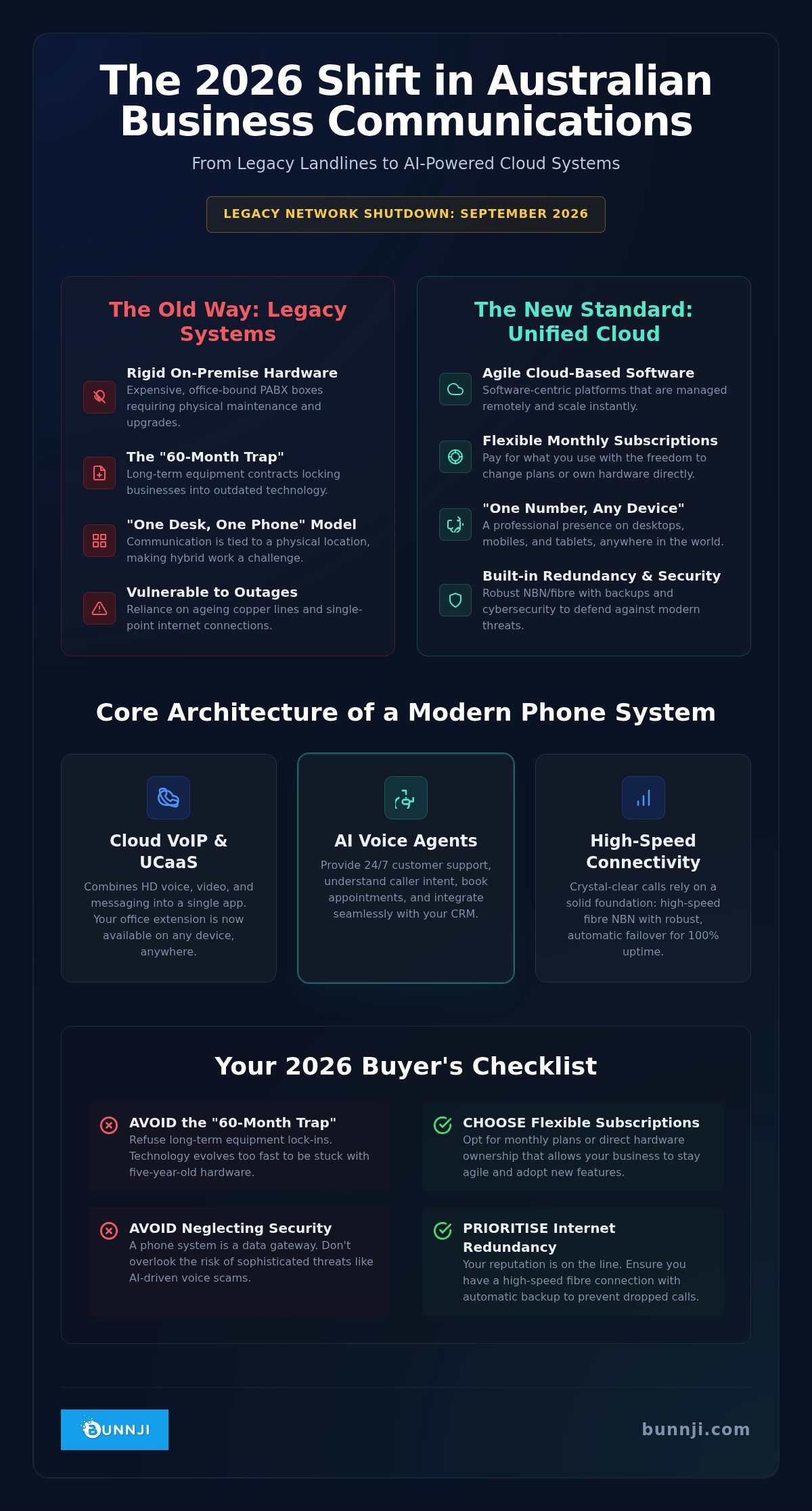
- Avoid the "60-month trap" by opting for flexible monthly subscriptions or direct hardware ownership rather than long-term equipment lock-ins.
- Integrate your communications with your broader cybersecurity strategy to defend against sophisticated 2026 threats like AI-driven voice scams.
The Evolution of Professional Business Phone Systems in 2026
The office desk phone is no longer the heart of the Australian workplace. In 2026, professional business phone systems have transformed from heavy hardware boxes into agile, software-centric Unified Communications (UC) platforms. We've moved beyond the era of the on-premise PABX. Today, your phone system lives in the cloud, allowing your team to maintain a professional presence whether they're in a boardroom or a home office. This transition represents a fundamental shift in how we define connectivity, moving away from physical wires toward a flexible, identity-based communication model.
The history of business telephone systems shows a steady march toward digitisation, but 2026 marks the final tipping point. With the national legacy network shutdowns now complete as of September 2026, the shift to Cloud VoIP isn't just a preference; it's a necessity for survival. Australian firms are ditching the "one desk, one phone" model in favour of a "one number, any device" philosophy. This shift ensures that every call is handled by a professional AI layer before it even reaches a human, setting a high standard for customer service that legacy systems simply cannot match.
Why Traditional Landlines Are No Longer Fit for Purpose
Legacy copper lines are an anchor on growth. They tie your staff to physical locations, making hybrid work a logistical nightmare. Maintaining this outdated infrastructure is also a drain on resources. You're paying for fixed-capacity lines that don't scale when your team expands. Scaling professional business phone systems used to require physical hardware upgrades and site visits, but now it's a simple dashboard toggle. In a market where speed is everything, waiting weeks for a technician to patch a physical line is simply unacceptable for a modern firm.
The Rise of Unified Communications as a Service (UCaaS)
Modern UCaaS platforms have consolidated your entire communication stack. Voice calls, video conferencing, and instant messaging now exist within a single application on your desktop or mobile. Softphones have replaced the need for expensive handsets for many remote workers, allowing them to take their office extension anywhere in the world. This integration is vital for Australian firms managing teams across multiple time zones or field locations. It allows for instant collaboration and ensures that your internal data remains secure within a managed ecosystem. By 2026, AI has become the baseline for professional call handling, moving from a luxury add-on to a standard tool that manages initial customer interactions with precision. By moving to a unified model, you eliminate the friction of switching between apps, allowing your team to focus on the conversation rather than the technology.
Modern Architecture: Cloud VoIP, SIP Trunking, and AI Voice Agents
Modern professional business phone systems are no longer just about making calls; they are complex ecosystems that blend connectivity with intelligence. Cloud VoIP serves as the foundation. It converts your voice into data packets and transmits them over your business NBN or fibre connection. The result is HD voice quality that surpasses old analogue lines. Because it’s cloud-based, you don't need a server room full of hardware. Everything is managed through a secure data centre, giving you the freedom to scale up during peak seasons without a technician visit.
AI Receptionists: More Than Just an Automated Menu
The "press one for sales" era is fading. Modern AI receptionists use natural language processing to understand caller intent immediately. They don't just route calls; they solve problems. An AI agent can check your availability and book an appointment directly into your calendar while you’re asleep. By syncing these interactions with your CRM, your team has a complete history of the conversation before they even pick up the handset. AI receptionists effectively eliminate the cost of missed calls by ensuring every customer is greeted and helped instantly, 24/7. If you're curious about how this fits your workflow, you can explore how AI receptionists are changing the way Australian businesses answer calls.
SIP Trunking: The Bridge Between Old and New
Not every firm is ready to bin their physical handsets. SIP trunking provides a vital middle ground. It allows your legacy PABX system to communicate over the internet rather than old ISDN lines. This transition is essential for businesses looking to reduce overheads while maintaining their existing investment in hardware. Moving to SIP often results in immediate cost savings because you’re no longer paying for unused physical lines. It offers immense flexibility. You can add or remove "virtual lines" instantly as your call volume fluctuates. When reviewing your options, it's helpful to consult general FCC compliance guides to understand the broader standards for telecommunications reliability and security.
The true power of 2026 architecture lies in integration. When your phone system talks to your CRM, customer service becomes personal. Your staff see the caller’s name, purchase history, and previous tickets the moment the phone rings. This data-driven approach reduces friction and builds trust. It turns a simple phone call into a strategic touchpoint. Choosing a partner who understands these technical layers ensures your professional business phone systems work for you, not against you.
The Critical Foundation: Why Internet Redundancy Is Non-Negotiable
Modern professional business phone systems are entirely internet-dependent. Unlike the old copper lines that carried their own power and signal, VoIP packets require a stable, high-speed data stream to function. If your office internet goes down, your phones go dark. This vulnerability is why we argue that your communication strategy is only as robust as the connection it runs on. Relying on a single point of failure is a risk no modern firm should take. It doesn't matter how sophisticated your features are if your customers can't reach you.
Business NBN vs. Dedicated Fibre Upgrades
Standard residential NBN plans often suffer from variable speeds and high contention ratios. For a home, a slight lag in a video stream is a nuisance; for a business, it results in jittery, unprofessional voice calls. Dedicated Fibre upgrades provide symmetrical upload and download speeds, ensuring your outbound voice traffic isn't competing with large file uploads. Low latency is the secret to crystal-clear call quality. Without it, you will experience annoying delays and echo. For a deeper look at optimising your setup, refer to our Business VoIP Australia Strategy Guide.
Disaster Recovery: Keeping the Lines Open During Outages
True redundancy requires more than just a fast primary line. It demands an automatic failover system. If a local construction crew accidentally cuts your fibre line, a professional setup should instantly switch to a 4G or 5G mobile backup. Your staff might not even notice the transition. Because modern professional business phone systems are cloud-based, routing can also be handled at the network level. This means if your physical office loses power entirely, your calls can be automatically diverted to mobile apps or an AI voice agent. This ensures your customer service remains uninterrupted regardless of local infrastructure issues.
We specialise in building these dual-path connections to give Australian business owners total peace of mind. We don't just provide a phone system; we secure your ability to stay reachable. It is about removing the anxiety of "what if" and replacing it with a resilient, always-on infrastructure. A professional image is built on reliability. Ensuring your internet foundation is rock-solid is the first step toward that goal. Without redundancy, you are simply waiting for an outage to happen.
The 2026 Buyer’s Checklist: Avoiding Contract Traps and Hidden Costs
Many Australian business owners sign up for what they think are competitive professional business phone systems, only to find themselves shackled to 60-month equipment contracts. In the fast-moving tech world of 2026, a five-year lock-in is an eternity. These agreements often bundle hardware leases with service fees, making it nearly impossible to switch providers if service quality drops. You should always aim to own your hardware outright or use a flexible monthly subscription model that allows for agility as your team grows or changes.
A professional telecommunications audit is the first step to reclaiming your budget. It often uncovers "ghost" services, which are billings for lines or features that were technically disconnected years ago but still appear on your monthly statement. By identifying these inefficiencies, firms can often fund their entire upgrade to a modern cloud platform simply by eliminating waste. Before you change providers, ask these critical questions: Who owns the hardware? Is there a local support team? What are the specific porting timelines for your existing numbers?
Number Porting and Ownership: Don’t Get Held Ransom
Porting is the process of moving your existing phone numbers to a new provider. In Australia, you have a legal right to keep your number, but some predatory contracts use complex administrative barriers to slow down the move. Before signing anything, verify that you retain full ownership of your numbers. Confirm the numbers are registered to your ABN and ask for a written guarantee that no "port-out" fees apply. If a provider makes it difficult to leave, they're usually hiding a lack of service quality behind a wall of bureaucracy.
The Hidden Cost of "Free" Hardware
The promise of "free" handsets is a classic marketing lure. These devices are usually paid for three times over through inflated line rentals and service charges hidden in the fine print. Modern firms are moving toward SIM-only or BYO device professional plans to stay lean. This approach allows you to use your existing smartphones or high-quality headsets without the baggage of a long-term lease. For a detailed breakdown of these options, check out our Business Mobile SIM Only Plans Guide.
Choosing the right partner is about more than just the monthly price per user. It is about transparency and the freedom to evolve. If you're unsure where your current contract stands, we can help you find the exits. Request a professional telecommunications audit today to uncover hidden costs and reclaim your flexibility.
Future-Proofing Your Firm with an Integrated Communication Strategy
The convergence of communication and technology is now absolute. Your phone system is no longer a separate utility; it's a critical component of your digital infrastructure. In 2026, professional business phone systems must be integrated with your IT support and cybersecurity protocols. This holistic approach ensures that your data stays protected while your team stays connected. By managing the entire stack, including Voice, Internet, and Security, we remove the friction of dealing with multiple vendors who often point fingers at each other when technical issues arise. It's about creating a single, reliable point of contact for your entire operation.
Cybersecurity: Protecting Your Voice Network
Voice networks have become a primary target for sophisticated social engineering. AI-driven voice scams can now mimic the voices of staff members with alarming accuracy, making traditional security training insufficient. Modern professional business phone systems use advanced filtering to identify and block these threats before they reach your handsets. This proactive defence aligns with broader national efforts, such as the SMS Sender ID Register launched in July 2026, to secure Australian communications. Encrypted VoIP is a non-negotiable standard for firms handling sensitive client data, ensuring that conversations remain private. A managed firewall acts as a vital barrier, protecting your communication platform from unauthorised external access.
The 2030 Outlook: Where Are Phone Systems Heading?
Looking toward the end of the decade, the distinction between "calling" and "workflow" will vanish entirely. We expect to see total integration where AI Voice Agents manage complex business processes, from initial enquiry to final invoice. These agents won't just answer questions; they will execute tasks within your CRM and project management tools in real-time. This level of automation will allow Australian firms to operate with unprecedented efficiency, regardless of their size. It turns your communication platform into a revenue-generating asset rather than just a monthly overhead.
The first step toward this integrated future is understanding where you stand today. Most businesses are overpaying for fragmented services that leave them vulnerable to outages and attacks. We specialise in simplifying this complexity and finding the hidden costs that legacy providers often hide. Contact Bunnji for a comprehensive telco audit today. A 10-minute review of your current setup can uncover significant savings and security gaps, ensuring your firm is ready for 2026 and beyond.
Take Command of Your Communication Strategy
The shift to professional business phone systems in 2026 is a strategic move that places your firm ahead of the curve. By integrating AI voice agents and prioritising robust internet redundancy, you ensure that your business stays reachable even during local network outages. It's about replacing rigid, expensive legacy hardware with agile cloud platforms that scale alongside your team. You've learned how to spot predatory contract traps and why a unified, software-centric approach is the only way to stay competitive in the current Australian market.
You don't have to navigate this transition alone. Our expert Australian-based support team specialises in AI voice agents and seamless CRM integration to streamline your daily workflows. We provide transparent pricing with no 60-month contract traps, giving you the freedom to evolve as your needs change. It is time to reclaim your communication budget and build a resilient foundation for your firm's future.
Book Your Free 10-Minute Telecommunications Audit with Bunnji today to uncover hidden costs and modernise your connectivity. Your path to a smarter, more reliable phone system starts with a single conversation.
Frequently Asked Questions
How much does a professional business phone system cost in Australia?
Market pricing for professional business phone systems in 2026 typically ranges between A$20 and A$60 per user, per month. Basic plans usually exclude advanced features like call analytics, recording, and AI integration. For a comprehensive cloud platform including AI voice agents and CRM syncing, you should expect to pay between A$28 and A$45 per user. These rates generally exclude GST and initial hardware costs if you choose to purchase new handsets for your office.
Can I keep my existing business phone number when I switch to VoIP?
Yes, you can keep your existing numbers through a process called porting. Under ACMA regulations, Australian businesses have the right to move their local, 1300, and 1800 numbers between providers. It's essential to verify that your current contract doesn't contain predatory port-out fees or administrative hurdles designed to hold your number hostage. We handle the technical migration to ensure your service remains active during the transition to a modern cloud platform.
What is the difference between a cloud phone system and a traditional PABX?
The primary difference lies in the location and management of the hardware. A traditional PABX requires a physical server box on your premises, which is expensive to maintain and difficult to scale. In contrast, a cloud system is hosted in secure data centres and managed via software. This allows your team to answer calls on any device, anywhere, without needing a technician to patch physical lines or upgrade local server capacity as your firm grows.
Do I need a special internet connection for a cloud phone system?
While a standard NBN connection can support VoIP, a dedicated Business NBN or Fibre connection is highly recommended for professional quality. These business-grade plans offer symmetrical upload and download speeds, which prevent your voice traffic from competing with large file transfers. This stability is crucial for maintaining low latency and preventing jitter. A robust connection ensures that your professional business phone systems deliver the crystal-clear audio quality your clients expect from a reputable firm.
Are AI receptionists actually effective for small Australian businesses?
AI receptionists are highly effective for small firms because they provide 24/7 coverage without the overhead of a full-time staff member. Modern AI agents use natural language processing to understand caller intent, allowing them to book appointments directly into your calendar or update client records in your CRM. This automation ensures you never miss a high-value lead after hours. It allows your human staff to focus on complex tasks while the AI handles routine enquiries and routing.
What happens to my phone system if the office internet goes down?
If you have a redundant connection, your system will automatically switch to a 4G or 5G mobile backup within seconds. Because cloud systems are hosted off-site, your calls aren't tied to your physical office. If your local power or internet fails entirely, calls can be instantly diverted to your team's mobile apps or an external AI voice agent. This disaster recovery capability ensures that your customer service remains uninterrupted regardless of local infrastructure issues or accidental line cuts.
Is it better to use Microsoft Teams or a dedicated VoIP system for calls?
The choice depends on your specific communication needs. Microsoft Teams is excellent for internal collaboration, but a dedicated VoIP system often provides more robust telephony features like advanced call queuing, detailed analytics, and deeper CRM integrations. Many Australian firms now opt for a hybrid approach, using SIP trunking to bring professional voice capabilities into their Teams environment. This gives you the familiarity of the Teams interface with the reliability and advanced routing of a specialised business phone platform.
How long does it take to set up a new professional phone system?
Setting up the cloud environment and mobile apps can often be completed within a few business days. The longest part of the process is usually porting your existing numbers from your old provider, which typically takes between two and four weeks depending on the complexity of your current setup. If you're using new numbers, you can often be up and running within 24 to 48 hours. We manage the entire timeline to ensure there's no downtime for your business.


