

Traditional copper networks are effectively a relic; with major global carriers planning a total retirement by 2029, the era of the physical desk phone is over. You've likely realised that the high cost of standard international dialling is only half the problem. The real growth killer is the "overseas" stigma. When a prospect in London or New York sees a foreign code on their screen, they rarely pick up. It's a friction point that stalls expansion before the first conversation even begins.
Securing international voip numbers for business allows you to bypass this distrust by establishing a local presence in seconds. We'll show you how to manage global enquiries from your Australian office while maintaining a professional, "on-the-ground" image. This guide covers everything from 2026 regulatory shifts to integrating call data directly into your CRM. You'll discover how to slash communication costs by up to 75% and use AI voice agents to ensure you never miss a lead, regardless of the time zone. We're moving from identifying your global requirements to explaining the specialised approach needed to dominate foreign markets from home.
Key Takeaways
- Harness "digital proximity" to increase your call answer rates by using local area codes that build immediate trust with global prospects.
- Distinguish between geographic, toll-free, and universal numbers to meet specific regional regulations and customer expectations.
- Deploy international voip numbers for business to create a seamless global footprint while maintaining all operations from your Australian office.
- Solve the time zone challenge with AI-driven voice agents that capture leads and sync with your CRM while your local team is offline.
- Ensure call stability by pairing your global voice strategy with business-grade fibre and a local partner who understands Australian market conditions.
The Strategic Advantage of International VoIP Numbers
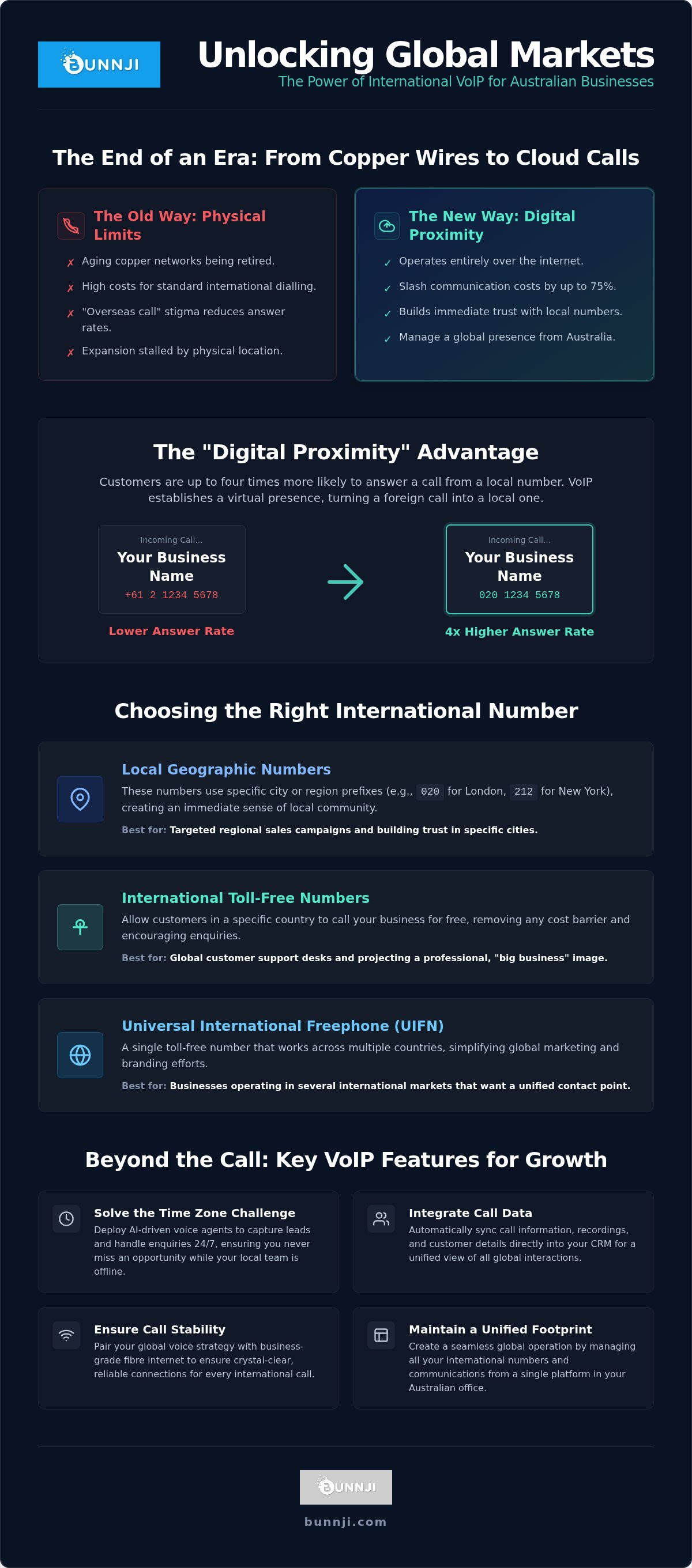
In a world where physical borders are becoming secondary to digital reach, international voip numbers for business serve as your virtual identity. Unlike traditional landlines, these numbers bypass the aging copper infrastructure that carriers are currently decommissioning. They operate entirely over the internet, allowing your Australian team to answer calls as if they were sitting in a London or Auckland office. For a deeper technical overview of VoIP, it's helpful to understand that these systems convert voice into data packets. This enables global connectivity without the need for international hardware or expensive local telephone contracts.
We call this concept "Digital Proximity." Data suggests customers are up to four times more likely to answer a call from a local area code than an unrecognised international number. For Australian exporters, this is a game changer. You can maintain a unified global identity while avoiding the massive overheads of physical international branches. Renting a virtual presence in New York or Singapore costs a fraction of a physical lease, yet the perceived authority is identical. It isn't just about saving on rent; you're also avoiding the legal complexities of foreign business registration while testing new markets with almost zero risk.
Building Trust in Foreign Markets
Local numbers act as a psychological bridge. They immediately strip away the "overseas call" stigma that often flags a business as high-risk or difficult to reach. If you're targeting markets in the UK, US, or NZ, you can establish a professional presence instantly. It's about consistency. When your website, email signature, and caller ID all reflect a local presence, you move from being a foreign vendor to a local partner. This reliability is central to long-term growth. It signals that you're committed to their region and suggests that support is always within reach.
Reducing Friction for Your Global Customers
Friction is the enemy of conversion. If a potential client in London has to check international dialling codes or worry about their own phone bill just to ask a question, they'll likely move to a competitor. By providing a local geographic or toll-free number, you remove the cost barrier for them. This simplicity encourages more frequent communication and builds loyalty.
- Local Geographic Numbers: These provide a sense of community and local presence in specific cities.
- Toll-Free Numbers: These project a "big business" image and encourage enquiries by making the call free for the dialler.
- Familiar Formats: Using standard local formatting ensures your number looks "right" on a business card or advert.
Managing these numbers from a single Australian platform ensures your team stays efficient. You get the benefits of a global footprint without the technical complexity of routing calls through multiple foreign providers.
Types of International Business Numbers: A Comparison
Selecting the right international voip numbers for business is about more than just picking a prefix. It's a strategic decision that impacts your brand's perceived location and its regulatory compliance. Different regions have vastly different rules enforced by their local telecommunications organisation. For instance, while some countries allow instant activation, others require proof of local residency or a physical address before a number is issued. This is why a U.S. regulatory view on VoIP is essential to understand if you're targeting North American markets, as requirements for address verification can be stricter than in other regions. Understanding these nuances ensures your global expansion doesn't hit a bureaucratic wall.
Local Geographic Numbers
Geographic numbers use specific city prefixes, such as a 020 for London or a 212 for New York. These are perfect for targeted regional sales pushes because they create an immediate sense of local presence. When a prospect sees a familiar area code, the psychological barrier to answering drops significantly. Setup times for these numbers are usually fast, often taking only a few minutes unless local documentation is required by law. If you're unsure which region to target first, a telecommunications audit can help clarify where your current traffic originates and where a local number would have the most impact.
International Toll-Free and UIFN
Toll-free numbers allow customers to call you without incurring charges, which is ideal for global support desks. You can choose between country-specific toll-free numbers or a Universal International Freephone Number (UIFN). A UIFN is a single number that works across multiple participating countries simultaneously. While UIFNs offer a cleaner brand image for global campaigns, they often involve higher setup fees and more complex registration processes than standard toll-free options. They're best suited for established brands that need a single point of contact for a worldwide audience.
Inbound traffic costs are typically distinct from outbound rates. Most providers charge a small monthly fee for the number itself, plus a per-minute rate for incoming calls. Conversely, outbound calls made from your Australian office to a foreign destination are billed based on that specific country's VoIP rates. For industries like logistics or retail that rely on SMS, virtual mobile numbers offer a distinct advantage. They enable two-way messaging, allowing you to manage global enquiries via text without needing a local physical presence or a drawer full of SIM cards. This flexibility allows you to scale your communication infrastructure as quickly as your market share grows.
Technical Essentials: Ensuring Crystal-Clear Global Voice
Distance is the silent enemy of voice quality. When you deploy international voip numbers for business, your voice data travels tens of thousands of kilometres across subsea cables before reaching your client. This physical journey can introduce latency, which is the audible delay between speaking and being heard. To manage this, business-grade fibre is non-negotiable. Unlike standard residential connections, business-grade fibre provides the symmetric speeds and stability required to ensure voice packets aren't dropped or delayed. SIP trunking serves as the modern bridge for this data, allowing you to link your current office infrastructure to global cloud networks without a total hardware overhaul.
Reliability also depends on following global standards. While you manage your Australian operations, your provider must navigate complex international frameworks. These include protocols similar to those found in the FCC VoIP Regulations, which govern how traffic is handled and how emergency services are integrated. Ensuring your technical foundation is sound prevents the "choppy" audio that often plagues cheap, off-the-shelf international calling solutions.
Managing Latency and Jitter
Voice quality depends on more than just raw speed. Jitter occurs when data packets arrive out of order, making a caller sound robotic or distorted. Bunnji's network optimises routing by selecting the most direct path for your data, bypassing congested public internet nodes. We also implement "Quality of Service" (QoS) settings on your office router. This technical configuration instructs your network to prioritise voice traffic over less urgent data, such as software updates or large file downloads. It ensures that even during peak office hours, your global conversations remain fluid and professional.
Redundancy: The Global Business Safety Net
An internet outage is a local problem that can have global consequences. If your primary NBN connection fails during the Australian business day, your overseas branch effectively disappears for your customers. For any firm relying on international voip numbers for business, a single point of failure is an unacceptable risk. You need a robust strategy for internet redundancy: protecting your firm from outages to maintain your global presence. This involves secondary fibre links or a high-speed 5G failover that activates automatically the moment a disruption is detected. This seamless transition ensures your international lines stay open, protecting your brand's reputation for being present and responsive regardless of local infrastructure hiccups.
Managing Time Zones with AI and Unified Comms
Australian firms face a distinct geographic challenge. When it's 10 AM in New York, it's the middle of the night for your local team. If you've invested in international voip numbers for business, you need a strategy for those out-of-hours enquiries. Relying on a simple voicemail often leads to "ghosting" by global prospects who expect immediate engagement. Unified Communications (UC) addresses the physical side of this problem by allowing you to take calls on any device, whether it's your mobile, laptop, or a traditional desk phone. The real solution lies in combining these numbers with AI and CRM intelligence to bridge the time gap while you sleep.
AI Voice Agents as Your Global Front Desk
AI receptionists have evolved far beyond basic automated menus. They now function as capable agents that can qualify leads while your Australian office is closed. This shift is part of a broader trend where conversational AI is expected to reduce contact centre labour costs by $80 billion by the end of 2026. These agents understand natural language and can distinguish between a high-value sales enquiry and a general support question. By booking discovery calls directly into your team's calendar across different time zones, they ensure that the momentum of a sales cycle isn't lost. You can explore the full impact in our AI Voice Agents: 2026 Trend Report for Australian Firms.
CRM Integration for Global Context
Context is the key to building trust in foreign markets. Integrating your international voip numbers for business with platforms like Salesforce or HubSpot provides your team with instant visibility. When an international call arrives, the system automatically surfaces the customer's history, previous enquiries, and open tickets. This allows your staff to skip the introductory hurdles and provide a bespoke service from the first second. It makes your Australian operation feel like a local powerhouse to the person on the other end of the line.
Automatic call logging and transcription further support this workflow. If an AI agent handles a call at 3 AM local time, the transcript is ready for your team the moment they start their day. This visibility ensures that follow-up tasks are created automatically, reducing the risk of human error. It creates a seamless loop between your global voice presence and your local sales pipeline. If you want to understand how to bridge these technical layers, you should explore our cloud phone systems to see these integrations in action. This approach moves your business from being reactive to being a proactive global player.
Choosing Your Global Voice Partner in Australia
Selecting a provider for international voip numbers for business isn't just a procurement task; it's a strategic partnership. While global giants offer scale, they often lack the granular understanding of the Australian market and the specific challenges of our geographic isolation. Having a local partner means your support team works when you do. If a routing issue occurs during your peak morning period, you need an expert who is already at their desk in your time zone, not a support ticket that won't be seen for another eight hours. This local accountability is what ensures your global operations remain stable and responsive.
Bunnji’s approach focuses on bespoke architecture rather than rigid, off-the-shelf packages. We recognise that a one-size-fits-all model rarely accounts for the complexity of global trade. We combine global voice services with managed IT and cybersecurity to protect your firm from emerging threats. Since your business phone system is increasingly becoming an AI platform, it's also a potential target for data breaches. Securing your international comms within a broader managed IT framework provides the peace of mind that a simple "number-only" provider cannot offer.
Beyond the Number: The Managed Service Advantage
A managed service provider does more than just switch on a line. We begin with a comprehensive telecommunications audit to identify inefficiencies in your current setup. Many Australian firms discover they're paying for redundant international trunks or losing money on poorly routed calls. This audit also ensures you remain compliant with both ACMA regulations and international data laws, such as GDPR or the 2026 Dutch telemarketing updates. It's about building a foundation that scales without creating technical debt or legal risk.
Next Steps for Your Global Expansion
Transitioning to a global model doesn't have to be disruptive. You can port your existing numbers or secure new geographic prefixes in minutes. We recommend setting up a trial to test latency and the performance of your AI voice agents before a full-scale rollout. This allows you to fine-tune your response scripts and ensure the customer experience is flawless. Once you've verified the stability of the connection, you can expand into new territories with total confidence. The technology is sophisticated, but the transition should feel simple and supported.
Ready to optimise your global reach? The first step is understanding exactly where your current system is falling short. You should Organise a Bunnji Telecommunications Audit today to map out a clear path for your 2026 expansion. We'll help you navigate the technical and regulatory hurdles so you can focus on growing your business from your local Australian base.
Scaling Your Global Reach from Australia
The transition to a global footprint no longer requires a physical presence in every market. By leveraging international voip numbers for business, you can establish digital proximity and build immediate trust with customers in the UK, US, or NZ. We've explored how technical stability through business-grade fibre and internet redundancy ensures your voice remains clear across oceans. Integrating AI voice agents with your CRM allows you to capture leads at 3 AM AEST without missing a beat.
Success in 2026 depends on choosing a partner that understands the Australian landscape while delivering world-class infrastructure. Bunnji specialises in protecting your continuity with redundant links and providing expert telecommunications audits to strip away hidden costs. It's about removing the friction of global expansion so you can focus on your core mission.
Ready to take your business to the world stage? Explore Bunnji’s Global Voice Solutions to see how our bespoke cloud systems can transform your international operations. The global market is waiting; let's ensure you're ready to answer the call.
Frequently Asked Questions
Can I keep my existing Australian number while adding international ones?
Yes, you can absolutely keep your existing Australian number while adding global ones. Our cloud systems allow you to manage multiple numbers from a single interface. You can port your current business number to our platform or simply run it alongside your new international lines. This ensures your local customers can still reach you on the number they know, while your global prospects see a local prefix that they trust.
Do I need a physical office in a country to get a local VoIP number there?
No, you don't need a physical office to secure a local number in most countries. VoIP technology allows you to establish a virtual presence anywhere with an internet connection. It's important to note that some regions have specific "Know Your Customer" regulations that require proof of a business address or local representative. We help you navigate these bureaucratic hurdles to ensure your global expansion remains compliant and uninterrupted.
How does an international VoIP number affect my business call costs?
Switching to international voip numbers for business typically slashes communication costs significantly. Research indicates that businesses often save between 50% and 75% after moving away from traditional international carriers. You'll avoid the exorbitant per-minute rates associated with legacy copper lines. Instead, you pay a small monthly fee for the number and benefit from competitive data-based calling rates, making global outreach a predictable and manageable operational expense.
What is the difference between a virtual number and a traditional phone line?
Traditional phone lines rely on physical copper infrastructure and are tied to a specific location. Virtual numbers exist in the cloud and function as a software-based identity. This means you aren't tethered to a desk. You can answer calls on your mobile, laptop, or tablet from anywhere in Australia. It provides the flexibility to scale your global operations without the need for expensive hardware installations or long-term equipment contracts.
Can my international VoIP number receive SMS from overseas customers?
Many virtual numbers are fully equipped to receive and send SMS from overseas customers. This capability is vital for modern businesses that rely on two-way messaging for appointment confirmations or quick customer enquiries. You can manage these global text conversations through your unified communications app, ensuring all customer touchpoints are logged in one place. It's an efficient way to maintain high engagement levels across different time zones without using personal mobile numbers.
How do I ensure call quality remains high for customers in different continents?
High call quality is guaranteed by using business-grade fibre and prioritising voice traffic. We implement Quality of Service settings on your office router to ensure voice data packets always take precedence over standard internet usage. This prevents the lag and jitter that can occur on residential-grade connections. By using a network that optimises routing paths, your conversations with clients in Europe or North America will sound as clear as a local call.
Are there specific legal requirements for business numbers in the US or UK?
Yes, different regions have specific legal frameworks you must follow. For example, the United States has strict FCC requirements for address verification and emergency service routing. Similarly, European nations often require specific documentation to prevent the misuse of local prefixes. We specialise in helping Australian firms navigate these international regulations. This ensures your international voip numbers for business are fully registered and protected against sudden regulatory shutdowns or compliance audits.
How quickly can an international VoIP number be set up for my business?
Most international numbers can be provisioned and ready for use in just a few minutes. The setup process is remarkably fast compared to traditional telephony. If you're targeting a region with strict verification laws, the process might take a few business days while your documentation is reviewed by local authorities. We handle the technical heavy lifting, so you can focus on launching your global marketing campaigns and answering your first international enquiries.


