

The advertised monthly rate can be the least revealing part of a telecoms offer. The hidden costs of telecommunication contracts may sit in equipment repayments, minimum spend commitments, add-on charges or exit terms that only become clear when you read beyond the quote. If your phone, mobile and internet services are bundled, it can be harder to see what you’re paying for, or what you might owe if you switch.
That uncertainty is understandable. A long commitment or unclear fee can make renewing feel easier than checking whether the arrangement still suits your business. Comparing the full cost and service obligations before you sign can help you make a more informed decision.
This guide explains what to check in a current or proposed contract, how to compare providers on a consistent basis, and what to consider before changing services. Look at notice periods, equipment liabilities and number porting alongside the monthly charge, so you can plan a transition with business continuity in mind.
Key Takeaways
- Check recurring charges, one-off fees, conditional costs and switching risks to understand the value of a telecoms offer.
- Assess the hidden costs of telecommunication contracts across the full commitment, not just the advertised monthly rate.
- Compare providers fairly by matching services, inclusions, contract terms and support to your business needs.
- Map each phone, mobile and internet service to its users, purpose, renewal date and operational dependencies before making changes.
- Balance flexibility, equipment commitments and service fit, then plan a transition that protects business continuity and important numbers.
Hidden costs of telecommunication contracts: what the headline offer leaves out
The hidden costs of telecommunication contracts are charges, obligations or operational impacts that are easy to overlook in a sales quote. Some appear on invoices. Others only become clear when your business changes provider, needs extra capacity or discovers that a service depends on equipment or connectivity that is difficult to replace.
A low advertised rate shows only part of the picture. Check the agreement for four types of commitment:
- Recurring charges: ongoing service fees, equipment rental or support charges.
- One-off charges: setup, activation, configuration, delivery or installation fees, where applicable.
- Conditional costs: charges that may apply if you exceed usage limits, make international calls, use out-of-bundle services or end the agreement early. Check the exact triggers and amounts in the contract.
- Non-financial switching risks: disruption to calls or internet, number-porting complications, and time spent coordinating providers or replacing equipment.
Total contract cost includes recurring charges across the agreed term, applicable one-off and usage charges, equipment commitments, and costs that may apply if you change or end the service. This is a more useful basis for comparison than the monthly rate alone. Consider operational risks separately, since they may affect continuity even when they don’t appear as a fee.
Which charges and obligations deserve a closer look?
Read the service schedule and equipment terms, not just the proposal. Confirm whether devices are rented, paid off over time or included in another charge. Check who owns them at the end of the term, whether maintenance is included, and what happens if you cancel before equipment payments are complete.
Then check usage limits and out-of-bundle conditions. “Included” or “unlimited” may not cover every call type or destination, so clarify how international calls, excess use and other excluded services are treated. Ask the provider to identify applicable setup or delivery charges in writing.
Why bundled business services can hide the real commitment
A single proposal may combine phone, mobile, internet and support, but that doesn’t mean every service has the same contract term or renewal date. Check each service’s start and end dates, notice requirements and exit conditions. Ask what remains in place if you cancel or change one part of the bundle.
Map service dependencies as well. Your cloud phone system may rely on a particular internet connection, supplied router or third-party service. Confirm what support covers and which performance commitments are documented in the Service-Level Agreement (SLA). For more context on phone-system choices and planning, see the Business VoIP Australia strategy guide.
How telecom contract costs build up over the full term
A useful comparison looks beyond the recurring service charge. Add applicable charges at the start, likely usage costs, equipment payments and obligations that could apply if you leave early. This gives you a clearer view of the full agreement, rather than a snapshot of one month.
A monthly rate only makes sense in the context of the contract term: the same rate represents a different total commitment over a shorter or longer agreement. A longer term can also affect how you assess an incentive or the value of included equipment. Compare the contract duration with how long you expect to need the service or equipment, and check whether leaving early creates an outstanding obligation.
Recurring charges, usage conditions and equipment commitments
Compare what the service charge covers, including call allowances, data limits, fair-use conditions and services billed separately. Establish whether equipment is purchased, financed, rented or subject to return conditions. Don’t assume that equipment described as included is yours to keep at the end of the agreement. Check maintenance responsibilities, scheduled price changes and review clauses, and ask how they work in practice.
For example, one offer may have a lower monthly charge but separate setup costs, limited included usage and equipment payments. Another may have a higher service charge, more included usage and different equipment terms. Record each applicable cost for both offers, based on your expected use and the full term. This makes the trade-offs visible without relying on the headline rate.
Early exit, renewal and number-porting conditions
Before deciding, find the notice requirements, renewal date and termination formula in the contract. Check whether leaving early could leave equipment payments or other commitments outstanding. Don’t assume separate services in a bundle share one renewal date or exit process. The Australian Communications and Media Authority’s guide to understanding your telco contract is a useful reference when reviewing fees and terms.
Business numbers matter too. Confirm who controls each number, what the current provider requires to release or port it, and how the process could affect continuity. Check the provider’s current terms rather than relying on assumptions. If you’re assessing mobile commitments, the business mobile SIM-only buyer’s guide offers relevant comparison context.
To bring service, equipment and exit obligations into one view, consider a telecommunications audit before renewal or migration.
Compare telecommunications contracts beyond the monthly rate
A fair comparison starts with the same requirements for every provider. If one proposal covers more users, calls or support than another, the headline rates won’t show which offers better value. Use a shared checklist, then assess the financial commitment separately from service quality and business-continuity risks.
The hidden costs of telecommunication contracts are easier to identify when every offer is tested against the same service needs, exclusions and end-of-term obligations. Ask providers to explain their assumptions in writing before you compare proposals.
A like-for-like checklist for provider proposals
Record what each offer includes for users, phone numbers, devices, calling patterns, mobile data, internet connectivity and support. Capture fees and commitments alongside the service description. A comparison table can keep the details clear:
| Compare | Record for each proposal |
|---|---|
| Scope | Users, numbers, devices, call needs, data and connection type |
| Terms | Contract duration, renewal date, notice requirements and exit conditions |
| Inclusions | Allowances, support scope, equipment and any service-level commitments |
| Exclusions | Usage limits, separately charged services and responsibilities left to your business |
| Commitments | Setup and recurring charges, conditional fees, equipment terms and end-of-term obligations |
Not every factor is a dollar amount. Compare measurable charges and commitments in one view, then assess service quality, support accountability, resilience and fit with your workflows separately. You can rate each area against your own priorities, noting the evidence behind each rating instead of relying on headline claims.
When bundled, separate or cloud-based services may suit
A bundle can simplify billing, but it isn’t automatically cheaper or more suitable. Check whether phone, mobile, internet and support share terms, and who is responsible if a connected service has a problem. Separate services may offer more choice, but can mean coordinating multiple providers. Weigh flexibility and ownership against the clarity of having one accountable contact.
Match the phone technology to your setup. Cloud VoIP may suit a business seeking a hosted phone system. SIP trunking may be relevant if you need to connect compatible existing phone equipment to IP voice services. Confirm compatibility and support responsibilities before comparing offers. If you don’t need a handset included or financed, assess SIM-only mobile plans separately so equipment terms don’t obscure the mobile service comparison.
Choose based on total commitment, exit flexibility, resilience and operational fit, not the bundle label or monthly rate alone.
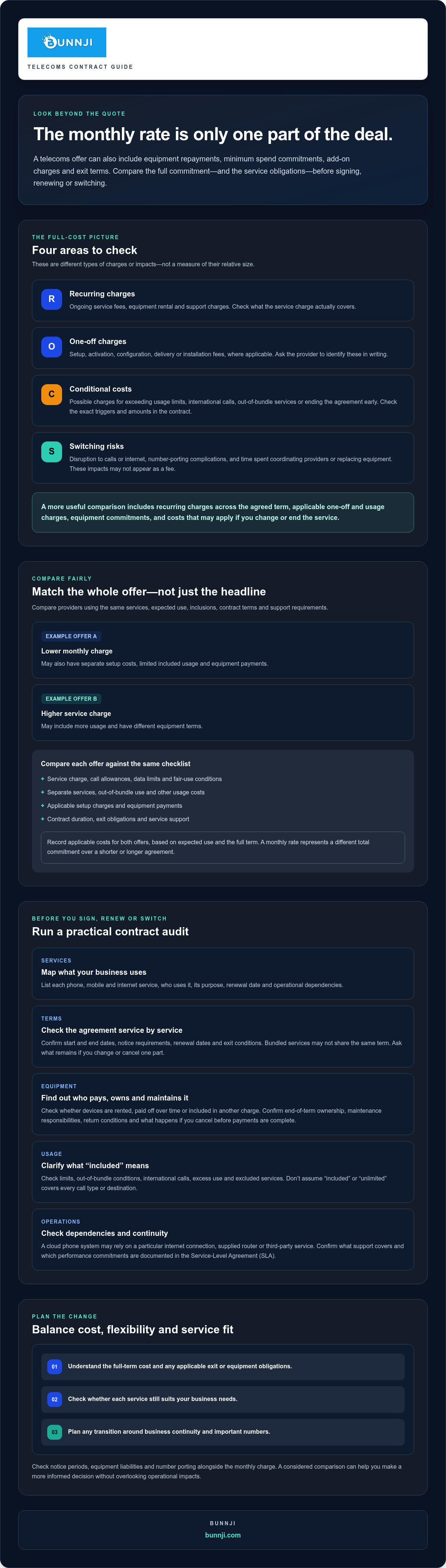
Audit a telecom contract before signing, renewing or switching
A structured audit can turn a stack of documents and invoices into a clear picture of what your business uses, owes and relies on. It can also surface the hidden costs of telecommunication contracts before you commit to a renewal or migration. Work through these steps with the people responsible for finance, operations and IT.
- Gather the records. Collect signed contracts, current invoices, service schedules, variations, equipment records and written promises or clarifications from the provider.
- Match invoices to agreements. Trace each invoice line to a contract term or service schedule. Flag unexplained charges, inactive services, duplicate lines and features no one uses.
- Map every service. Record its provider, internal owner, users, business purpose, renewal date and dependencies. Include phone, mobile, internet and support services, even if they appear on different bills.
- Check equipment and commitments. Note what equipment is in use, who owns it, any remaining payments and any return conditions. Mark unclear fees or terms for follow-up rather than assuming what they mean.
- Set decision dates. Add renewal and notice dates to a shared calendar, then name an internal decision-maker to review options before action is needed.
- Confirm uncertainties in writing. Ask the provider to explain unclear charges, obligations or process requirements in writing. Keep the response with the contract records, and seek qualified advice if you need to assess the legal or financial effect.
Plan a change without disrupting calls or connectivity
A contract review should include the operational handover, not just the paperwork. Before moving a phone service, confirm who controls each business number, what the provider requires for a port, any notice requirements, and who will coordinate the transfer. Check these details against current provider documentation. Don’t assume a number can be moved on a particular date or that a new provider will manage every step.
Next, map what depends on each connection. Consider phones that rely on internet access, remote staff, alarms and payment systems. Identify business-critical services and document how they would operate if a connection or transfer was delayed. Review backup connectivity and recovery arrangements before changing an essential service.
Keep the audit practical by assigning an owner and next action to each unresolved item. A telecommunications audit can help identify costs, service risks and dependencies across your arrangements. Review your business services with a telecommunications audit before renewal or migration.
Choose a lower-risk telecom contract and plan your next step
The right contract is the one that supports how your business works, not simply the one with the lowest quoted rate. A small team with mobile staff, a high call volume or limited internal IT support may need a different service mix from an office that relies on fixed phones and a stable internet connection. Match the proposal to your call handling, mobility, connectivity and support needs before weighing its term.
Longer commitments and equipment obligations can limit flexibility if your staffing, premises or technology needs change. Weigh those commitments against how well the service fits and what continuity measures are available. A telecommunications audit can help identify contract exposure and service risks across phone, mobile and internet arrangements. It can inform your decision, but shouldn’t be treated as a promise of savings.
Questions to ask before committing to a provider
Ask for the details that affect your business in writing. Clear answers make proposals easier to compare and reduce the risk of relying on assumptions.
- What charges, inclusions, exclusions and usage conditions apply, and can these change during the term?
- When does the agreement renew, and what notice or termination conditions should we plan for?
- What support is included, how are faults escalated, and which services or equipment does the support depend on?
- Who coordinates migration, including number porting, and what does our business need to do?
- Who owns each item of equipment, is it compatible with our setup, and are return conditions documented?
If an answer is unclear, ask the provider to point to the relevant contract wording or confirm its interpretation in writing. Don’t assume a sales conversation changes the agreement.
When an independent telecommunications audit can help
A review can be useful if invoices, contracts and service ownership are spread across teams or suppliers, or if phone, mobile and connectivity decisions have been made separately. Looking at these services together can reveal where one relies on another, whether support responsibilities are clear, and whether backup connectivity and recovery arrangements fit your continuity needs.
For a considered next step, gather your current contracts, invoices and service records, then compare proposals against the same business requirements. Mark unclear terms for follow-up before you sign, renew or arrange a migration. If you’d like help assessing those commitments and dependencies, contact Bunnji for telecommunications guidance.
Make your next telecom decision with confidence
A sound telecom decision starts with the full commitment, not the headline rate. Check charges and equipment obligations across the contract term, then compare proposals against the same service needs. Consider whether the arrangement supports your workflows and keeps essential calls and connectivity running through a change.
The hidden costs of telecommunication contracts can include more than charges on an invoice. Unclear exit conditions, service dependencies and number-porting requirements may also affect your next move. Reviewing phone, mobile and internet services together can help you see where commitments overlap and what needs clarification before you renew or switch.
Bunnji offers telecommunications audits to help identify hidden costs and service risks, and supports Australian businesses with cloud VoIP, business connectivity and mobile services. A review can give you a clearer basis for comparing your current setup with alternatives, without assuming a particular saving.
Gather your contracts, invoices and service records, and note the terms that need clarification. Talk with Bunnji about reviewing your business telecoms before you renew or migrate.
Frequently Asked Questions
What are the hidden costs of telecommunication contracts?
They’re charges, obligations or business impacts that aren’t obvious in the headline offer. Examples include setup or activation charges, usage outside included allowances, equipment payments, early termination obligations and service dependencies that make switching more complex. Some affect invoices; others may create disruption or extra work. Check the contract, service schedule, equipment terms and recent invoices together to understand what applies to your business.
Can a business telecommunications contract increase in cost during its term?
Yes, depending on the contract and how your business uses the service. Costs may change if the agreement includes a price review or adjustment clause, or if you exceed an allowance or use a separately charged service. Check when changes can apply, how they’re calculated and whether the provider must notify you. Ask for unclear terms to be explained in writing before signing.
How do I calculate the total cost of a telecom contract?
Add recurring service charges across the agreed term, then include applicable setup fees, expected usage charges, equipment commitments and any obligations that could apply if you leave early. Check whether equipment is rented, financed or subject to return conditions. Keep operational risks, such as potential service disruption during a change, visible as a separate consideration. Use the same categories for each proposal so you can compare like with like.
What should I check before signing a business phone or internet contract?
Confirm the services, users, allowances, equipment, support scope, contract term, renewal date, notice requirements and exit conditions. Check exclusions, usage limits, price review wording, equipment ownership and what happens at the end of the agreement. Map dependencies too: for example, a cloud phone service may rely on an internet connection. Ask the provider to clarify unclear charges or responsibilities in writing, and keep the response with your contract records.
Can I leave a telecommunications contract early in Australia?
You may be able to end a contract early, but the process and any resulting obligations depend on the agreement and service. Check the termination wording, notice requirements, renewal status and whether equipment payments or other commitments remain. Don’t assume the same conditions apply across every service in a bundle. Ask the provider for a written explanation of any amount or process it says applies, and seek qualified advice if you’re unsure about your position.
What happens to my business phone numbers if I change providers?
Your numbers may be portable, but the steps and conditions depend on the provider and service. Before arranging a change, confirm who controls each number, what information the current provider requires and which party coordinates the port. Check the proposed timing and how calls will be handled during the transition. Don’t cancel the existing service based on an assumption. Confirm the transfer process with the providers first to help protect business continuity.
Are bundled telecom contracts cheaper than separate services?
Not necessarily. A bundle may combine phone, mobile, internet and support, but assess its full charges, inclusions, exclusions and contract terms against separate proposals. Check whether each service has the same renewal date and exit conditions, and clarify who handles faults across connected services. Separate arrangements may offer flexibility but require you to coordinate providers. Compare the options against your actual usage, support needs and operational dependencies, not the bundle label alone.


